Gray-haired poker TRs: Living the WSOP dream

At the age of 62 (AARP members unite!), I have decided that I will write a trip report for my 2024 trek to the World Ser
Interesting point about not being too influenced by the information from the app. Because I’m such a tournament fish, I think that I would likely adjust my play too much after finding out the player’s histories. Will be fun to read if you are the table with any pros.
Poker road trip (Part 1)
Last week was a tsunami of work for me. A commercial retail property of ours was sold. It closed, but not without headaches. The title company botched the closing in a manner worse than anything I’ve ever seen, worse than anything our lawyer had ever seen. It took a while to unravel the screw up, but we finally got it done.
Then the funds needed to be disbursed to a variety of trusts. Then the proceeds needed to be invested. These are good issues to deal with, but it was a lot of work.
On top of everything else, my younger daughter put in an offer to buy a condo that required dad involvement. Quite a bit of dad involvement. A ton of back and forth, and more back and forth, only to finish second best.
This week things have been calmer for me, so I decided that the peace and quiet meant one thing, and one thing only ...
Road trip ...
... Poker road trip.
This morning, I went in to work for half a day and then I jumped in my car and headed to ...
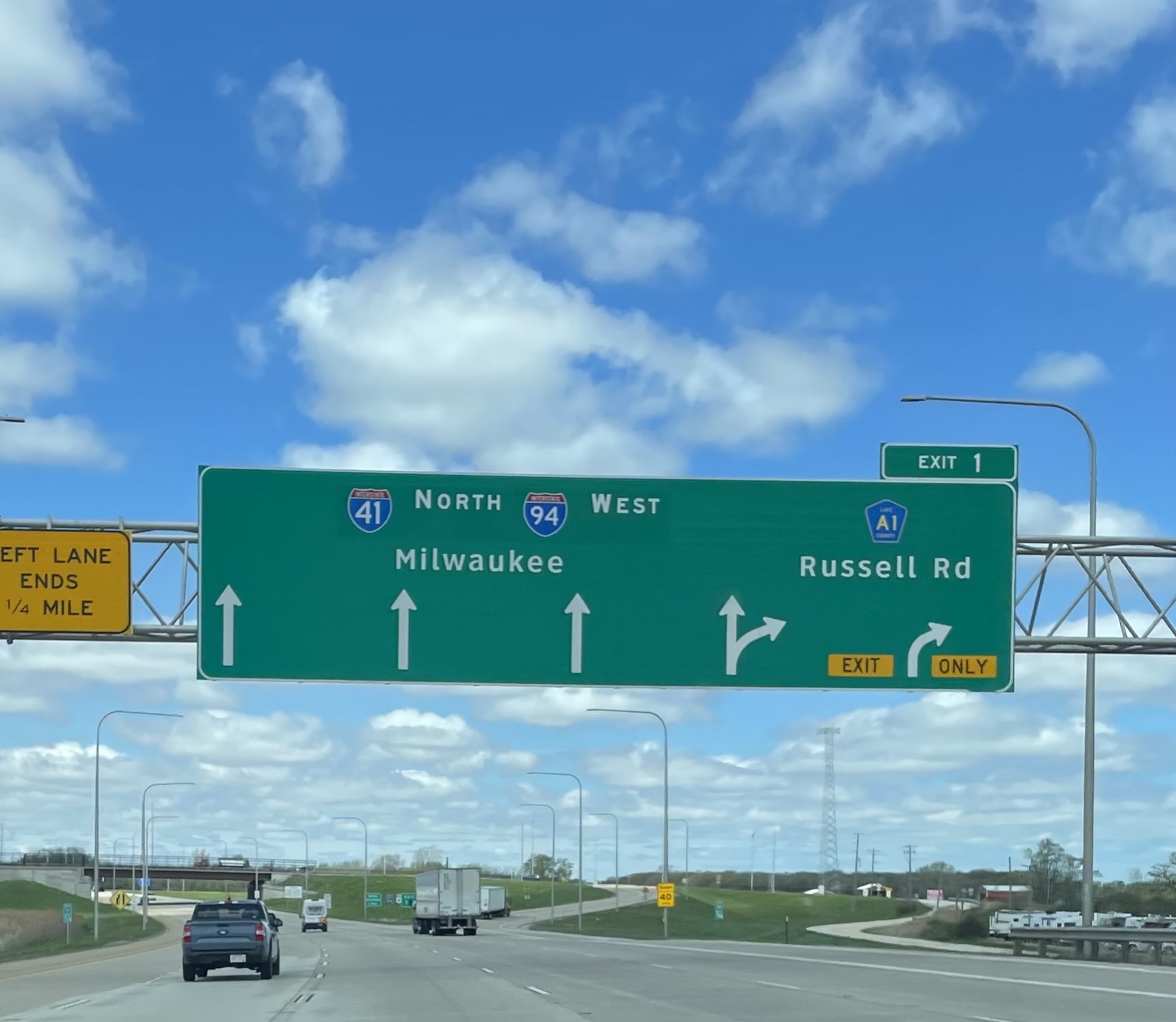
... more specifically ...


... even more specifically ...
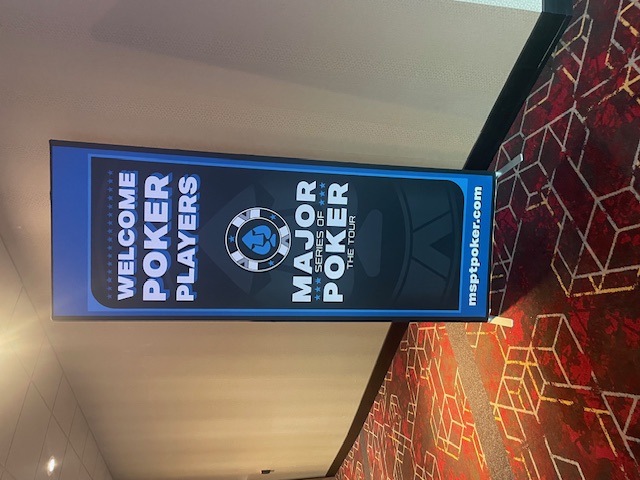
Event #2 of this MSPT stop is the Monster Stack NLH $300 Buy-in. It starts at 4:00 p.m. It's why I'm here.
The drive from my place of work to the Potawatomi Casino in Milwaukee was a mere 60 minutes. More importantly, virtually no traffic, which is so much better than is the case for most of my other Midwest tournament options in which I have to get through the gridlock that is highway driving through downtown Chicago.
I arrive at the Potawatomi Casino with almost two hours to spare, which I did by design. For starters, I realized I forgot to bring my Potawatomi player card. I get a new one very quickly.
Next up on my agenda is food. I have not eaten today, and I want something that will sustain me throughout my tournament given the fact that the breaks are too short to go eat a meal for dinner.
There is a food court that is part of the casino, and it has a wide range of options. I’m not expecting a gourmet meal. I just desire something basic and decent.
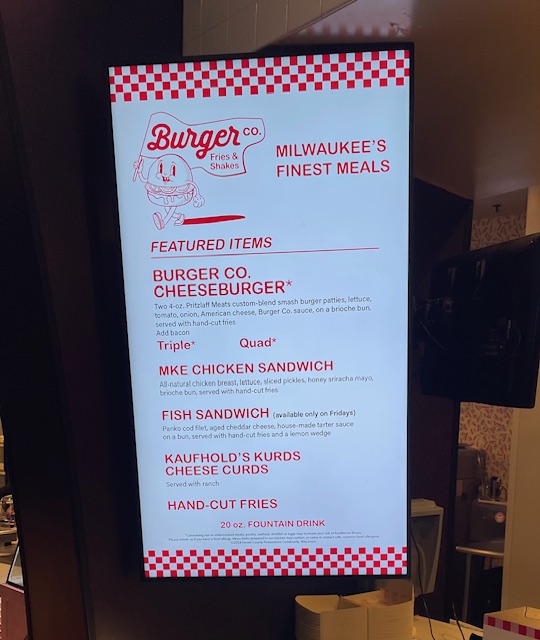
I go for a cheeseburger, fries and a strawberry shake.
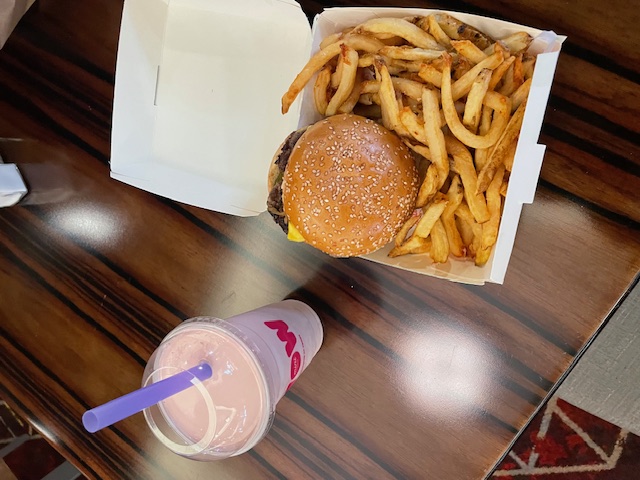
It’s all edible. Cost: $24.39.
With my belly full, I still have some time to kill, so I walk around the casino.
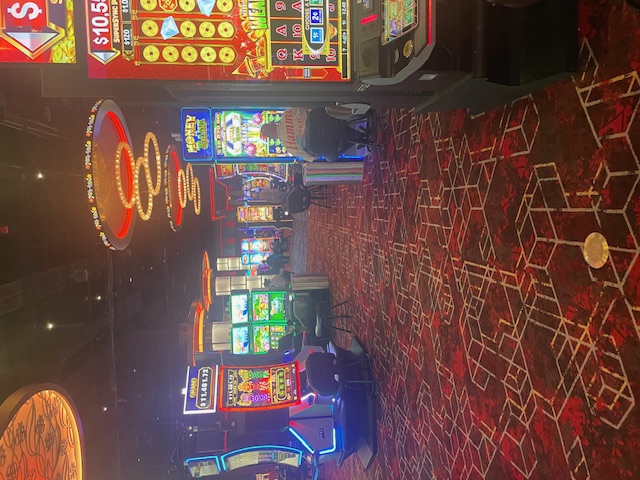

I get bored pretty quickly. I’m not a video gambling player.
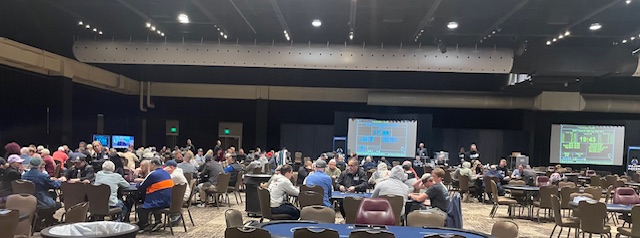
I head to the MSPT tournament area, which is located in the same ballroom as I’ve played in MSPT events here before. The room has an appealing look and the vibes are good. I head out to scout the nearest bathroom for future use on breaks. I find the bathroom entrances, and I see a man come racing out of the women’s bathroom. The man sees me staring at him with a confounded look on my face, and he sheepishly says, “I went in the wrong one.”
I think to myself, "What was your first clue?"
I have the lay of the land down, and it is still 30 minutes until shuffle up and deal for my tourney. I go back into the tournament ballroom, and I notice the $600 tag team NLH event is going on. I walk over just as this tournament goes on a one-minute break, which is 60 seconds of chaos as each tag team swaps out players.
I turn my attention back to the tournament I am about to play in, and I contemplate if there will be a theme to this tournament for me. As I see it, the are multiple possibilities ...

Poker road trip (Part 2)
Where was I?
Oh, yeah. Possible themes for this MSPT tournament.
Possible theme #1: I have played in several MSPT events in the last year. I have consistently run deep, gotten pretty close to extremely close to the money bubble, only to bust just before the money each time. Part of the reason is probably the fact that the MSPT seems to pay about 11% of the field. That requires a deeper run than at the WSOP where the top 15% get paid. It would be great if the theme of today’s tournament becomes, rpppoker finally gets over the MSPT money hump. Top 11% is tough.
Possible theme #2: About a week ago I went to sleep pain free. When I woke up, the side of my neck and my shoulder/trapezoid area were locked up in pretty deep knots of pain. Sigh. This has become a theme in my last two WSOPs. One year I had hip pain that kept me from being able to walk the strip. Another year I had heal pain that limited me the same way. It didn’t impact me at the tables, but mobility of any distance was a bit challenging. Now I have these knots of pain in my neck/shoulder/trapezoid area, and after a week the pain has not lessened. Getting older sucks. Thus, a possible theme for today’s tourney is, will these knots of pain distract/impact me while seated at a poker table for hours on end? I think these latest ailments might become more of a problem at the poker tables than was the case with prior years pain. I hope it isn’t an issue.
Possible theme #3: This figures to be my last live tournament prior to my 2026 WSOP. In other words, prep work for the WSOP. It would be great to have some momentum headed into the WSOP in five weeks.
Possible theme #4: It’s not really a theme of today’s tournament, but while I am waiting for it to begin, I notice a lot of players waiting for the start who are chatting with one another in groups. As usual, I know no one here. I am really looking forward to interacting with LVL players at WSOP 2026. I did some of this at WSOP 2025, and it looks like I will be able to do even more of it at WSOP 2026. I don’t know that we will be a full-fledged crew, but I’m looking forward to the social interaction at the WSOP. And if TonySoprano9 or TJ or any other LVL friend makes a final table and I’m out of my own tournament, I have every reason to believe that I will be loudly and proudly on their rail.
Poker road trip (Part 3)
MSPT Milwaukee, Event #2, Monster Stack NLH, $300 Buy-in
(Aside: As I am writing this my Achilles’ tendon cramps up twice, which briefly freaks me out. First my neck/shoulder/trapezoid, and now my Achilles. At this rate I am going to end up on the poker injured reserve list before I ever get to Las Vegas.)
Level 1
30,000 chips 100/200/200
Just before we shuffle up and deal, the tournament director is announcing that while the tag team tourney going on in another part of the room is on break they are opening up flip n go tables for anyone interested. Then he announces it again. Really selling it. I don’t get why anyone would do this. There’s no skill to this. It’s gambling for gambling sake. Of course, the flip n go tables find a paying audience.
Back to my tournament. I quickly get dealt J-J. Two players limp. I raise. They fold.
We are only 6-way at the moment at my table. I have K-10 suited and I open the betting 500 chips. Two players call. The flop is A-K-9. I have second pair, OK kicker. I continuation bet and get one caller (Bald Guy) whose physical tells look very, very strong. The turn is another Ace. In theory, this should make it less likely that villain has an Ace in his hand, but Bald Guy looked so strong in calling my flop bet that I decide to slow down, check and I’ll assess after he acts. He bets. I realize that it is awfully early in level 1 of a tournament to read too much into a perceived physical tell, but my spidey senses are screaming at me. I decide to listen to my instincts, and I fold.
I have Q-Q in the big blind. There is an open for 400 and a call. I raise it to 1,500. The initial bettor calls and the other guy folds. The flop is 9-8-2 rainbow. I bet 2,000 and villain folds. Yes, a case can be made that instead of donk betting I should have just checked to induce, but villain has been very sticky so far. I didn’t think he would fold.
I have 8-8 in either late position or the small blind. There is an open and two callers. I just call. It’s level 1 so I am thinking I’ll set mine and if I hit it someone in a four-way hand is going to pay me off. I miss on a 2-7-10 rainbow flop. If I were just head’s up this wouldn’t be a bad flop for me, but four-handed I don’t want to get out of line with a pair of eights on a 10-high board. The pre-flop aggressor bets the flop. I fold. It goes to showdown eventually and the aggressor in the hand turns over Q-Q.
End of level 1: 30,500 chips
Level 2
200/300/300
I have 9-9 and I open the betting. Bald Guy calls. I whiff the flop. My notes are not great. But we both get to the turn, which is a beautiful 9. I have a set. I check and Bald Guy, who it will later turn out is drawing to an inside straight with J-10, bets. I check raise and Bald Guy calls. The river is an 8, which is a terrible card. The board is A-9-7-6-8. My notes don’t say what the betting was after the river other than to say, “I lose a big hand.” I think I checked, he bet, and I called.
The very next hand I have A-J suited UTG. I open the betting and four players call. I guess my bet scared no one. I completely miss the flop, and I fold when there is betting. I am down to 18,000 chips.
The next hand I played was A-10. I open the betting and get two calls. The flop is A-4-2. It goes check-check and I then bet half pot. I get one customer. The turn is a blank. I don’t think my hand wants to go three barrels, so I check planning to call a bet. Villain checks back. The river is another blank. At this point I think a value bet makes sense. I bet 3,000. Villain calls. I show. Villain mucks. I am back to 25,000 chips, which is below starting stack but I am rebuilding.
I have been dealt a very decent amount of good cards so far (“so far” being the key phrase –- foreshadowing -- but I am hardly getting smashed by the deck.
End of level 2: 25,000 chips
Level 3
200/400/400
A new player joins the table to my immediate left. There is nothing terribly noticeable about her, so I simply mark her down in my notes as Lucky Lady as a placeholder name until she gives me reason to give her a new nickname. Turns out she is not lucky for me, as the moment she arrives I proceed to go massively card dead. Massively. I become a man crawling in the desert looking for a drop of water (decent cards) to quench my thirst.
In the big blind I am dealt K-2o. Three players limp. I check. The flop is A-J-3. Four ways, I am done with this hand. All someone has to do is bet a napkin, and I will fold. Everyone checks. The turn is a 2. I have fourth pair and still no interest in betting. Everyone checks. The river is another 2. I now have trips. The small blind bets. I raise. Everyone folds.
In the small blind, I am dealt two cards so poor that I don’t even bother to write them down in my notes. But it folds to me, so I just complete the blinds and Lucky (Unlucky?) Lady checks from the big blind. The flop does not improve my hand, but Lucky (Unlucky?) Lady has the same number of chips as me (below starting stack) and she has not shown a willingness to pay chess rather than checkers so I bet and she folds. I have 27,600 chips. Still a smidge below starting stack, but I am grinding my way back.
At this time, I write down my state of mind. I write down that I am tired, antsy and on edge. It’s certainly not because I am intimidated to be playing in an MSPT event. I’ve played in several before this one. It’s not because of the venue. I’ve played here before. I write down, “It may have been a bad idea to get up early and work half a day before driving to Milwaukee to play in a poker tournament.” I’m not sure if this is the cause of my lethargy, but I am definitely off.
Lucky (Unlucky?) Lady then proceeds to lose a brutal hand to the table fish (he has already mistakenly identified his chips twice and made ridiculous sized raises and then announced to the table that he has misclicked, along with taking some really strange lines). Lucky (Unlucky?) Lady is dealt Ks-Kc and loses a big pot when the river brings a fourth diamond to the board and Mr. Misclick shows Js-5d. Lucky (Unlucky?) Lady then says that just prior to joining our table, she got knocked out of the tag team tournament when her J-J lost to 9-9 on an all-in hand.’
OK, I’ve seen and heard enough. She is not Lucky Lady. She is Unlucky Lady. And not only is she unlucky for herself, but her poor luck is contagious seeing as how I am getting dealt garbage every hand since she joined the table.
End of level 3: 26,500 chips
Poker road trip (Part 4)
Level 4
300/600/600
I continue to be card dead. The only positive is twice I get walks (when I had 7-3o and 8-4o). I never get walks in MSPT tournaments. This table is way less aggressive than past MSPT tables I’ve experienced. But my cards are so bad that I can’t justify getting out of line. Just be patient, I tell myself, my time will come. It doesn’t come this level.
Meanwhile, I still feel jittery. I continue to feel off, and I have no idea why. Nothing bad happened at work. I don’t know what’s causing this, but I write in my notes, “I came here prepared to fire two bullets if necessary, but if I bust and late reg is still open I’m thinking I may just call it a day.”
End of level 4: 25,100 chips
Level 5
400/800/800
There is card dead, and then there is CARD DEAD. I think the epitome of CARD DEAD occurs when the dealer only deals me one card. When it becomes clear a second card is not coming my way, I say to the dealer, “I only got dealt one card.”
The dealer quips, “I heard you were good enough to play just one card.”
All things being equal, I think I’ll take the second card, sir. I think to myself that surely this is where the drought ends and I get A-A, making for a great story. I check my cards.
2s-7h
The deck is mocking me.
When I am in the big blind I have Q-10 suited. It’s the best hand I’ve had in forever, but it is far from a premium. Two players limp. I consider raising, but I tell myself not to overplay a decent but hardly spectacular hand just because I have been so card dead. I just check and we go three to the flop, which is Q-5-4 rainbow. I think it is very likely I am ahead. I bet and get one caller.
The flop is a 6. I bet again and get called.
The river is ugly. It’s a 7.
The board is Q-5-4-6-7. Four to a straight. I have top pair, mediocre kicker. At this point, I really only have a bluff catcher. I slow down and check, hoping to get to showdown cheap. Villain bets pretty big. What can I beat? He has a 3 or an 8 in his range for the straight. He has all kinds of two pair hands in his range. He has sets in his range. Although unlikely, he could have better Queens than me. All I beat is a bluff, and I don’t see that many bluffs that would have called my flop and turn bets and then bet the river. I take my time deciding, but I’m convinced I’m beat. I think he has the straight, or at minimum two pairs. He hasn’t been overwhelmingly sticky, so I just don’t see him playing this hand this way with nothing but air. I fold.
As the level ends, I write down in my notes, “Ever since Unlucky Lady joined the table to my immediate left, I have not been dealt a playable pre-flop raising hand.” I don’t believe in jinxes or bad luck, but Unlucky Lady has me questioning this.
End of level 5: 19,100 chips
Poker road trip (Part 5)
Level 6
600/1,200/1,200
Unlucky Lady really is unlucky. Her Q-Q runs into A-A, and she’s out. With her gone, maybe I finally start getting dealt premium hands since one theory (not a good theory, but a theory still the same) is that her bad luck has infected my starting hands. Maybe now the premium hands start heading my way.
Maybe not.
I keep getting dealt rags. The blinds are killing me.
I am down to 13 big blinds and I’m UTG, meaning I am going to have to post the blinds again after this hand. I look down at 4-4. Normally UTG I’d probably just fold this. But it’s the best hand I’ve seen in forever. I’m about to be in the blinds again. As I see it I can either fold or go all-in. I certainly am not deep enough to limp and try to set mine. I am leaning toward going all-in for a couple of reasons: 1) The table has to be aware that I have not opened the betting in forever, so if I go all-in it is going to look like I have quads (might I have fold equity?), and 2) If I go all-in and get called there are more combinations of over cards than there are of higher pairs that will call, in which case I will be flipping with a very slight advantage and that would be just fine with me given my dwindling chip stack.
I don’t love it, but I go all-in. A player with a shorter stack than me calls. Everyone else folds. Villain has K-Qo. It’s a flip with me having a tiny advantage. Exactly what I hoped for. The flop is 2-7-9 rainbow. I’m now a 3-to-1 favorite. The turn is a King. Sigh. I need a two-outer. I don’t get a two-outer.
I am down to 7,100 chips. I have to fold my blinds when I am dealt 2-4o and then the next hand I look down at the exact same 2-4o.
The deck is once again mocking me.
End of level 6: 3,100 chips
Level 7
1,000/1,500/1,500
I have two big blinds. Two stinkin’ big blinds.
And as desperate as I am to gets my remaining chips into the middle, I can’t when dealt 2-4 (again), 2-7, 3-8, 4-8.
I am UTG+1. I can no longer be even mildly picky. I am about to blind out. I am dealt J-Ko. Best hand I’ve seen in quite some time. This is the hand. This is the hill I am prepared to die on. UTG raises, which is not part of my plan. Ideally, I go all-in first to act with J-Ko rather than calling it off with J-Ko, but it’s not even a close decision. I put in my paltry chips and hope for the best. A blonde-haired woman who is new to the table then raises, and UTG calls.
So, for those not paying attention, I have to not only beat an UTG open, but I also need to beat a player whose hand is strong enough to 3-bet an UTG open. Surely, I am dead man walking.
UTG has my K-Jo dominated with K-Qo. Blondie has A-A.
The flop is A-J-rag. Had blondie not woken up with A-A, I would have actually outflopped UTG and gone on to win the hand. But Blondie flopped a set of Aces. There is no coming back from that for me. I’m out.
Decision time. There is still time for me to late reg, but it will only be for 20 big blinds. Plus, I am frustrated from being so card dead, and I just haven’t felt like myself all tournament. The cost of the second bullet is pretty inconsequential. My game plan prior to the start of the tournament was to fire a second bullet if necessary. But I just don’t feel like I am in the right frame of mind to play well. I’m not on tilt. But I am also not firing on all cylinders.
I take a seat by myself in the back of the poker ballroom. Re-enter? Go home? I’m not leaving, but I’m also not walking to the buy-in desk. Am I subconsciously trying to talk myself into firing another bullet? I consider it.
No!
I’m just not feeling it. My sense is if I re-enter, I am just going to light the chips on fire. I have an overwhelming feeling of impatience. I am feeling impatient with the deck, which has not been my friend.
I was dealt nothing worthwhile in levels 3-7, and yet I think I showed remarkable patience trying to wait out the drought of bad cards. But I feel like my patience has worn thin. I almost never feel impatient at the poker table. But I feel impatient now. Not that impatience on a 20 big blind stack is completely wrong, especially with the blinds soon to increase yet again. Beyond my impatience, I think if I re-enter it won’t be for the right reason. If I re-enter, I will be chasing. I will be hoping. And, as I like to say, hope is not a plan.
I’m done. I’m out.
Next stop: WSOP 2026.
Poker road trip (Part 6)
Let’s revisit the possible themes I mentioned prior to the start of the tournament.
Possible theme #1: I have a bit of a history of running deep in MSPT tournaments, but getting knocked out just short of the money.
Post mortem: I didn’t even sniff the money bubble this time around. Did I get over the hump? Heck, I wouldn’t have seen the hump today even if I had binoculars.
Possible theme #2: I am dealing with neck/shoulder/trapezoid pain. Will this be a problem at the poker table?
Post mortem: Not one time did I feel the pain while I was at the poker table. I think my high level of concentration made me temporarily unaware of the pain. It was like intense poker concentration blocked out the pain. The second I was out of the tournament I immediately felt the pain again. I think this is rather fascinating.
Possible theme #3: This was my final preparation in a live tourney setting prior to WSOP 2026.
Post mortem: Well, that didn’t work out so well. In fairness to me, I’m not sure there was a lot to learn from being so card dead. On the bright side, I remained patient in the face of terrible cards, and at WSOP 2026 the structures will be much slower, so maybe this was in fact good preparation for the WSOP.
Poker road trip (part 7)
Picture of Potawatomi MSPT poker ballroom I forgot to post. It was taken right after I busted in level 7.

Poker is a brutal game and the brutality comes in many forms. You can go card dead for hours, take bad beats in big spots, get coolered for your whole stack.
Unfortunately that's all very normal. That's why even the very best tournament players might only cash 15-25% of their entries.
As you move into the summer, my advice would be to reduce the psychological importance you place on cashing tournaments and just continue to focus on making the best decisions you can in each spot. That may sound hypocritical coming from someone who nearly bricked his whole schedule last summer and was relieved to score a dinky min-cash in his final event. I understand that we want to cash and that it feels like success, but I'd also argue that this can set us up for irrational disappointment when we fall short and distract from what's most important when we make the money (posturing for the win). Poker is definitely a skill game, but the prominent luck component means that results over a small sample are still going to hinge pretty heavily on chance. Emphasizing this makes it easier to absorb the cold runs.
I am down to 13 big blinds and I’m UTG, meaning I am going to have to post the blinds again after this hand. I look down at 4-4.
I don’t love it, but I go all-in..
Although you ended up getting a flip versus a shorter stack (a great spot as you are not out even if you lose!), I still think this have to be a fold with 13 big blinds. We can easily afford passing through the blinds once more without being crippled, and it seems somewhat unlikely that we can get through the entire table without someone waking up with a better hand behind.
For what it's worth, I checked this spot in the app SnapShove, and it actually says that with 13 bb you can profitably push any pair 55 and above + all suited Aces down to A9s (and A5s), all suited Kings down to K9s, and all suited Queens down to QTs. We can obviously also jam stuff like JTs, AJo, AQo etc.
With that in mind I guess your jam was only a small mistake, and it's never wrong to err on the side of aggression in live tournaments as some people in the field will call way tighter than they theoretically should. But personally, I would have mucked this hand in a heartbeat and not thought twice about it. We are bound to get some better spots the next round when it folds to us in later position.
PS: Have you decided on your WSOP-dates for this summer? There is a good chance we might overlap after all.
PS: Have you decided on your WSOP-dates for this summer? There is a good chance we might overlap after all.
June 4-16 is when I will be at the WSOP. What are your WSOP dates?
Poker is a brutal game and the brutality comes in many forms. You can go card dead for hours, take bad beats in big spots, get coolered for your whole stack.
Aint it the truth! But my "least" favorite landmine to land on is being card dead. I find it much more painful than bad beats or getting coolered. I just want a chance to play and card deadness takes that away. It makes for pure frustration.
It's a marathon, not a sprint
I just read something interesting on Poker.org*, which conducted a Q&A with David 'ODB" Baker about his plans for the 2026 WSOP.
When asked what he plans to do on rest days at the WSOP, he responded, "I do not take a rest day. I will be playing poker 45 out of 45 days. I'm Team No Days Off."
That is either remarkable/superhuman or impossible/insane.
My schedule calls for me to play 11 straight days/nights at the 2026 WSOP, but I have identified a couple dates where I might take a day off (most likely Day 10 or 11 based upon past WSOPs where I have sometimes hit a wall at the very end).
I can't imagine going 45 straight days/nights without a break.
WSOP prep work: With apologies to Phil Galfond, my own personal 5 keys to survive poker downswings and variance
I stumbled across a Phil Galfond video* he released a few weeks ago titled “5 Keys to Survive Poker Downswings and Variance,” and I thought to myself that it might be something useful as I prepare for my WSOP 2026 that is now just a month away.
* https://www.youtube.com/watch?v=87y7aIKr...
In the video, Galfond uses a fancy, extremely detailed, deep dive Variance Calculator (apparently there is a solver for everything in poker).
I’m not going to go into the tall grass that the Variance Calculator detailed. Instead, here is the quick recap of Galfond’s five keys:
1) Downswings are more likely than you think.
2) Know what normal looks like.
3) Move down in stakes when you need to.
4) Understand the impact of your win rate on your actual results.
5) Zoom out on your career or zoom out on five years.
Galfond’s wisdom makes sense to me, but I really think its target is grinders/poker pros, or to put it another way, people who are playing to earn an income.
None of those descriptions are me.
I’m not a grinder. I’m not a poker pro. I’m not playing to bank an income stream.
To the contrary, my WSOP is about 1) competing against people who are better/more experienced than me for the sheer challenge of it, 2) getting to experience a poker professional’s lifestyle for two weeks, 3) playing for the pure joy of the game, and 4) essentially taking a poker vacation.
So, I don’t fit Galfond’s demographic. Nonetheless, his video inspired me to come up with my own 5 Keys to Survive Poker Downswings and Variance at my WSOP. Here is what I came up with:
1) If things go poorly, ask myself, am I playing poorly or am I getting unlucky? This has to be an honest discussion with myself. For example, if I keep bleeding chips getting it in badly over and over, and then when I get short stacked my aces get cracked, I’ve played poorly way more than I got unlucky. Be truthful when looking in the mirror.
2) Suck it up, Buttercup. Downswings happen. Bad variance happens. Bad beats happen. When this happens, take it on the chin, shake it off, and move on to the next hand. There’s no crying in poker. Have emotional intelligence after a bad, improbable run out of cards.
3) Even playing two weeks at the WSOP, which for me is a ton of volume, whatever happens is still a very small sample size. Either embrace the randomness or don’t show up. Yes, these two weeks are the most important two weeks of my poker year, but it is still an extremely small sample size. Know that going in.
4) The deck has no memory. Just because the cards don’t run my way for what feels like a long time, that doesn’t guarantee the law of averages will kick in as fast as I want/expect.
5) Bankroll management. In my opinion, these are the two most important words in poker. I have decided ahead of time which events I will fire only one bullet and which events I will fire multiple bullets. I have a budget diligently crafted in a calm, thoughtful setting well ahead of time. I will not deviate emotionally in real time. I will not play in cash games after getting eliminated from my tournaments. I am prepared to lose every buy-in I have built into my tournament schedule. I hope I don’t, but I am prepared for the possibility. Yes, I’d like to cash. Yes, I’d like to be profitable. But that is not what will determine the success or failure of my summer. If I have a great time, that is all that matters … but … yeah ... (pause) … I’d really like to make the money. Of course I would. But I can have a great time even if I don’t add to my Hendon Mob page. When people ask me about the potential of losing money at the WSOP, I respond with a question. The question is, if you go on a two-week vacation to Europe, do you expect to return home having turned a profit? Naturally, they say no. Same thing with me going to the WSOP. Poker vacation. I will play what I am prepared to lose, and not one cent more.
WSOP prep work: re-entries ... bubble play ... shove light, call tight
Alex Fitzgerald has an interesting article on poker.org titled "5 WSOP lessons I learned the hard way." *
* https://www.poker.org/poker-strategy/ale...
It isn't rocket science. It doesn't go deep into the solver lab. But it does have some good common sense WSOP poker insights that I already was planning to incorporate. An article like this is a good reminder of things I want to do.
Here are quotes from the article that provide just such reminders.
-- "Re-entries have changed everything ... If everyone else is willing to re-enter and you’re not, that can put you at a serious disadvantage. They may be much more willing to bluff, gamble, and make loose call-downs against you because they know they have another bullet available."
-- "The bubble is supposed to be chaotic ... One of the biggest mistakes I see people make when they first play tournaments in Las Vegas is getting way too tight on the bubble. ... That is the exact opposite of how you should be thinking. ... Everyone else wants to go home and say they cashed at the WSOP too. That means you should be putting more pressure on people, not less."
-- "Do not call off all your chips too wide ... Because people are not bluffing nearly as much deep in these tournaments, you need a very good reason to call off your stack. ... The general rule deep in these tournaments is: shove light, call tight."
WSOP prep work: Responding to raises ... Bet sizing
Poker.org just had a Q&A with Dara O'Kearney titled "WSOP strategy edges and emails with David Bowie." *
* https://www.poker.org/latest-news/dara-o...
In it there was a section I found especially interesting:
What’s the biggest leak you see from amateur players?
Playing far too many hands early on when the stacks are deep, and calling raises too often rather than three-betting or folding, which makes them too predictable.
Anything else?
Many recreational players just have one continuation bet sizing they chose from. They bet a third pot or half pot or whatever, and that's what they do in every situation. Really difficult players to play against are betting 10% on some flops, and on others they're betting two times the pot. That’s much more difficult to play against.
.........
The point about facing raises and it being better to three bet or fold as opposed to calling is something I have worked on quite a bit this past year. I'm not saying I never call, but I have faced a lot of aggressive players this past year and my approach against them has been heavily weighted to fold or raise as a response, which overwhelmingly has worked well. I feel good about this approach as I head in to the WSOP.
The part about continuation bet sizing variety is intriguing. For the longest time I have heard that recreational players should keep their bet sizing constant for both value bets and bluffing in order to avoid being exploited by pros who will catch on to what different bet sizing means. On the other hand, when I have been watching tournament streams (i.e. multiday 11-hour streams of the WSOP Paradise Main Event that I am down to the Final Table) I have seen a lot of much smaller continuation bet sizes (usually one-third point but sometimes tiny, tiny 10% block bets) and the occasional huge bet (pot sized and larger). While I have experimented with varying my bet sizes, I have not done a ton of work on this. Is the WSOP really the time and place to experiment? I think I will view this as having an additional tool in my poker tool box. I'll pull it out from time to time, but I don't think I will make it my primary tool of choice.

Bet sizing variations, particularly on flop and turn (and whether to c bet or not) are mainly because of board texture vs your perceived range, relative position and number of people in the pot.
It shouldn’t vary much at all between value and bluffs.
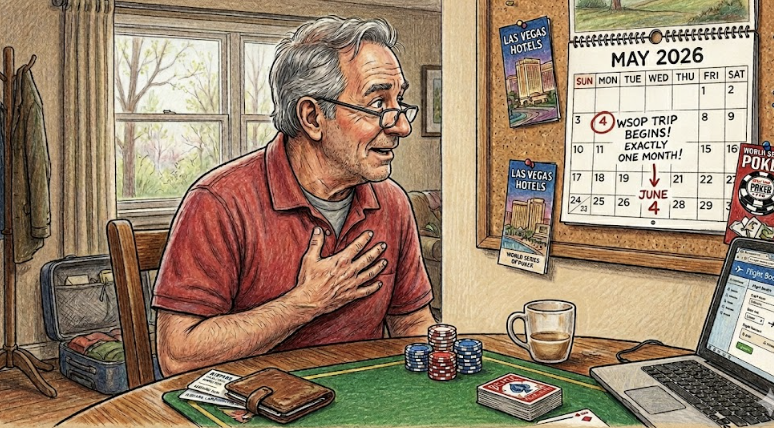
WSOP prep work: Dealing with uncertainty ... flight change e-mail ... WSOP Paradise Super Main Final Table viewing ... Inside the Mind of a Pro (Leo Margets) viewing ... Joy of the Game approved versus Solver approved
My mind is very, very much on the upcoming WSOP. Yes, it is a month away, but already I am becoming hyper focused thinking about it.
I start out tonight by asking Artificial Intelligence for suggestions for playing in the WSOP. I have no idea if anything useful will come of it, but let's see what it produces. Most of the A.I. suggestions are things I already know, things I already do, things I disagree with and choose to ignore. But there is one suggestion that grabs my attention, which is, "The Session Review Habit: After each day, briefly note 2–3 hands where you felt unsure. Don't obsess over the bad beats, but analyze the decisions to keep your logic sharp for the next day."
This isn't ground breaking, but it is good advice that I think shines a light on a leak of mine at past WSOPs. Yes, at day's end, I have run hands through my mind. But it is random. It is whatever happens to pop into my head. It is not laser focused. It is not intentional. I like the idea of when I take down notes at the table for this thread, I want to start writing a capital "U" for "Undecided" on hands I wasn't sure what to do in real time. Then when I am back at my hotel later that night the goal is that I consider how I played the hand, how I might have played it differently, why was I unsure, what can I learn from this and apply tomorrow? I'm not saying I will be able to definitely say how I should have played it different or the same, but I think giving added though to confusing situations is a good habit to get into.
A different WSOP situation came up today when I received an e-mail from my airline with the title, "The schedule for your trip to Las Vegas has changed." Big problem or insignificant update? Happily, it is an insignificant update. My flight will now leave three minutes later than was the case when I first booked my reservation. Three whole minutes. When not on WSOP double secret probation, Will Kassouf sometimes tanks for longer than that. I think I can deal with three minutes.
The streams I watch tonight are the latest installation of Leo Margets (who always comes across as a supremely nice, genuine person) deep 2025 WSOP Main Event run in the Inside the Mind of a Pro series, plus I also watch some of the Final Table stream from the most recent WSOP Paradise Super Main. In both cases I try to play along and think what I would do. I try to reach my conclusion quickly so I decide prior to the players actually making their decision.
The overall WSOP Paradise Super Main coverage is more helpful to my process because there has been 64 hours of coverage (from multiple Day 1s through the Final Table) that I have been working my way through. For the most part you get to see every hand played at the feature table (other than when there is the occasional break away to a Jeff Platt interview or a hand is shown at a secondary table). The point is, by seeing almost every hand of the featured table you can develop ranges on players based upon the history of play at the table. Of course I get to see everyone's cards which is not the real world for when you are at a table. But it is good practice for trying to look at hands to determine if people have made the ideal play or not. It is good practice to observe playing styles that are both different and similar to the way I play.
The Leo Margets videos have been highly entertaining. It is good practice to not know what the cards are of the other players and to think if I would play the hand similarly or differently than Margets does. What keeps the videos from being even more of a learning tool is the fact that tons and tons of hands are skipped. This makes it very difficult to put her opponents on ranges and playing styles. What is great about the videos is you get her thoughts in each hand shown, as is always the approach in Inside the Mind of a Pro. It is great to watch her play various hands in a completely different way than I would have. Afterward I ask myself if there is something to be learned and is this an approach I might consider incorporating into my own game? I'm not looking to replicate her game. I am looking for new ideas, thought processes and insights.
Is all of this as good as robotically devouring solver printouts? Of course not. But a machine-like approach to grinding more and more and more charts will bore me to tears. I have studied quite a bit on poker training sites in the past. By no means have I learned everything there is to learn from training sites. Not even close. But to take the next solver-based steps would absolutely kill my love of the game. The approach I am taking to search out lengthy poker streams is not solver approved, but it is fun, it is keeping my mind engaged in poker every night, and I think there is something to be said for that.
For the next month, all of my preparation for the 2026 WSOP will be Joy of the Game approved rather than solver approved. I recognize the fun to be had from this approach. I recognize the limitations of this approach. I am good with both.
The Leo Margets videos have been highly entertaining. It is good practice to not know what the cards are of the other players and to think if I would play the hand similarly or differently than Margets does.
I don't know if you are 100% up to date with these episodes, but I really liked one small piece that she said in the last episode (released yesterday). She was considering 3-betting an opponent preflop for the third time in relative short succession, and although she recognized it was a bit unusual she just concluded that:
"If I think it's +EV to play my hand as a 3-bet, I'm not going to change my strategy because of what happened earlier. I don't want to let the past influence my current decisions".
I think that is a great mindset to have, and one I struggle with a lot myself. It's way too easy to back out of a close spot because you don't want to 'overdo' it against a specific player, or maybe you raised the previous hand and thus choose to muck an otherwise playable hand. But that is silly thinking based on what the others might think of you, while in reality most people likely have a very neutral impression of you or maybe even haven't noticed your tendencies.
And in general I agree with your study habits; while it's probably even better to grind the sims, watching episodes like this still makes me think a lot about poker and gives me ideas to use for the next time I am playing etc. For example, Davidi Kitai used the 15% bluff sizing a couple of times in his episodes, and from that I derived the idea of betting very small in some spots etc.
I am getting very anxious too! I have been grinding solvers though at least a couple of hours per day. I had never used them before but got involved about 5 or 6 weeks ago because I wanted to work on some of my own leaks. Mainly tightness in the blinds and EP, 3 bet squeezes, and especially bet sizing. I found it encouraging that most of my instincts have been mostly correct. But I am not even trying to memorize charts but rather get a general outline and basic rules of thumb for spots and situations.
And I am loving the Margets run on Inside the Mind of a Pro. I have also been watching at least some sort of poker content every day.
I don't know if you are 100% up to date with these episodes, but I really liked one small piece that she said in the last episode (released yesterday). She was considering 3-betting an opponent preflop for the third time in relative short succession, and although she recognized it was a bit unusual she just concluded that:"
You focused on precisely the two situations (Margets three bet bluffing a third time versus same opponent, and Kitai 15% bluff sizing) that most grabbed my attention.
The best hand in recent Margets episodes IMO was the 4 bet pot where she whiffed with AK on QJx, villain checked back turn and she led river for 20% to bluff him off an almost certain chop. Big stones and incredible situational awareness
That is incredible play and was inspirational for me - I’m almost certainly checking and hoping to get to showdown there and often getting bluffed off the chip

