Why does the solver defend more than MDF in this spot?
100 BB cash game. Open from lowjack, get called by big blind. Flop comes 642 rainbow. Big blind donks for 1/3 the pot. MDF dictates that lowjack should fold out about 25% of his range, but the GTO Wizard solver folds only 13% of the time.
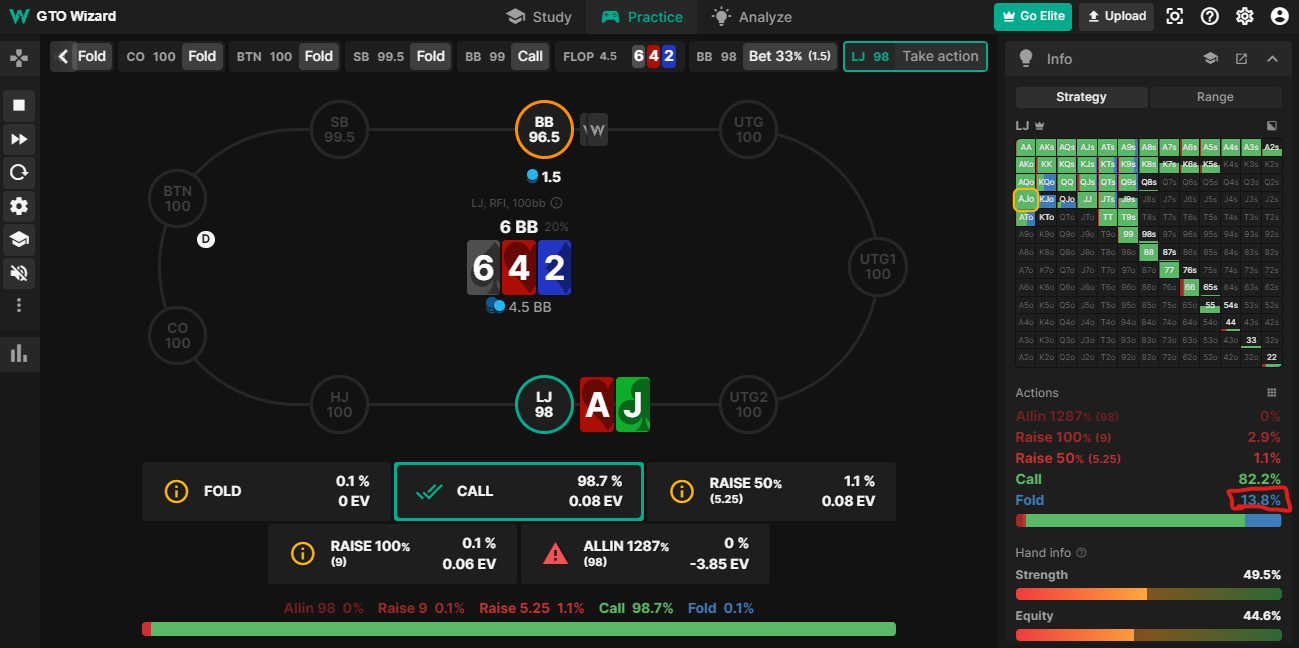
Why does the solver defend so much more than the MDF in this spot?
9 Replies

This is probably the wrong forum.
And you understand that there isn't really a "reason" for it, it just is. So the explanation is what humans say to try to explain reality after they've seen it.
However I assume you are aware that if you open (doesn't matter position really) and BB defends and when the flop goes x/b BB will often (almost always?) fold more than MDF. The reason is because you could have just folded preflop and so have a better range going into the flop, thus. if BB only made MDF folds he'd still have a worse range into the turn.
This, I assume (far from a solver expert), is the opposite of that ... LJ range is still better overall, so on certain boards where BB can/should lead LJ can overdefend because there's still a lot of bluffs in BB's range.

Wrong forum, but I would assume the reason is range advantage plus positional advantage. In range ~neutral spots, the solver will typically defend at ~MDF frequency in position. So if in position has range advantage, they will defend over MDF
Sorry. I see that I have posted to live cash games. What is the remedy for having posted this to the wrong forum?
I would assume the reason is range advantage plus positional advantage.
Lowjack does not have a range advantage on this board.
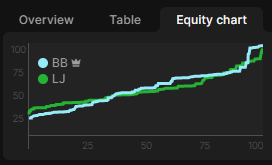
The in-position player typically defends at or around the MDF while the out-of-position player defends slightly less than MDF, so positional advantage does not explain it.
on certain boards where BB can/should lead LJ can overdefend because there's still a lot of bluffs in BB's range.
If lowjack is over-defending against bluffs, how can big blind profitably bluff? I don't think that this is correct.
And you understand that there isn't really a "reason" for it, it just is. So the explanation is what humans say to try to explain reality after they've seen it.
Maybe I should have posted this question to the theory board (hahaha).

MDF (note, the M stands for MINIMUM) represents the % of times you must call in order for a Vs bet to not be instantly profitable. The old theory was you had to call at LEAST the MDF or you could be exploited by a range bet. The problem is that from the other side, if you call that much, a bluff becomes instantly unprofitable, meaning that on the river they would have no incentive to bluff. So this means its sort of simultaneously a minimum AND maximum (but also its neither because its a concept thats kinda wrong).
On the flop, MDF is a concept that has even less relevance, because every hand has equity, so a “pure bluff” is purely theoretical and cant possibly exist. You can call over the “‘maximum” and V might still be incentivized to semibluff, because they have equity when called. Further, the dead money in the bb preflop means that the caller doesnt need to reach the “minimum”, as the goal is to lose less than 1 BB.
Hi everyone,
I am already very familiar with the concept of minimum defense frequency. In most spots, the solver defends at around the MDF. When the villain has a range advantage, hero may defend at a lower frequency than MDF, allowing the villain to profitably bluff with any two cards. This is acceptable because getting bluffed is less expensive for hero than defending a wide range against a range advantage. But my question is still unanswered. Why does hero defend more than MDF in this spot? I am not looking for general information about MDF. If you do not know the answer, please do not reply.
The old theory was you had to call at LEAST the MDF or you could be exploited by a range bet. The problem is that from the other side, if you call that much, a bluff becomes instantly unprofitable, meaning that on the river they would have no incentive to bluff... On the flop, MDF is a concept that has even less relevance, because every hand has equity, so a “pure bluff” is purely theoretical and cant possibly exist. You can call over the “‘maximum” and V might still be incentivized to semibluff, because they have equity when called.
This is helpful, but I'm still struggling to see why we defend more than MDF in this spot. I am not seeing that big blind has a lot of high equity bluffs and semi-bluffs here, or am I wrong?
More hands than MDF have greater than 0 EV in the solution. Solvers don't inherently care about MDF. Sometimes they fold more than MDF. And it is minimum defense, so that implies sometimes you might defend more.
Some of the factors that are probably at play here are that LJ is going to have a ton of equity with a lot of hands and pretty good realization with a lot of those hands. It can float flop with A high and some king high hands and have the best hand sometimes. It can also continue with hands that can get better hands to fold on later streets, or that can become the best hand later. Sometimes you don't have to have much going on with your hand to call a small bet on the flop in position. Just a bit of equity and fold equity on later streets can be enough to make it + EV, and generally that means solver will continue.
This is helpful, but I'm still struggling to see why we defend more than MDF in this spot. I am not seeing that big blind has a lot of high equity bluffs and semi-bluffs here, or am I wrong?
I dont know the answer, but my guess is a glut of medium strength vulnerable hands on a wet board OOP, which have tough equity realization.
I also just think that defense being close to MDF is more an illusion created by competing factors, and its much more common to see overfolds than underfolds because the player facing the bet is the player who called from the BB, whereas this is the BB donk betting, so several factors are sorta reversed.
Like, just think about this, lets say you have Q6 in the BB here, what cards make you actually happy? Q… and 6…
Every single card is either an over (7+), gives a pair (2/4/6), or gives a straight draw (3/5)


