Light 3-betting
I am a "winning" cash game player at 2/5 and I do particularly well at 5/10. My goal is to double what I won last year. If I manage to do it, then I'll give a go at the 25/50 game at my local casino. I keep very detailed stats so I know my numbers.
On the other hand, there is a concept in poker that I am either not applying properly or it is simply overrated and I know this is the right place to find the answer. I need feedback from other players about their experiences using the "light 3-bet". I have tried to incorporate this into my play and each time I tend to lose more chips than I win. My understanding of this tool is that it's for when you are dealt a hand that is near the top of your folding range and someone directly ahead of you opens. For example, let's say that I have K7o on the button. The action folds to the cutoff which open-bets a standard raise of 3 or 4BB. I then choose to 3-bet him since I have positional advantage. My 3-bet would be around 3-4X. Everyone else folds and then it goes to the flop. From there I'll typically C-bet about half-pot. I know some players like to keep it around a third as a range-finder, but half-pot seems to give me max value on my fold equity and if players don't hit, they go away and give me the pot. In this case, I can't tell you how many times players have had a hand worth staying in for and then I have a growing problem.
Where it seems illogical to me is that here I am betting into a player who is showing strength after that player opens the betting. Yes, their range is wide and yes they may not be very strong, but the players at my tables are not rec players who are giving away their hands by using poor bet sizings. I am firing at them when I only have a marginal hand that pretty much only has one way out if I need it, otherwise I have to count on them folding, bluff it the rest of the way or give up at some point.
So I currently do well w/o doing any light 3-betting, but I would love to hear from others on their thoughts about this strategy. If some of you are using this as a profitable tool, then tell me what I'm missing.
Thanks!!
15 Replies

My understanding of this tool is that it's for when you are dealt a hand that is near the top of your folding range and someone directly ahead of you opens.
You seem to be applying this tool indiscriminately rather than exploitatively. For light 3-betting to be successful, your opponents need to be making identifiable GTO mistakes, such as raising too lightly, making bad decisions when facing 3-bets, or overfolding post-flop. Aggressively 3-betting simply because someone open-raises in MP+ means that you're the one deviating from GTO.
In addition, it sounds like you're C-betting too often and possibly for unnecessarily large sizings, which not only costs you money when you can't will your way to stealing the pot, but makes it harder to successfully bluff on later streets if bloating the pot leads you to not having enough money left to generate fold equity on later streets.
I wouldn't say that I have done it "indiscriminately." I am looking for times when I feel that the player is someone who I can simply get to fold. Sometimes I'm right in that assessment, but if the player does not deviate from their bet sizings and provide information relative to the strength of their hand, then it's very challenging to gauge whether or not it's the "right" time. I do agree with you that if you have some indicators, then great, but most of the guys I'm playing with are not inexperienced.
As for the C-betting, it has worked exceptionally well for me. When I would do a range-finding bet of one-third pot, I couldn't get the folds I needed when I missed the flop. Half-pot has been the sweet spot. When I have big hands, I drop it down slightly to maybe 40% to entice the one or two callers I want in the hand. If they do notice the small difference in my betting, then they interpret it as weakness which gives me an even bigger edge.
ok i had a long post about this that i lost and i need to find later but real quick:
your definition of light 3betting is actually a manner in which you would find bluffing candidates post flop NOT necessarily applicable to the construction of a polar 3bet range of value + bluff.
Also it sounds like youre kinda merging your post flop lines whether you have a value hand (which should also be distributed slightly differently across inflection points) or a "light 3bet" candidate. An analogy: sometimes you can take your foot off the gas when you have a 'light 3bet hand' and attempt to get to SD for cheaper (eg. not c'betting just because opportunity presents itself etc)
perhaps im misunderstanding your description above but those were two quick things that really jumped out at me.
ill find the **** i wrote elsewhere and maybe even edit it for mistakes/syntax/artistic enjoyment for the reader and post later.
I wouldn't say that I have done it "indiscriminately." I am looking for times when I feel that the player is someone who I can simply get to fold. Sometimes I'm right in that assessment, but if the player does not deviate from their bet sizings and provide information relative to the strength of their hand, then it's very challenging to gauge whether or not it's the "right" t
If you are net losing chips from this as you state in your first post C-betting is not working especially well for you. It seems it is lowering your losses. Given your description here it looks like you are bluffing too often and enough of the table sees it and they are therefore calling you at above GTO frequency which given your play is their proper exploit.
B_Love, it would be great if you can find that link.
To Polarbear, you would think with my constant C-betting that I would indeed get called down more often, but I'm very tight in general, so when I open or reraise, I've always got something to work with and other players are typically nervous to be in a hand with me. They know I won't hesitate to make a pot-sized bet on the turn when I have it and when I don't. The only times when I'm getting hurt is when I am pretty card dead, missing flops to the extreme and there are some LAGs who are very aggressive at the table. That can be a formula for me to have a poor session, but my winning sessions outweigh the losing ones.
But tell me... when you yourself light 3-bet and you miss the flop completely (not even backdoors), what are you doing from there? The cutoff and the button are so close to each other in range, that either of us could hit/miss what's on the board. Are you playing it safe and checking? Doing a third-pot bet to see where he's at? Would you say that light 3-betting is a tactic that is generally profitable for you?
BTW, one of my own favorite defenses to someone doing it to me is instantly firing back against someone who thinks they can bleed me with 3-bets. Generally the player directly to my left may occasionally do it if they haven't played with me and I'll give it to them up to two times. By the third time I instantly grab a stack and move it forward. It happened just days ago when I made a raise to $40 and he made it $175. The key is not hesitating, so I quickly pushed forward $500 to which they folded their AQo to my A8o (he told me later what he had). When you do it that quick and you're a TAG, players always put you on AA or KK. In that situation, I turn it around and make that play profitable for me by being right just one out of four times.
But tell me... when you yourself light 3-bet and you miss the flop completely (not even backdoors), what are you doing from there? The cutoff and the button are so close to each other in range, that either of us could hit/miss what's on the board. Are you playing it safe and checking? Doing a third-pot bet to see where he's at? Would you say that light 3-betting is a tactic
Ok so here's a quick macro view of 3bet light strat pre and post flop:
1) if you are correct in your observation that your opponent is raising way to wide then by definition, they should be folding more to a 3bet flat out - can explain mathematically if required but this just seems kinda like a necessary conclusion to me but I'm also speaking from my own POV and sometimes its hard to see where potential confusion/lack of clarity comes from
2) You are 3betting light to get a fold PF and scoop a pot without a drop (avoiding the rake is super +EV) BUT sometimes they call. we're ignoring the times they 4bet. A solid opponent SHOULD have a 3bet calling range from OOP that isnt as lopsided/poorly thought out such as the weak player limp/call range would be. EG. it should be inelastic depending on factors like position, stack size etc
3) BU vs CO ranges will be wide. I dont know if you ever looked up suggested PreFlop action charts but the BU 3bet to CO first to raise range is pretty sizeable and the CO response to the 3bet is not as compact as a tighter configuration - UTG vs MP say. Quick estimate you probably would be 3-betting the CO raise with something like 19-23% of your hands (maybe more maybe less depending on opponent/game conditions etc but we're talking baseline strategy here). That range right there is wider than your UTG opening range for a single raise - i say this last point to help visualize just how much larger the range is. It is STILL less than SB vs BB though.
---
Using teh BU vs CO example cited and moving to the flop when CO calls, CO should be floating and c/r'ing a lot more than in SRP to defend against what they SHOULD perceive as a wider 3bet range since it includes "light" 3bets.
In BU vs CO against a competent opponent in a live situation due to how wide the calling ranges can be means almost all boards will connect with BOTH of your ranges. Because of this equity advantages run much closer in this spot than in others and nut advantages tend to tilt in favor of BU or CO a little less than in other setups.
Your strategy imo should remain aggressive because of position but you want to be down betting more often and quite possible checking more often IP depending on villain's range that calls your 3bet excluding the obvious 4bet hands.
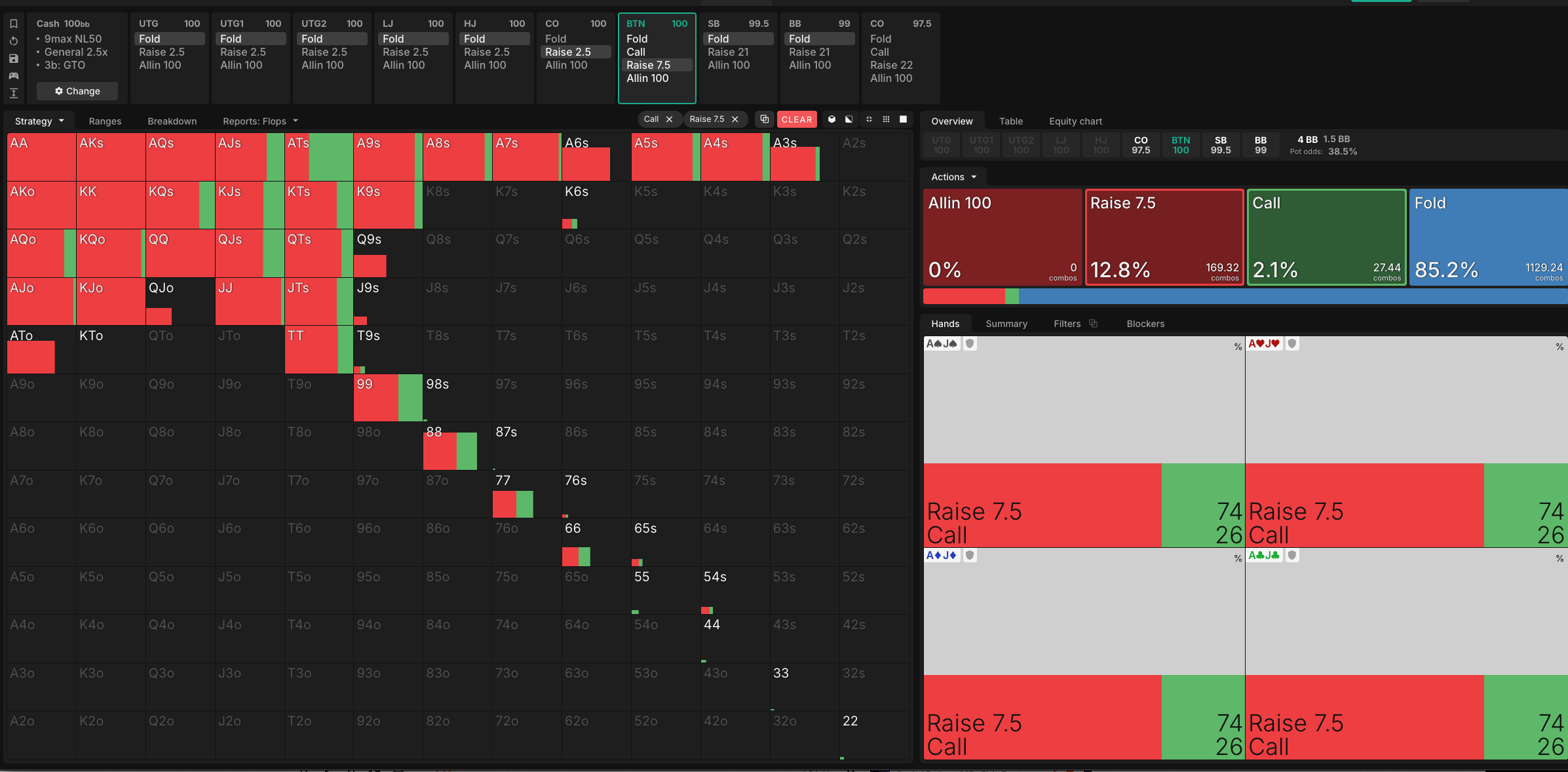
I dont have any solver memberships but I think I can get 1 free "solve" at gto wizard i'll screen shot their standard ranges but I say this with a HUGE caveat that these ranges are most likely different than your average 5/10 reg's ranges but as a foundation to build your strategy around, they are the best place to start. I may be able to spoof my IP to get multiple free "solutions" so I can demonstrate the above statement of equities run closer together/nut advantage doesnt tilt as extreme as it would in other situations - for example: SB 3bet BU raise flop comes AK3, SB has a HUGE nut advantage but BU still has a grip of Ax hands so equities will differ more towards top end but run tighter at the mid to lower comparisons with BU having some equity advantage demonstrated by having way more Ax combos than SB might in their Raise/Call3bet range.
----
That said: your post flop play in BU vs CO would more or less tread a little .. lighter? not sure if i want to say this exactly because I dont want to paint the wrong idea. but the way i conceptualize it is that postflop play in this scenario is more delicate and less obvious than if it were a BU 3bet EP or MP situation.
Ill post the solver **** later when i get a chance to look it up.
here is button's range and frequency of action to a CO raise - notice specifically hands like K6s, Ax suited down to the A3, Q9s, A10o all 3bet some % of the time. I mention those specifically as making up the beginning of forming a "light" portion of the 3bet range but this response is taylored against an opponent who plays optimally so against opponents who deviate to suboptimal, finding opportunity to maximize expectation would shift this range somewhat for sure.
This image is the BU response on flop after CO check calls the 3bet and checks the flop. Notice you would still be checking 30% of the time against the most optimal strategy. I imagine against opponents who deviate, the check back portion wouldnt necessarily decrease considerably UNLESS your opponents deviation from optimal is simply: folds to C-bet in 3bet pots considerably higher than general population. The solvers take a rather mixed strategy both betting and checking with varying frequency amidst the same combo. Most interestingly, QQ checks a healthy portion of the time relative to the entire range check back frequency (overall, the range checks 30% but QQ looks like it checks back 1/2 the time).
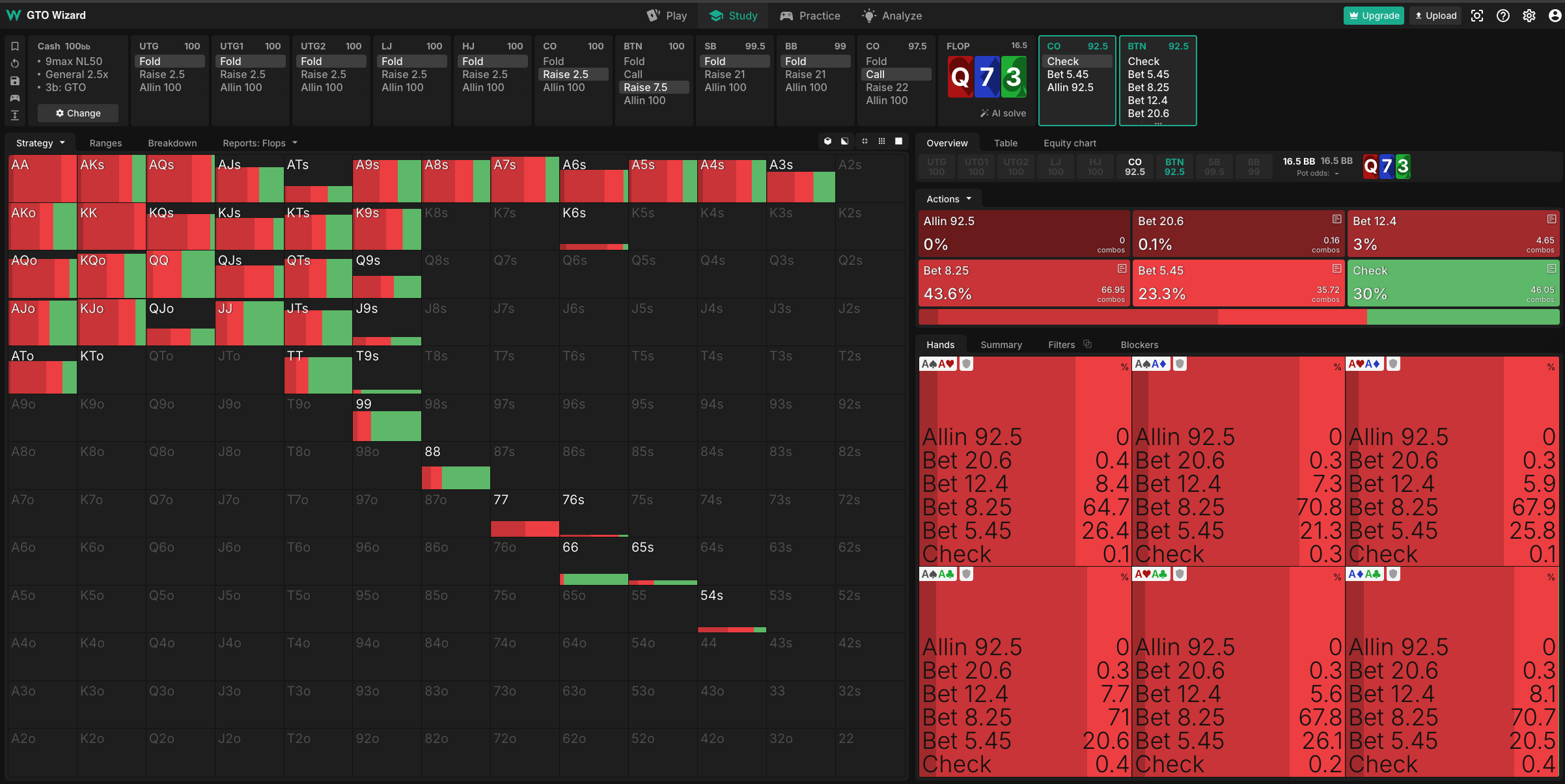
Im usually not one to want to use solvers for hand discussion but this topic is clearly in the realm of theory so it makes sense to build our strategy around a theoretical optimal and then alter that strategy to maximize against opponents playing sub-optimally.
So what do you think are the biggest mistakes gen pop at 5/10 make preflop in the CO raises hero on BU does.... ?
BB_Love, thanks so much for taking the time to put this together! It's pretty much how I envisioned it. The solver shows a very wide 3-bet range, and as you said, that's against an optimal opponent, never mind someone who is not playing effectively.
I do find it interesting that Hero must:
1. First subjectively assess Villain's tendencies and identify that Villain is playing sub-optimally.
2. Wait for the right conditions to 3-bet.
3. Then balance out how often to check or raise if things go post-flop.
I do wonder if a human is necessarily going to catch on to patterns in the same way that an opposing computer will, but that's another discussion.
I don't think I'm understanding your question of "So what do you think are the biggest mistakes gen pop at 5/10 make preflop..." Are you asking what mistakes the gen pop make preflop when they are in the CO or are you asking what mistakes they make when they are defending the BU?

I generally like to 3! if I am 3-betting light suited broadway or good suited connectors. Those are hands I might play anyway and have good playability. You can semibluff with draws representing an overpair or TPTK with AK. You can also just 3! premium hands. There are situations where it seems better to 3! than to call or you want to isolate versus a fish or the raiser's range is really wide when 3-betting might be good with whatever hand you want to play.
3-betting hands weaker than what you would call with may work late in tournaments when you pick up blinds and antes plus the original raise. In live low to mid stakes people want to see a flop.
If K7o is just below what you would be calling with, then it sounds like you are calling raises with KTo, A9o or K8s. That is pretty bad, and generally I would not open raise or raise limpers with those hands. The play in lowish stakes tends to be very loose, and it may be best to play solid ranges.
K7o is just below what I would open with from the button if all of the action folded to me at that point. In other words, if all of the action folds to me on the button, I'll open bet with K8o or K9o. If there is a raise from an earlier position, then I unquestionably fold them. If the action folds to the CO who opens the betting, then this is where I would take a chance to light 3-bet a middling king in the hopes of getting the preflop fold. If I were to defend that hand with a call, then I wouldn't do it below KJo.
I do think I am going to stick with only 3-betting the premiums which is what I do now. Maybe that will change if I feel that I can refine this tactic.
When we 3! light, it is a bluff. Our goal is to generate some fold equity against the weaker portion of our opponents' range. Like any other bluff, when called, we need to play some poker and make principled decisions on when to continue the bluff on future streets. We shouldn't just keep blasting with 100% of our bluffs on all runouts.
At equilibrium, in a CO vs BTN situation, the CO should be folding roughly 60% of opens against a 3!. It sounds like that isn't happening in the game you are playing. Now we need to figure out why. It could be:
1: V's are playing stronger ranges than GTO, so when 3! they legitimately have stronger hands that can call with. If this is the case, we probably don't want to 3! light. We want to 3! larger with a stronger, more linear range, because if V has a stronger than theoretical range, they have more hands that are going to be willing to call larger bets. We want our bluff frequency to be lower than theory, because Vs have a stronger range than theory. In some games, we might not have any bluffs at all. That's ok. If our opponents are unbalanced, there is no reason for us to be balanced.
2: V's are calling 3!s too much with too weak of a range. If we 3! the CO and they show up with hands like A6s, Q9s, KJo, V is calling too wide. We can exploit this by 3!ing more frequently with a smaller size, with a range of hands that have good post-flop playability. We don't want K7o, that hand has terrible playability. But K7s? Let's go. In this scenario, we want to 3! a smaller size (2.5x-3x)because a higher SPR will benefit the IP player in post-flop play. Since we have some weaker hands, we don't want to be piling money in and we want the whole array of options postflop to allow for maximum pressure bluffs and just giving up on unfavorable runouts.
So we need to figure out which bias opponents have and adjusted our 3! range. When we are bluffing with the weaker portion of our range we have to use caution post-flop. If you're bluffing preflop, you can't be barrelling 100% of flops. So a flop like K62 FD, yeah, barrel everything. V probably doesn't have AA, KK, AK, or even KQ at full frequency because those will 4-bet with some frequency. We have more K and stronger Ks, and with a FD on board, we can expect to be called a lot by hands we can bluff effectively later like QJs, AQs, AJs, etc.
If the flop comes TT5r, we should be checking back roughly 50% of the time in equilibrium. Since live Vs rarely x/r enough, maybe we can expand that to 60-70% exploitatively, but if we are betting this flop 100%, we are asking for trouble unless our opponents are simply terrible. We need to start choosing which bluffs we are going to continue, and which we give up on (for this street) based on typical bluffing concepts like blockers, the elasticity of opponents value hands, our perceived range, etc. For example, I'd bluff QJs on this flop all day, but if A4s is in my range its checking back. I want to block QT, JT when bluffing, and I want to unblock Ax.
In general, live opponents are going to be most sticky pre-flop and on the flop. So if your strategy is 3! and then bet 100% of flops, you're firing two barrels of your bluff when the opponents range is inelastic and they aren't going to be pushed off much. Checking back the flop sometimes will set up a very profitable bluffing opportunity on the turn because most V's will check 100% of their range in a 3! pot on the flop. After it goes x/x, if V checks again on the turn you can apply a ton of pressure with little fear because their range is now very weak. And sometimes V lets you off the hook with a nice big bet, and you can fold your bluff before you lose more. If V checks turn, we can look to bet/bet turn and river with bluffs if the texture doesn't change and expect it to be very profitable against most players. If V bets small, any bluff would have to start with a raise on the turn, looking to bluff again on many rivers, which is a more profitable line against aggro players but very dangerous against the nitty side of the force.
If you're just going to fire nearly 100% of flops with a half-pot bet after 3!ing, you should probably keep your 3! range tight and only 3! hands that are happy doing that on almost every flop. Which is probably fine in many casino games if you are playing different people frequently. If you're playing the same people regularly, they are going to figure out what you're doing and your value will eventually suffer because they'll just know you have a really strong range when you 3! and play optimally against you post-flop.
K7o is just below what I would open with from the button if all of the action folded to me at that point. In other words, if all of the action folds to me on the button, I'll open bet with K8o or K9o. If there is a raise from an earlier position, then I unquestionably fold them. If the action folds to the CO who opens the betting, then this is where I would take a chance to
If you are 3-betting just below your range, it should be just below your calling range, not just below your opening range if it is passed to you on the button. You wouldn't flat call a raise with K9o. Maybe something like K9s would be just below your calling range and would be a reasonable 3-bet hand BTN versus CO.
Not sure about just below though at lowish stakes live, as the 3! isn't going to get many immediate folds, so you can do it with a hand that was worth calling with.
Also, BTN versus CO, you theoretically should be 3-betting a high percentage of your continuing range.
BB_Love, thanks so much for taking the time to put this together! It's pretty much how I envisioned it. The solver shows a very wide 3-bet range, and as you said, that's against an optimal opponent, never mind someone who is not playing effectively.I do find it interesting that Hero must:1. First subjectively assess Villain's tendencies and identify that Villain is playing s
Ok so your strategy at the table already is based around identifying the mistakes you think your opponent makes and capitalize on them. Do they fold too much OOP? Bluff more. Do they call down too often? Value Bet more and bluff less. etc etc.
Re: conditions - I mean this is definitely situation dependent much like any other decision tree node in the game. Hypothetically you can dealt a hand on BU like A7s where action folds to you and you raise, SB folds and BB 3bets. You have a mental note that BB has been 3-betting quite often not just against you, but against the entire table. This PROBABLY means (even tho small sample) that BB is 3betting a little too often which suggests their 3bet range SHOULD have more hands that will fold to a 4bet. A7s is a prime candidate to 4bet your opponent's lighter 3bets as 1) its not necessarily a pure value 4bet HOWEVER if you are called you have outs to nut flush + you have equity/outs vs any and all pairs that BB flats - clearly we would remove something like QQ-KK from BB at this point because we'd expect a 5bet but when they call, of the pairs in that range, the top would be JJ say. depending on how frisky they are we can even discount it from a full6 combos of JJ to only 3 say if/when we do some combinatoric math later in the hand for example. but point is we can spike an A to beat that part of their range post. We select a suited hand to give us equity against the parts of their range like connect and suited broadway hands - we can flush over flush their KxXx suited connectors on occassion.
we arent taking A7 and playing it like the top of our value range post flop most often though. We use A7 because its trash, but its kinda pretty - so we want FOLDS preflop the most, tahts the biggest benefit when we 4bet A7 and villain folds out hands like QJss or 77-TT say etc etc. But on the off chance we gotta take it to the streets, we have a hand that can still flop and turn solid equity against their entire range. And then obviously dependent on flop and villain actions, we may want to tread light/cautious with the A7 but in case we flop solid equity we play it like any other.
I know the example i used here is a 4bet scenario but i wanted to use a hypothetical here that has rather wide raise/3bet/4bet ranges - generally wider less defined ranges pose slightly more difficulty vs something like UTG vs UTG +1 - UTG+1 3betting a UTG raise we're talkin a very small slice of hands here and therefor fewer 3bet bluff candidates.
One other important note: while GTO ranges have "light 3bet" candidates and i'd say if you're playing 5/10+ everyone except some whale with too much money and not enough sense would probably have opening ranges and tendencies supporting some lighter 3bet candidates.
think of it like this: you sit down you have no idea about opponents yet. as you gather info and notice maybe one player is real ****ing active from all positions. and maybe you ahvent even seen a showdown but quick estimate says he's VPIP'ing something like 35% in a full ring game - no matter how you slice it, the guy is opening way too ****in wide. You can choose to just call in these spots and hope to out play post flop in position but if you have some solid players behind you, you dont want them eating up your equity post flop or maybe getting frisky and popping the entire range you flat pre. So what do you do? You add some light 3bets.
Lets say you 3bet a 35% VPIP'er in MP from the BU within the first hour with K5s. Say they 4bet you - ez decision to fold. Say they flat? Board is QTT not your suit. they check maybe you fire 1/3rd pot and they ch/raise - ez fold with hardly any backdoors and Khigh.
im tryin to just put into practice how the light 3bet can be used where you run into the walls.
but there's gonna be a TON of spots where our 35% VPIP'er raises from MP, you 3bet and they dump some of the mid to bottom of their opening range and you scoop. Thats money printer right there with a hand that now performs WAY OVER its expectation. If you tracked every combo you held and how much you won/lost with it, K5s is most likely not in the net positive. but now you can start eating away at its negative win rate when opponent folds.
Generally the advice on light 3bet hands when you do is to just give up post flop or get to showdown as cheap as possible. I think thats solid advice. When do you bend those rules? When you think have enough edge to find some spots where K5s becomes a decent low equity bluff hand. For example: you 3bet, Villain flats flop is T62r villain checks you check turn is 5 villain checks - here's a great 75% pot bet low equity semi bluff.
etc etc
Yami/Deuce/BB...thanks all you guys for your valuable insights! It always amazes me how when I ask a question I can get such varied responses, all with solid guidance. I'm especially grateful for the time some of you put in to respond. The longer comments took far more than a few minutes, for sure.
Deuce, one thing you said that stuck out right away is that, yes, I have been 3-betting at just below my opening range and not my calling range...ugh...that one seems very obvious but for some reason I didn't even realize it.
After reading all of this, I may yet give this another shot. You can never have too many tools in the toolkit and if I take this one out, it's one less weapon for me to use at a specific time.
Again...much appreciated!!


