Bigger?
Couple 1/3 strategy questions:
1. Say Hero has A8 in a standard pot, the flop comes 832 - I’m seeing big flop over bets. The player then slows down on the turn, but mostly get folds. Do we like this?
2. I’m aware of geo-sizing, but not always using it and have a hard time defending against it.
3 streets 70-80% pot
2 streets 110-130% pot
I usually run the triple barrel fine, but I get tangled up in doubt with 2 streets, not betting enough and not bluffing enough.
This is mathematically sound pressure, but I just never feel comfortable pulling the trigger in these spots with value or bluffs.
I play in wild games with a lot of action most of the time, not a bunch of nits. Should I go bigger more often? Lot of my opponents do? How do I decide when?
I appreciate you sharing your thoughts
8 Replies

The answer to all of these is it depends on specifics and there's no simple answer

I play in similarly wild games, so I'll try to just give some practical tips that aren't necessarily in line with theory. KVND is right that it depends on specifics.
1. Asuming you are the pre flop raiser and are heads up against the BB. 832 will generally connect with the BB's range, so you should be doing a fair amount of checking as the PFR.
Overbetting with a portion of your betting range could be theoretically sound, but if you're using an overbet size you'll likely need to split your range into at least two sizes. It gets complicated and hard to execute. I also find that when you go this big you run the risk of folding out many of the hands you're targeting for value, specifically when you hold something like A8.
If I were you I would probably just bet something smaller like 2/3 pot. You'll get called more this way with worse hands like 8x, 3x and 2x.
2. Regarding geometric sizing, this is one of the key skills in poker. That is, constructing and executing strong polarized ranges. Even some excellent players don't get it right in every spot.
Here's my tip. Start with your value range.
Think about what hands are strong enough to want to get stacks in. Then start adding in bluffs. The nice thing about wild low stakes games is that the players are often oblivious and will pay you off even if you're not bluffing much. So if you're under bluffing at first that's generally not the worst leak. Over time as you get more comfortable taking these lines you can start adding in more bluffs.
Regarding whether to go for two or three streets. A lot of time you'll want to go bigger and get the money in in two streets when your strong hands are more vulnerable. Oftentimes that means sizing up on draw-heavy boards.
Broadly speaking I don't like overbetting with a hand like A8 on 832.
An overbet theoretically narrows our opponent's range right down, I don't really want to compress it to "stuff that smashes us" when I have a hand I'd rather get some value with. We can achieve our aims more efficiently with a smaller bet. At say ~50%, J8s pays us off and hands with some equity against us like T9s or KQs are often folding.
Also, in a vaccuum, I'd prefer to apply maximum pressure with a polarised range. Like on this board 3 combos of 88 and 3 combos of either A4s or 54s would be a much nicer starting point for an overbet range that A8. Now we're gunning for stacks with the nuts and hands that can make the surprise nuts, not a mid-range value hand.
First of all, I have not been betting big in the A8 type of situations, but I have seen others do it with success. So far the consensus is that it’s not a great idea, but how/when do you defend against a villain with this plan. If I know this is happening, what do I need to fight back?
I am very interested in people’s thoughts on geo-sizing. My point here is that ‘l know what to do’ but I am not doing it. With value, I don’t want folds & talk myself into betting smaller.
In trying to patch leaks:
I think both my opens & 3bets pre-flop need to be larger. If everyone is just going to throw in 15 with any hand, I need to make them think
I’ve got to develop a more ‘go for stacks attitude’ and unleash over-bets on the turn with a polarized range. I find some good bluffs on the river & early in a hand, but not enough on the turn. This should help.
Yea, specifics matter
Just looking at things I could do better
With help from the opinions of others
Thanks
Like everything 'it depends' but if someone is blasting off with decent but vulnerable one pair hands, I start by calling with hands that beat them and folding hands that don't. It's pretty easy to beat a guy who insists on driving themselves to value town.

The best answer is to fold A8 pf in a wild, nobody folds pf game.
I'll show you why I prefer betting smaller, like 2/3 pot with A8 on an 832 board.
Let's assume you raise button and the big blind calls. Flop comes 832 and it checks to the button, who then overbets 120% pot.
This is how the big blind is supposed to respond:
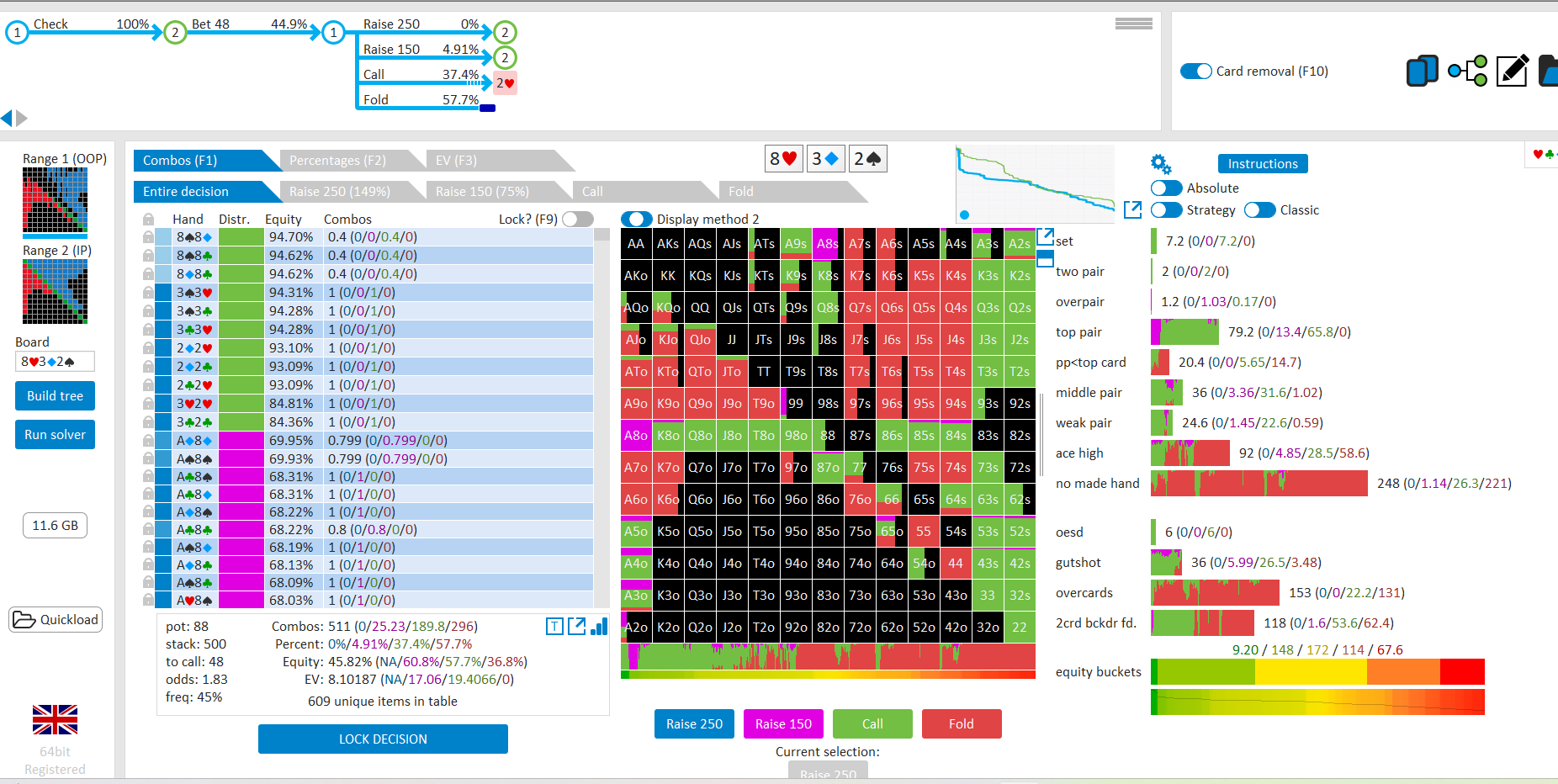
Notice they're supposed to be basically calling with any pair, including 3x and 2x.
Human opponents will usually overfold and start folding out many of these hands, leaving you in a worse position on the turn against a stronger range when they call.
The flop overbet probably has more merit as a bluff to take advantage of their overfolds.
I do understand that it is not considered a good idea here on the forum, but I see people doing it successfully. There are some players that will never go away if they hit the flop. I’ve seen A3 catch a 3 on the flop, call down and win.
Example: Asian guy triple barrels with AK that misses everything, unknown flops a duece with K2 and calls down stacks to win with a pair of twos. This was the first hand in my last session.
Surely, this is not strong poker
But trying to read these people and not make mistakes is not easy. A big pair is never safe in this crowd, I’m looking for ways to navigate, not trying to play like them.
The K2 guy bought in for $700 and ran it up to $3k (absurd amount for 1/3). Then a couple hours later went broke and left -$700
With so much action, it’s hard to get exploits right. It’s easy to sit tight and wait, but I wonder if there’s a better way.


