Pot geometry under ICM pressure

Hello, im still cash game pilled and trying to convert my thinking to understand tournaments a bit better.
In cash games I have learned that bet sizing across multiple streets is frequently with the intention of either A- getting to Showdown, or B- getting the whole stack in. Ive learned the river all in bet is so powerful with value (for max value) and for bluff (to maximize fold equity). And Ive learned its rarely correct to make a big bet OTR thats non-all in when all in isnt too much more (or is even 1.5x pot, 2x pot, etc).
Now, my question is does this theory still apply to poker Tournaments?
for example IP OTR with 150p behind, theres a sentiment that we should value bet 50p and bluff 150p. This seems obviously incorrect to me as it creates range imbalance.
I assume we want balanced ranges for each bet size we take.
In cash game, i would think betting 75p here is kind of a fish play, since it makes the XR so so painful, and there probably isnt too much elasticity btw the range that calls 75p and the range that calls 150p, and were probably just about as polarized either way.
But does that change at all for Tournaments? should I unwire my brain from thinking 50p and 150p are the only good size in this type of scenario? does 75p become better somehow simply because of ICM?
also 33p is something I wouldnt bet IP in cash because If i want show down i just check, and if i wanna polarize i bet bigger, and the possibility of getting Check-raised kills the EV of a thin value bet.
But is 33p IP OTR in tournament much more reasonable?
5 Replies

In ICM you can sometimes even bet 99 % of pot when you have 1 pot behind. 😀
As for small IP bets, I would start around half pot and larger. Not much sense going 33, even in ICM it would be pretty rare. And usually people do too many tiny river IP bets.

You know, every now and then, I pop into 2+2 and find a question that actually makes me think. I don’t think I’ve ever seen an exploration of pot geometry under ICM pressure before.
Look, I get that what you’re really asking for are ICM bet sizing heuristics, and I’m sure some crushers here can provide solid rules of thumb. But this is actually a super interesting problem from a mathematical standpoint.
The ICM Tax
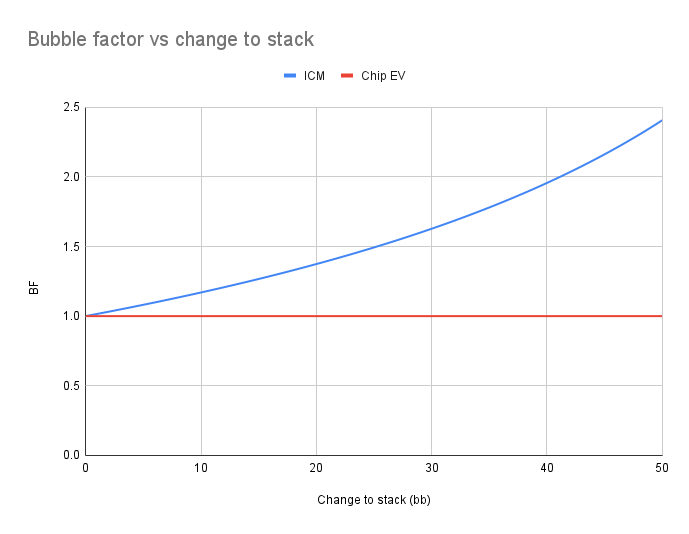
In ICM spots, the more you invest in a pot, the steeper the penalty you pay. We can visualize this as a bubble factor graph (how your BF changes as you invest more of your stack):
Or another way to look at it:
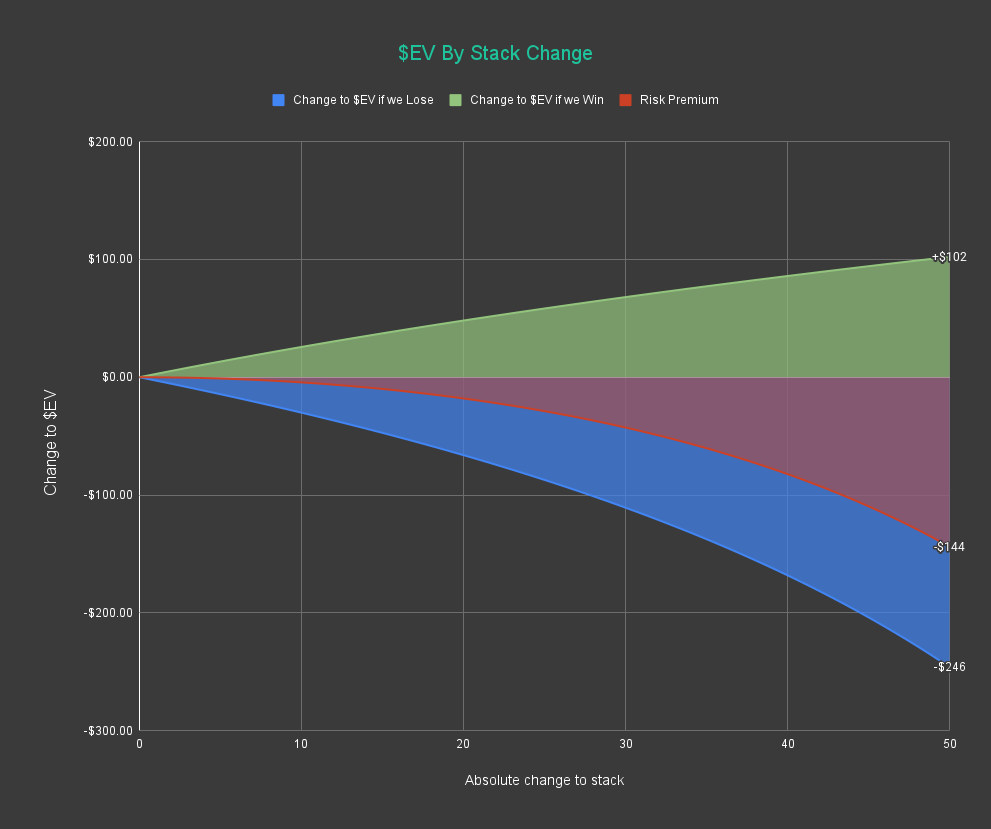
These graphs just say that as you put more chips in, your ICM tax increases. So how does that impact pot geometry?
Pot Geometry in Chip EV vs. ICM
Pot geometry, in simple terms, asks:
“How can I build a pot in a way that maximizes my opponent’s contribution?”
- In Chip EV spots (cash games or early MTT stages), the answer is easy: bet an equal fraction of the pot on each street to get stacks in by the river. This obligates the defender to call as wide as possible and maximizes their contribution to the pot, increasing the EV of the aggressor’s polarized range.
- In ICM spots, it’s trickier. Since your bluffs need to be indifferent to betting or checking, the entire defense strategy shifts. The very concept of MDF warps according to the ICM utility function. So it's not clear if you should still bet an equal fraction of the pot on each street.
Sanity Check: Do You Still Want to Play for Stacks?
If you’re perfectly polarized in a tournament spot, do you still want to play for stacks?
Yes. The reason is simple:
- You still maximize the $EV of your nuts by maximizing the chips your opponent contributes to the pot.
- The defender should still fold enough that your bluffs are $EV = 0 at every decision point.
So in principle, the same logic holds—you still want to build a pot to maximize their contribution.
What’s the Best Way to Build a Pot in ICM Spots?
Should you still bet an equal fraction of the pot on each street (like in cash games)? Or does ICM force a different approach, like frontloading aggression?
Honestly, I wasn’t sure—this isn’t an obvious toy game to solve. So I ran a Pio sim to test it.
Results: Pot, Pot, Pot-sized bets (on the stone bubble of a satellite)
- Bluff % on Flop, Turn, River: 80%, 70%, 52%
- Call % on Flop, Turn, River: 49%, 46%, 35%
Takeaways
- 1. Pot geometry doesn’t change. The best way to maximize your opponent’s contribution to the pot is still to bet an equal fraction of the pot on each street.
- 2. Bluffing frequency changes. Compared to Chip EV, you need to bluff way more often, and the defender has to fold a lot more on the river.
So while ICM warps strategy, the fundamental way to structure bets across streets doesn’t change—you just need to adjust your bluff:value ratio accordingly.
Disclaimer:
In real play, you’re almost never "perfectly polarized", and if you run spots in an ICM GTO solver, you’ll see plenty of situations where not playing for stacks is better, even when it would seem natural at that SPR.

Postflop ICM play is one of the more complex topics, and there's not nearly as much good content available relating to it as there is for other aspects of hold em tournaments.
I don't even understand how postflop ICM strategies are calculated.
Tombos maybe you can shed some light on this topic? My understanding is that PIO postflop just calculates an equilibrium strategy using ICM-adjusted preflop ranges?
I don't understand how you can have an ICM-adjusted equilibrium strategy postflop when the incentives are often so different for both players? It seems like it's not really a zero-sum game anymore when one player can make a play that causes both players to lose $ EV.
What I've heard from the best players is that in ICM spots you want to generally reduce your sizings somewhat to try to control the size of the pot.
The exception though is that if you reach a threshold where you are willing to stack off then you sometimes increase your sizing to get your stack in and put the ICM pressure back on your opponent. Basically it's better to be going all-in first as it forces your opponent to play tight. If they go all-in first then it puts you in a difficult spot and you end up having to fold a lot.
Anyway I realize what I just wrote sounds contradictory, and I admit that I don't fully understand these spots. But it sort of makes sense that you would want to either get to showdown relatively risk free or get all your chips in and put all the pressure on your opponent.
If anyone has any additional insights or links to good content I would appreciate it too.
Postflop ICM play is one of the more complex topics, and there's not nearly as much good content available relating to it as there is for other aspects of hold em tournaments.
That’s changing fast. GTO Wizard recently added postflop ICM solving, leading to a big influx of high-level theory in this area:


Tombos maybe you can shed some light on this topic? My understanding is that PIO postflop just calculates an equilibrium strategy using ICM-adjusted preflop ranges?
No, it uses ICM as the utility function, meaning it directly calculates optimal strategies in ICM $EV. You have to enter every player's stack and prize in the tournament.
I don't understand how you can have an ICM-adjusted equilibrium strategy postflop when the incentives are often so different for both players? It seems like it's not really a zero-sum game anymore when one player can make a play that causes both players to lose $ EV.
Yeah, it gets super weird—it’s almost like a prisoner’s dilemma.
ICM behaves as a negative-sum game because active players “leak EV” to the rest of the field. And the amount leaked scales with aggression.
This leads to paradoxes where giving one player more actions can sometimes reduce both players’ $EV. You even see stuff like how one players mistakes can reduce both player's $EV (think playing vs manic on the bubble).
I wrote a detailed breakdown of these ICM quirks here:

ThatÂ’s changing fast. GTO Wizard recently added postflop ICM solving, leading to a big influx of high-level theory in this area:
No, it uses ICM as the utility function, meaning it directly calculates optimal strategies in ICM $EV. You have to enter every player's stack and prize in the tournament. Yeah, it gets super weird—it’sThanks for the info!
I read through the links and my main takeaway is that it's best to play like a nit in ICM-heavy spots. From your article it seems clear that the risk-reward is heavily in favor of under bluffing. Betting smaller in general also seems like a good adjustment.
Even in the most extreme example, it would seem that aggression is much more likely to cost you when your opponent deviates incorrectly. Barry Carter uses an example where the ICM-adjusted GTO strategy for a big stack against a smaller stack is to shove 100% pre flop on the bubble of a satellite. That's because a rational opponent should respond by folding 100% if their stack is big enough that they can fold themselves into the money.
Even in that extreme scenario though you likely give up less by not shoving and giving up the pot. You will still likely be able to fold yourself into the money on the bubble of a satellite.
On the other hand if your opponent calls inappropriately and you lose then you lose a significant amount of chips and are much more likely to bust before the bubble bursts.
Anyway playing overall tighter has been my general approach. It often feels like I'm playing too passively and getting ran over. My overall results have been good though. So the crux of it is that sometimes you have to sacrifice chip EV for the sake of $ EV. It is still very challenging to navigate these spots in practice though.


