shoving all but 1bb

Ive seen it happen on televised poker tournaments where a player will shove all but 1bb in an ICM situation. I presume this is because you leave yourself room to fold if theres enough action after you and the other stacks collision allows you to fold and ladder up.
I was wondering if theres any science to leaving exactly 1bb back as opposed to 1.5bb or 0.5bb?
9 Replies

The science for me would be to make it 1 bb in rooms where the BB comes first and the BB ante comes second. So left with 1 bb you wouldn't have to post a BB ante. Personally I think this is wrong from a cardroom standpoint and I would force the BB ante to come first (because everyone is anteing for everyone else and the BB shouldn't be allowed to not ante for everyone else...)
If I was playing in a room that made the BB ante come first (which is getting rare now) I would leave exactly 2 bb's on my almost all in bet.

I think it usually makes more sense to shove something like 80% of your stack. That's enough that you're effectively committed unless you have multiple all-ins behind you. You're still exerting the same effective leverage, but you maximize your remaining stack if you do fold after facing multiple all-ins behind you.
Maybe even 70% of your stack might be enough to be viewed as an effective all-in? Anything less than 70-80% though and I think other players might start thinking you could raise-fold to a single all-in.
What Rick said about saving 1 BB so you maximize what you can win out of the BB without paying the ante makes sense too though. That's especially true if you're on a final table and have something like 10 BB or less, with the BB approaching soon.
You can think about it logically to get a solution:
- Start with the presumption that ICM forces these NAI bets that wouldn't exist in the absence of ICM (It's true)
- Consider that once you post up a betting range, you make segments of the defenders range what are at best axiomatic catchers: they beat no value and can only scoop against air, with catching priority largely/entirely dependent on blocker effects
- It stands to reason that if the NAI bet isn't too much less than the whole effective stack, then there will be no change to the axiomatic catching region in the defender's range. Shifting from catching half the time to 40% of the time does not impact overall EV--it's EV-neutral
- So you want to bet up to the largest sizing beyond which the combos comprising the axiomatic catching region do not change
Here's a toy game. The "corner game"
Ranges for both players:
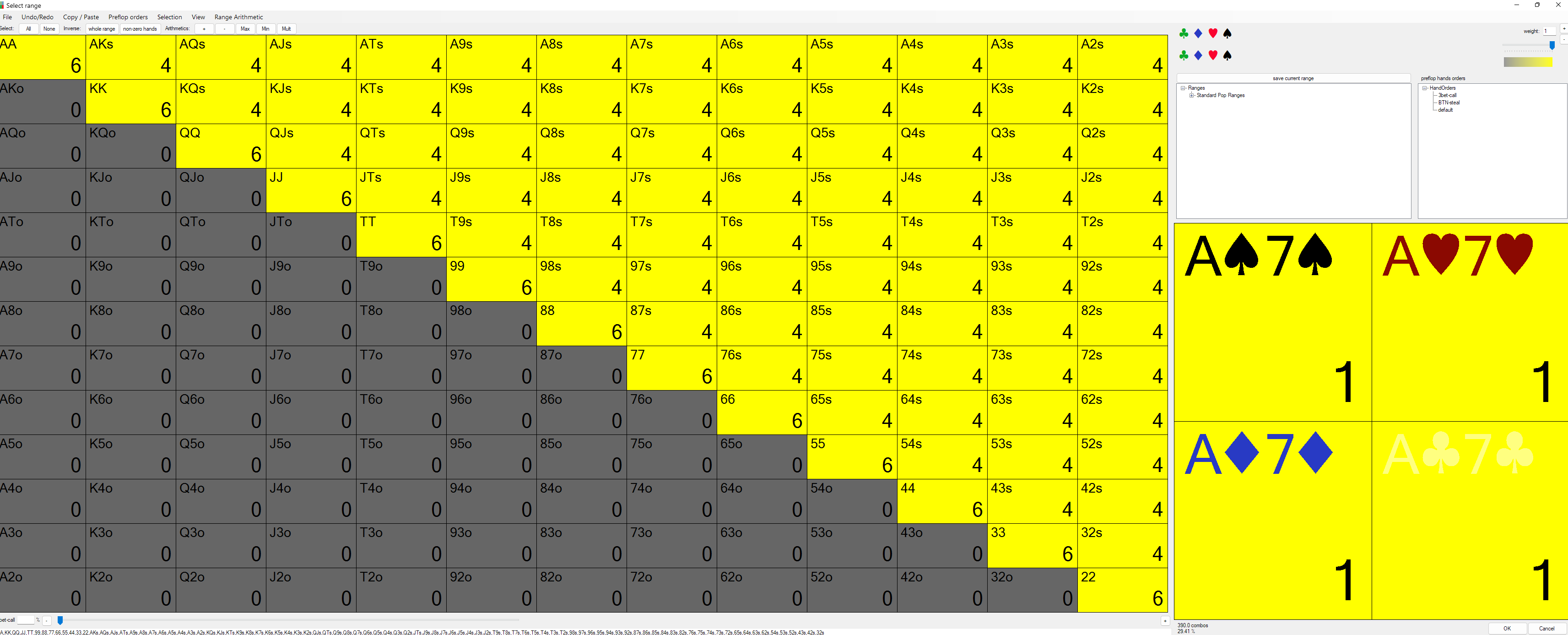
Assume stacks and pot are both 1000
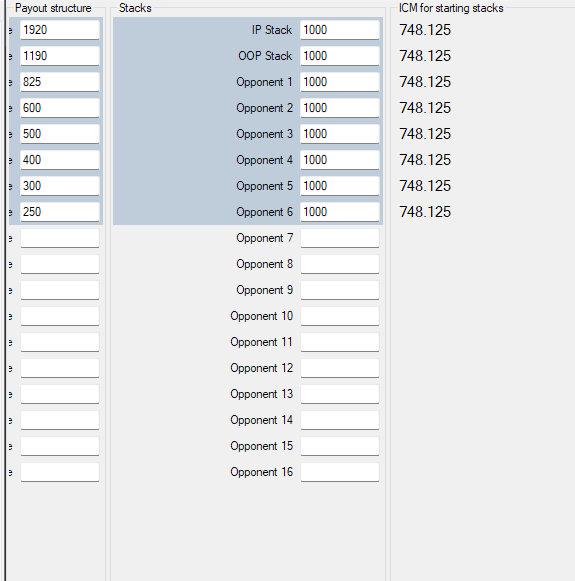
Payouts. Assuming even stacks for simplicity.
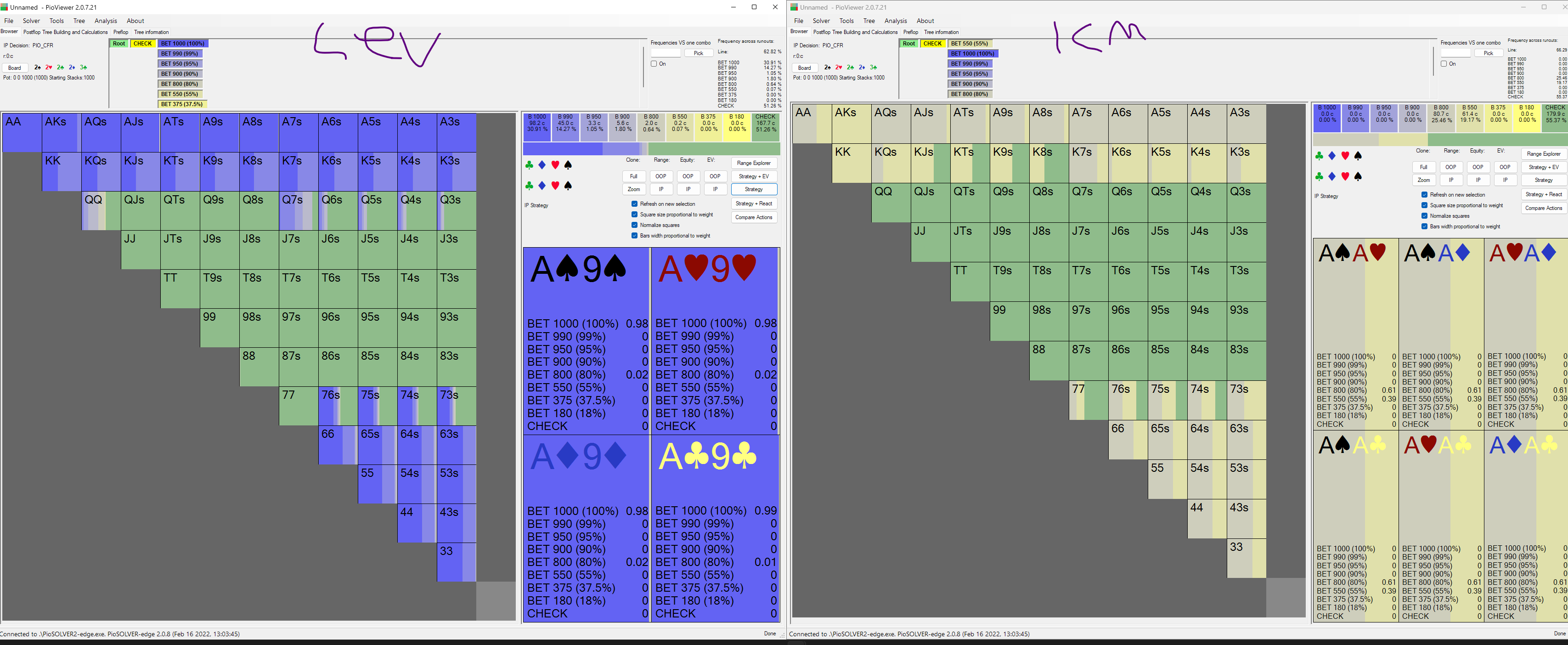
cEV on the left, ICM on the right. Clear strategy shift as the chips gained with all-in do not outweight the money lost when losing.
Closer look at ICM strategies. Bet 80% pot (20% of effective stack left behind).
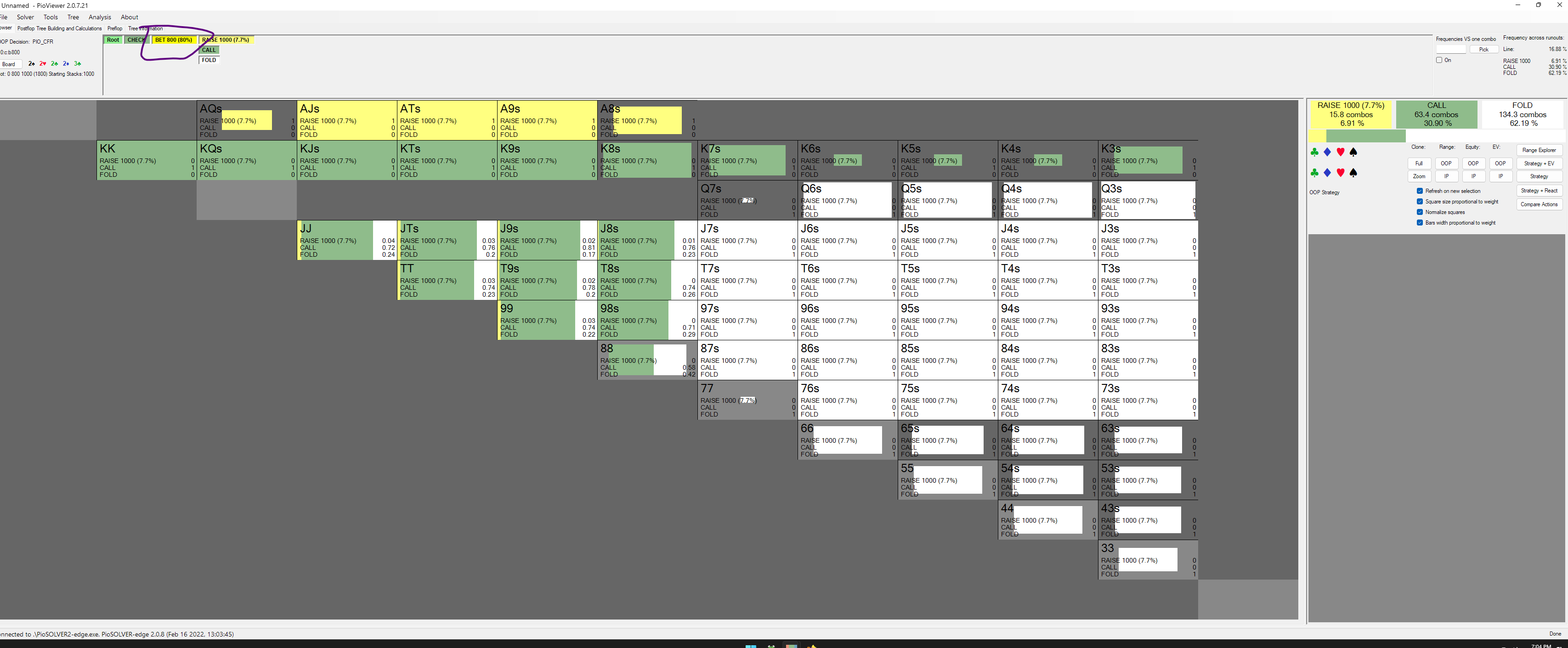
Bet 95%. No change to the axiomatic catching region
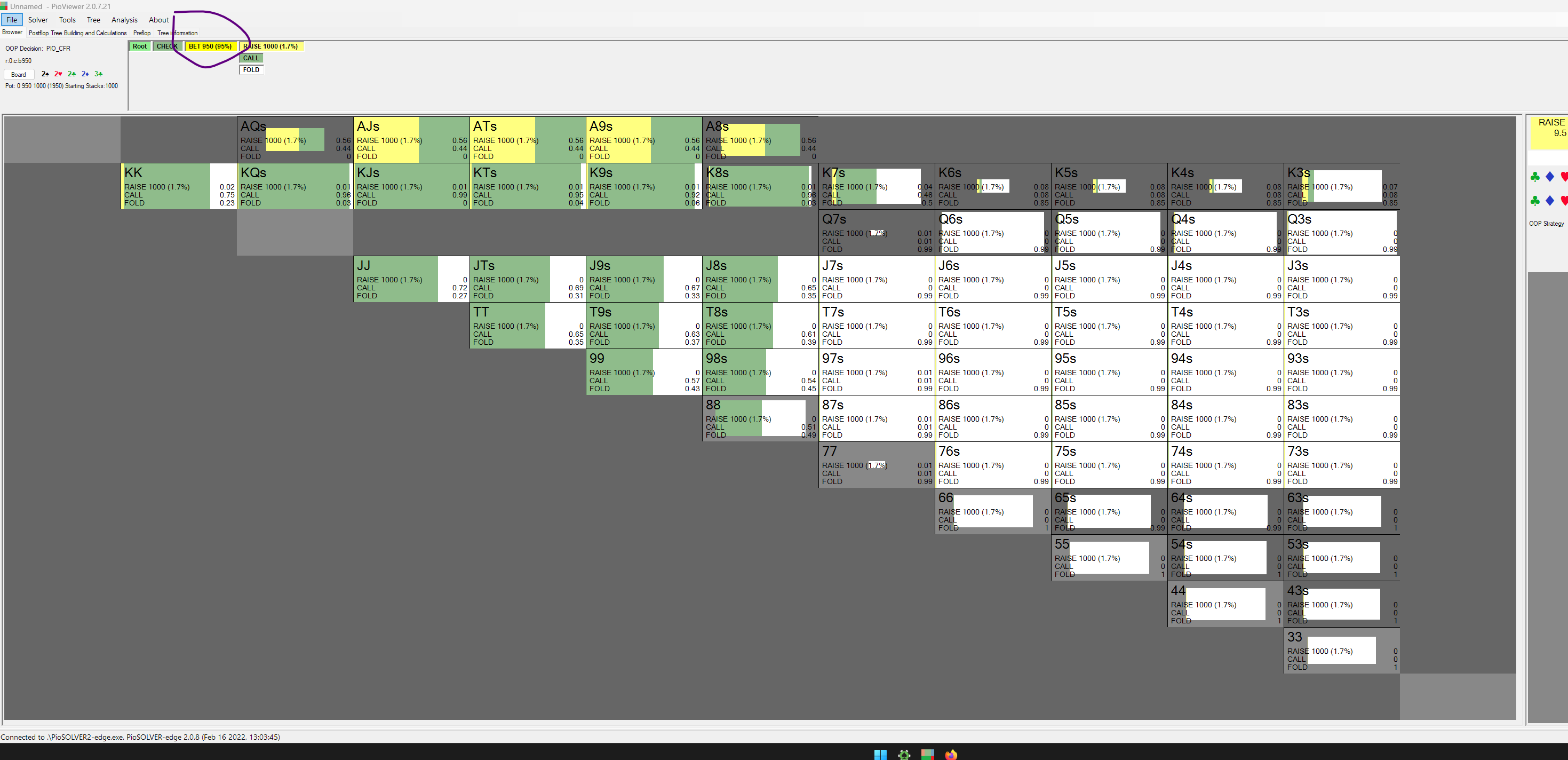
You can think about it logically to get a solution:Here's a toy game. The "corner game"Ranges for both players: Assume stacks and pot are both 1000Payouts. Assuming even stacks for simplicity. cEV on the left, ICM on the right. Clear strategy shift as the chips gained with all-in do not outweight the money lost when losing. Closer look at ICM strategies. Bet 80% pot (20% of e
I'm having trouble interpreting what's going on in your PIO screenshots. But based on what you're saying in your post you must be talking about a river spot where bluffcatchers effectively have 100% or 0% equity right?
In my post I had preflop spots in mind. So that makes a big difference when discussing fold equity, since preflop all hands have equity and you still have additional opportunities to put the rest of your chips in.
But going back to your river example, it seems that the play that maximizes fold equity against the "axiomatic bluff catchers" is still not necessarily the best strategic play in a tournament.
In a cash game where you're talking about pure chip EV that would be true, because the highest EV play captures the largest percentage of the existing pot by maximizing fold equity. So in that case what you said would be true, " you want to bet up to the largest sizing beyond which the combos comprising the axiomatic catching region do not change."
But in a tournament the strategic value of not going broke when you're bluffing can outweigh the incentive to maximize your chip EV in that hand. Your last chip in a tournament is worth more than any other chip as it allows you to survive and potentially ladder.
So maximizing fold equity against bluff catchers is not necessarily the goal since survival has value and increasing your stack has diminishing returns. Does that make sense?
yeah i meant preflop, altough betting all but 1bb OTR kinda makes sense to me too if ur polarized enough to just bet/fold ur bluffs
It's all the same phenomenon
Few practical reasons to leave 1bb behind preflop.
1) Card Protector. If you use a chip as a card protector, then now you can keep it on your cards and since now you are going to be calling allin, your hand gets tabled as the chip goes in. I have had my hand mucked before after going all in because I didnt protect it
2) Stalling for pay jumps. This is an annoying reason, but also profitable. It lets you tank tank tank, go mostly allin, and then before you put in your last chip you get to tank tank tank again. Particularly useful online with fixed time banks.
3) Angling. If your opponent accidently tables their hand because they think that you are allin, then its possible for you to fold on the low% of flops where even one chip isnt profitable to call off.
4) Folding for pay jumps. Still gives you a slim option to fold if multiple stacks go allin behind, although usually you see people jam half their stack or similar for this. Risks less the times you do end up folding.
#2 is a legit tactic
respectfully I'd say it shouldn't be annoying because you should honestly and without judgment be looking to use it when it's advantageous to you. Everyone should.
Expectations are the source of frustration. The expectation should be people pull every pullable lever they got. Then there's no more annoyance.
I once talked to a buddy who said in his assessment good time bank usage on the bubble made him thousands$$$ over his career
Start calling clocks more often IMO and when they don't do it to you for some weird meaningless silly "etiquette" reason then you've basically found a tactical exploit
#3 too. Rules are rules.
does any want to opine on my attempted proof by example/induction?


