What do you think about this nifty little x/r?
PokerStars, $27.30 + $2.70 - Hold'em No Limit - 800/1,600 (160 ante) - 6 players
Hand delivered by Pokeit
UTG: 39,948 (25 bb)
MP: 100,500 (63 bb)
CO: 62,696 (39 bb)
BU: 35,982 (22 bb)
SB: 59,550 (37 bb)
BB (Hero): 27,336 (17 bb)
Pre-Flop: (3,360) Hero is BB with Q♦ J♦
UTG raises to 3,600, 4 players fold, Hero calls 2,000
Flop: (8,960) T♦ 2♥ T♠ (2 players)
Hero checks, UTG bets 3,000, Hero raises to 8,000
11 Replies

Your hand is generally a pretty good check raise candidate. You have little to no showdown value and a fair amount of equity with two overs and all the backdoor draws.
The one thing I will say is that I would like the raise better if our opponent had opened from a later position. Their UTG range is just going to be very strong to the point that we probably shouldn't be check-raising all that much.
You're also short-stacked enough that they might just jam over the raise with a hand like 88, and it would suck to have to fold off your equity.
So in that exact configuration I might just call the flop bet, knowing I can still sometimes bluff later in the hand.
I would actually be curious to see what a solver does in that spot.

Your hand is generally a pretty good check raise candidate. You have little to no showdown value and a fair amount of equity with two overs and all the backdoor draws.The one thing I will say is that I would like the raise better if our opponent had opened from a later position. Their UTG range is just going to be very strong to the point that we probably shouldn't be check-rai
Good post. I think I do like the c/r better when we're deeper, both because getting blown off hurts more here and because here we might get jammed on with a lot of non-Tx hands we have good equity against.
Three to a straight flush + two overs, we can actually just check/call here and even have some turn leads on favorable cards. which is probably how we'd also play Tx (although sometimes we'd check-raise it like this).
Keep in mind we're 6-handed, so UTG is actually LJ.
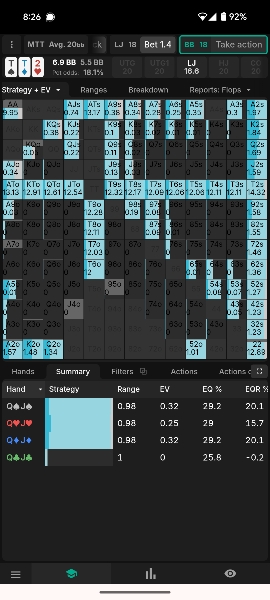
Solver likes the play and also has us making this move with all the Tx too.
Sent from my Pixel 8 using Tapatalk
Keep in mind we're 6-handed, so UTG is actually LJ.Solver likes the play and also has us making this move with all the Tx too.Sent from my Pixel 8 using Tapatalk
Good point about being 6-handed so UTG is actually LJ.
Is the lightest blue color a raise or a call? I would be surprised if all those Ax were check-raising and not calling.
If QJs with a BDFD is mostly calling but with a sliver of raising that would make sense to me.
Good point about being 6-handed so UTG is actually LJ.
Is the lightest blue color a raise or a call? I would be surprised if all those Ax were check-raising and not calling.
If QJs with a BDFD is mostly calling but with a sliver of raising that would make sense to me.
Sorry, it's a bit hard to see but the shades of blue are all raising sizes. GTOW actually does very little x/calling here. It's almost entirely raise/fold.
With QJs in particular, 3 of the combos are raises and the clubs are a fold (the only combo with no backdoor flush draw).
Sorry, it's a bit hard to see but the shades of blue are all raising sizes. GTOW actually does very little x/calling here. It's almost entirely raise/fold.
With QJs in particular, 3 of the combos are raises and the clubs are a fold (the only combo with no backdoor flush draw).
Interesting. I guess with us being so short-stacked and having a big Tx advantage it makes sense to build a raising range around the Tx right from the flop?
I would be curious to see if he is supposed to be jamming over our raise with hands like 88 or just calling? I'm also wondering what our stack off range is supposed to be after we raise flop? I would guess any pair 2x+ is supposed to get it in and maybe even some Ax?
Yeah your range is Tx, 2x and all those doublr backdoors
- No reason to xc Tx very much. Too strong and IP can exploit by getting chearper showdowns if you fail to push it with Tx
- 2x needs max protection
- You can still value turned/rivered pairs with double backdoors. Maybe even turn 2x into a bluff [not sure; maybe big mistake is not 😉]
- etc.
So all the arrows point heavily in the same direction: xr across continue range
these textures are heavily exploitable
somehow I remember this hand posted in 2022:
somehow I remember this hand posted in 2022:
What're the odds? It's the same board and it's also 17 bb deep.
I find it interesting that BB doesn't have more of a calling range on this board.
I just ran the spot in GTO+ so I could look at it in a little more detail.
LJ is range-betting and BB is supposed to fold 73.7%. So after BB folds all their trash it effectively flips the equity advantage to where BB has the advantage against LJ's condensed range. So I guess from that perspective it would make sense that BB would be raising with its continuing range.
Interestingly in the sim I ran only 2.7% of BBs range is supposed to call, but QJs with a backdoor draw is mixing so it does have some properties that support calling as a viable strategy moreso than most other hands.
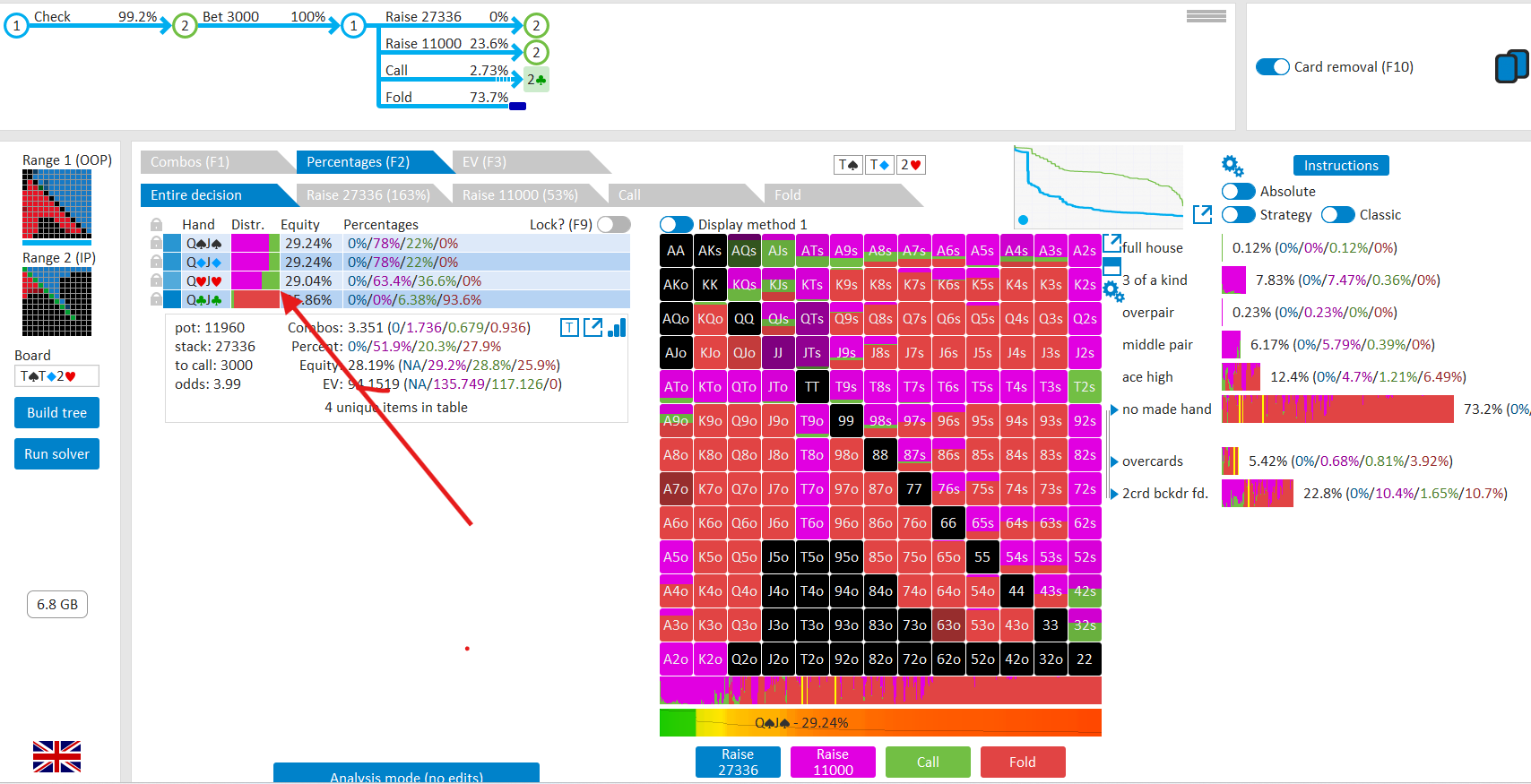
If you do check raise flop then LJ is supposed to be jamming 27%, calling 28% and folding the rest. 88 is jamming every time (as are most pocket pairs).
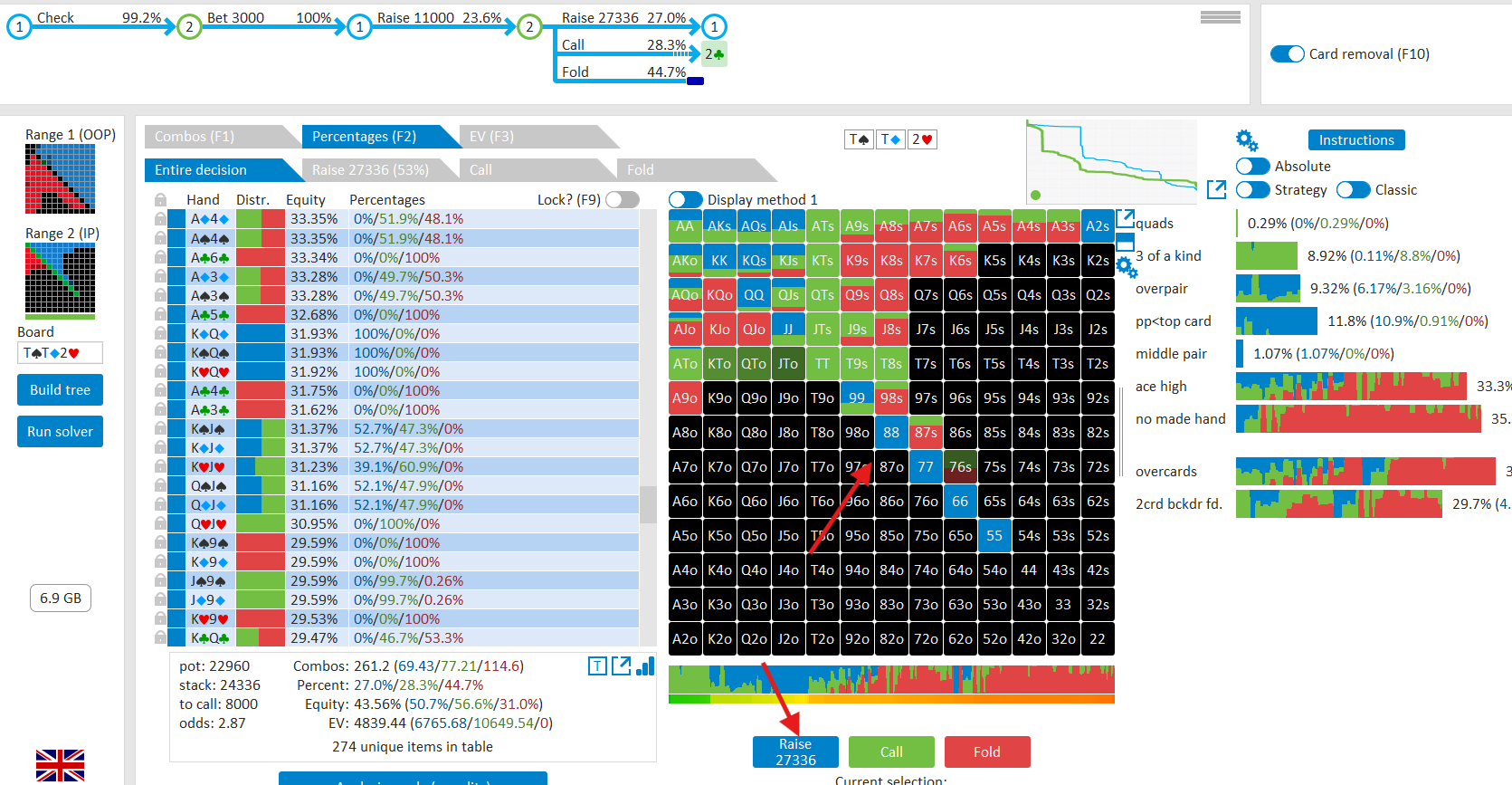
Interestingly you're supposed to call off the jam with the QJs BDFD!
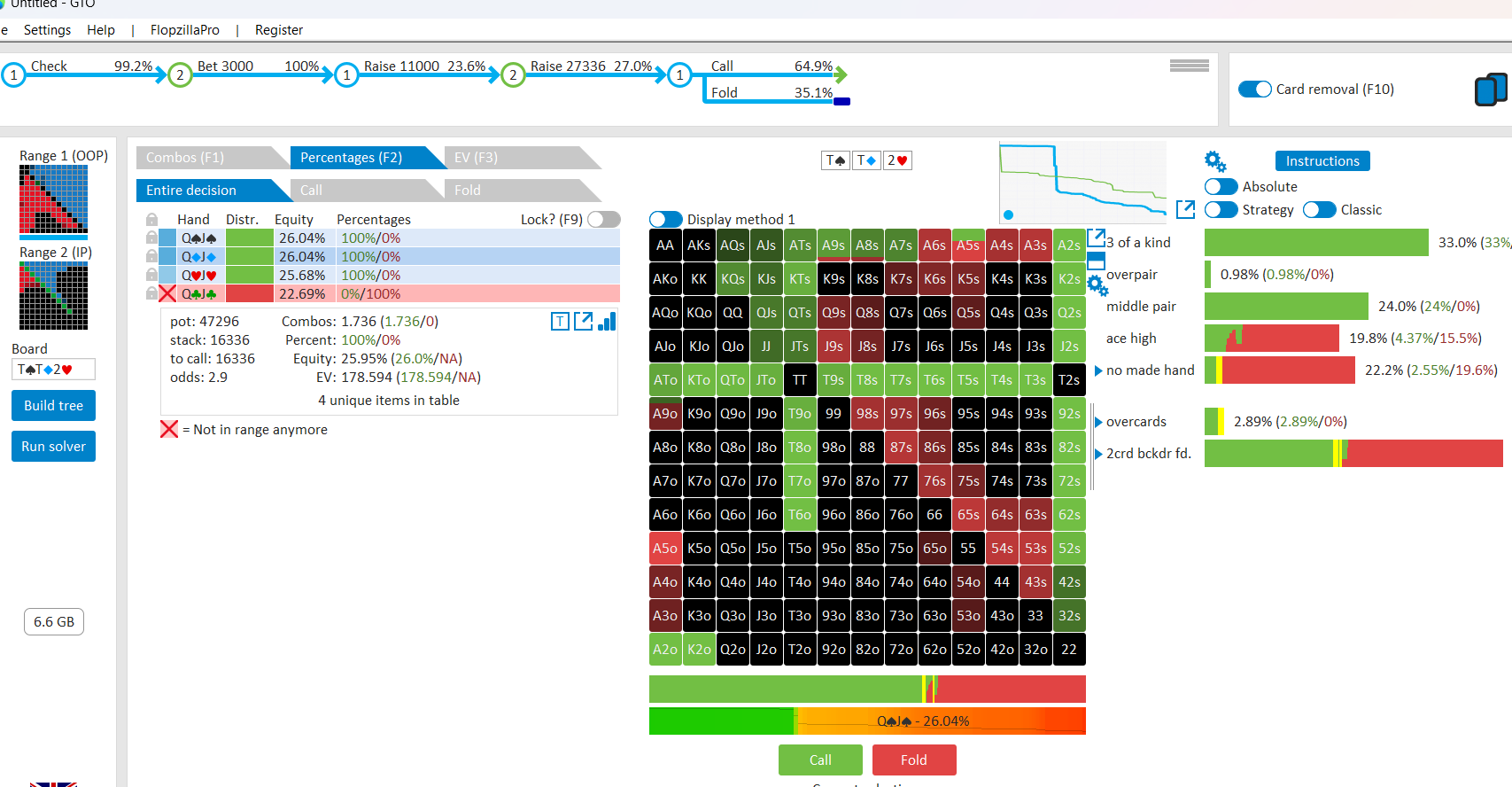
I guess QJs just has enough equity in this formation to stack off, which seems very counterintuitive. It's effectively "priced in." Don't think many of us would find that call vs. the LJ reraise jam!
Interesting about calling off with the QJs.
Does the solver's "reasoning" process work in reverse? Meaning, does it make the x/r with QJs partly because it will call off when shoved on? If you could nodelock in reverse and tell it not to call off on the river, would that change how it plays the QJ on the flop?
Interesting about calling off with the QJs.
Does the solver's "reasoning" process work in reverse? Meaning, does it make the x/r with QJs partly because it will call off when shoved on? If you could nodelock in reverse and tell it not to call off on the river, would that change how it plays the QJ on the flop?
Yeah that's sort of what I was thinking. You typically don't want to raise fold hands with a good amount of equity.
The QJs is calling off on the flop BTW, not sure if that was clear. The action in the last screenshot was LJ bet, BB raise and LJ jam over the top, all occurring on the flop. That last screenshot is showing BB's response vs the jam.
I think it's likely just going to be bad to call the jam with QJs against MOST humans, who probably won't make some of the solver's more marginal shoves.
Then again it's interesting to look at a spot where practically no one is playing anywhere close to a solver. People are going to be all over the map on a board like this.

