Live ~ We made a mistake preflop?
Live 2/2, no bring in, 9 handed timed rake
V1 ~ Loose spewy? Just lost 200. Effective 100
V2 ~ Mid aged asian guy, seems loose, opening 5 every hand. Effective 160
V3 ~ a winning reg here, plays laggy preflop, loves ds axxx or ds wide gappers, 3b wide, calls wide as well
postflop between tag/nit.
Effective 400
V2 opens to 5 in utg
Hero flats w/3♦4♣6♣7♦
V3 3b to 20 in +2
V1 coldcalls in bb
V2 calls
Hero calls
4way pot 80
Flop T♥8♣5♣
V1 jams for 80
V2 jams for 140
Hero?
V3 has yet to act
We hate life we have bottom end of wrap, weak fd.
18 Replies
I think this rundown is too small to vpip. Have to fold now.
Not insulting OP, just worth mentioning (IMO) that more than a few of the hands in Reuben’s book are very similar to this one, except they were played 30 odd years ago with £25-£25 blinds.
Fold pre.
Even in a time raked game you shouldn't VPIP such hands. Well, call a raise from BB only.
Flop is an easy fold of course.

Pre is a fold except in a limped pot from the blinds -- mainly the bb. Now that you are here, how much do you like to gamble? 😉

Monker-solver based RFI ranges include this combo UTG.
Spoiler
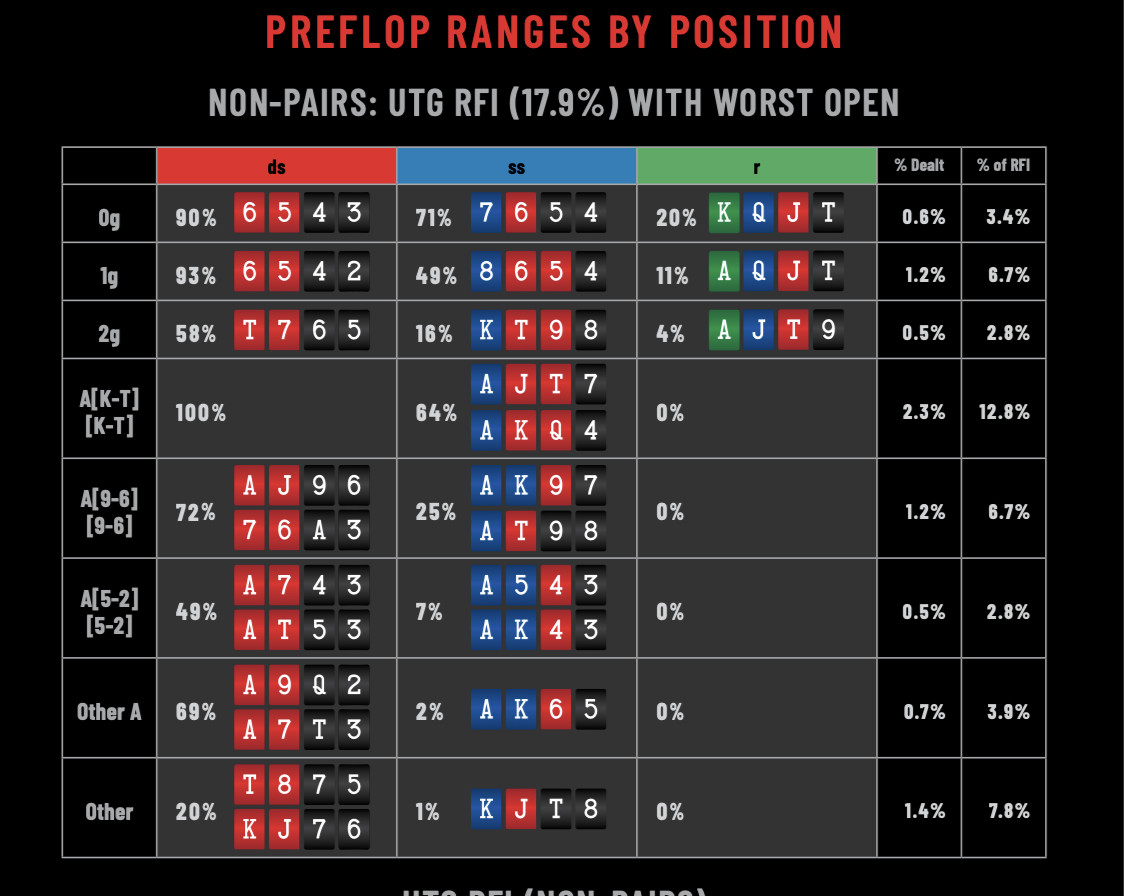
So, assuming the UTG bring-in for 5 is effectively a straddle/third-blind, I think it's ok. There is a strand of PLO theory that claims small is bad (e.g. low pocket pairs and run-downs) but I'm not sure that the solvers agree. The key issue in this hand is the T and the fact that we don't have a 9 and that's it's multiway with two players AI , so folding on the flop is an option (although against these player types and one short stack I think we can go with our hand here, as we're in good shape versus sets and two-pair combos).
Imagine the scenario where Hero raises rather than flats V2 preflop, V3 3bets, Hero defends and we're HU on the flop with our inside-wrap and flush draw. Now that's a good spot.
So, assuming the UTG bring-in for 5 is effectively a straddle/third-blind, I think it's ok.
But it's not a straddle or a third blind. It's a 2,5x open.
There is a strand of PLO theory that claims small is bad (e.g. low pocket pairs and run-downs) but I'm not sure that the solvers agree.
Well. They might be good against tight ranges because then you can assume people don't often have low cards. In loose games they are atrociously bad.
Imagine the scenario where Hero raises rather than flats V2 preflop, V3 3bets, Hero defends and we're HU on the flop with our inside-wrap and flush draw. Now that's a good spot.
Not really. It's easy to imagine a two card hand that has Hero in trouble.
It's effectively a straddle given the description of V2 as "Mid aged asian guy, seems loose, opening 5 every hand" (i.e. his UTG RFI doesn't define his range in a significant way.)
Well. They might be good against tight ranges because then you can assume people don't often have low cards. In loose games they are atrociously bad.
Yes, low-rundowns function well in games where tight ranges are the norm (particularly in respect of board coverage), but they can still be effective against loose-ranges (value from two pair combos, worse straights, nuts with redraw scenarios, overplayed overpairs). To say low-rundowns are "atrociously bad" is just not accurate: to say proceed with caution is perhaps better.
I actually can't think of that many apart from apart 87, 98, T9 and bigger flushes, but in multiway scenarios we're not stacking-off versus better straights and flushes. HU these scenarios aren't nearly as likely, plus our opponents can stack-off versus us with worse, particularly if they perceive our 3bet-defend range as not containing lower rundowns.
It's effectively a straddle given the description of V2 as "Mid aged asian guy, seems loose, opening 5 every hand" (i.e. his UTG RFI doesn't define his range in a significant way.)
Fair. Though even if we can treat it like a straddle, we need to play tighter in a 3-blind game.
Yes, low-rundowns function well in games where tight ranges are the norm (particularly in respect of board coverage), but they can still be effective against loose-ranges (value from two pair combos, worse straights, nuts with redraw scenarios, overplayed overpairs). To say low-rundowns are "atrociously bad" is just not accurate: to say proceed with caution is perhaps better.
If "proceed with caution" = "often end up folding multi-way even when you hit" then yes. Thus in loose games those hands are horrible, no matter how good you perceive yourself to be post-flop.
I actually can't think of that many apart from apart 87, 98, T9 and bigger flushes, but in multiway scenarios we're not stacking-off versus better straights and flushes. HU these scenarios aren't nearly as likely, plus our opponents can stack-off versus us with worse, particularly if they perceive our 3bet-defend range as not containing lower rundowns.
Really? Any higher fd, right. Yeah you need to stack off, but you said "now that's a good spot". No, it's not.
villain 'seems' loose, so we don't have a great read on him. he could have just picked up some hands. anyway, even if we give him an extremely liberal 40% range, this hand is still a clear fold. there is a world of difference between facing a raise (loose or not) UTG + 1 at an 9 handed table and RFIng UTG in 6 max.
also I would argue that the ultra loose game conditions of a plo live game make this hand less attractive than opening utg 6 max as a gto bot playing other gto bots. the reason being, this hand plays a lot better heads up than it does mass multiway.
This hand just sucks multiway - usually dominated by better flush draws, even if you make two pair it's rarely top two. If you could 3b this and get HU it's fine, but you'll prob get cold called behind given there's 7 to act.
Really? Any higher fd, right. Yeah you need to stack off, but you said "now that's a good spot". No, it's not.
If you're HU it's a good spot, assuming we've also got two-pair+ and straight draw equity. If you're not taking on these spots HU because you're worried about losing to higher flushes, then you're bleeding EV by not taking-on enough risk. I understand how much non-nut FDs are devalued multiway but HU it shouldn't be a major consideration unless you're playing very deep.
Spoiler
In game we felt sick but couldn't lay it down at the heat of the moment, we jammed.
V3 mucks saying how he missed as the 3bettor.
Turn 2
River 7♣
We hit the straight flush on river and scooped.
V2 shows K high flush
V1 mucks.
Afterwards, I know I got lucky, I messed up somewhere. And preflop seems to be the main error. Flop might be a fold vs 2 as well.

I don't mind pre but we're going to have to be extremely careful with hands like this. It's hard to get a pure ds rundown / single gapper, and we can smash all hell out of some flops.
Flop is a very easy fold.
What two pair equity? Yes when you have no pair on the flop you can hit running two pair. If you are suddenly talking about something else than this actual hand, note how low cards are in trouble especially against medium cards but obviously also against big cards. You are making up a story how they are somehow great and how much value you miss if you fold some ds low garbage pre.
If you're not taking on these spots HU because you're worried about losing to higher flushes, then you're bleeding EV by not taking-on enough risk. I understand how much non-nut FDs are devalued multiway but HU it shouldn't be a major consideration unless you're playing very deep.
Again, no idea what exactly you are talking about. Though I can guarantee you are not "bleeding EV" if you fold the weakest hands that you are able to VPIP. I can also guarantee that if you are playing live, people VPIP way too much making most spots multiway. You can perhaps figure out yourself how you should adjust. GL!
@OP in my opinion: pre bad, flop horribad.
What two pair equity? Yes when you have no pair on the flop you can hit running two pair. If you are suddenly talking about something else than this actual hand, note how low cards are in trouble especially against medium cards but obviously also against big cards. You are making up a story how they are somehow great and how much value you miss if you fold some ds low garbage p
I'm not talking about the flop in this hand, but a theoretical scenario where we are HU OOP in a 3bet pot with a double-suited low-rundown, where our opponent's range is big-card and/or big- pair heavy. If we flop a pair (1) we HAVE two-pair+ equity; (2) we're likely to have some additional straight-door equity; and (3) because it's HU our flush draw equity is likely to be relatively clean. It's not a matter of making-up stories! It's a matter of assessing equity in quantitative terms of range v range. While we're never going to have a range advantage preflop with this so called "garbage", we may have an equity edge on certain flop textures, particularly when our opponents may not include low ds rundowns in our utg RFI/defend range and therefore may assess that their one-pair hands have sufficient equity to stack-off on low board textures (e.g. AA is more likely to stack-off on a 257 flop, where we're a typically 60%+ favourite with a ds low rundown, than say KQ8). I like making up stories, in general, but NOT when it comes to assessing equity.
Again, no idea what exactly you are talking about. Though I can guarantee you are not "bleeding EV" if you fold the weakest hands that you are able to VPIP. I can also guarantee that if you are playing live, people VPIP way too much making most spots multiway. You can perhaps figure out yourself how you should adjust. GL!
In respect of players VPIPing too much live --- I'm more than aware. Also I'm aware that we need to work on strategies to get into more HU and 3way pots. Generally very few hands have a discernable advantage from UTG v 4-5 opponents in a SRP. Generally we are raising from EP in the hope of narrowing the field by getting folds or getting 3bet and then deciding whether we should have a defend range (for example if 3bettors only have AAxx then we can defend more, knowing they're capped); otherwise we're probably better-off limping and folding over 90%. I wouldn't be RFIing 7653ds if it were most likely I'd be OOP in a 5way pot, so generally just fold unless relatively deep. In respect of the actual hand posted, V3 is described as someone who does "3b wide" and is 200bb effective --- and it's for these reasons that I don't mind an UTG RFI with a ds low-down over a quasi-straddle, although it's far from mandatory, especially since V3 "loves ds axxx or ds wide gappers", which potentially dominate our hand.
I'm not disagreeing really. I'm just talking about this hand, the conditions OP plays in and you are talking about theory. Thank you for your input.
if you want to play it pre, I think you have to 3bet


