PLO has no starting hand chart. I built one.
Omaha4S: the first starting hand classification method for PLO. Here's how it works, why it matters, and its honest limitations.
---
1. The problem: 270, 725 starting hands, zero standard
If you play No Limit Hold'em, you're probably familiar with starting hand charts. Those grids that tell you which hands to play based on your position, stack size, and opponent tendencies. They've existed for decades. Entire books are dedicated to them. Solvers integrate them natively.
For Pot Limit Omaha? Nothing. Nada. A complete void.
If you apply the same classification logic as Hold'em — 4 cards instead of 2, all possible combinations — you end up with 16, 432 unique hand types. Better than 270, 725, but still completely unmanageable for a human being who just wants to know whether their hand is worth playing. And more importantly: there is no visual representation, no chart, no tool that makes these 16, 432 types readable and usable at the table.
That's the gap I built Omaha4S to fill.
---
2. The Omaha4S method: 270, 725 hands into 206 categories
The core idea of Omaha4S is simple: group hands that behave similarly into the same category, and assign a unique code to each category.
Result: 270, 725 starting hands → 206 categories, each identified by a 3-digit code.
Why does this matter? Because 206 is a number a human being can actually work with. You can build charts from it. You can sort by strength. You can construct ranges on top of it. You can discuss hands with other players using a shared language.
The Omaha4S method is built on four steps, summarized by the 4 "S" that give the method its name.
---
3. How the method works: the 4 S
S1 — Sort
Start by sorting your four cards from highest to lowest. As-Kd-Qd-6c becomes A-K-Q-6. Simple.
S2 — Subtract
Calculate the gap between each consecutive card. A-K-Q-6 gives:
- A→K = 1
- K→Q = 1
- Q→6 = 6
The hand is provisionally coded 116.
S3 — Simplify
This is the key step. The fundamental rule: above a gap of 5, no straight is possible between those two cards. A hand like A-K-Q-6 can never make a straight involving both the Q and the 6 — the gap is too wide. So we cap all gaps above 5 at the value 5.
The final 6 becomes 5, and A-K-Q-6 gets the code 115. This capping is what brings us down to 206 categories — gaps of 6, 7, 8 and beyond all behave identically in terms of possible straights.
S4 — Suit
Finally, apply the suit structure: rainbow (no shared suit), single-suited (one suit pair), double-suited (two suit pairs).
Our hand As-Kd-Qd-6c becomes: 115 — single-suited — A-high.
The table structure
All 3 digits in the code fall between 0 and 5. That's precisely what makes the tables possible: 6 values × 6 values × 6 values = a perfectly structured grid. Omaha4S tables are organized in 2 columns with 3 sub-tables per column (6 blocks total). Rows represent the 2 gaps between the first 3 cards, columns represent the gap between the 3rd and 4th cards.
Here's a first table: all 206 PLO hand categories, unfiltered.
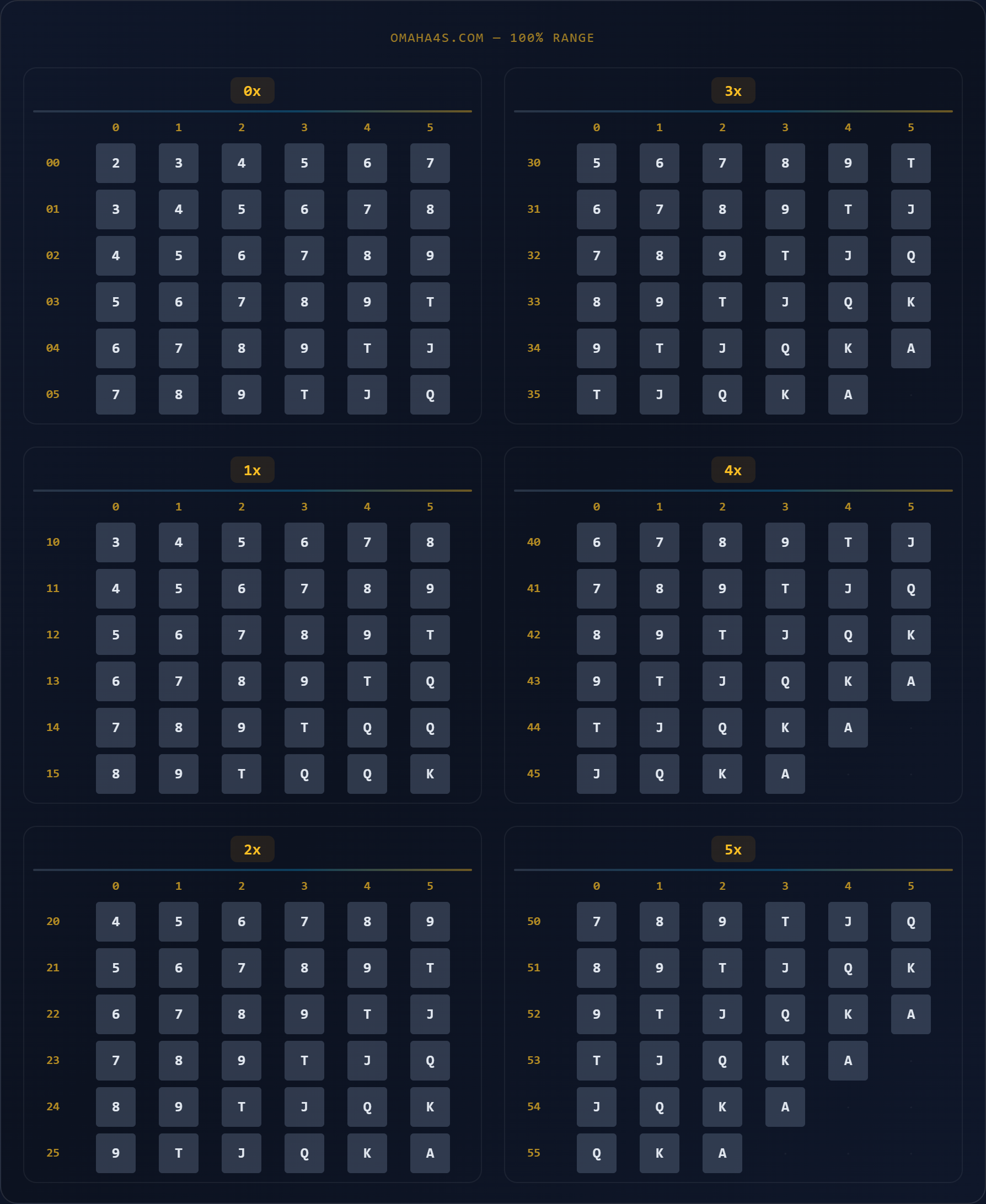
In this table, each cell shows the minimum high card required for a hand to exist in that category. For example, if a cell shows "J", it means the weakest hand in that slot has a Jack as its highest card. All stronger hands (Q, K, A as high card) also exist in that same cell. This table is the complete "identity map" of the Omaha4S method: 206 cells, 270, 725 hands.
---
4. The strengths of the Omaha4S method
A shared language for all PLO players
Right now, when you discuss a hand on a forum, in a Discord, or with a friend at the table, everyone describes things differently. "I had a nice hand", "I had aces with a suit", "I had a rundown with blockers". Vague, inconsistent, impossible to compare.
With Omaha4S, saying "I was in category 132" lets any player using the Omaha4S method immediately understand the hand structure, its relative strength, its strengths and limitations. Just like in Hold'em, where "I had AKs UTG" is enough to start a real strategic discussion.
Simplified range tables — example: top 40%
This is where the method becomes genuinely practical. Because hands are classified, you can build tables filtered by strength threshold.
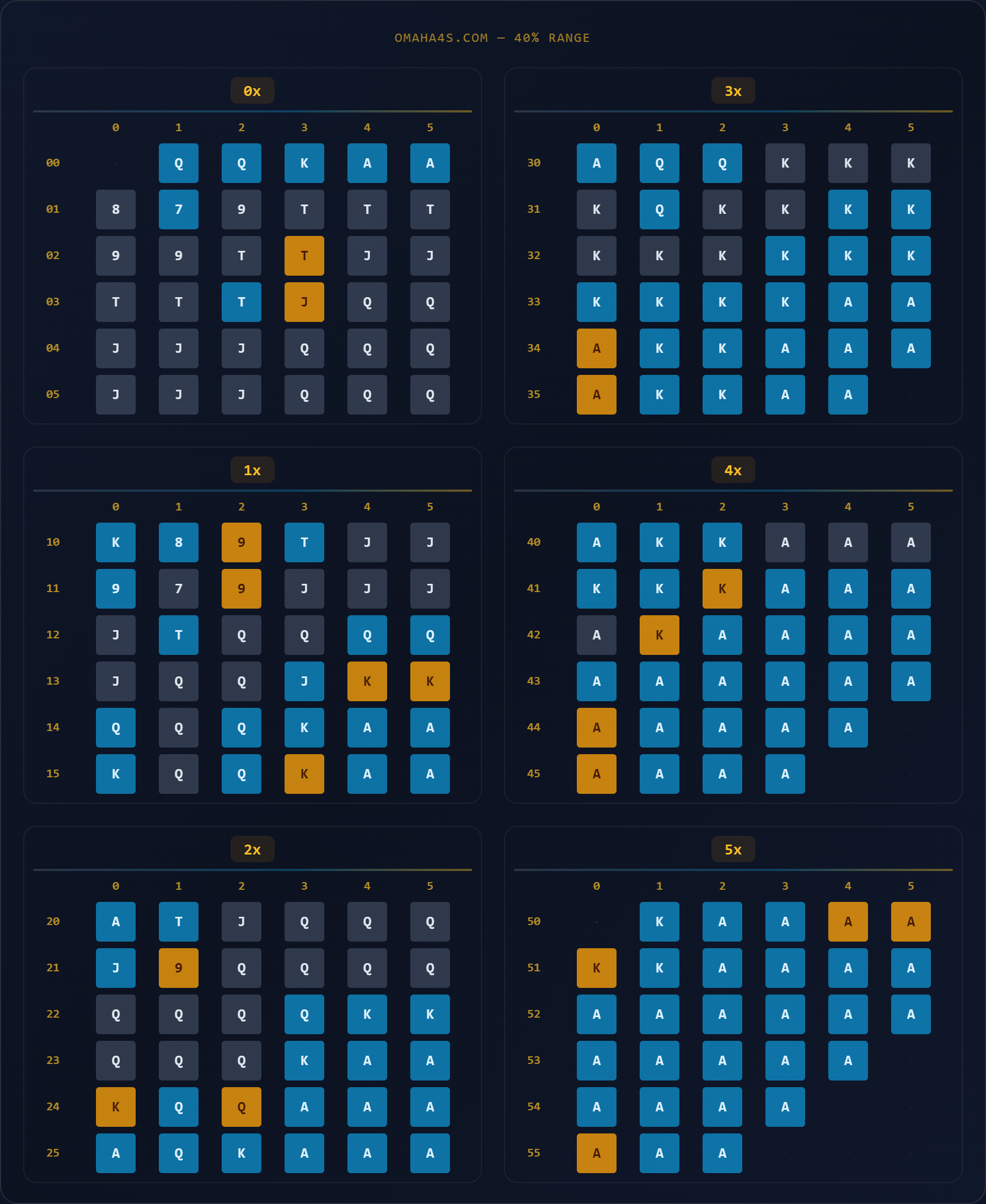
In this table, each cell shows the minimum high card required for a hand to belong to the top 40% of all Omaha hands.
Color code:
- Grey = offsuit (no shared suit)
- Blue = single-suited
- Yellow/Gold = double-suited
How to read a cell concretely? Take position 034, which shows the letter Q. This means a hand with Q as its high card is the minimum to qualify for the top 40% in this group. So QQ95 makes the cut, and everything stronger in that group does too: KKT6, AAJ7, etc. The letter marks the floor, not the only qualifying hand.
This approach lets you build an opening range in seconds, without memorizing hundreds of individual hands.
For more advanced players: tables filtered by high card and suit
The Omaha4S method also lets you drill into a specific hand family. Need to know exactly which of your K-high offsuit hands are worth what?
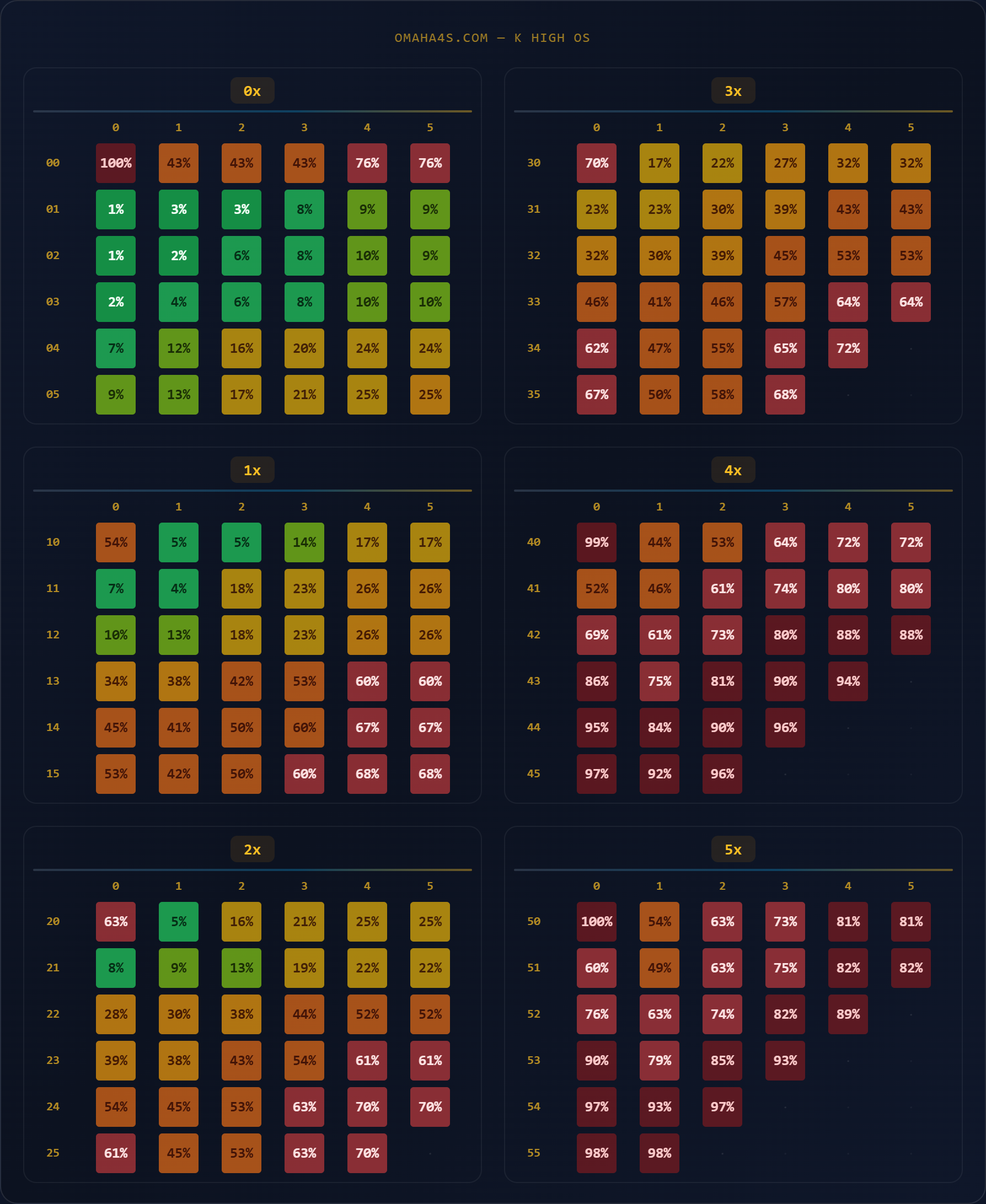
This table shows all K-high offsuit categories with their strength percentile among all 270, 725 PLO hands — color-coded from green (~top 1%, strongest) to dark red (~top 96%, weakest).
Three concrete reading examples:
- Category 010 (KKQQ) → top 1%: one of the best K-high offsuit hands in the Omaha4S method. An elite hand in this family.
- Category 322 (KT86) → top 39%: a mid-strength K-high hand. Playable depending on context, but nothing dominant.
- Category 452 (K942) → top 96%: one of the weakest K-high hands in the Omaha4S method. Only 4% of Omaha hands are weaker. Avoid unless in very favorable conditions.
Note on reading: the higher the %, the weaker the hand in this table. A top 1% (green) = a hand that achieves max equity on a very high number of boards. A top 96% (red) = a hand that will rarely be in a max equity position.
---
⚠️ Important note on the displayed percentiles
The percentages shown in the tables are theoretical values. They were calculated by measuring, for each hand, the number of boards on which it is the "max hand" (the best possible hand at that point). It's an intrinsic strength indicator, independent of any opponent's hand.
These percentiles do not account for your opponents' holdings. A hand theoretically in the top 30% can be dominated in certain table configurations. That's why the real value of this method isn't in the raw percentiles, but in the ability for each player to build their own tables adapted to their style, stakes, and game situations.
A concrete example: in category 421, K976 double-suited hands fall in the top 40%, while K976 single-suited hands do not. Same cards, different strength depending on suit structure. Custom tables let you make these distinctions precisely.
---
5. The honest limitations of the Omaha4S method
Every simplification method has blind spots. Here are the three main ones, in full transparency.
The hierarchy around JT combinations can be misleading
The percentile tables assume that a higher top card always means a stronger hand. That's true in most cases... but not always. Combinations around J and T are particularly sensitive: a well-connected J-high hand can generate more straight possibilities than a less connected Q-high hand. In certain configurations, a J-high hand is objectively stronger than a Q-high hand. The simplified top % table can therefore seem counterintuitive at that specific point — worth keeping in mind.
Gap 5 groups a lot of hands together... but the impact is limited
All gaps above 5 are treated the same way. This creates broad groupings. But in practice, the impact on actual hand strength is minimal: whether you have A-x-x-2, A-x-x-3, A-x-x-4 or A-x-x-5, the strength difference is negligible. In none of these cases does the low card contribute to a "nut" straight. The strategic value of these hands doesn't change meaningfully. The simplification is acceptable in practice.
Suit structure hides real complexity
This is probably the Omaha4S method's most significant limitation. For double-suited hands, there are at most 3 different suit combinations. For single-suited hands, there can be up to 11 variants: 1 monotone, 4 combinations with 3 cards of the same suit, and 6 combinations with exactly 2 cards sharing a suit.
These variations change almost nothing for most hands... except when the high card is an Ace or King. In those cases, the ability to make the nut flush significantly affects hand strength.
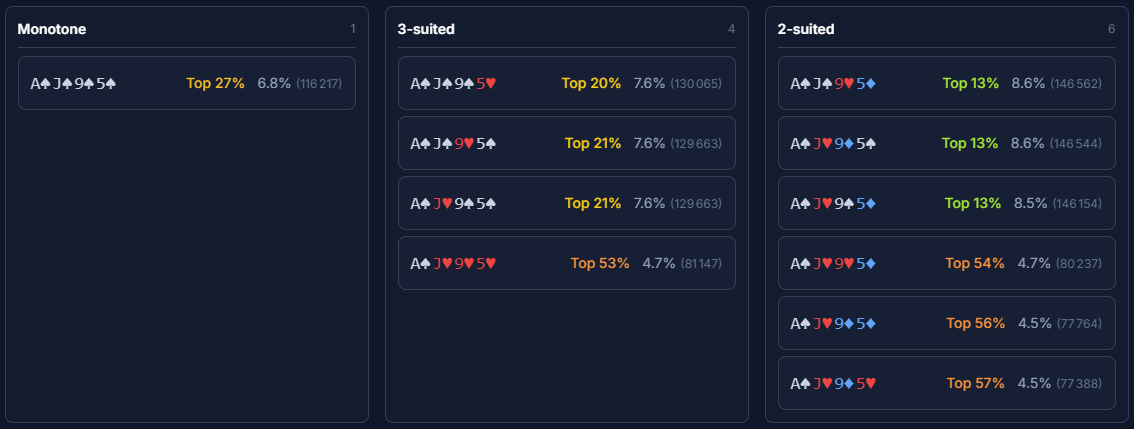
Look at this example with category 324, A single-suited version. The same hand, radically different strengths depending on which card pair shares the suit:
- Monotone version (A♠J♠9♠5♠): top 27% — 6.8% of boards as max hand
- 3-suited with the Ace suited (e.g. A♠J♠9♠5♥): top 20-21%
- 3-suited without the Ace (A♠J♥9♥5♥): drops to top 53%!
- 2-suited with the Ace: top 13% — among the strongest variants
- 2-suited without the Ace: up to top 57% — among the weakest
From top 13% to top 57% for identical cards: that's a massive gap. In these specific cases, the Omaha4S method requires additional study to refine hand selection. This isn't a fatal flaw — it's simply an acknowledgment that every simplification has its limits, and advanced players will need to go one level deeper on these specific hands.
---
6. Conclusion: why this method exists
Omaha4S wasn't built to revolutionize high-stakes poker. Its goal is more modest and, I hope, more useful: to make PLO more accessible, and give new players a structure to start correctly.
Because today, someone moving from Hold'em to Omaha hits a wall. 270, 725 possible hands, no framework, no chart, no clear starting point. Many give up before they've really started, simply for lack of an accessible structure to understand what they're playing and why.
With 206 categories, a simple code, and visual tables, we can finally answer the fundamental question of every Omaha beginner: "Is my hand worth anything?" Not perfectly, not like a solver, but well enough to make informed preflop decisions rather than intuitive ones.
The site omaha4s.com is live. For now it's a landing page — the full interactive tool is in development. I'm sharing the method now to get feedback, identify blind spots, and test the Omaha4S method against the experience of real players.
If you have questions about the method, disagree with certain classification choices, or just want to dig into a specific case, I'm here for the discussion.
Thanks.


