How to stop being a calling station with TP?
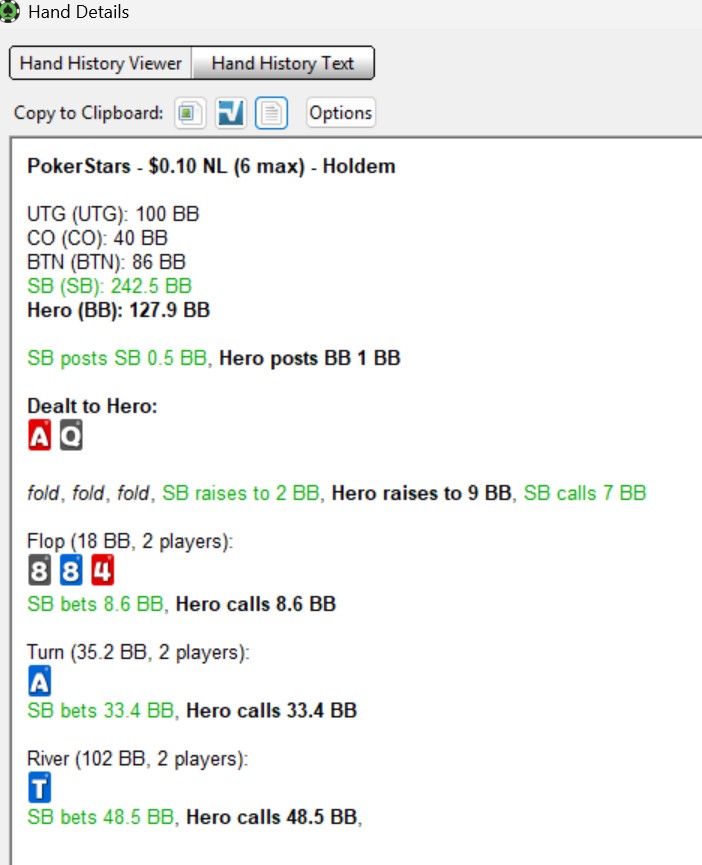
A common behavior I'm seeing in my play that is hurting my win rate is being a calling station when facing constant aggression with a dry board.
I'm readless with this villan. This is an example. Villan Donks 1/2 pot into 884 flop to the 3 betor. A clue could be that he doesn't care that I can have QQ-AA? Still very hard for me to give credit and I call with my 2 overs. Turn is an A and bets almost pot. I turn TP. Very strong bet again with no real bluffs other than 56s and diamond draws, but I don't think those donk bet a dry flop to the pre flop 3betor. I'm a bit confused. I call. should I fold? . River comes a Td completing the flushdraw, but he is not shoving, just bets 1/2 pot. Now that the flush is there, is now a fold? I only need 25% ...right?
6 Replies
When reviewing a bluffcatching spot, try going through this checklist :
1. How big is the opponent's range?
Combo-wise. The larger it is, usually the smaller their value-region will weigh vs their whole range, whilst they'll drown into air ; which means they'll be likely to overbluff when they bet.
2. How many frontdoors are there in the opponent's range?
Since reality doesn't have much to do with solver outputs, the proportion of draws a given board allows will dictate most players propensity to 'bluff'. It's tough to pure bluff, so players typically rely solely on frontdoor draws to select the bluff candidates ; thus the more draws mean more opportunities to bluff. And, so, the 'wetter' the board, the likelier it is that a player is overbluffing, and vice-versa.
3. What is the opponent's value threshold?
If you have to pinpoint a threshold where the player's value region begins, what would it be? For instance, for the hand here, it could be something like 8x (given that you have no info). Obviously, A) the bigger the bet size, the higher the threshold and B) the higher the threshold, the tinier the proportion of value within the whole range (because, for instance, and still for your hand, 8x+ is less combos than, say, AJ+).
4. What is the bet size?
The bigger the bet size, the more you should bluff, as prescribed by V:B. So, for instance, in a vacuum, for a 1/2 pot bet, the V:B (value-to-bluff ratio) should be 3:1 (3 valuebets for 1 bluff) ; for pot size (1/1), it should be 2:1 ; for 2X pot (2/1), it should be 3:2 ; etc. The thing being that, the smaller the bet is, the harder it is to balance it properly. Small bets are often wildly overbluffed. A lot more than big bets. N.B. Those ratios are not 'correct' for preflop to turn spots, as bluffs have equity, and thus aren't 0EV. The comparison still holds for all streets though though : the bigger the bet size, the more bluffing you should do.
When it comes to your hand, I think by step 2 you have an answer. Opponent donks flop + pot turn likely means a super tiny range, and the board is indeed super dry.

Wp- losing the hand doesn’t mean that you played it bad though
[B][B][B][B] When reviewing a bluffcatching spot, try going through this checklist :[B]1. How big is the opponent's range?[/B]Combo-wise. The larger it is, usually the smaller their value-region will weigh vs their whole range, whilst they'll drown into air ; which means they'll be likely to overbluff when they bet.2. How many frontdoors are there in the opponent's range?Since reality doesn
This is great free knowledge, ty for that! OP I would read this over and over if I were you until it clicks.
To answer your first question: The reason he donks the flop and should be at mixed frequencies is because he has more suited 8x then you have in his range. He also has all the 44s and you have none so technically speaking he smacks this board way more than you do. So in these spots he gets value from aa-kk etc and frankly hopes you have those hands when he flops a big hand. However keep in mind the stakes you are playing, it's hard for ppl in general to be BALANCED in these spots because the bluffs aren't as obvious.
if villain is a recreational it is a pretty easy call down because fish dont think in terms of ranges they just see the A as a scarecard and not realy considering you having alot of ax in your range also donking ranges of fish can be very random stuff like QJo here etc.
If villain is a regular then it is a easy fold because they would be to scared to barrel into you with airtype bluffs so regular will not have enough hands in that line because there are not enough natural draws etc
When reviewing a bluffcatching spot, try going through this checklist :1. How big is the opponent's range?Combo-wise. The larger it is, usually the smaller their value-region will weigh vs their whole range, whilst they'll drown into air ; which means they'll be likely to overbluff when they bet.2. How many frontdoors are there in the opponent's range?Since reality doesn't have
Great advice. Just to build on it. 2. This is greatly diminished by the equity portion of their drawing bluffs and they will be sticky with their draws. 3. IMO it's wider, most will value bet their overpairs as they should, against a calling station I would consider to value bet even AQ here. 4. In theory, in microstakes smallish bluffs are great, especially on the river and on dry board. You get enough folds and leading checks to make them EV+.


