Chasing Mastery in HUNL
Hello, I’m a university student trying to break into and climb the stakes in HUNL online. I’ve been a fan of the format for a couple of years and played casually without any serious studying. But a few months ago, I felt motivated to actually get good at HUNL and pursue it competitively.
For Christmas, my dad bought me PioSolver , and I’ve been studying a few casual SRP spots using the GTO Wizard 100bb HU ranges as input. After a couple of months of studying, in March I decided to deposit some money online and take a shot at 50HUNL on Coin. I lost around 10 buy ins before calling it quits.
Since then, I’ve shifted gears studying a lot more and playing a lot less. Since the end of March, I’ve been studying around 12 hours a week and playing about 500 hands per week against the best player I know someone who beats 1/2 fast fold 6-max online over a respectable sample.
Most of the lines I’ve studied have been SRPs IP, and I gave OOP some but not the same level of attention and I am starting to regret it now. The main thing I’ve solidified in SRPs is identifying the correct flop sizings, the strategies that follow those sizings, and some understanding of why those strategies work though a lot of that has come from forming hypotheses until things made sense. I’ve also studied turn c-bet spots, sizing, and the associated strategies, but I likely overlooked turn defense OOP, which I plan to revisit.
The parts of my strategy I’m currently working on and which I’ve identified as fundamental weaknesses are my turn and river probes, as well as my defense against them. I also want to add more river check-raises and river probe-raises into my game in the turn check check line, which I’ve started incorporating into my game tree in SRPs. I’ve briefly looked at 3-bet pot flops across about 5 textures, but not much beyond that. A big part of my process has been figuring out which complexities I can cut without losing too much EV.
So far, my study process has looked like this: I pick a given line, try to understand how the strategy plays out and what each hand class is doing, and once I have a rough idea, I’ll go into the trainer with a randomizer and grind out that line. If any decision or frequency doesn’t make sense, I’ll go back and review it.
The goal is to start playing 50HUNL on Coin again, beat the stake over a large sample, and then move up to 100HUNL. I don’t really have a financial reason to pursue poker my motivation comes mostly from the competitive nature of HU and the level of consistency and strategic depth required to be a winner. I hope to post here about my HUNL study progress and what spots I'm reviewing as well as some hand history and results when those come. I know getting to a super high level in this game format will not come any time soon, but I hope to get better day at a time.
If anyone has advice on how to approach HUNL study more efficiently to help reach this goal, I’d appreciate it.
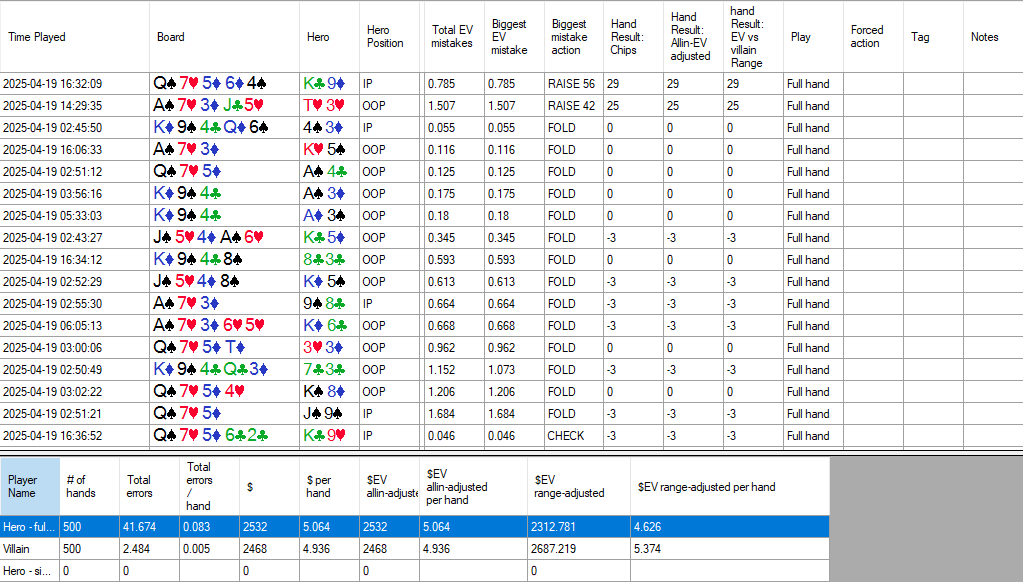
Trained 500 hands of SRP on Broadway high boards, both IP and OOP, and obtained an average EV loss of 0.083bb/hand (this doesn’t account for any mixing skews I might make). There are definitely some spots I need to work on. One that became obvious to me is the turn strategy after the flop gets check-raised.
It seems like in this line, if the OOP check raises the flop and then checks the turn, the IP is supposed to apply pressure on certain turns by building a fairly aggressive overbetting strategy. I node locked a few of these spots and noticed that when the IP stops punishing the OOP’s turn checks with these overbets and instead checks back more than they're supposed to the OOP starts check raising even more.
This makes a lot of sense to me. If we’re OOP and we’ve check-raised some draw heavy hands on the flop, and then our opponent starts checking back the turn too often, we get to over-realize our equity by seeing rivers more frequently. On top of that, if IP over checks, it changes the hand classes that bet the turn. Instead of trapping with some or most of our two pair hands on the turn hoping to face the overbet we end up betting them ourselves and in return pushes our weaker overbet hands with decent showdown into the check line.
I haven’t looked at all the nuances of this line yet, but it definitely seems interesting. My OOP play still needs a lot of work on the defensive side, especially in lines where I don’t end up probing.
I’m also starting to really enjoy these probe lines and want to get solid with them across multiple textures. The next set of boards I’m planning to review are paired boards in SRP both tt and rainbow. I’m excited for these, since a turn check raise strategy appears for the OOP in some of the turn spots since smallish bets are allowed there. I think it’ll be fun to study and try to get the right frequencies, especially since I don’t think I’ve ever really had a proper turn check raise in my strategy yet. Below is the trainer hands sorted by biggest mistake action:
I had some school work that needed to get done before I could study poker these last two days the one highlight however is finally seeing the what proper ranges look like for HU with ante and rake plus some exploitative ranges for when my opponent over/under defends look like using the GTO wizard AI feature. I have been using the no rake low ante solutions for what I base my range on.
Its cool to see how far you can go to exploit your opponent pre and proved some my intuition both wrong and right on how to approach changing my range exploitatively. To some extent it is a bit gross that in theory this means there is a bunch of new game trees with this new preflop that I have to look at but I think if you're already killing them pre your intuition on some spots given range is probably better then theirs.
I additionally did have a little time to review the check raise line and sizings in SRP that are broadway and rainbow, I already achieve a decent check raising frequency on the board with about 16% check raise on those boards but I think I'm missing out when I don't check raise TP as often as solver likes to. Not even closer to completely understanding these boards but def more accurate then I've ever been ever.

always in for some hu! gl
Sup guys, I've been continuing to study paired boards and just getting an intuition for the sizings/strategies on the turn in SRPs, but wanted to mention that recently I've been watching alot of the $100/$200 HU match between Linus and Kayhan trying to test my sizing intuition and looking some of the more interesting spots in pio just to review. They def opened my eyes on the raising strategies that happen on certain 3 bet pot flops when they face a smaller bet and even the 3 bet strategies that start to emerge when your opponent does have a respectable raise in the 3 bet pots.
I also wanted to add that since coin poker stopped streaming the match I recently started streaming a watch party for the match (and all other show table games) incase anyone wanted anyone to discuss the action with and reflect on strategy. I'm not completely sure what their session schedule is but ill try to figure it out to make it more scheduled rather than just turning on the stream when I notice they are playing. If you guys are interested in joining the stream on youtube: @ocram575 and twitch: ocram_575, it would be nice to discuss some spots with other people live.
Been a few days since an update sorry about that, school work has caught up to me plus I lost my voice from trying to stream and talk throughout all the high stakes HU matches so took some time to recover. I have a fundamental idea of what the betting strategy on paired boards look like plus the sizing that accompany the strategies on the turns and rivers, mainly the IP bet bet bet line and the OOP defends that come with it. I plan on taking some more time to look at the probe lines and delay cbet lines which are personally more interesting to me.
Additionally, I have been stalking a few of the 100NL and 50NL regs on coin poker and have a list of names I would like to beat once I start playing in the summer. My friend who started playing a bit regularly on coin and who I discuss strategy with has accumulated some stats on a few of the players on my list and I have seen some of their frequencies. I am still quite new to interpreting frequencies so a lot of the counter strategies are derived from what I assume increases or decreases in frequencies mean for them and their overall strategy. There is a solid 100NL HU reg imo who has nice check raise frequencies across all the streets, I really want to get my frequencies closer to that threshold because rn my strategy hasn't really developed nice clean check raises in the turn and river lines.
I have been following the LinusLove Vs Prodigy/KayhanMok/SeaLlama Heads up matches and have opened my eyes to some of the strategies available in 3 bet and 4 bet pots I have not gotten to touch yet. I do want to note that although these seem really fun to get to I think having the discipline to not jump in all at once before doing some of the heavy lifting of SRPs and gaining intuition/theoretical understanding might help me in the long run when it comes time to learn 3bet and 4bet pot strategies. I also want to thank anyone who tunes into the stream for their support, I honestly would probably not find the energy to stream the match if it wasn't for the 4-8 people who lurk in the stream.
I'll keep you guys updated but for now its back into the lab for me.
Hey good blog thx, how much bb/100 rake are you paying in coinpoker?
@babolino Not my data but the person I know who plays 100NL HU on coin pays around 10bb/100, coin gives you around 33% rake back for everyone so adjust this accordingly.

Been a few days since an update sorry about that, school work has caught up to me plus I lost my voice from trying to stream and talk throughout all the high stakes HU matches so took some time to recover. I have a fundamental idea of what the betting strategy on paired boards look like plus the sizing that accompany the strategies on the turns and rivers, mainly the IP bet bet
What 3bet/4bet strategies have you found interesting from LinusLove Vs Prodigy/KayhanMok/SeaLlama Heads up matches that we can learn something interesting? Gl at the tables mate
Sure, yeah sorry when I said this I think what I meant by this is that they were playing their 3Bet and 4Bet spots a lot differently then I would have thought you would play the spots/they had a much more extensive game tree of options in certain spots than expected (e.g. small flop 3 bet versus just having flop jam, etc) . Maybe it isnt so unexpected for people more familiar with HU but I'll happily go through the VOD later today pick out a couple of spot I found interesting and try to reviewing them here in the thread for yall to see with some pio analysis as well as maybe my intuition for the spot that way you guys can correct me if I'm far off or missing something.
Sure, yeah sorry when I said this I think what I meant by this is that they were playing their 3Bet and 4Bet spots a lot differently then I would have thought you would play the spots/they had a much more extensive game tree of options in certain spots than expected (e.g. small flop 3 bet versus just having flop jam, etc) . Maybe it isnt so unexpected for people more familiar w
speak of the devil, coin poker youtube released some 3bet and 4bet pots where prodigy gives commentary, so if you're really itching you should check that out, but Ill release some hands I thought were interesting regardless.
Sorry for the lack of post finals and final assignment deadlines are coming soon I've been occupied with that, I have a big notepad with some of the Linus Love hands that I found interesting strategically but I still have to clean it up a bit before posting. I've dropped my HU study to around 5-6 hours a week at this point, but I did "finish" looking at turn and river sizing's and accompanying strategies for paired boards both the rainbow and tt versions.
I need to to work on the probe line for both either turn and river probe but I did refine my probe lines and probe raise in the SRP where the board is rainbow and broadway high and repped a couple hundred hands when I had the time. I am also looking into getting a mic so I can have nicer quality on my high stakes HU watch party live streams so stay tuned for that.
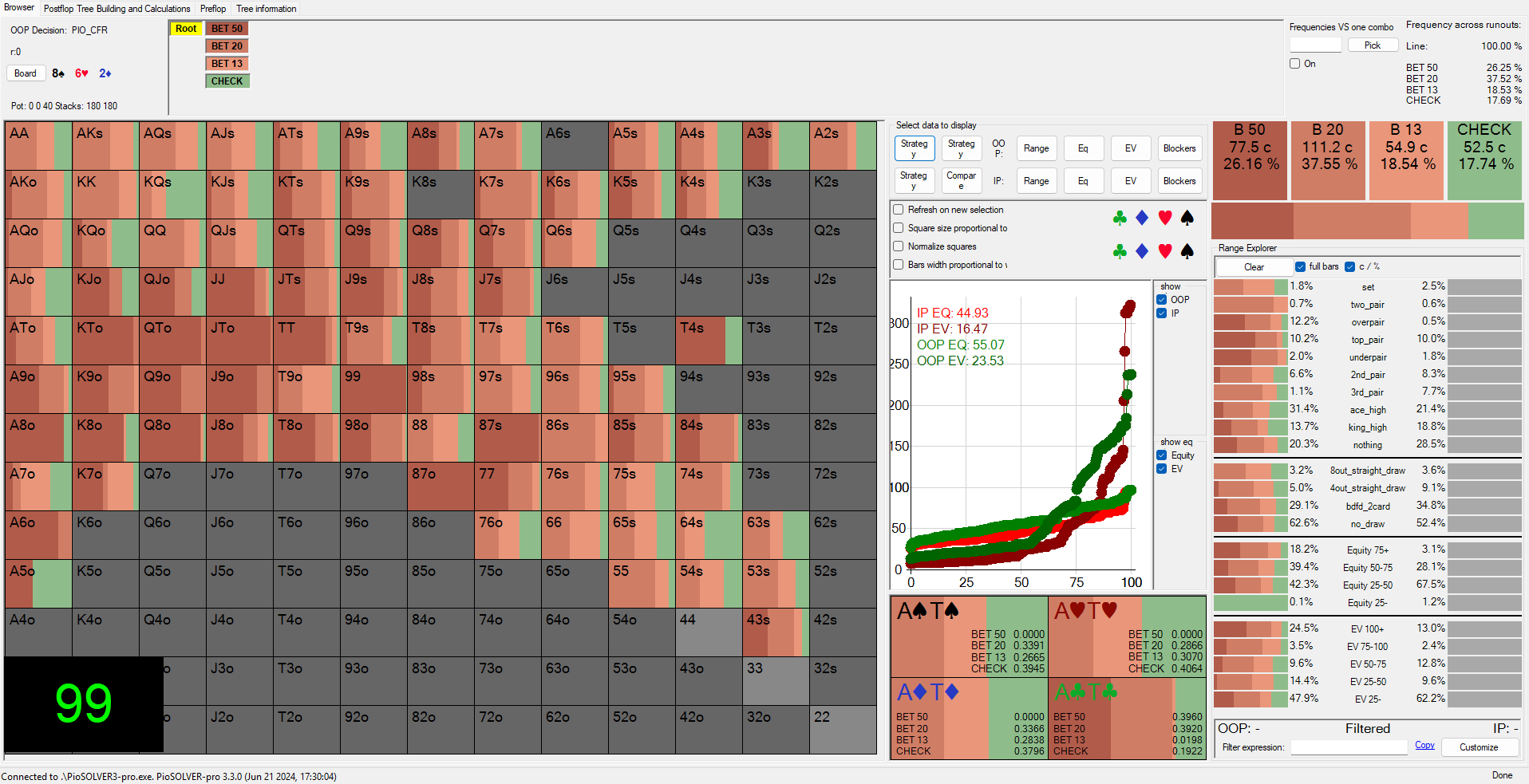
I did want to ask about some advice on study tips, more specifically Ive been trying to study 3 bet pots flop and check raise strategies but some boards have that all 3 sizes are used pretty frequently take the one posted for instance. I was wondering about tips on simplifying these before there seemed to be a clear outlier and the ev loss was minimal but I was wondering if it is ever worth to maybe use 2 bet sizes for flop instead of one or just simplify tank the EV and learn the simpler strategy. I know alot of high stakes regs say something like "flop size doesn't matter" and I do agree on this philosophy in a implementation standpoint but I think being able to under stand each bet size and the strategy accompanies it might be helpful for long run when you face an opponent doing something else. Please share any insight on this. I might just be over thinking this and it probably isnt that big of a deal.

You'll make it
Just don't get complacent
If you move up and make it, keep studying
You got this
Ups
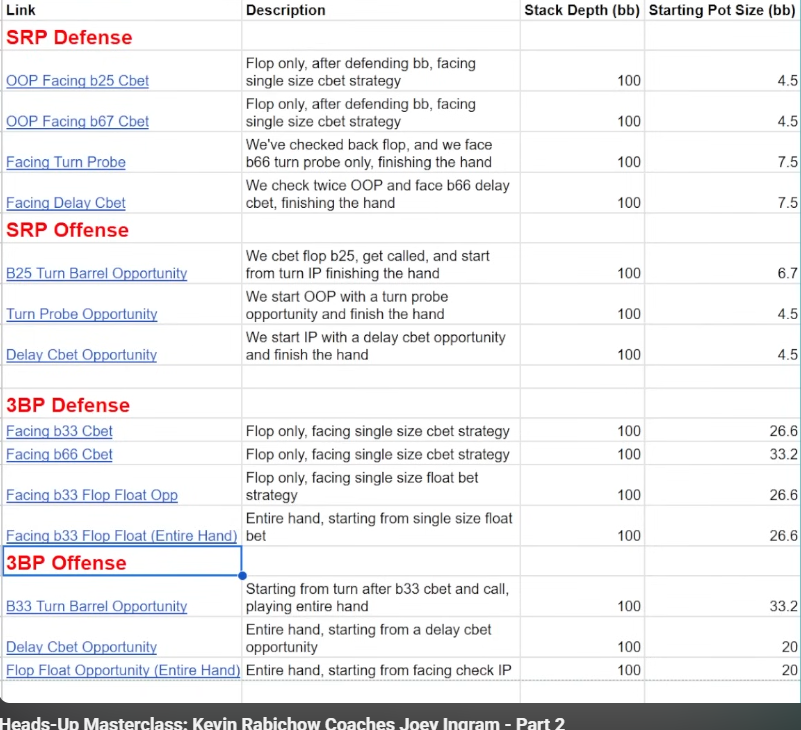
Thank you guys for the support, I just want to updated yall on some thoughts heading into the summer. My last final is on the 19th, then a couple weeks later I start my internship. The plan is to continue grinding out boards and spots, and try to hit a sufficient amount of 3 bet pot spots both IP and OOP. The ideal situation is that before my 1st paycheck hits I go ahead and do a surface level coverage of these "spots" Kevin Rabichow mentions in his HU-masterclass video across a few different board textures (photo attached).
Then once my 1st paycheck hits I hit the 50NL HU streets with 20 BI's and start getting in reps versus real players. There is no real goal in terms of WR for right now and the point of the 50NL HU is not to make money which means no bum hunting, but just to learn where my implementation is flawed or where certain strategic ideas are maybe a bit unnecessary to implement. In the case where I lose everything after maybe taking a study break and leak review when I hit around 10BI's, I will head back into the lab for another month and run it back with 20 BI's with the following months paycheck. In the case where I do not lose everything and Im a moderately winning player after a sufficient sample, I will take a around 50/50 study to play to study routine and do that until I have a sufficient bankroll for the next stake 100NL.
Some activities I might do in the summer is continue to stream the HS HU battles that happen as well as hand reviews from those matches, and then also stream some training sessions where I study a specific strategy by trying understand the intuition to building that strategy then drill the spot in the trainer in similar spots. I did want to buy a new mic before I start streaming again tho I listen to the audio the last couple streams and it def got worse for some reason so once I receive that I will bring the streaming back up .
Again the goal here is to get good at HU and try to push myself and my strategy to the highest stake possible and I think, like langozam mentioned, in order to do this I cannot get complacent at any stake. I know it's going to be hard and will take a while but as a young guy about to graduate I have enough time to push myself in HU especially until I get busy with the rest of life, the opportunity to be living in this time of my life where I don't have to worry about much is a privilege and to not take this time to push myself in something I'm passion and competitive about doesn't seems right to me.
I've been playing some HU versus a friend who plays 100NL HU online and I lost a few buy ins (he lets me play him 10NL) in a match of ours where he just beat me (small sample but I can feel I played bad, and took a few spots I shouldn't have) and we both sort of approach the game in our own ways which I respect, but for some reason I can't stand losing to him. Like it sucks so much, especially after a long period of study between our matches where I spend weeks on developing a strategy across flop in a spot and then just get beat like that. I was up the versus him month of March (small sample ~2k hands) and then we didn't play in April for context and he has been grinding out 100NL online and I might be wrong but he seems to use solver more as a sanity check thing then a strategy training tool he is a big fan of Uri Peleg and sticks to "feeling" based strategy, I respect this approach to the game a lot of people are successful this way and this frustration against it is kind of derived from this fact that his intuition is beating me. I definitely treat the game with a sufficient amount of intensity that even these 10NL matches get super competitive to me to the point where I feel horrible after losing. I reflect on these feelings alot to be sort of recontextualized a bit in the space of HU, where I'm thinking "oh cool I completed another strategy analysis I wonder how much better I am" then to get beat for a handful of BIs. I hope no one takes me saying "I'm intense about this game" the wrong way as some pedestal I'm implying exist because I want to take the game more seriously, I don't think that's what it means if anything its more of bad thing imo where I am not big picture oriented enough to relax when I take these big hits. I know some also might be thinking "wow he gets frustrated when he gets beat, he'll never make it past (enter number)NL like that" which is fair but I think this puts a bad taste in why I'm frustrated, I'm not frustrated because I think I should be winning I'm frustrated because I hate losing.
It truly does suck but I don't want to lose the intensity I think its moments like these that I just have to endure when trying to get to where I want to go with the game. These spots where the world sort of does that to you, it beats you down and then sees if your willing to run it back doing the same thing despite it all, then it'll do it again and again without knowing when it'll be over, but moments like these will never explicitly tell you to quit it'll wait for you to do that to yourself for you to sort of doubt yourself and what you're doing, that's how it gets you, that's the whole test.
I'll leave y'all with a few quotes and lyrics I though about and looked at when I was feeling frustrated about the match (some might be irreverent to frustration but made me happier):
"Patience is the foundation of eternal peace. Make anger your enemy. Harm comes to those who know only victory and do not know defeat. Find fault with yourself and not with others. It is in falling short of your own goals that you will surpass those who exceed theirs."
- Tokugawa Ieyasu
"Some people are just born to fight, I think. It's not that they're born brave. It's not that they're born strong. It's just that the universe has decided that this one, this one will have grit and fire and steel in their blood. And it'll be tested, this cosmic mettle of theirs. They'll face trial after trial, be broken and damaged in countless ways. But this one was born to fight. Maybe it's not the life they would have chosen. Maybe they'd love to lay down their arms. But they were born to fight. It's what they know. It's what they do best. It's all they can do." - ? (dont know)
"Captain, Captain, Smile
After all, a smile is the flag of the ship
Captain, Captain, Pull yourself up
Only the brave conquer the Sea" - (translated song lyrics) Муслим Магомаев - Песенка о капитане
"people say 'what do you think about when you shoot', to know what a perfect shot feels like you have to earn that, that love for basketball and natural ability it can only take you so far, so when people say 'what do you think about when you shoot', I'm like 'absolutely nothing' " - Steph Curry
"Yeah I cried, I cried on national television, so what? Failure hurts, in that moment winning was everything. I'll move on, I'll cry again, I hope I never lose that intensity." - Adam Morrison
Thank You

Cool thread, I am also new to HUNL and have been studying a bit lately. I play just 10NL on partypoker (zoom pool) and even though I'm winning the rake is really getting to me. I'd love to become a 50NL reg this summer, but I'm not sure how realistic that is. Definitely looking forward to seeing how you do on 50NL!
Thank you, I'm not sure how difficult the pool is on party poker, but I'm a big believer that effort into the game is never a waste if you're truly spending that time learning and are growing as a player even if result dont hit right away (<- hard part) . I think as long as you're efficient about your studying you can improve rather quickly.
Something to maybe think about is how often these smaller stake people are studying if at all (some might be coming over from 6 max) if you think you aren't winning enough at these stakes but following some notion of equilibrium strategy you might want to consider their strategy first. In a traditional HU repertoire its important to have a probe, however, your strategy (bluff catching/defense) should change some what if your opponent has no "real" probe strategy or delay c bet which could be costing you a few bb/100 that could help you beat rake. Something I am planning to do is node lock a few river spots and turn and see what to my response when an opponent maybe isnt playing a super balanced probing strategy or delay line, which probably effects how thin you can go as the IP in the SRP lines. In these lower stakes, I suspect people aren't going as thin as they probably should be making defense against bets in the check line a bit different. All being said this shouldn't be a major consideration while playing just something to implement when it seems right, this more a suggestion to my own strategy then to yours lol.
If you want to see a really weird example of your opponents strategy effecting yours try picking out a high frequency small c bet (65 >) spot in SRP and node locking your opponent to have a balanced but reduced frequency small cbet (<40), youll see OOP start donking lol (I wouldnt suggest trying this out), but if you lock flop to always check the turn probes will change into this reduced frequency probe with preferences toward bigger size for like (<25) frequency something that is a bit harder to implement than the equilibrium probe. Messing around with stuff like this is probably nice to have the "solutions" to "problems" your opponents naturally throw at you.
I did recently receive a small roll for HU NL 50NL so I have been getting a few hands in, I am not aiming for volume rn and just trying to play high quality hands single tabling aiming to maximize WR, so far I only played around 750 hands and will post a graph when I hit 5K hands(even though this is small sample just want to give y'all something), my sessions are also very short rn around 45 - 60 mins just because I really like reviewing hands when action gets stale . I did just want to share a cool hand in a 4 Bet pot I played, I'll give my though process along with the equilibrium strategy and the node locked solution based on the information we gained from playing the hand.
~100bbs deep
BB(me): dealt 77s
SB: opens 2.5bb
BB : rolled the 3 bets to 8.5bb
SB: 4 bets to 18bb
BB: call
After I roll the 3 bet I need to defend unless I see my opponents 4 bet is a giga nit or a 6max player, you can fold a bunch when this happens and develop a bigger 3 bet and Jam only versus 4 bet if you assume he calls everything correctly but doesn't 3 bet his easy folds which are his bluffs so he is in theory calling to much now. This is hard to know off a small sample so most time I assume my opponent is somewhat competent unless they clearly show me other wise.
Flop AAQr
BB: checks
SB: B33 -> bet 12bbs
Here I though that I can probably start folding these pocket pairs a little bit here but I thought about that how my opponent on the AAQ should probably start having a checking range in theory and if I thought he had one. I decided no, that everyone near these stakes is probably range betting these boards. I also thought about min check raising since this was occurring and I want to make money with my Ax but I felt like I wanted some hands that were not super showdown heavy to bluff.
BB: call
Turn 3s
Board: AAQr 3s
card brought flush draw
BB: check
SB: check
When the check happened I did think about what he should be value betting for small size, like in theory his Qx and KK probably value bet small
river: Qd
Board: AAQr 3s Qd
I think about it for a little bit and decide that when I have value I want to JAM and I need bluffs so 7 high suffices and aleast all my 88 and 99 would do the same in this spot.
BB: JAM All- in 120% pot
SB: Folds
it was later revealed to me that he had KK.
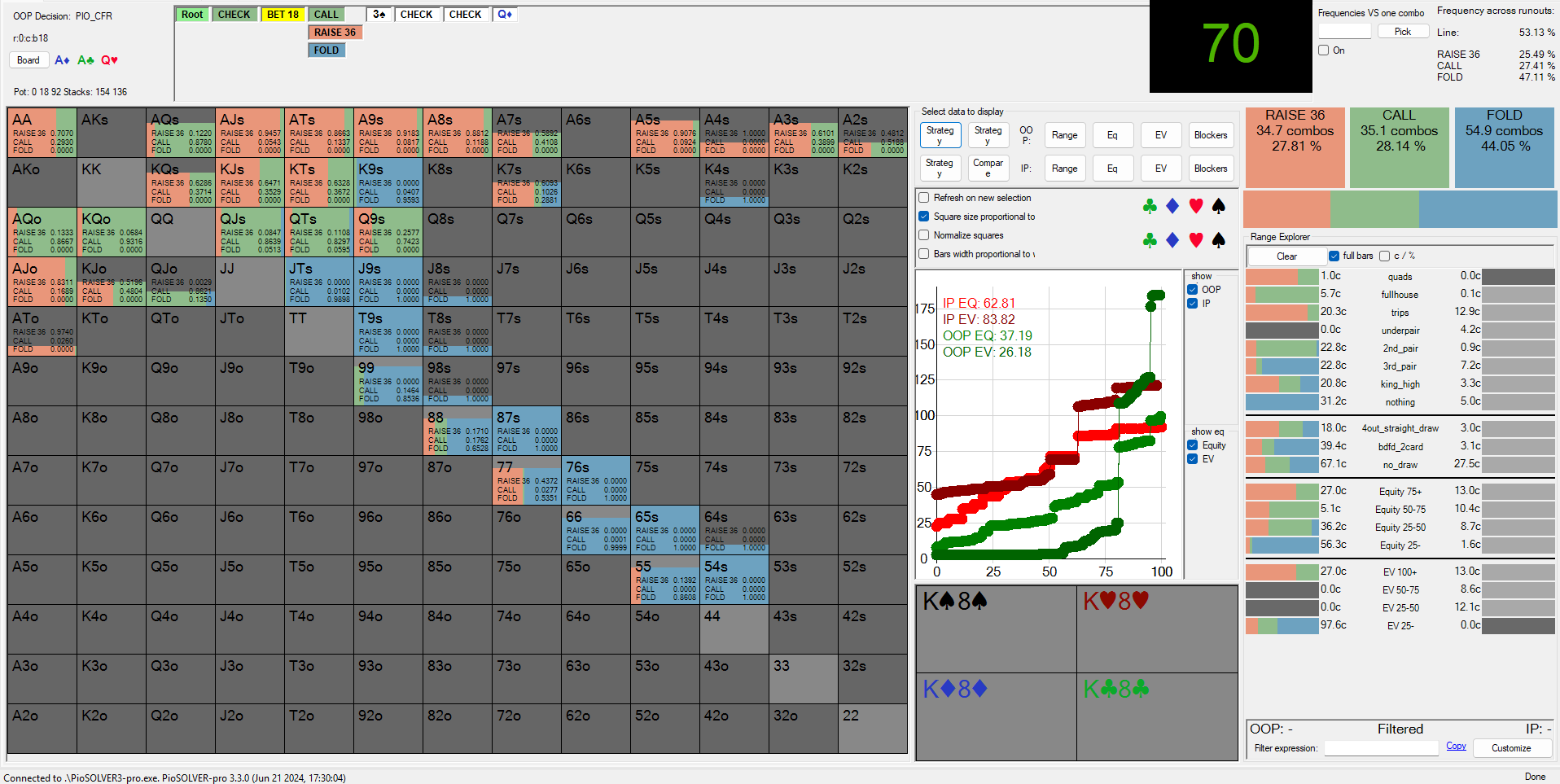
Okay I will show you the equilibrium result when we take this line with these sizings:
IP bet:
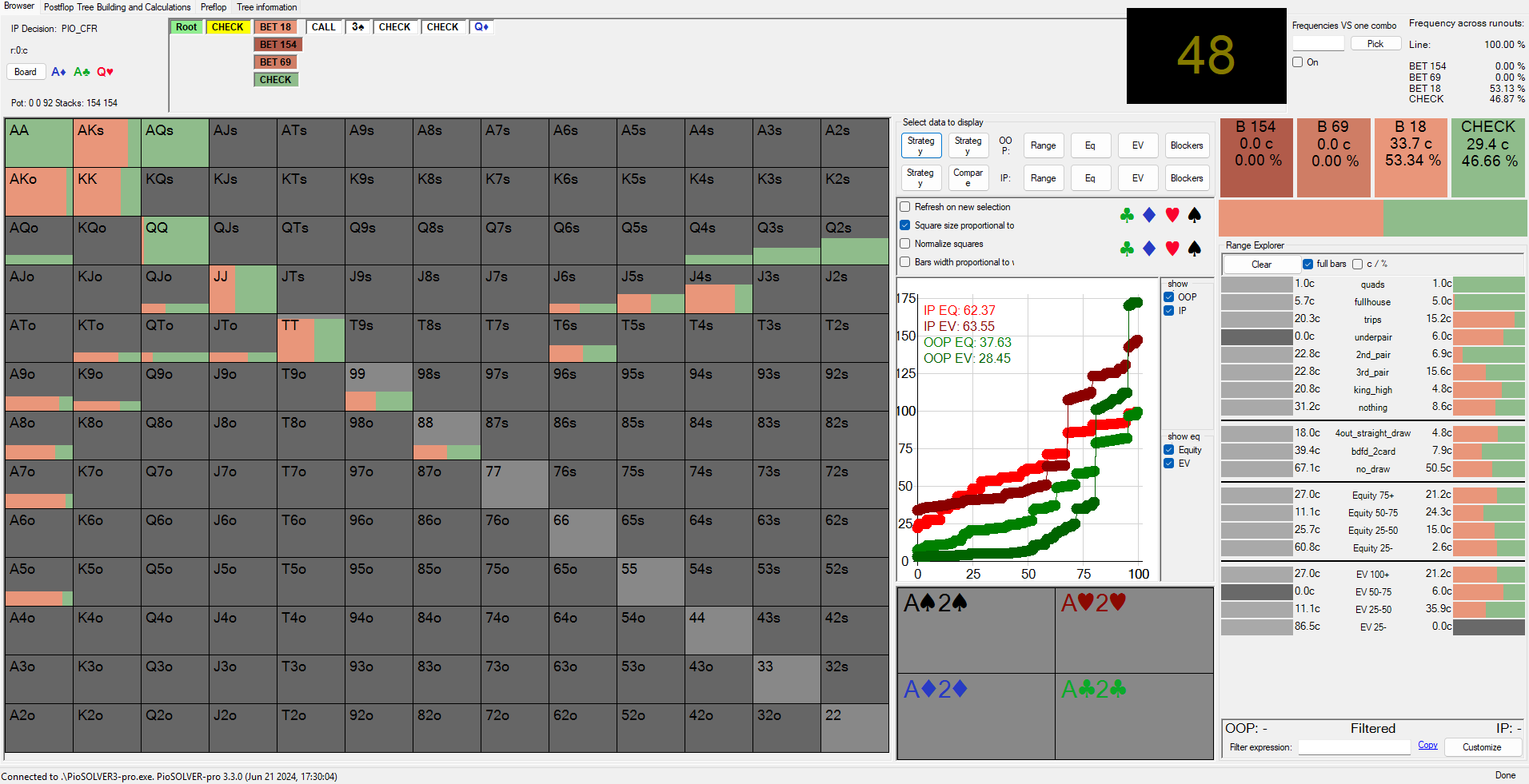
defense against bet
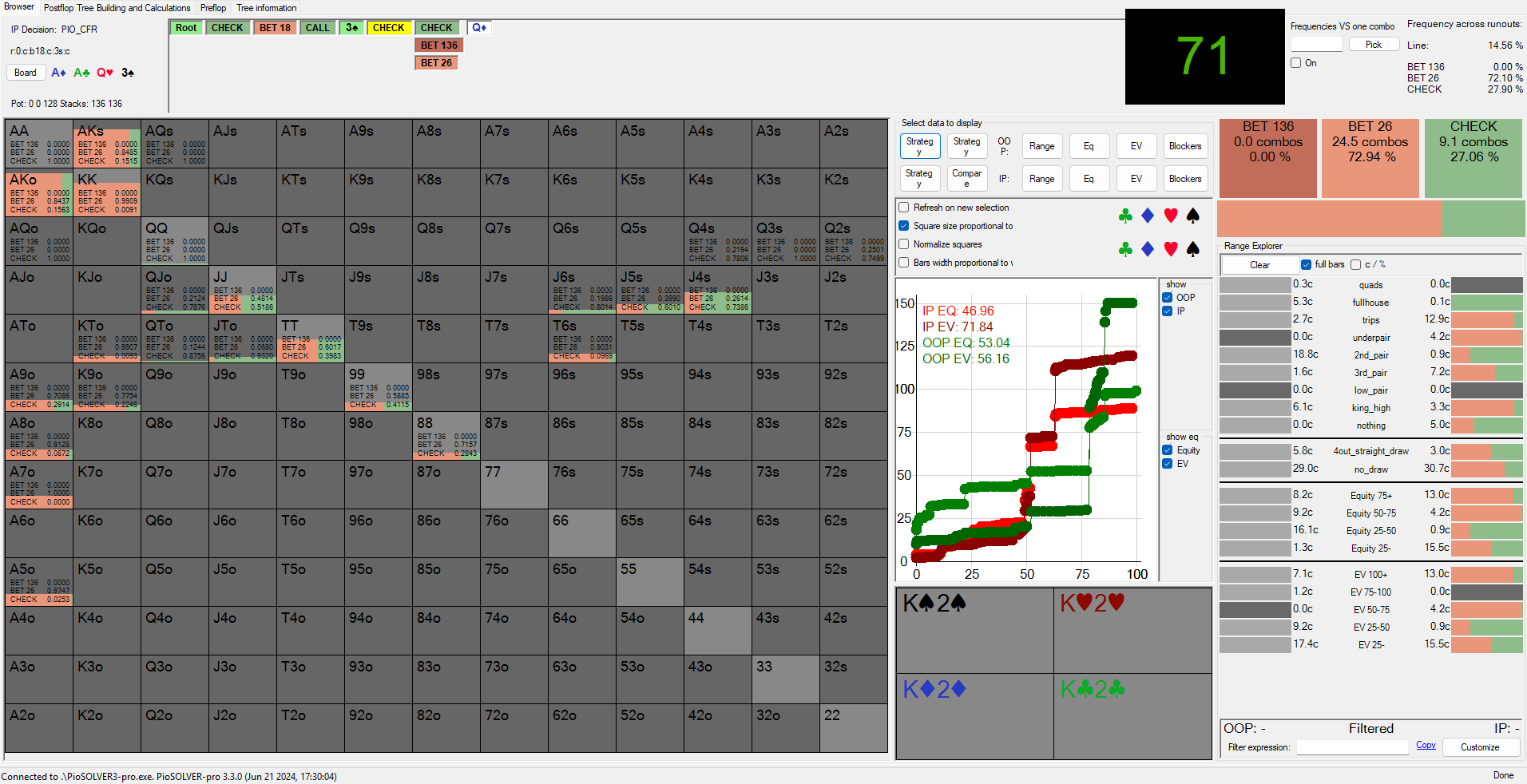
IP turn cbet:
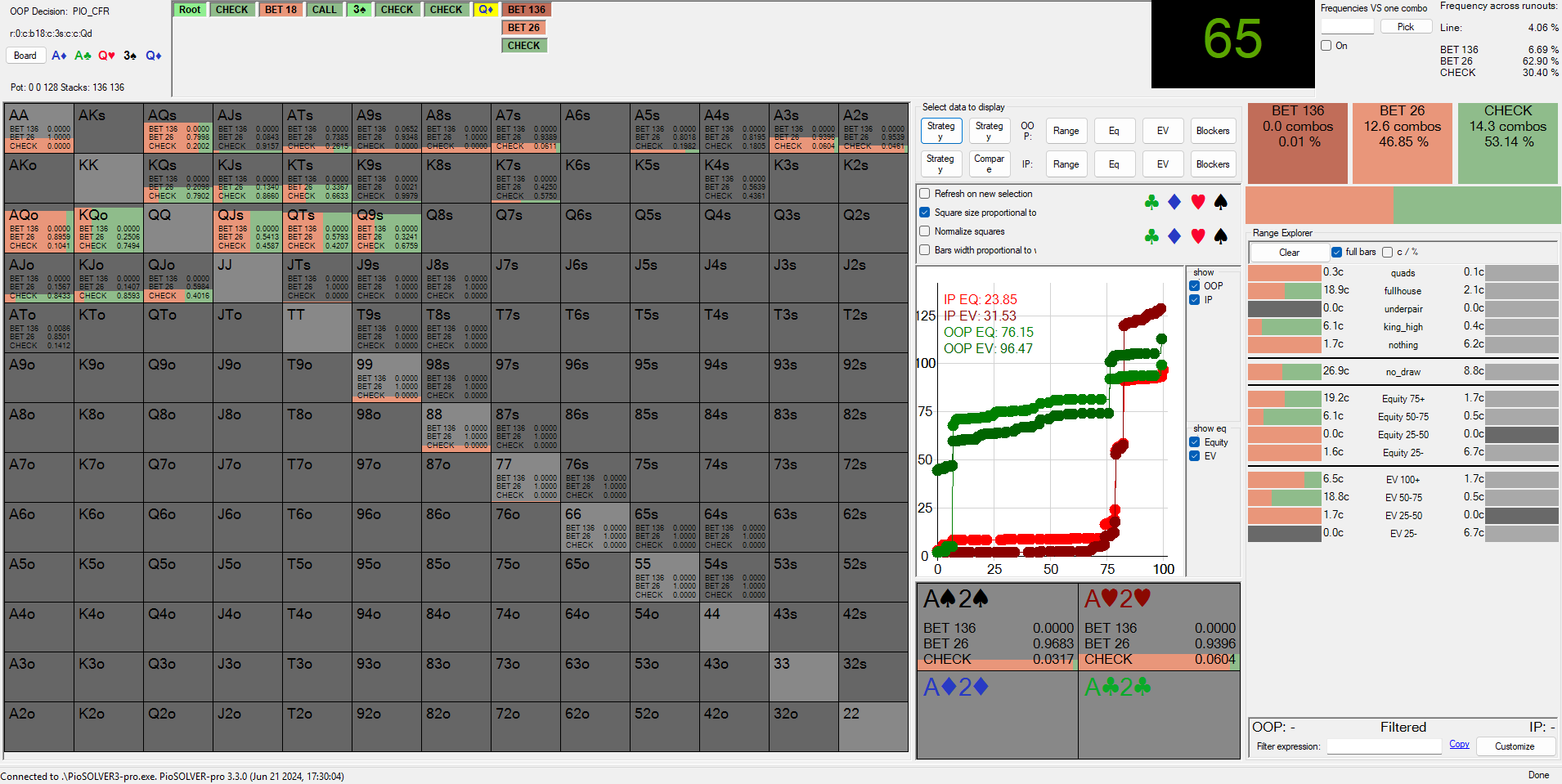
OOP river probe after missed turn C bet:
Node lock that we face range bet:
defense against bet:
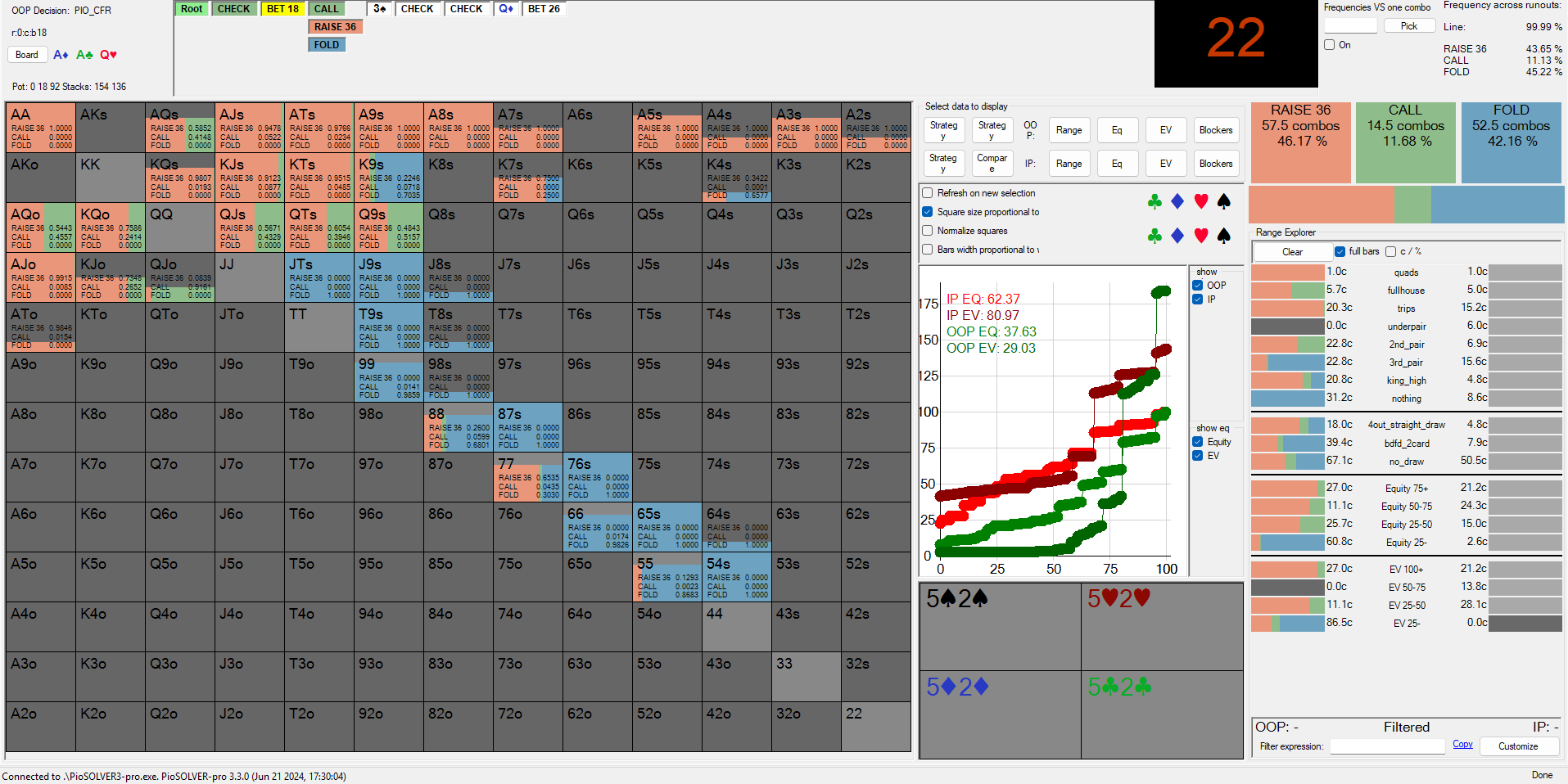
Node lock that we face range bet but keep our lower raise frequency strat and we lock that SB doesn't turn c bet small the KK and showdown pairs they keep betting Ax Qx with some mid high frequency still traps QQ and AQ somewhat:
New IP turn c bet:
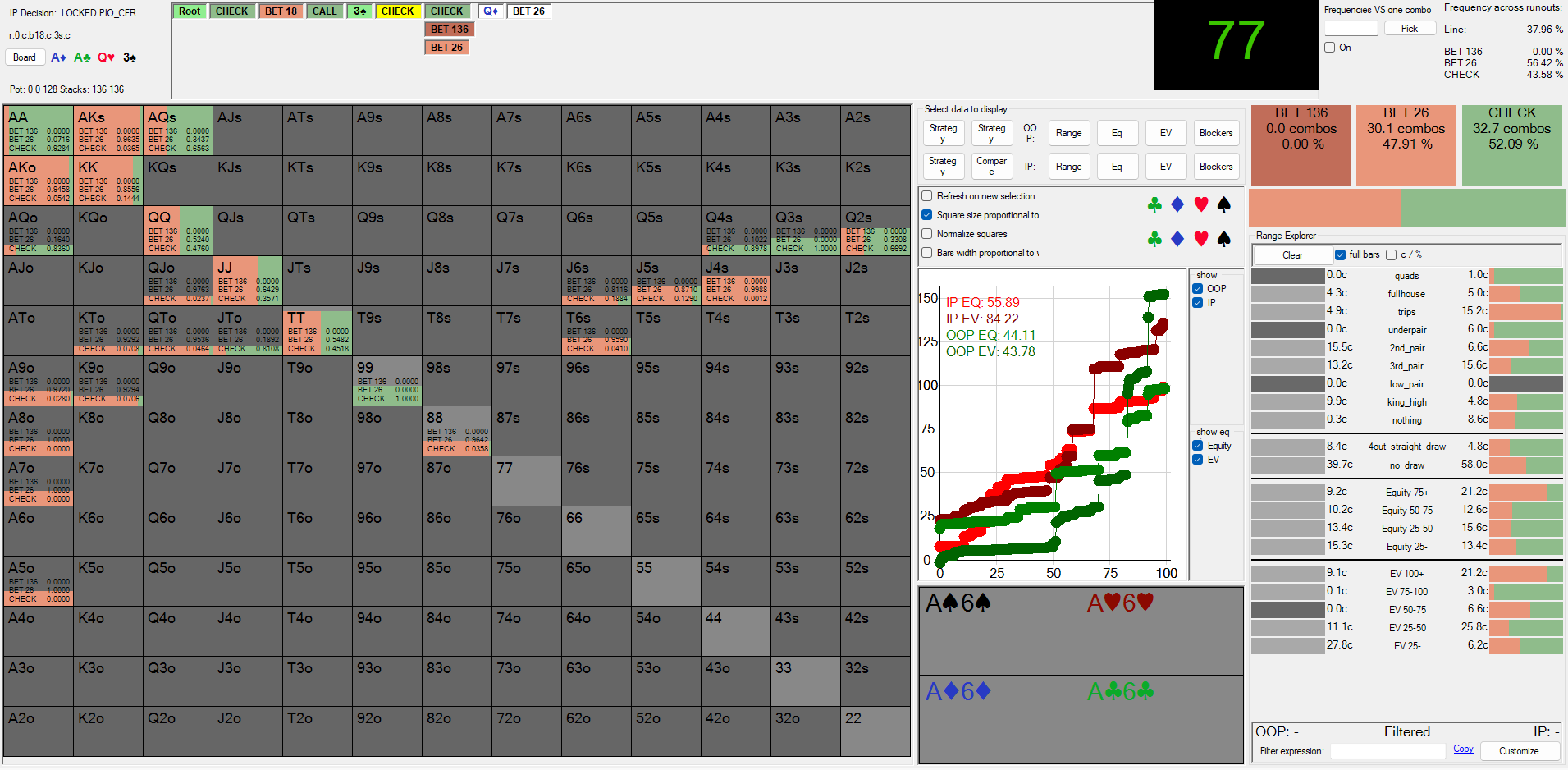
our response in the check line:
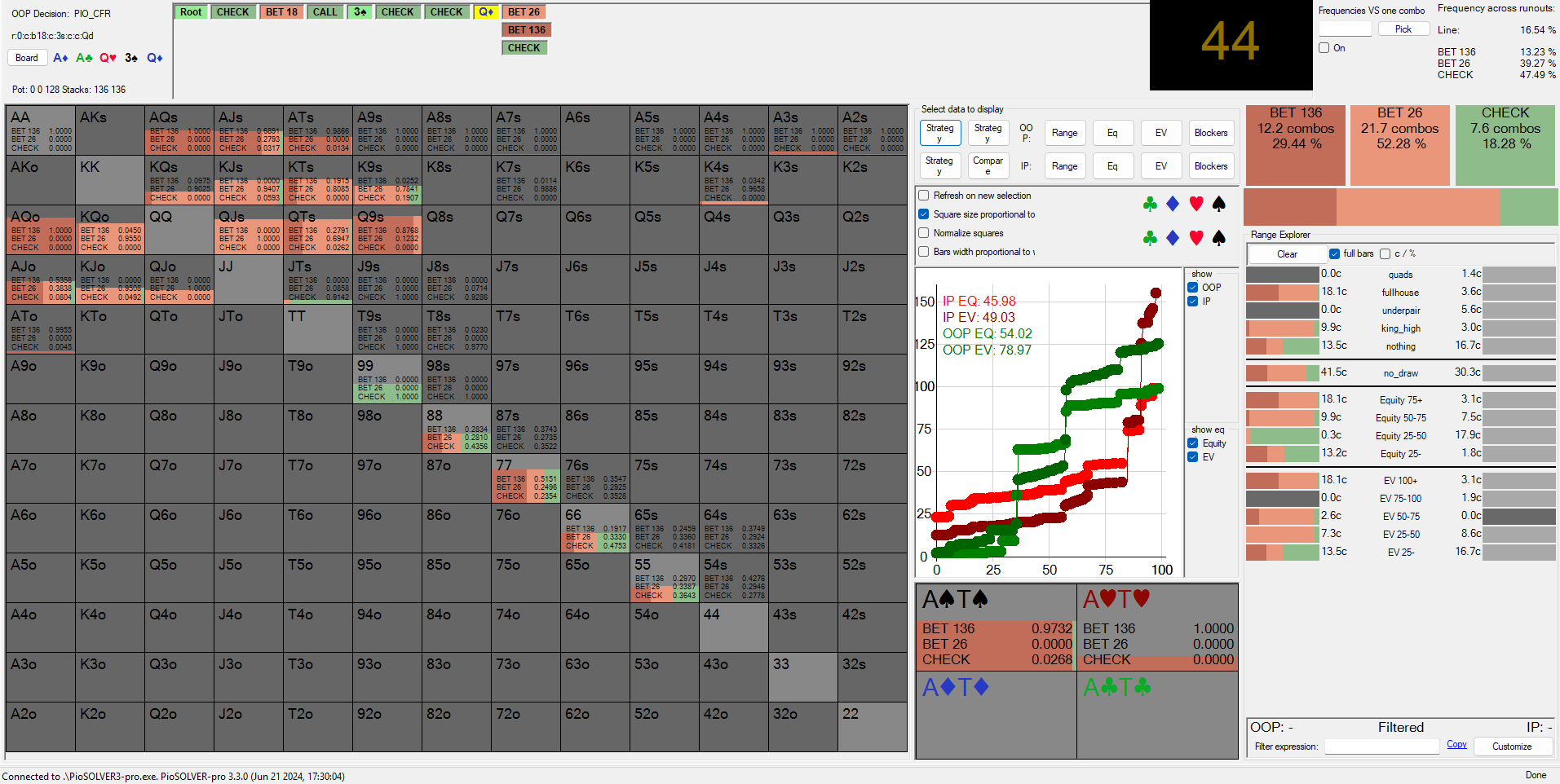
IP defense in the check line:
(forgot to attach picture but they call KK 26% of the time, JJ 57%, TT 17% and 3.3 combos of King high, they have 3.6c of boats and 1.4 combos of quads to call pure)
Of course this is probably all meaningless since I can essentially have the solver do whatever I want but as they say some all models are wrong but some are useful. I'll update yall on the HU stuff when I get more reps in, I am also planning on posting about this Linus Prodigy Hand where Prodigy bluffed a -20bb bluff assuming a simplified strategy and why he might have done it rationally speaking. I also want to preface that I do not study 4 bet pots I don't think they come up too often but I do look at them from time to time after Linus love prodigy matches happpen, I am currently studying some 3 bet pot strategies.
Hello everyone, just wanted to make a post now that my exams are over and let yall know what I plan to do for the next couple of weeks. I played a insignificant sample of hands on coin poker 50NL HU, but I found myself very disorganized in 3 Bet pots I felt like my strategy was incomplete and often questioned myself on decisions I made both IP and OOP. This makes sense imo because other than A high rainbow boards I did not study much 3 Bet pot, this seems like a natural temporary weakness and I am not too worried about it.
I will rule that it is because I am unfamiliar with 3 bet pots but another hypothesis is confidence, a sort of am I bad at 3 bet pots because I haven't sufficiently studied them or is my natural strategy bad because I am not confident in 3 bet pots so I don't take the spots I should (maybe a mix of both). TBH I would like to believe it is the former but I still recognize that emotions are a factor of the game and can affect implementation of strategy.
I plan on just doing the same thing I did for SRPs but for 3bet pots and sneak in some study on two tone flops for SRP and 3bet pots since I haven't covered them in either setting. I might want to stream a few of these study sessions and some trainer grinding, starting from basic flop strategy and defense all the way to the probe lines for each board texture, covering each board texture over the course of a few days. I might do a bit of this independently first just because I am in the middle of going back home but I plan to start in a few weeks at the latest, so if any of yall are interested or want to give any theory insight (I sort of just guess why things are happening [but isnt that definition of theory] ) it would be on ocram_575 on twitch where I stream all the high stakes HU action . Once I am done with these study sessions I will probably hit the coin again and finish grinding out those hands so I cna post a graph and maybe record/stream a session depending on how comfortable I am with implementation at that point.
Hello everyone, it has been a week or so since I've written on here, I wanted to update yall on what Ive been up to. I finally finished traveling and I am back home and will start my internship in 2 weeks or so. I have been looking at 3 bet pots IP and OOP flop strategies on broadway high rainbow boards. I plan to continue to turn then river then probe lines on these boards before moving on to a different texture. My small sample coin results are on their way but I will most likely postpone them until after I learn a bit about how strategies are supposed to look in 3 bet pots.
I do want to keep myself accountable to this training over the summer so I am going to set a goal to average 3-4 posts a week over the summer about my HU training and spots I found interesting. I would also like to stream around the same frequency as well.
I do think there is substantial edge in 3 bet pots that it is worth waiting for my strategy to properly develop them until I start playing, which should be a few weeks if I'm consistent on my study. To justify this statement I want to recall that when Doug Polk did the CMU Human vs Bot HU challenge he said that the bot was only slightly winning in the SRPs and dominating in the 3 bet pots so fundamentally I can somewhat argue that even the best humans are not very good at 3bet pots. I don't necessary want to replicate the solver play however but more figure out where it would be hard to do so, like where some bluffs might be naturally difficult to develop which would help me stop paying off all these people in 3 bet pots because even if you were to only select obvious bluffs usually this isn't sufficient to justify 0 EV catchers or maybe even slightly winning catchers. This is something prodigy talked about in the coinpoker video where he spoke about his time playing Linus.
Something else I hope to develop is my own foundational game tree, what I mean by this is to expand my repertoire of game tree to hopefully "take opponents into deep waters". I once had a conversation with one of the researchers at GTOWizard about how much they would think LinusLove would lose to the solver by and my initial guess was 10s of bb/100 but the researcher told me that a lot of top HU professionals curate their game trees in such a way that they don't lose much when they decide to simplify and force the game tree into spots that they are familiar with so the number would most likely be mid to high single digit bbs/100. This is definitely true as we usually see the simplification of strategies through stuff like single sizings or range bets or even removing raising range is an example of this. I think doing the sample simplification but still including nodes that I personally would like in my strategy like one that I would like to implement is a small raise both IP and OOP when solver thinks they exist.
Okay that's about it from me for now, thanks for reading more to come soon
Mid Stakes Cash Game Championship is happening I am hoping to stalk some of the 2/5 and 1/2 HU regs who are playing and see their WR in 6max. The 25K WSOP HU event just happened fun watch, I would eventually like to play some smaller HU tourney events but limping strategies + deep stack play seems very annoying to think about so maybe after my run at cash, I'll dedicate a bit of my time looking at a few of those strategies but no reason to spread my self thin doing it now.
Regardless, still just studying I play a couple hundred hands here and there on coin just to rep some spots in game nothing too bad, I am running a fair amount below EV but I assume that's is just how HU is,I mean not like this money feeds my family ( I dont have a family [maybe someday]) so as long as I'm +EV I shouldn't be complaining. I did encounter my first proper over better who threw a 12x OB my way which was very fun to bluff catch against, I did have to quit them early however because +250bb deep makes me uncomfortable for now.
Continuing to identify weaknesses and improve my game as usual when I'm done studying a spot I'll play some music and rep hands in the trainer isolating that spot. Adding the raise lines for some of the boards I care about slows me down a bit but I think it is worth implementing against a high frequency 3bet c better in spots that basically require having a proper checking range. The only downside is getting the turn and river strategies down for these spots to conserve some of the EV from the line.
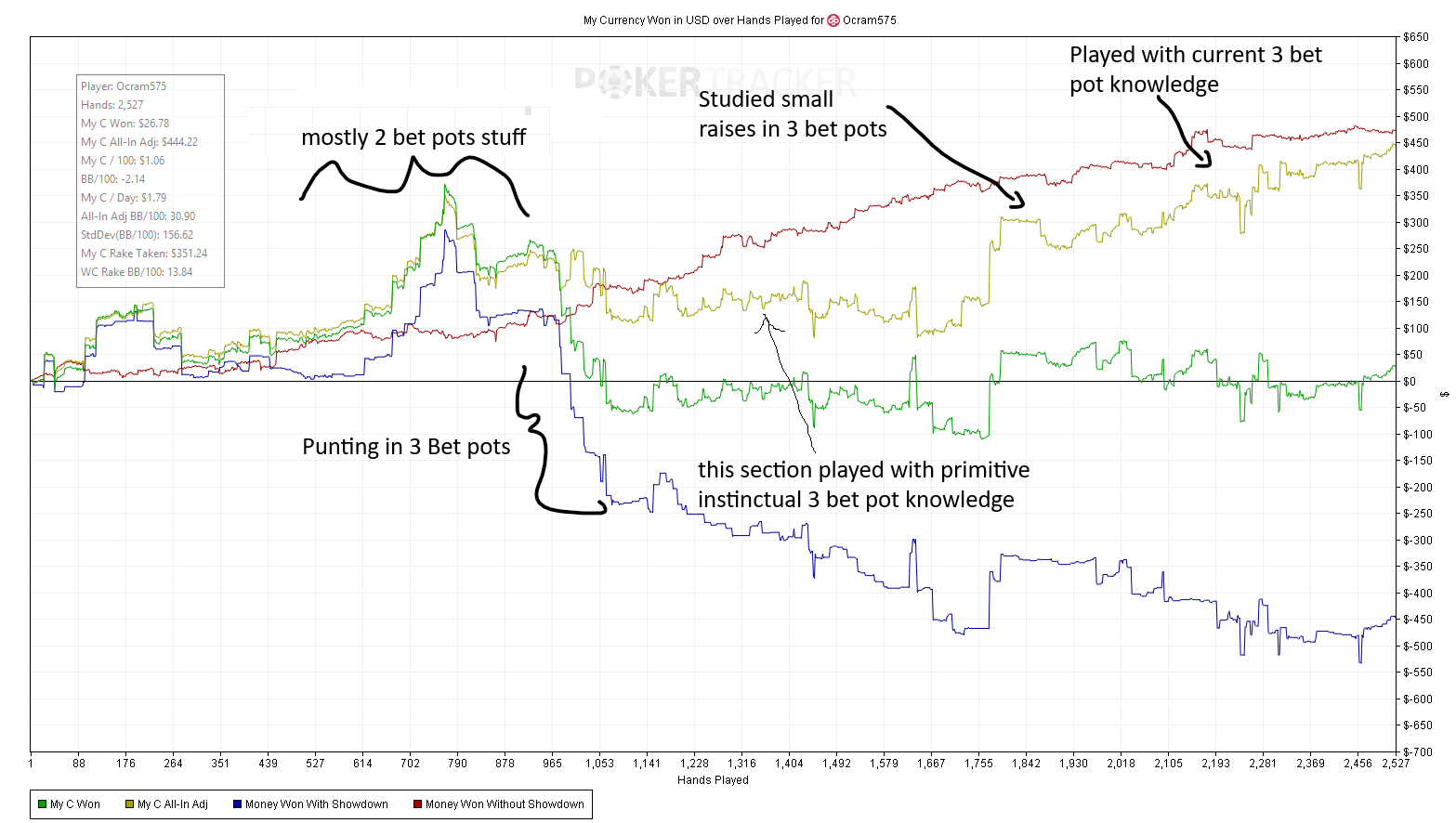
Hello Everyone, I wanted to drop a graph a bit early just because it is probably going to be a while until I can finish the 5K hands (I heard the first couple weeks of the internship are the some of the busiest). I do want to release a full sufficiently sized graph somewhere around 25-50K hands but I need to find a time where I can sit down and grind out those hands probably by the end of the month progress will head in that direction and I have been keeping you guys waiting for while so I should at least show you guys some form of results. This graph is 2.5k hands mostly at 50NL HU but some hands (< 200) were played at 100NL when action was a bit dead (hence the negative realized bb/100 but positive $).
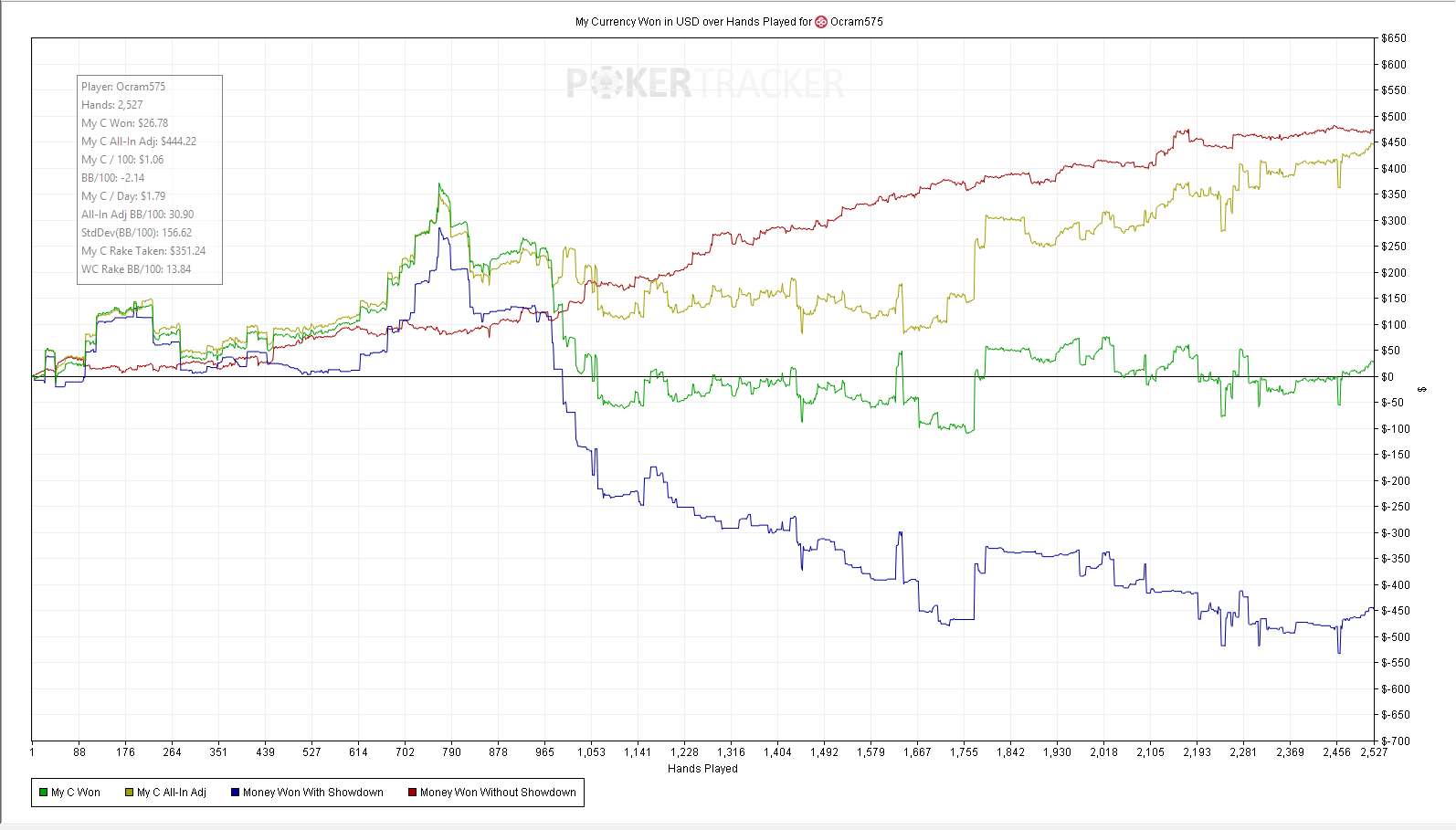
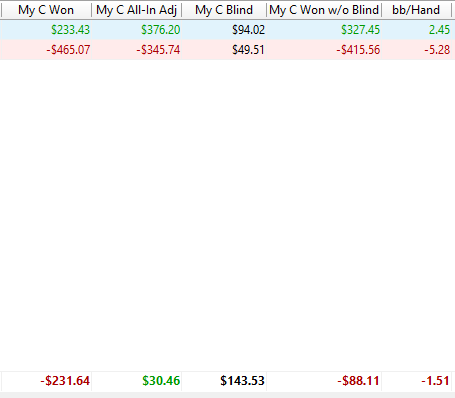
As you guys can see I am running around 8.25 buy ins below EV, with a EV win rate of 43bb/100 pre rake and 30bb/100 post rake (only thing that matters to me). I wont show much of my frequencies but I will show my positional stats to some extent but I am going to separate them into 2 bet and 3 bet pots because if not I'm actually losing overall from the SB and winning from the BB, I also dont have enough samples from 4 bet for you guys to care.
2 Bet Pots:

3 Bet Pots (currently working on these):
If anyone is wondering why the sample is so small after such a long time, honestly probably shouldn't be but I usually 1 table and just recently started 2 tabling if its the same opponent, I also dont like being super deep since I know strategy changes a bit and I would like to familiarize myself with the extent it changes. I also use most of my play as like real time trainer to rep random spots instead of the ones I care about. In terms of game selection for these stats I play nearly everyone who sits but if someone is implementing a limp versus me and isnt a total punching bag I will leave because I haven't studied limps (I am winning versus limps its more for enjoyment sake), I will also quit if I feel like I'm becoming or I am tilted which usually results in me changing my call,bet and raise frequencies by a few percentages nothing crazy but more like if I have a 4 bet at <20 roll Ill look at the rolled 27 and 4 bet it anyway. I am getting better tho and I become a bit more conscious of what is happening that I sort of catch myself, usually forcing myself to use my whole time bank per action helps me chill out.
Just to end off this post, I wanted to give my thoughts on this graph I know the sample is insignificant sizing to really say anything any peoples single session is this many hands. I hope to increase my bb/100 in the BB and SB this coming month, I'm in the lab working on these spots in rainbow broadway high boards trying to decipher them, there are also a couple of post flop frequencies I want to fix in my game tree. By the end of this month I want the strategic repertoire to be confident while grinding out the 25K hands even in deep spots. I think there is still a lot of work to do I haven't covered all the spots I really want to yet even in SRPs I am missing alot of ideas but I love this game so I should get to them eventually. I will try to hold up my goal of posting more starting next week, thank you for any support. I am also officially positive for life time on coin excluding the rake back (in EV) so that is nice. I definitely do not want to cement my strategy early so although I hope to ride what I am currently doing (plus anything picked up in study) into 100NL HU (if it even works), I am hoping to change my strategy even in spots that are familiar to me and are "working", especially if the new strategy something that is harder to play against or is harder to decipher. Yeah not much to talk about in terms of result though since 2.5k hands is insignificant.
For some information on the graph (now labeled)
Nice work ethic! Gl.
Hello Everyone, I want to start getting in some studying so starting tomorrow I will stream a quick study session mostly looking at turn strategy in broadway high rainbow 3 bet pots. I will probably start on the small bet size high frequency bet flop lines first and look at the OOP c bet turn then look at IP bet when checked to on these board. After I figure out this strategy (I briefly looked at it in the pasted so it will probably be a review), I will continue to the turns that require a more precise flop strategy like the Q high and J high B50/67 boards and the AKX B100 boards which have a more significant checking range. This is probably where most of my time will be spend since learning both the check and bet turn lines is going to be substantial especially if there are raises to potentially implement. The stream will start around 4pm pacific time +- 15 mins and I am going to hold myself to at least 2 hours of strategy study and 1 hour of trainer strategy implementation practice. I bought a notebook today which I want to take some notes in and write down any question I have about a solution that maybe doesn't make obvious sense to research offline. The stream probably wont be entertaining or that educational since I'm going to be learning most of this for the first time and is mostly for accountability sake.
Hey I found your post super interesting, I am also super interested in HUNL, and was wondering if you had any interest in forming a study group?


