Keep it simple stupid - Grind – How Far Can I Get Until December? start at nl2
Blog Start – May 2026
Hey everyone,
I’m starting this blog at the beginning of May as a way to share my poker journey a bit more openly. I’ll be posting this here mainly because I’ve realized that grinding completely on my own just isn’t as enjoyable anymore.
A bit about me: I’m not a poker pro — I’m a gamer at heart. I’ve always spent a lot of time grinding PC games, whether it’s ARPGs like Diablo or Path of Exile, or older favorites like World of Warcraft and Counter-Strike. Poker kind of fits into that same mindset for me: steady grinding, improving step by step, keeping things relatively simple.
Over the past couple of years, I’ve been playing on and off, usually sticking within my bankroll and grind my way up. I’ve had a few shots at higher stakes — I reached NL200 once and NL100 two times — but I also cashed out every December during the last 3 years. Looking back, it’s pretty clear to me that beating higher limits consistently with my current skill level is tough. As a recreational player, I feel the gap compared to full-time grinders and professionals.
And honestly, the effort required to compete at those limits just isn’t worth it for me right now. Poker is a hobby for me — one I enjoy — not something I want to turn into a full-time grind.
That said, I don’t want to play completely in silence anymore. There used to be more streamers, more interaction, more chat — that’s something I’ve been missing lately. So this blog is my way of bringing a bit of that back: sharing results, thoughts, struggles, and maybe connecting with others who are in a similar spot.
No crazy goals, no “road to high stakes” promises — just a simple grind, honest updates, and hopefully some good discussions along the way.
Let’s see where it goes.
15 Replies
I’ll be keeping things very simple.
I’m starting with a basic approach, mainly following a beginner strategy from the old, well-known PokerStrategy. I’m a German speaker and still check the German forum from time to time, but unfortunately there isn’t much activity there anymore. So I’m hoping to reach more people here in the English-speaking community.
I’m curious to see how far I can get.
Over the years, I’ve picked up a decent amount of knowledge, but my actual playstyle is still very straightforward. I don’t use any RNG tools and I’m not trying to copy GTO — I just rely on logical thinking and solid fundamentals.
10k hands on NL2 rnc
→ 9.11 bb/100 (small sample)
Playstyle:
Solid preflop approach (24/21/8)
Adjusting vs different player types
Overfolding vs aggression
Assuming almost no 4-bet bluffs from opponents
Postflop analysis will follow later.
cbet range anyone?
SRP as IP PFR
→ C-bet: 30% sizing
→ Success rate: 42%
May 6, 2026
Things That Still Confuse Me – Brainstorming
There are a few things I still haven’t been able to fully figure out, even after all these years.
This topic is also part of my current challenge.
It’s about comparing my stats to those of strong winning regs.
I’m not talking about preflop stats like VPIP, PFR, or 3-bet — those have always been solid for me.
What really stands out are my postflop numbers:
Aggression Factor (AF)
Aggression Frequency (AFQ)
WWSF (Won When Saw Flop)
WTSD (Went to Showdown)
W$SD (Won $ at Showdown)
Typical winning reg stats look something like this:
AF: 2.5
AFQ: 30–45
W$SD: 52–54
WWSF: 47–49
WTSD: 28–30
Mine look more like this:
AF: 4
AFQ: 60
W$SD: 55
WWSF: 55
WTSD: 22–24
Which leads me to the same recurring question:
Am I playing the game wrong? What exactly should I change?
Last year, I managed to bring my AF down to 3.7 and my WWSF to 49 — but my winrate didn’t change at all.
Where does this come from?
To explain that, I need to go back a bit.
I originally learned poker through PokerStrategy — a lot of which I’d consider outdated today.
My foundation is a classic TAG (tight-aggressive) style.
Postflop, that translates into:
going as thin as possible for value
stabbing and bluffing a lot in small pots
I do use traps and slowplays occasionally, but I don’t put much emphasis on protecting my checking range.
In my experience, most player pools simply don’t bluff aggressively enough anyway.
So naturally, this inflates my stats.
Whenever I have the choice with a marginal made hand (e.g. top pair, weak kicker), I tend to bet instead of check/call.
→ AF goes up.
At some point, I basically internalized the idea that:
“Check/call is bad.”
Of course, I understand the theory:
Checking medium-strength hands allows opponents to bluff future streets, which increases EV.
But in practice, that just doesn’t seem to happen often enough — at least not in my games.
Only certain player types are capable of applying that kind of aggression.
So from my perspective, thin value betting often feels more profitable than giving up initiative.
Why is my WWSF so high?
Another big factor is how aggressively I attack perceived weakness.
My mindset has always been:
“If someone checks twice, they usually don’t have much.”
I learned early on that spots like:
delay c-bets
river stabs
are extremely profitable — sometimes even with very low equity.
I’m completely comfortable bluffing multiple streets if I believe the spot is overfolded in the long run.
And when I look at my data, it actually seems to work:
I don’t get called as often as solvers would suggest
I rarely see proper bluffcatchers
Instead, I often run into passively played strong hands
Which is interesting, because in theory I’m probably overbluffing —
but in practice, people still don’t call enough.
The result
All of this leads to:
high AF / AFQ from betting instead of checking
high WWSF from winning many small pots uncontested
low WTSD because hands don’t make it to showdown
At the same time:
my checking range becomes very weak
I assume most players underbluff
→ so I end up folding a lot instead of bluffcatching
Where things get tricky
I can’t point to a single issue.
It’s probably a combination of many small tendencies that add up to these “unusual” stats.
However, one thing stood out over the past couple of years:
When I took shots at NL100 / NL200, I often felt like my style was getting punished.
Players there seem more willing to:
attack capped ranges aggressively
bluffcatch much wider
My goal going forward
This year, I want to finally move toward stats that are closer to those of strong regs.
It’s possible that my current approach works well in:
softer games
tighter, more passive pools
…but starts to break down at higher limits.
Another important factor:
I’ve played almost exclusively Zoom / fast-fold formats my entire career.
Most of the reg stats I’m comparing myself to come from datamined regular tables —
so it’s not a perfect comparison.
Still, even among players I know personally (including a solid NL200 reg), the numbers look much more “standard”:
WWSF ~49
W$SD ~51–52
WTSD ~30
Which makes me think there are definitely leaks in my thinking — especially in certain postflop spots.
I’d love your input
I’m genuinely curious how others see this.
Do you think this kind of stat profile is fundamentally flawed?
Or could it actually be optimal in certain environments?
Where would you start adjusting — aggression, bluff frequency, showdown selection?
And how much do you think format (Zoom vs. regular tables) really affects all of this?
If you’ve had similar experiences or went through a comparable adjustment phase, I’d really like to hear your thoughts.
Quick update.
Lately I’ve spent some more time looking into AF, WWSF and WTSD, and it made me rethink parts of my strategy.
I’ve mentioned before that I tend to play fairly simple strategies. I’m not a huge theory guy or someone who constantly thinks in super complex ranges and tries to solve every spot live at the table. What I’m better at is recognizing patterns and remembering things well. I prefer thinking about how I want to approach certain spots away from the tables.
One thing I realized is that a lot of my “thin” value bets are probably slightly -EV in reality, or at least very marginal compared to checking. The bets themselves are rarely going to be outright bad, but they’re often not max EV either.
For a long time I assumed that if you have top pair and bet/call two streets, you can’t really be making a huge mistake. Same thing when villains check — I often felt like betting can’t be that wrong. Whether it’s second pair or third pair, it’ll probably be fine somehow.
Going forward I want to build my betting ranges in a much more polarized way and stop putting money into the pot too carelessly just because I have the initiative and a bet is “probably okay.”
I say you might be focusing on the wrong aspects of the game. I reccomend "limit hold em poker for advanced players" by sklansky and malmuth. Read it, play a bit and go back to it. Do it over and over and over till the concepts sink in. You might need a brush up on fundamentals
Thanks for your feedback.
Funny enough, I actually read Matthew Janda’s Applications of No-Limit Hold'em last week, and yeah, he indirectly talks about the exact problem I’m struggling with.
Basically: how strong does a hand really need to be to value bet when you’re planning to keep betting future streets as well?
Well… tough luck for me, cheeseburgerlover — top pair weak kicker apparently isn’t exactly the dream candidate for that strategy.

GL mate
3.05.2026 – Short Update
I’m now playing NL5 RNC.
Current stats:
21,175 hands
All-in adjusted winrate: 6.96
VPIP: 24.32
PFR: 20.62
3-bet: 8.05
4-bet: 5.05
Fold vs 3-bet preflop: 67
WSD: 55
WWSF: 52
WTSD: 23
Agg%: 42
AF: 3.51
XR flop: 13.88
Bet flop/turn/river: 49 / 39 / 48
Fold to flop/turn/river bet: 51 / 53 / 65
I’m still not happy with these stats, as mentioned in the topic above.
W$SD seems too high
WWSF also seems too high
WTSD feels too low
AF is very high
Fold to bets is high as well
Preflop stats also look a bit strange
But maybe this is actually the correct approach for the Rush & Cash fast-fold format.
A lot of players in the pool have an extremely low VPIP, and some only 3-bet around 5%, so there often isn’t much worth defending against. Many players seem to just grind the RNC pool for the leaderboard: they bet 75% pot postflop when they have it, otherwise they just check/fold.
From my perspective, it’s difficult not to overfold while simultaneously overbluffing against that kind of environment.
In the long run, though, I would still like to have more “standard” winning reg stats, similar to the ones you see on datamining sites.
komodo dragon shared some stats
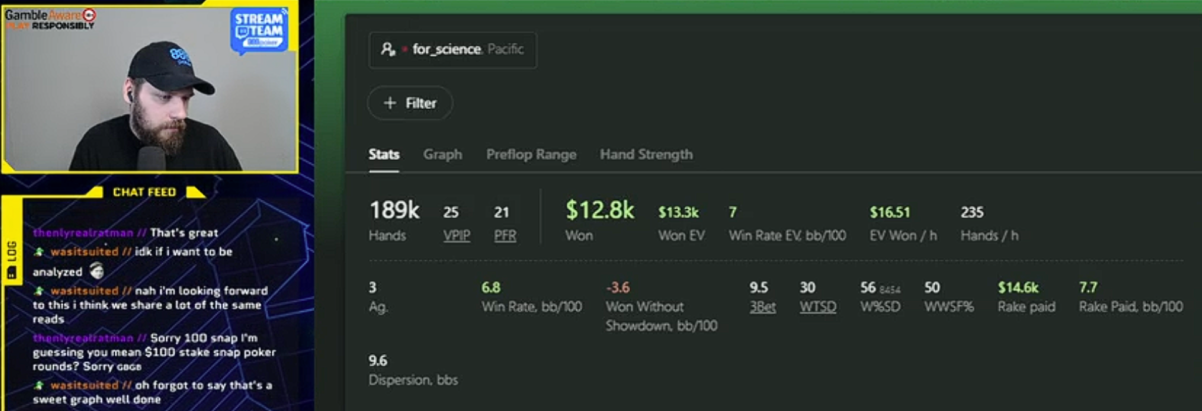
and thats the kind of stats i want too
Example:
I just watched a short video about delayed c-bets.
So: we are the aggressor, but we don’t c-bet the flop, and then action gets back to us on the turn.
Back in the day, I used to play this spot like:
“Bet any two” → it’s always profitable.
And honestly, pretty much all the content I own says the same thing.
But most of my videos are from like 2018. ��
Now when I look at what GTO does, it seems more like:
only betting the turn around ~30% of the time.
Which kind of makes sense:
we usually don’t have that much after checking back flop.
We mostly only have:
* strong hands we slowplayed on the flop
* hands that improved strongly on the turn
* some draws
And the rest just keeps checking.
So now I’m confused about how I should actually play these spots.
Do you guys stay close to solver frequencies here?
Or do you still over-bluff delayed turn c-bets in practice?
I tend to think that using GTO frequencies is not the right way to go especially at the microstakes. GTO is only good against someone that plays GTO, exploitative play is probably preferable IMHO.
Quick Update
A short update on my challenge.
My bankroll is up to $1,500 now. remember i started with 120 at the end of dezember last year. Last week I also took another shot at NL50 R&C and ran pretty well there. Right now, though, I'm mainly grinding NL10.
The reason is simple: I want to remove unnecessary stress, focus more on the quality of my decisions, and deliberately step outside of my comfort zone.
What do I mean by that?
I mentioned before that I've been tracking my preflop and postflop stats and comparing them to target frequencies. For years, I never really made significant progress in that area.
This year I want to change that.
I've noticed that it's very difficult for me to fully commit to a new strategy. So my new approach is simple: play 25k hands with Strategy X first, then review the stats afterward. The goal is to identify and fix 2-3 leaks per review cycle instead of constantly adjusting things.
Why do I care so much about having solid preflop and postflop stats?
Because strong winning regs tend to have very similar frequencies across many key stats. If my numbers move closer to those benchmarks, there's a good chance I'm doing something right.
The good news is that my stats have changed noticeably and are getting much closer to my target ranges.
Positive developments:
Established a proper Button calling range.
Improved Big Blind defense, especially versus 2bb opens.
Lower Agg%/AF due to fewer automatic range bets and stabs, while building more protected checking ranges.
Fold vs Flop Bet and Fold vs Turn Bet have improved thanks to better protected checking ranges.
Still working on:
PFR has dropped too much because my 3-bet and 4-bet frequencies are still too low.
3-bet% remains below target.
4-bet% has decreased as well.
Fold vs River Bet is still extremely high.
W$SD is still unusually high, which might indicate overfolding rivers, not bluff-catching enough, or missing thin value bets.
Overall, I'm happy with the direction. The focus right now is not moving up quickly, but building fundamentally stronger habits and making the strategy changes stick over a meaningful sample.
keep it up mate, im writing this cause u mention path of exile, one of ARPG game i love for past 6 years, just this year im quit playing PoE and focus on poker
fightning!
keep it up mate, im writing this cause u mention path of exile, one of ARPG game i love for past 6 years, just this year im quit playing PoE and focus on poker
fightning!
Haha, thanks.
I quit PoE1 a long, long time ago. I must have put in about 3,000 hours over the years—though I did start back during the beta days. Eventually, though, it just became impossible to keep up.
These days, the only ARPG I still play every now and then is Grim Dawn—I’m particularly fond of the season mod.
ARPGs are just so satisfying for a dopamine-addicted brain. I think they trigger the same response in your head as poker does—just without the bad variance! 😃
Very short update:
I've been playing NL100 for the past few days/weeks and have now reached the 30k hand mark. Currently sitting at around 2.5 EV bb/100 on GGPoker R&C with a healthy bankroll.
The blog is pretty much dead. There simply isn't enough activity in forums anymore to make extensive blogging or sharing progress feel worthwhile. It was definitely different 2–3 years ago when the communities were much more active. sadface


