On EV Relativity
I came across the term "EV Relativity" when reading this article: https://blog.gtowizard.com/what-is-expec...
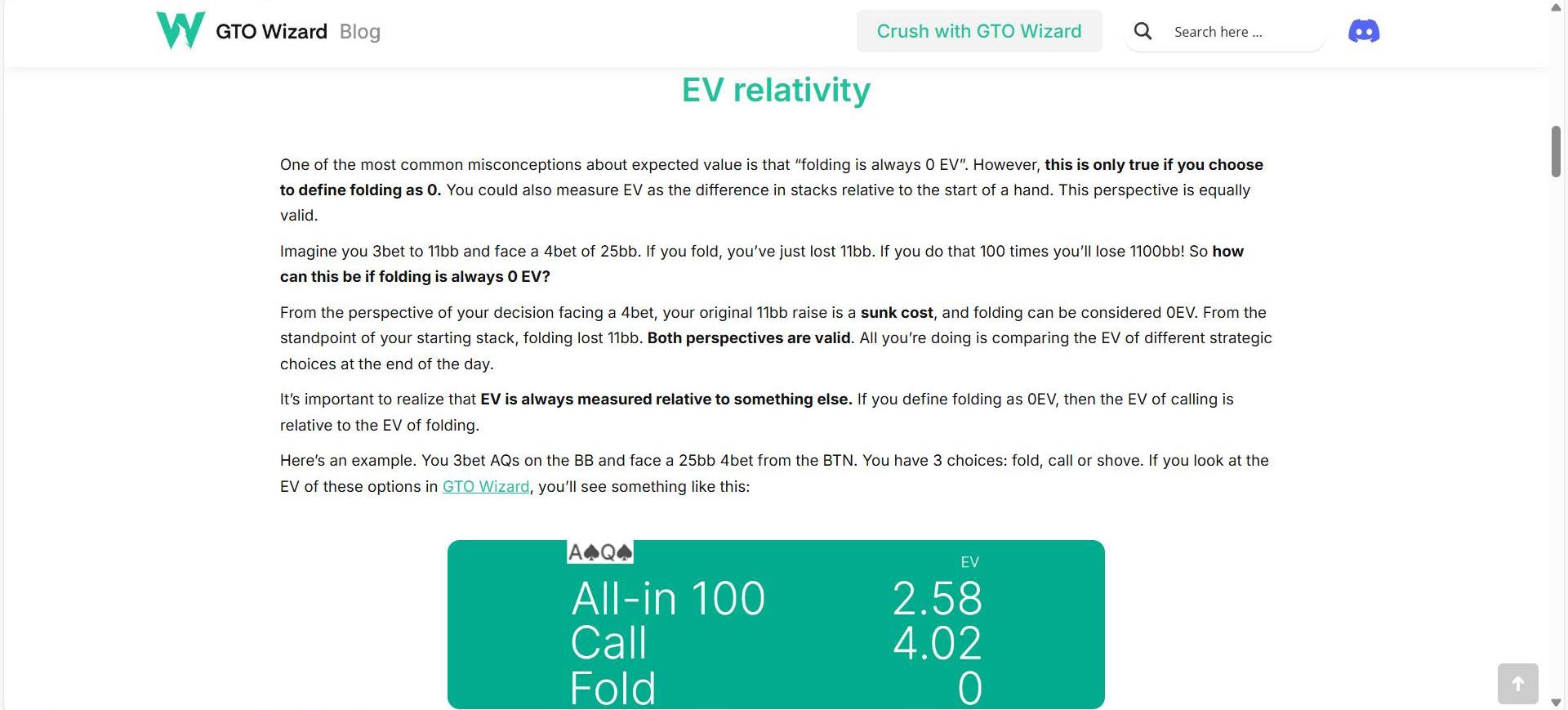
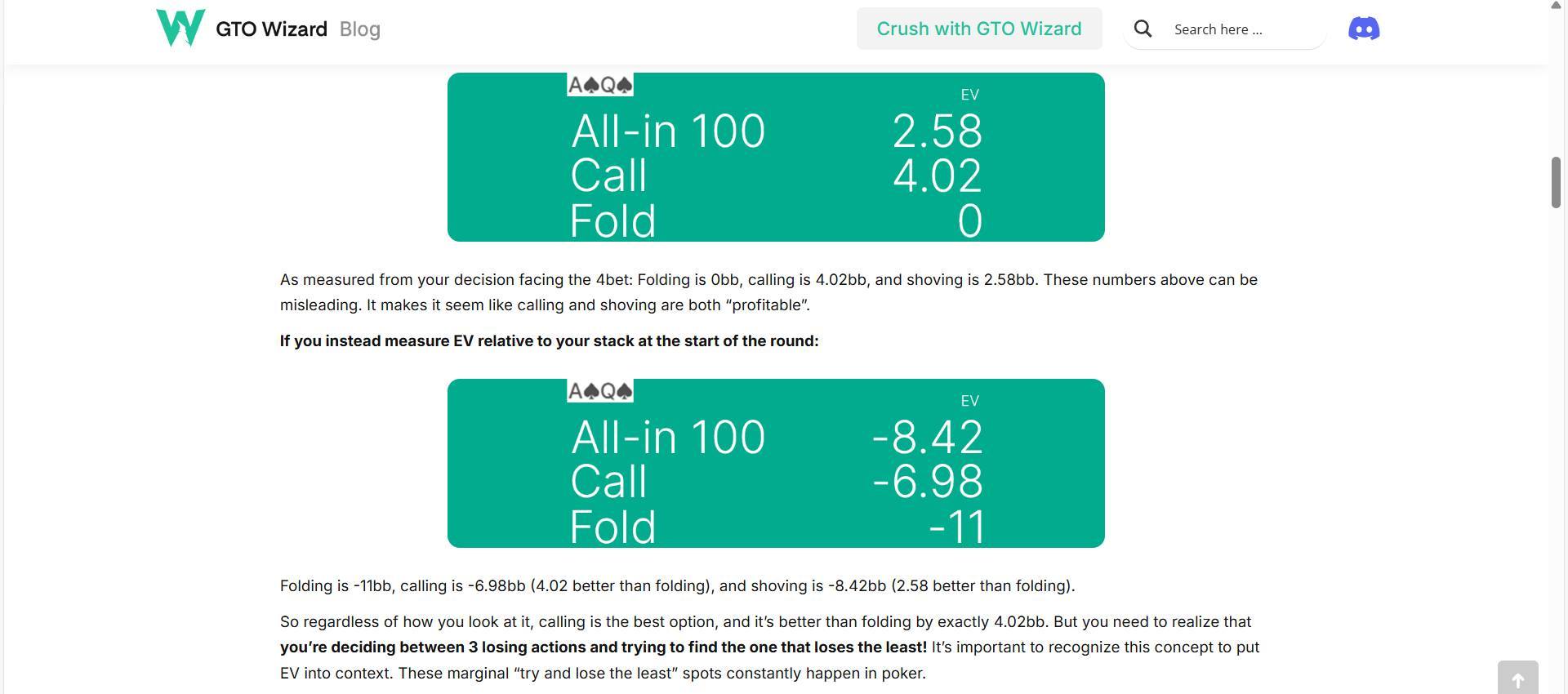
Here is what it has to say about EV Relativity (Pictures)
My questions:
1. How does the solver calculate the answer responding to the second perspective?
2. There are 2 perspectives mentioned in the article. So why did the author decide to summarize that calling, shoving and folding are all losing plays? Isn't this only consistent to the 2nd perspective????
It feels like I am missing a lot of things here @@ Please help me out!!
3 Replies

Hi mackerel99,
I'm the author of this article, allow me to clarify:
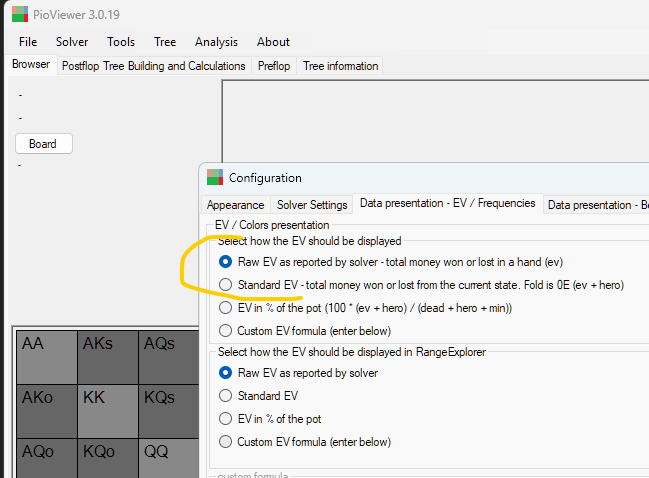
1. Solvers first calculate something called Raw EV (shown in the second picture). If you put 11bb into the pot and then fold, your stack decreases by exactly 11bb from the start of the hand, giving you a Raw EV of -11bb. Poker solvers then normalize this to set folding at 0 EV as a convention.
Spoiler
It's not just GTO Wizard btw. All poker solvers do this. Look at the difference between Pio's 'Raw EV' vs 'Standard EV' in the settings.
2. The reason I describe calling, shoving, and folding as "losing plays" is because, relative to the beginning of the hand, your stack ends up smaller on average no matter which action you choose. Calling is just the least damaging option.
However, if you treat the initial 11bb as a sunk cost (i.e., assume you're starting fresh at a 89bb stack), folding now becomes 0 EV, and calling shows a +4.02bb profit. This shift is purely philosophical and doesn't affect your strategy mathematically.
Here's another way to look at it:
- Folding: leaves you with exactly 89bb
- Calling: results in an expected stack of 93.02bb
- Raising: results in an expected stack of 91.58bb
You could say calling "loses you 6.98bb" compared to your original 100bb stack, and that's accurate. You could also say calling "gains you 4.02bb" compared to folding right now, and that's also accurate. Both statements are simultaneously true; the difference is only your chosen frame of reference.
Now you might wonder why I even included this section. I sometimes ask myself that too, since it often creates confusion. I suppose I was partly motivated by wanting to dispel the common myth that folding is always "0 EV," which isn't true.
EV relativity matters a lot when you start measuring your play against GTO using a HUD. For instance, if you analyze spots where you defend the big blind, you might see you're losing chips overall. But that's completely normal. You can't expect that spot to be profitable. Your goal is simply to lose less than you would by folding and forfeiting your blind. This misunderstanding happens in countless scenarios, so believing the myth that folding is always zero can severely distort your understanding of these situations.
There are so many spots in poker (and in life) where every option sucks, and your task is to find the least sucky option.
EV relativity also becomes particularly valuable when performing multi-street EV calculations because you need a consistent frame of reference across decisions. Here's an example from my blog illustrating exactly this point:


Thanks for the detailed reply. I do indeed find the section on EV Relativity helpful in deepening my understanding of the concept of EV. Your article on the math of multi-street bluffs is really insightful as well. Appreciate the good work~


