71% Pot is a Magical Bet Size

Six years ago, I wrote a Reddit post called "[B]The Golden Ratio is hiding in poker[/...", pointing out that Pot Odds and MDF intersect when you bet the golden ratio (~162% pot). That's cool and all, but I've since found a more interesting number:
1/√2 ≈ 71% pot
Why is 71% pot special?
1) Betting exactly 1/√2 pot grows the pot by a factor of the [B]Silver ratio[/B] (δ ≈ 2.4142), a mathematical constant (like π, e, or φ😉 that regularly appears in nature and geometry, and apparently poker.
2) If you bet exactly 1/√2 pot, the ratio of pot odds / (1-MDF) equals exactly 1/√2. It’s the only bet size that equals itself in this way.
3) The product of (1 – MDF) × Pot Odds is maximized when you bet 1/√2. I wonder if this represents some underlying optimization? Probably just meaningless numerology.
4) Your pot odds when you bet 1/√2 = 1 - 1/√2.
5) Due to property #4, if you bet 1/√2 pot with polarized range of 1/√2 value hands, your river bet is perfectly balanced.
6) The Pot Odds formula extends across multiple streets. If there are N betting streets left and you always bet 71% pot, the correct value percentage on each street is (1/√2)^N.
7) When you bet the magic size, the product of (1-MDF) × Growth rate = 1.
8) If you bet the magic size on each street and get stacks in, then the product of folding frequencies is inversely proportional to the SPR. Useful for multi-street bluff calculations.
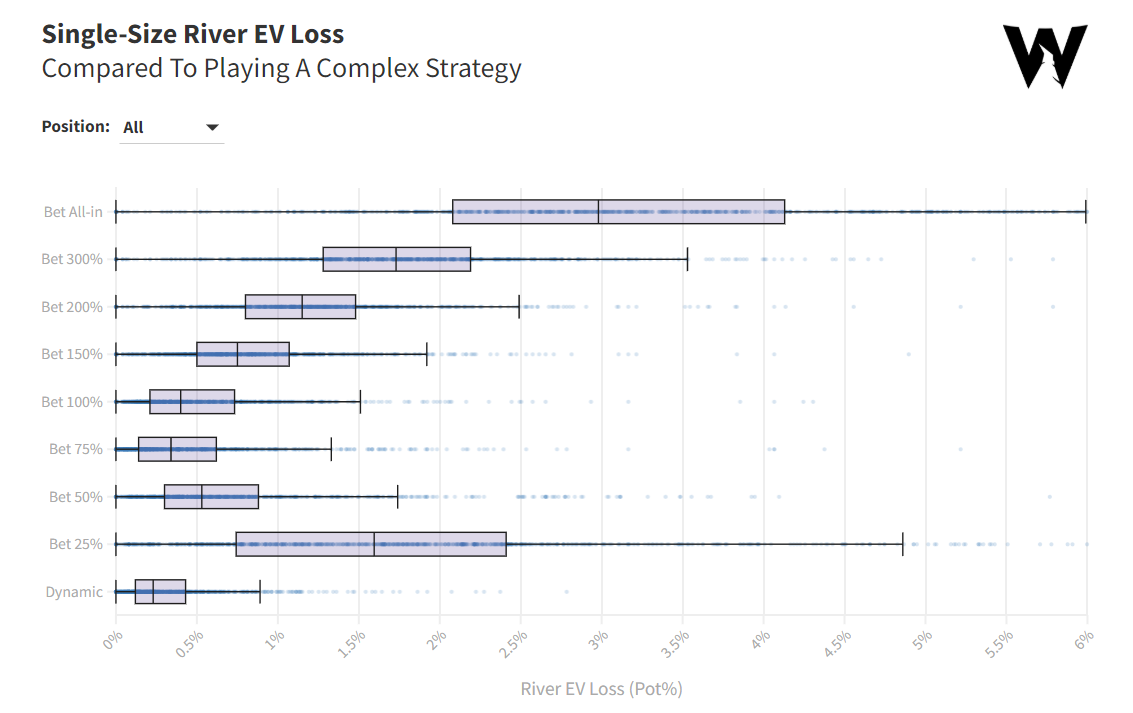
9) In practice, ~71% pot is an excellent, solver-approved default size. Two years ago, GTO Wizard benchmarked the optimal single river size and found that 75% pot minimized average river EV loss. Suspiciously close to our magical number, isn’t it?
Look, I’m not saying you should always bet exactly 71%. I’m also not saying you shouldn’t. But next time you lose a pot, remember: you probably angered the poker gods by betting 70% or 72% (or god forbid 69%) by disrespecting their favorite irrational fraction.
All hail 1/√2
15 Replies

Thanks for the continuing to make interesting posts, Tom! Hope you are doing well. I've never even heard of the silver ratio before today.
Does the bet size on river that minimizes the average EV loss change as a function of stack depth?
Thanks Brokenstars!
Admittedly 2p2 is kinda dying, but I still have a soft spot for it. Fortunately, people see my work on other platforms, so I don't feel like I'm talking to an empty room lol.
Does the river bet size that minimizes average EV loss depend on stack depth?
Good question! Almost certainly yes, but we didn't measure river SPR specifically. Our methodology involved generating rivers from GTO hand histories - HU 100bb cash, so it covered a range of SPRs.
It is incredibly dead compared to what it once was... and it was "dying" when I started browsing these forums around 2008/2009/2010.
Thanks for your response.
Wait. IIRC the Mathematics of Poker, the "perfect" bet size in that [ 0, 1] game was supposed to be sqrt(2) - 1 or approximately 41%? Is my recollection off here?
Wait. IIRC the Mathematics of Poker, the "perfect" bet size in that [ 0, 1] game was supposed to be sqrt(2) - 1 or approximately 41%? Is my recollection off here?
Oooh good catch! The Author's of Mathematics of Poker also noticed this constant that keeps popping up in poker theory. Not just in the [0,1] game but in many other spots too:
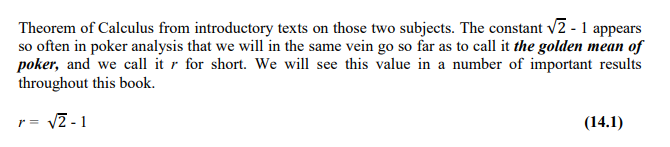
The breakeven fold% when you bluff the magic bet size ~71% is their "golden mean of poker" ~41%
1 − MDF(1/√2) = √2 − 1
Looking into this more deeply, it's all part of the silver ratio lore of poker. In particular a lot of toy games are secretly trying to find the roots of this polynomial: x^2– 2x – 1 = 0
Which gives us: x = 1 ± √2
When you bet 1/√2:
- MDF = 1 - √2
- Growth Rate= 1 + √2
I guess poker is just √2's all the way down lol
Sorry, but do you mean by "silver lore of ratio"?
If I am wrong - just tell me. I am not - tell me.
We are not all aware of your mandate to dominate poker any more, sorry.
You denominated your trust in democracy a thousand wise.
So what do I not understand?
Or after all!
Phill Ivey will still own you, but after a while, he will be crushing GTO bots.
Why is that?
Nobody can ever crush GTO bots? Are you crazy?
No! But who react like robots. They are easily crushable.
See point 1 in my OP. Poker theory seems to be deeply tied to a mathematical constant known as the silver ratio:


δ ≈ 2.4142
When you bet 1/√2:
Growth rate = δ
1 - MDF = 1/δ
Pot Odds = 1 / (δ + 1)

Just for fun I input what you wrote in OP into ChatGPT and asked if it could think of any other connections between the silver ratio and poker/game theory.
I have no idea if any of these are true, but here were some ideas it had:
* Preflop sizing: Just like you thought 75% was suspiciously close to 71%, it thought that the standard opening size of 2.5bb was suspiciously close to 2.414bb.
* Game tree pruning (bet size spacing): It thought that the metallic ratios (golden=1.618, silver=2.414, bronze=3.3) would be ideal spacing between different bet-sizes to make abstraction as non-exploitable as possible.
Some reasons it gave:
Spoiler
* They provide the slowest possible convergence when approximating real numbers with integer ratios of small size.
* That sounds bad at first—but in game-theoretic regret minimization, it’s actually desirable. Here's why:
* When you're approximating a continuous action space (like choosing a bet size between 0 and 2x pot), your goal is to minimize the maximum regret from not including every possible size.
* The continued fraction expansion of a number tells you how well it can be approximated by rational numbers with small denominators. The golden ratio [1; 1, 1, …] is the worst-approximable number; the silver ratio is the next worst.
* That means using metallic ratios as spacing constants lead to more uniform error distribution across all sizes.
* No common fraction gets privileged
* This is related to the idea of "maximin" optimization: you’re choosing the ratio that maximizes the minimum accuracy (or, minimizes the worst-case inaccuracy) of your size approximations.
* This prevents bias and increases the robustness and coverage of your model.
***************
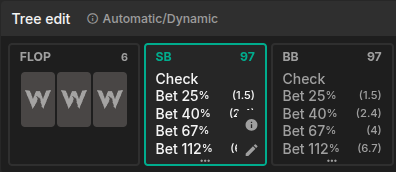
If we start from 25% sizing, the spacing would look like this:
Golden ratio: 25%, 40%, 65%, 106%, 171%, 277%, 449%
Silver ratio (less accuracy, more abstraction): 25%, 60%, 146%, 352%
Bronze ratio (even more abstraction): 25%, 83%, 272%
***************
And fascinatingly, we can see that the spacing between the sizes that GTOW AI uses follows the golden ratio quite closely.
***************
Bonus (Why the golden ratio is the most irrational number):
Spoiler

cool topic. when i first read this the other day it reminded me of this thread:
https://forumserver.twoplustwo.com/15/po...
ive been pondering the geometric relationships a little, but not enough to have anything good to say about it.
like i cant even decide if the growth should be represented in 3d or 2d. fibonacci growth is usually shown in 2d representations, but why shouldn't it be the volume of a sphere nor a cube increasing?
but i didn't come here to ramble. just wanted to link that other thread and hope someone else riffs on the connection.
I really like your posts tombo please help keep these forums alive! Even though they say the forum is dying it's still much better than reddit or the discords imo. Even on the GTO wiz discord it's really only Vanja that's adding quality discussion usually imo.
41% or 71% seem to me to be a big difference.
Maybe not though. 😀
Since, all what the solvers "tell us" is more or less redundant, since we are playing humans, not bots.
Right? 😉
Bookmarked.
Spoiler