Some questions about nodelocking.
Hi,
I have noticed that the adjustments that are created when nodelocking often only provide 0.1-0.3bbs additional EV and that is when they are implemented perfectly by the solver.
When you are exploiting a real opponent who isn't aware of your exploit, where they wouldn't be adjusting their strategy in other parts of the game tree, would EV be much higher, especially considering you could make adjustments to their imbalances many times in a single hand?
I wonder whether I am actually utilizing the nodelocking feature correctly, or whether the compensation of the solver in other areas of the tree is making this EV figure less accurate. Is one supposed to lock the whole tree, or just the single imbalance/mistake of the opponent your trying to learn how to exploit?
Thanks, I mainly make this post to ask how to properly use the nodelocking feature in Pio and whether what i've written here has any merit.
8 Replies

The relevance of the total EV gain is going to be a function of the pot size for the node you're evaluating. Every 1% increase in EV is quite substantial. To answer your question as to whether or not you might gain more EV than this is just a, "it depends."
Try posting an example of you node locking something along with your take aways.
BTN open SB call
Mistake: IP player raises vs river probe too infrequently
Used frequency tool exclusively too decrease the frequency of of the raise from the IP player from 7% to 3%.
(Should I have selected specific hands here instead or something like that?)
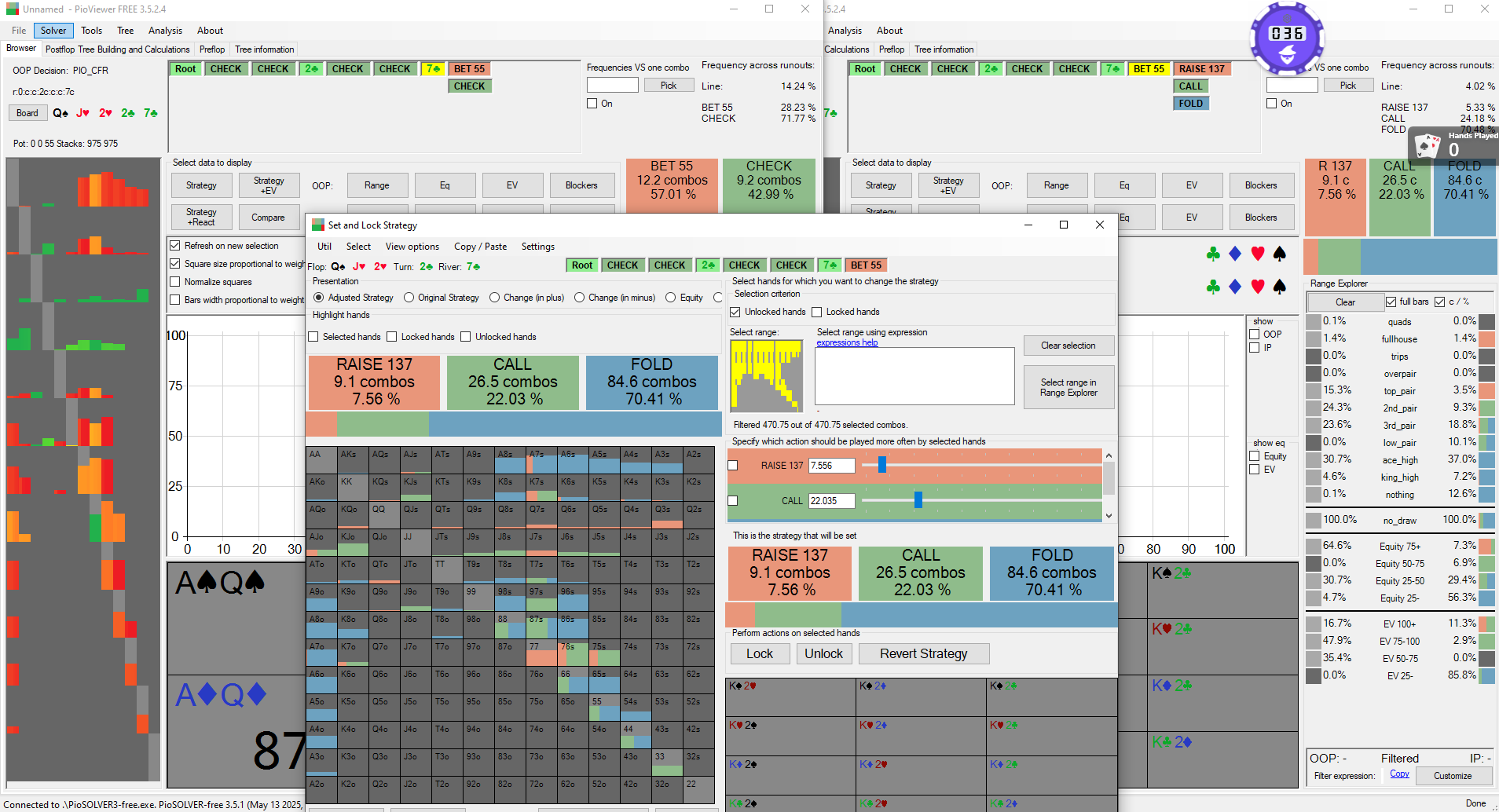
hit lock all, save and close then hit go to solve.
Result:
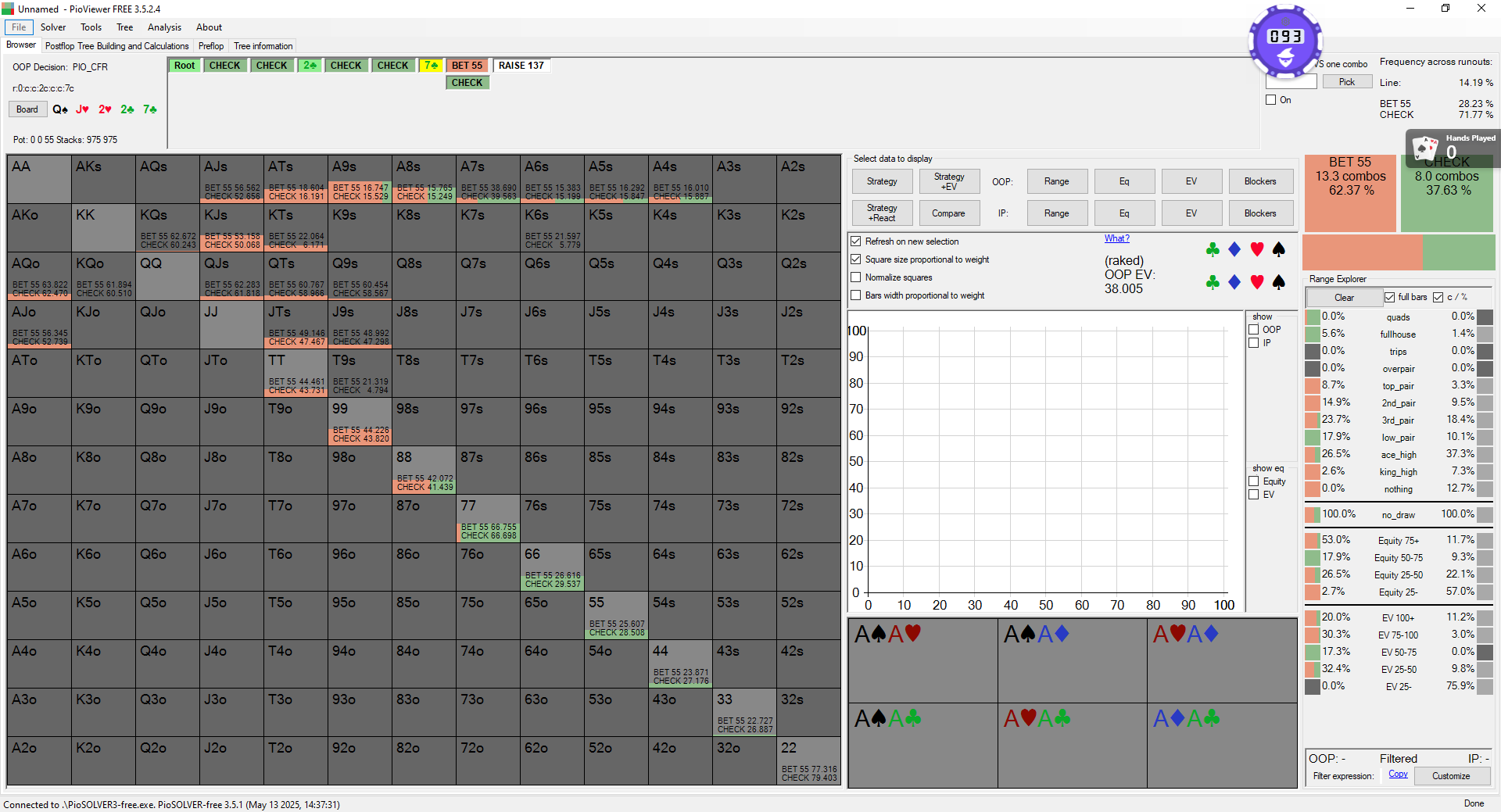
equilibrium probe strategy
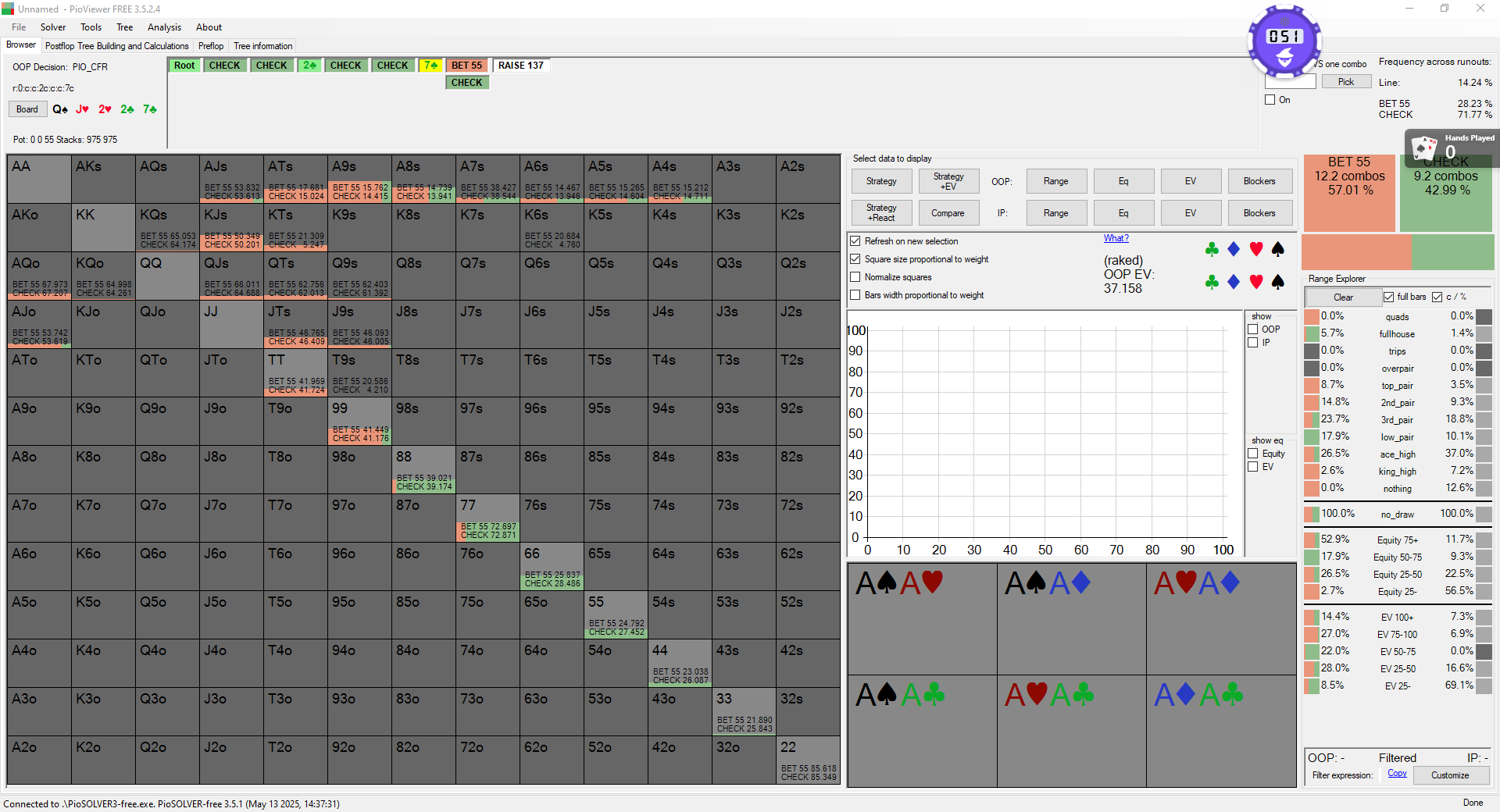
exploitative probe strategy
equilibrium strategy vs raise
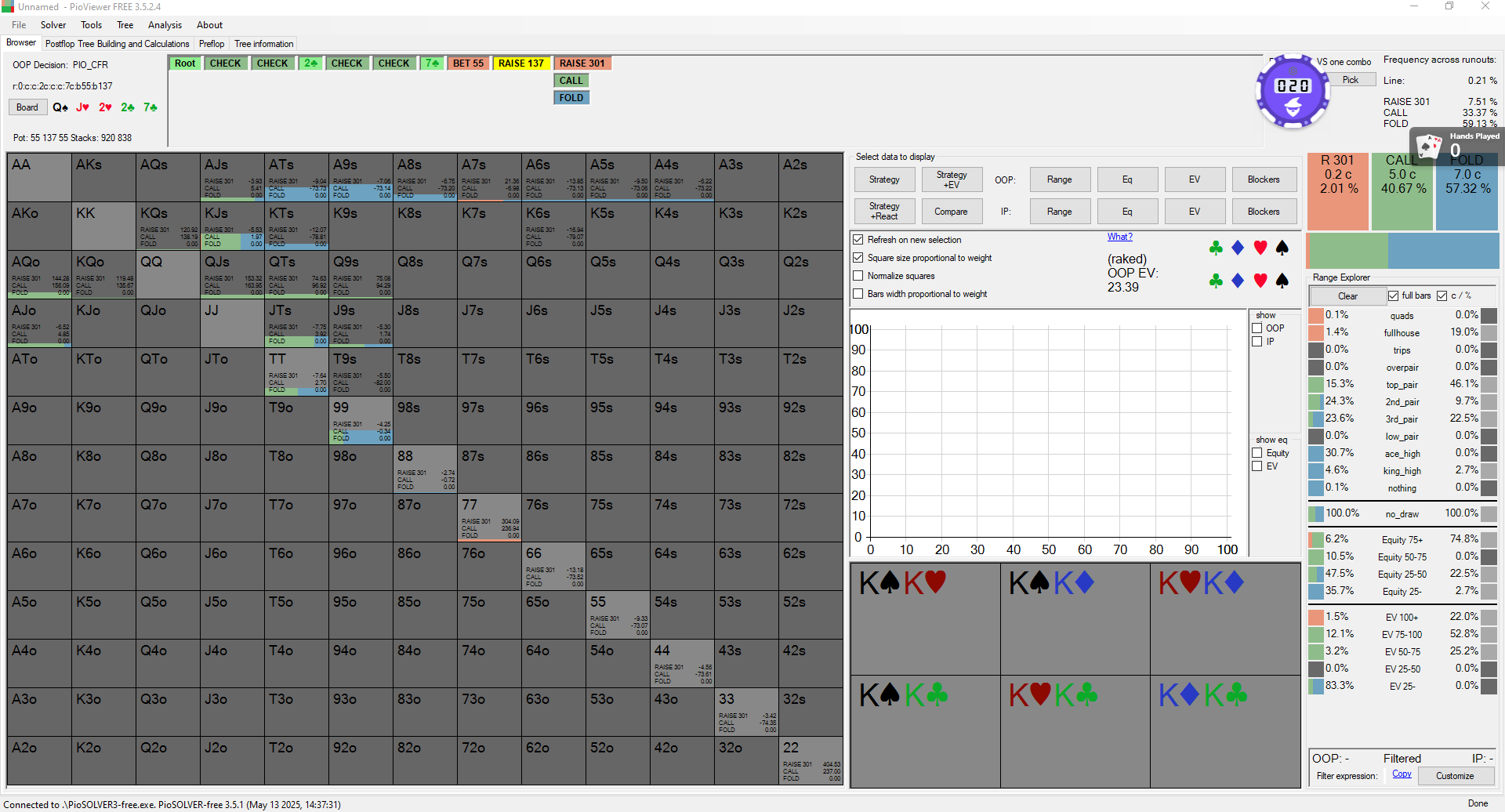
exploitative strategy vs raise
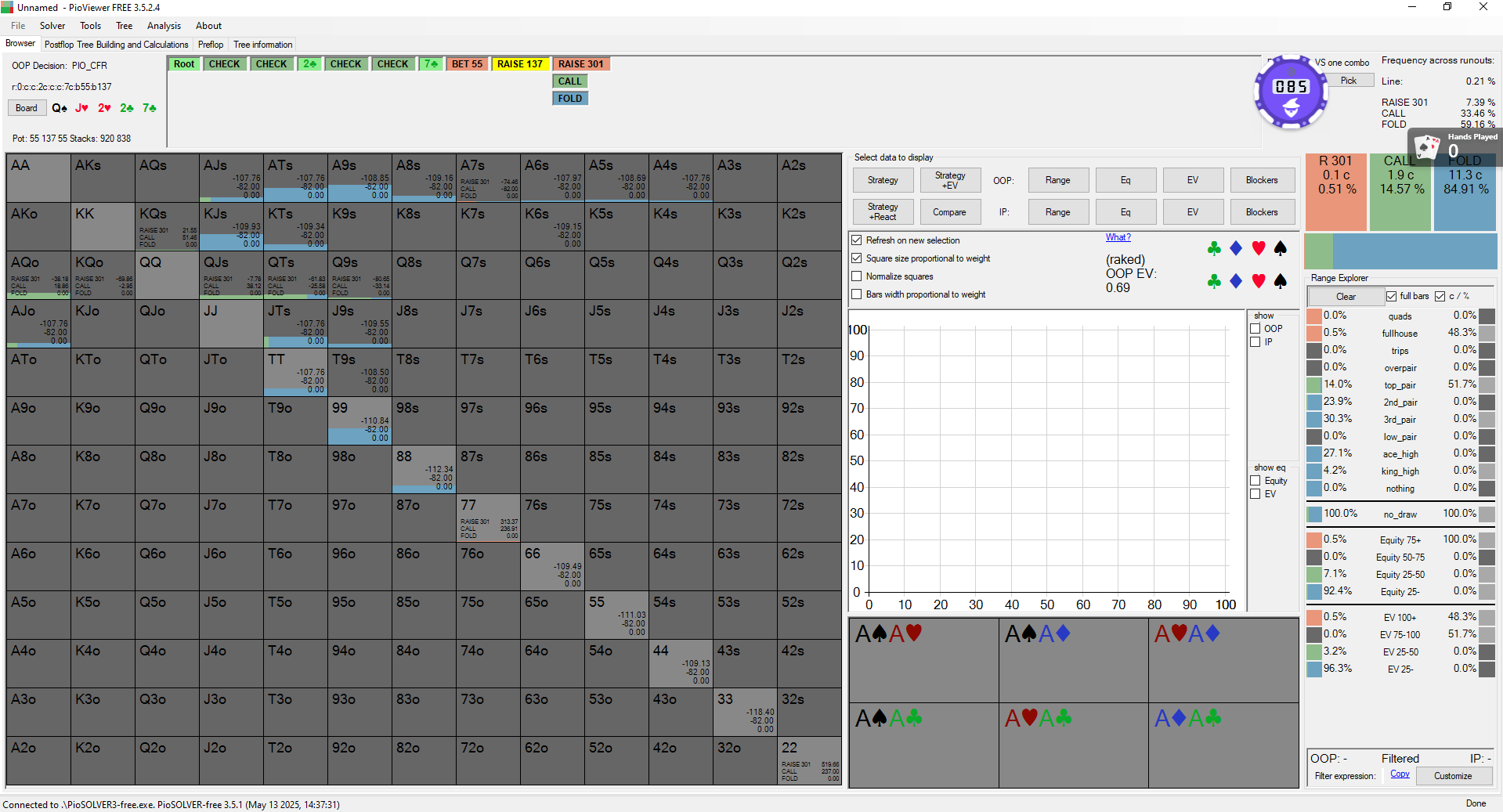
OOP player bets more frequently and for thinner value on the river, with 2nd and 3rd pair betting more frequently because they can now better realise their equity without the risk of being raised as much.
When IP player does raise vs the probe, fold with a significantly higher frequency, calling with only the best hands 2nd to sets and only re-raising with sets because of IP players much stronger/tighter raise range.
any advice or criticism is appreciated.
Thankyou
This type of evaluation on the river (otr) is probably not particularly accurate. The reason is you've skipped through the game tree and there is going to be a lot of deviations from population... starting from preflop ranges.
Most sims are going to have SB predominantly have a 3B or fold range vs. any BTN RFI sizing equal to or greater than 2.5bb, so if you're utilizing an equilibrium SB range starting from the preflop node, then that is going to be a large mistake here. I'd also like to see how you've set up the tree. For GTO+ if you leave a node empty, then it will automatically fill it in with some value. For example, in GTO+ if you do not manually input flop raises, then they will be automatically filled in with some default value—for PIOsolver that is not true. So, for example, if you do not allow flop raises on the flop node, then it will assume that player can have 0 raises for that node and that results in a heavily skewed equilibrium if the player has no raises.
So, basically you'd want to start with evaluating realistic preflop ranges for SB/BT, and then you would need to evaluate the equilibrium strategies for both players on flop and on turn before getting to the river as the river ranges are going to be a function of all actions/nodes prior to that one. My main piece of advice for this is that when you are evaluating river nodes you want to take the extra time to evaluate and node lock the ranges prior to that node.
Regardless of how you proceeded through the tree, your last paragraph detailing your findings is accurate. When IP players are raising too infrequently, then the OOP player tends to bet/block at much higher frequencies as this allows them to realize additional equity.
Here are the settings I used for the solve, I only used one sizing on each street for speed, as I knew I would have to solve it multiple times because of the limitations of the free version of Pio, and my primary goal was to identify the direction of the adjustment that the solver would make against the specific imbalance as attempting to memorize the spot would be impossible / not very useful. Generally when studying the GTO strategy I will use 2-3 sizings each street.
#1 How would I go about determining these preflop ranges (I get mine from GTO wizard)
#2 When you say I should be locking the flop and turn, should I just be locking the nodes of the line that was being played? Ie just locking nodes in the check,check:check,check:bet,raise line? And should I be locking them with the intention of exploiting a specific profiled opponent? such as one that is generally check raising too infrequently on all streets in this case, or in another spot someone who calls too wide IP in all streets etc. Locking each node with that specific tendency? Or is that simply another option like a tool in a toolbelt kinda.
I don't see your settings.
1) either best estimate or population data
2) basically yes... for example, if you think the IP player is not betting much value for flop/turn when checked to, then that would make IP range much stronger than equilibrium here for the river node. The converse of this could also be true. The takeaway is that actions on previous streets will change the composition of the ranges and therefore change the equilibrium output that you are nodelocking to begin with.
My apologies
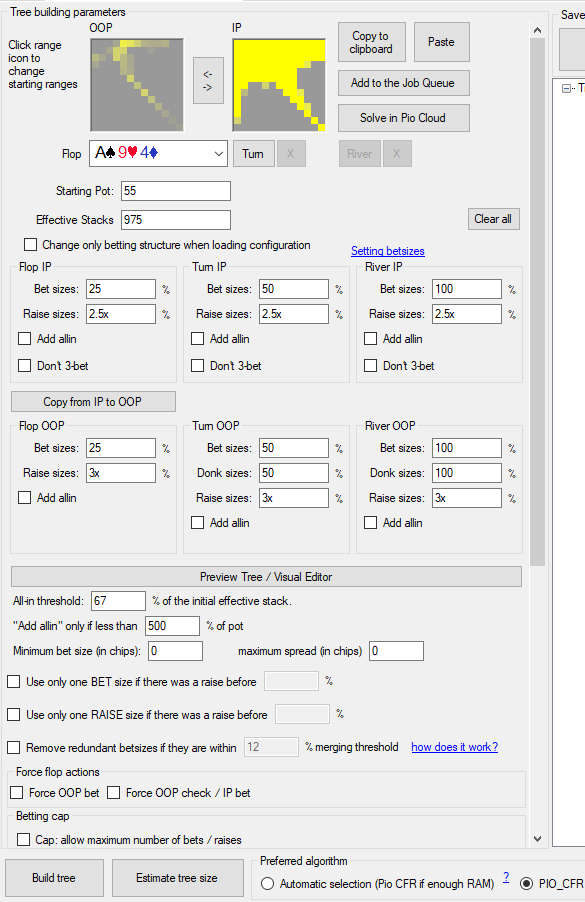
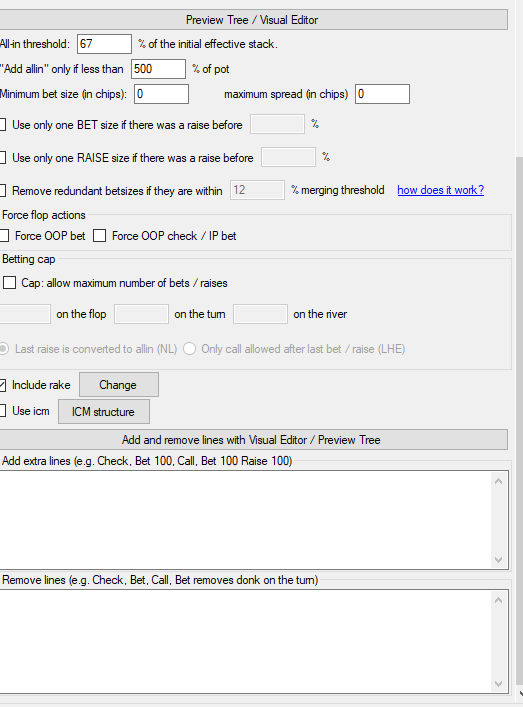
thanks!

You can’t just lock one node or street, usually you have to lock everything and then use scripts to lock as well all future runouts to get a picture which is clearer for you.
How much EV does an exploit gain? Well, how long is a piece of string?
A lot of v reg exploits tend to be more subtle ones that are hard to defend against whereas v rec exploits you go MES as they likely won’t last on the table for too long.


