How much variance does all-in expected value account for?

Obviously, all-in EV removes one (relatively small) dimension of variance from bottom-line results, but I'm not sure how to factor *how much* less variable AIEV is.
Let's say the standard deviation for winrate in a game is 100, what would you expect (or how would you calculate) the standard deviation to be for AIEV? I understand intuitively that it is far less than half of poker variance but is it 75% as variable? 90%? 95%?
I presume stack depth has a large effect here. At 10bbs deep with tons of flips, AIEV could actually make up fully half of your variance, whereas at 1,000bbs deep I imagine there are far too few AIPF and AI OTF scenarios to make a meaningful difference. I play 100bb+ cash games, but am interested in the discussion regardless of applications to specific environments.
NOTE TO MODS: I already tried posting this to Online NLHE (with a note that that might not be the correct forum either) and didn't get any nibbles. I know this sub is generally more dedicated to discussions about equilibrium, but poker statistics are also a theoretical discussion point separate and apart from application and exploitation. That being said, I am open to recommendations on other places to post this question.
2 Replies

All-in Adjusted EV removes the variance from every all-in pot. Measure your standard deviation before and after filtering out all-in hands.
I measured a few databases. The following data shows the standard deviation in bb/100 before and after filtering out hands where someone called an all-in bet.
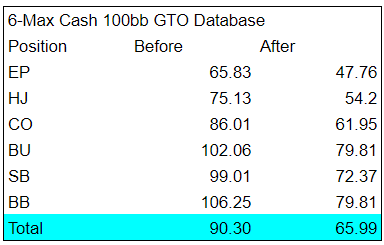
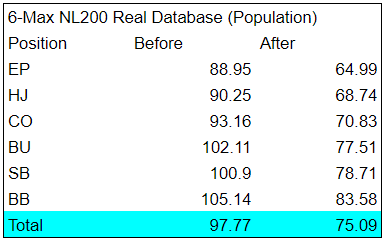
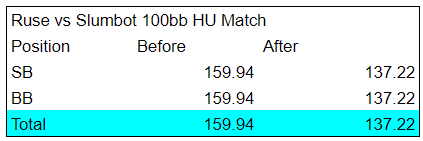
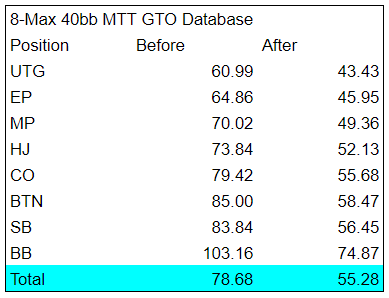
How much variance do all-in spots account for?
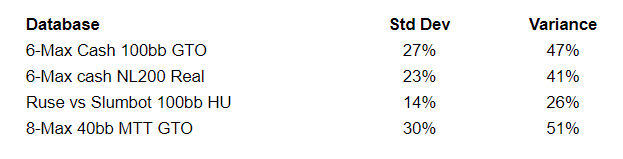
Example calculation using NL200 database:
Spoiler
- Standard deviation goes from 97.77 to 75.09 bb/100 after filtering out all-in hands.
- All-in hands account for 1 - 75.09/97.77 = 23% of your standard deviation
- All-in hands account for 1 - 75.09^2/97.77^2 = 41% of your variance
So to answer your question, all-in adjusted EV reduces your variance significantly.
Thank you for this, tombos! Honestly that's on the higher end of what I expected.
Just curious, how big are the samples for each of these? It looks like the ruse vs slumbot match was 150k hands, but I presume the other databases are significantly larger?
Yes, the other databases are millions of hands large. Standard deviation converges quickly anyway.


