4 betting strategy
Today I played two hands that made me question my 4 bet strategy. I thought my questions would be more fitting in this part of the forum as opposed to doing two individual hand breakdowns.
Question 1: Is AJs a 4! hand irrelevant of stack sizes?
To my understanding having AJs in my 4! range allows it to function as a high equity retention semi-bluff (if I'm wrong on this let me know). While I was playing I was 3! by a short stack. It folded around and I 4! him allin (he had about 30bbs and I had 100+). Do I have the fold equity to justify this 4!? Are there any other considerations that would make me want/not want to 4! this here?
Question 2: How do deeper stacks and bigger 3! sizings mutually interact to shape my 4! range?
I opened KJs from the SB for 2.6. I was 3! by the bb to about 15bb. He was about 150bb deep and I was about 300 bbs deep. I ended up folding because I thought using KJs as a 4! here would be lighting money on fire. His 3! range from the BB is strong, im oop, the pot would be more inflated than usual, and my reverse implied odds are terrible. Should I have 4! or was my fold correct? Furthermore, was my logic justifying the fold correct?
20 Replies

1. You should play more exploitatively vs. a short stacker... so it would be a function of his 3bet range and then his subsequent call and folding ranges/frequencies.
2. This is sort of awkward situation to be honest. Again, though, because the 3b sizing was so ridiculously large you should just deviate to a more exploitative approach. I think just folding if you think it's close is completely fine.. a 2.6 -> 15bb sizing is really large.

Not to give the cliched answer of "It depends, " but 4bing in ~100bb cash games (the standard buy in for these games and the most common size used in hand charts) just happens to be arguably the most divergent actions with optimal play being highly constrained to specific stack, raise size and positional considerations. Just clicking around GTOw will make this apparent, but even more idiosyncrasies will arise comparing to different tools altogether.
Among 30bb solutions for 4bing, there should be more convergences because it's a simple jam. Which is to say 30bb charts will look more similar to each other than 100bb charts do, but 30bb solutions will not look similar 100bb charts. So the answer to your 1st question is "No." Regardless of what I think of your jam (it seems fine), the reason that it seems fine is not because AJs is a blanket 4b hand regardless of stack depth (and other factors).
And the answer to question #2 is "A lot." In this particular case, the large size:
- Makes their range theoretically tighter, which raises the bar of how strong your pure value and "bluffs" need to be
- Lowers your MDF and makes calling a smaller part of your strategy
- Constrain your 4bing choices to a small 4b (which should be more linear) and 10x jamming (which is more semi-bluff oriented), whereas a smaller 3b would give you the option of 4bing a more convergent R100-150 or 15x jamming (which is more oriented toward vulnerable valuable than the 10x jam)
Not to give the cliched answer of "It depends, " but 4bing in ~100bb cash games (the standard buy in for these games and the most common size used in hand charts) just happens to be arguably the most divergent actions with optimal play being highly constrained to specific stack, raise size and positional considerations. Just clicking around GTOw will make this apparent, but eve
When you say 4-betting is the most divergent action, do you mean to say that even seemingly trivial modifications of various hand aspects leads to very different ranges? As in it's very difficult to generalize a strategy from what we see in a solver and extrapolate that strategy as stack depths, positions, etc. change across the span of a game?
When you say 4-betting is the most divergent action, do you mean to say that even seemingly trivial modifications of various hand aspects leads to very different ranges? As in it's very difficult to generalize a strategy from what we see in a solver and extrapolate that strategy as stack depths, positions, etc. change across the span of a game?
I believe that is what he is saying, yes. Small changes in 3b/4b sizings will make big differences to 4b/5b ranges. Stack depths are also another consideration. Even rake plays a pretty big role in how wide you can defend 4bs because the rake % and rake cap at lower limits basically means if you call you're going to be paying 3+bb in rake.
In addition to all these parameters having large consequences on optimal strategy from the POV of a nash equilibrium, there are also significant differences between players in a give population with regards to: ranges/sizes/stack depths, etc. so even if you were attempting to play a "solid" baseline strategy there is still just a massive amount of room for you to deviate exploitatively.
Yes, that's right.
I'm not being nihilistic or anything. Generalizations can be made and you can extrapolate from there, but to answer your particular questions there's not going to be a lot of hands that are going to be pure 4bs in all situations and raise and stack sizes will have large effects on your range.
Yea that makes a lot of sense. So just look to be very exploitative with 4 betting and 5 betting. Thanks for the input everyone.

1. The shove seems fine at some frequency assuming your opponent is an active 3-better. Other people have shared some good thoughts.
2. The size is extreme, so it does skew things. That being said blind vs blind KJs normally seems like a good combo to call a 3-bet, even OOP. My default would be to call if the 3-bet was more of a standard size. Even with this monster sizing I suspect a GTO response could be to call? I might be wrong, but ranges are wide blind vs blind.
In practice I'm basing my response on whether I read the sizing as strength or weakness. I would assume the big size indicates a polarized range, so I don't see any reason to 4-bet bluff KJs. It's going to be in good shape against bluffs, so you don't really want to fold out that portion of his range if you're going to continue.
I likely fold the first time I see this play from an opponent, but if I call I'm playing a flopped top pair carefully but looking for opportunities to make a straight or flush and stack a big hand. I'm also just trying to realize equity. By that I mean playing defensively similarly to how you would when you're defending out of the big blind or something.
I would rather use a combo like A5o as a 4 bet bluff (obviously you have to control your combos and can't just bluff with all the A5o combos though). Also hands like AJo make good 4-bet bluffs. Suited combos often play better as calls, but if I'm looking for suited combos to 4-bet bluff I would prefer something like a weaker suited king. Having some additional board coverage is another benefit of using these big card/ small card combos as 4-bet bluffs.
Anyway you might not agree with everything I'm saying but my main point is that I don't really see suited Broadways used much in GTO 4-bet ranges. Suited broadways tend to make good 3-bets but don't perform as well as 4-bets as you can tend to fold out dominated hands and isolate yourself against hands that dominate you.
2. The size is extreme, so it does skew things. That being said blind vs blind KJs normally seems like a good combo to call a 3-bet, even OOP. My default would be to call if the 3-bet was more of a standard size. Even with this monster sizing I suspect a GTO response could be to call? I might be wrong, but ranges are wide blind vs blind.
Someone with a preflop license should really run a custom sim of this since it’s just a heads up spot.
In the meantime, I would expect a bot to react to such a large 3b (and the relatively small amount of money in the pot OOP is left defending) functionally like they’re facing action cold, which would mean almost pure re-raise-or-fold strategies OOP.
Indeed the size halves our MDF and standard defense ranges OOP at this SPR is usually about 1:1 raise:call, so the fact that we only need to defend half our range would suggest we could in fact defend with reraises alone.
So my guess is our continuation is to just 4b the top ~20% of our range (ie: any top 8-10% hands) and fold everything else. I would also suspect that since our response is purely linear, we would largely go for the small 4b size and not do a lot of jamming.
I further suspect KJs would make the cutoff for this small 4b, but as you can tell I’ve layered a lot of assumptions on top of each other at this point and we’d be better off getting a custom sim.
Someone with a preflop license should really run a custom sim of this since it's just a heads up spot.In the meantime, I would expect a bot to react to such a large 3b (and the relatively small amount of money in the pot OOP is left defending) functionally like they're facing action cold, which would mean almost pure re-raise-or-fold strategies OOP.Indeed the size halves our MD
What you said here does make sense in theory. If you force your opponent to play that sizing, the solver will likely make them 3-bet extremely tight. If we allow for them to call or use that sizing only I'm assuming they will call more in position, and when they do 3-bet it will be with an extremely strong range. Our response will definitely be tighter too, and I agree that the incentive is to 4-bet more and call less. That's part of the reason I said my default would be to fold the first time I see them make this play, assuming it means they're fairly nutted.
I'm just not sure that a sim will align with reality. It's pretty easy for our opponent to get out of line in these B vs B spots. If I get a chance I will try to run it later in HRC anyway to see what a solver would do.
At equilibrium it is incredibly unlikely to be folded... more 4b or call, possibly even 4b jammed vs. this large of a size, but at equilibrium BB is likely supposed to be incredibly polarized which does not happen in practice. This is not ran to high accuracy and is a simple tree, but this is about what I'd expect.
edit:
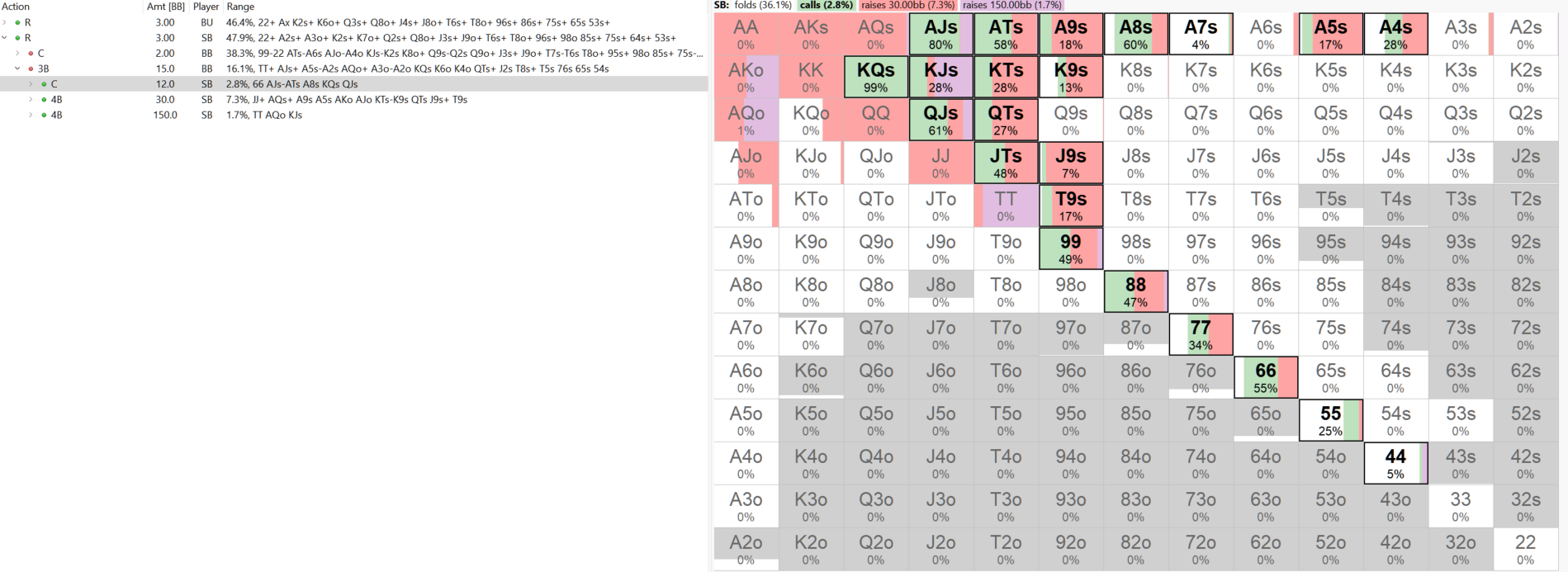
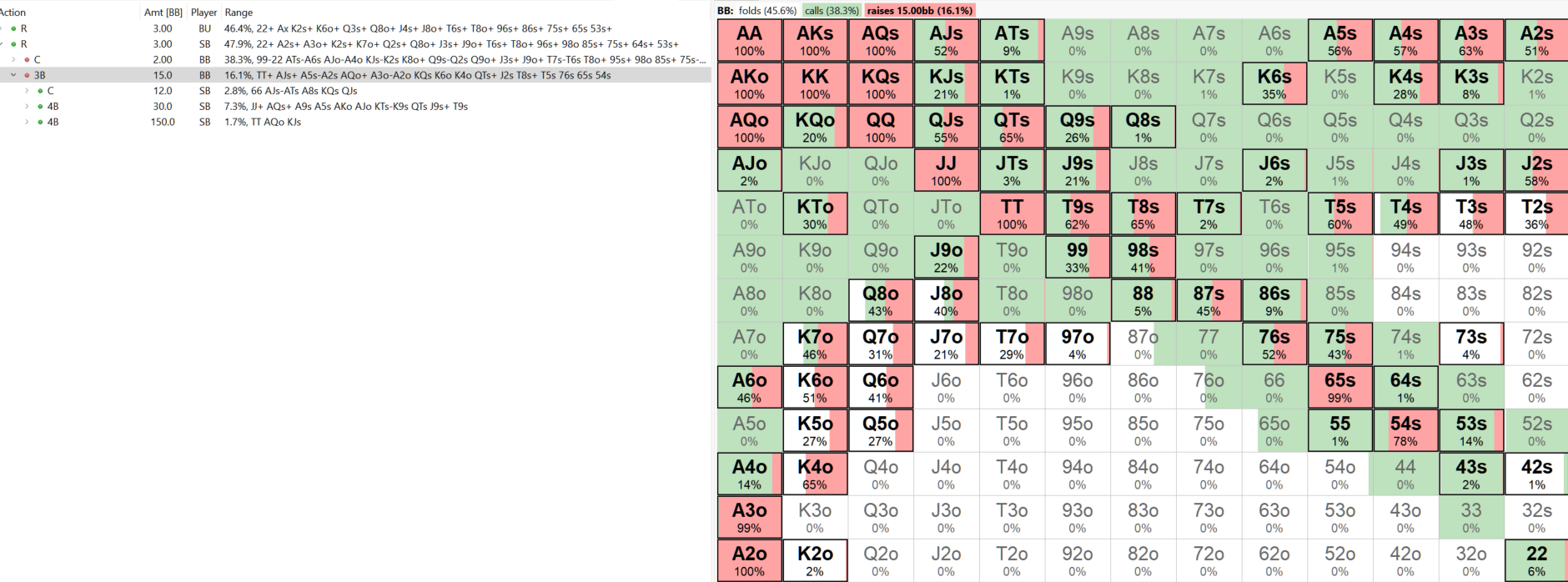
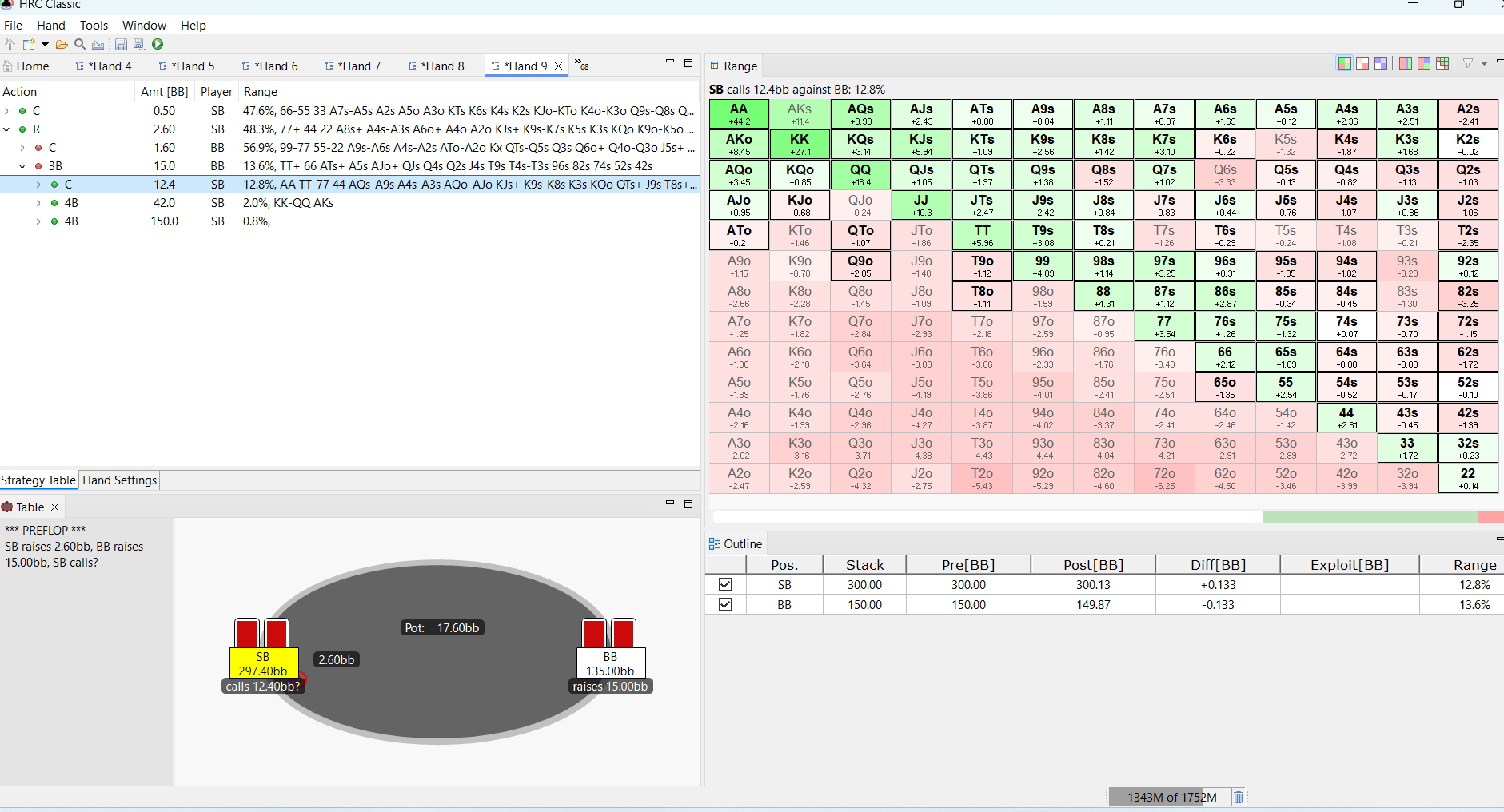
SB calling range vs BB 15 bb 3-bet
Tried to run it real quick before I leave for the tournament I'm playing today. Someone else can rerun it if they want as I'm a little rushed and couldn't get the settings quite right in HRC.
I forced SB to use OP's sizing and BB to only use the 15 BB 3-bet sizing. I figured if I allowed for a smaller more optimal sizing almost everything would end up in that category and the results for the larger sizing would be nonsense. I did not account for rake. I tried to set up a small SB 4-bet sizing but no matter what I was entering the sim was only allowing for a 42 bb 4-bet, which is practically committing. I'm not sure what I was doing wrong in the settings.
Anyway here's what I got, even though the results are basically meaningless. BB is actually 3-betting with that sizing using small fractions of tons of different hands including some weak ones. I would expect a human's range to be more nutted. Also the 4-bet sizing is probably skewing things. The sim has SB mostly continuing by calling and only 4-betting with KK, QQ and AK.
Take this for what it is. The question comes down to what does it mean when your opponent uses that size and what does their range look like?
For what it's worth I'm still responding with KJs by either calling or folding. I don't see the purpose of 4-betting, folding out all their junk and isolating yourself OOP against a nutted range.
Well one computer said I'm a genius and the other said I'm an idiot, who am I to believe?
My cope logic here is that the 42bb 4b size makes 4bing effectively untenable and is forced to predominantly call. Obviously flatting AA, QQ and AKo against a 16% 3b range is kind of a major redflag that something hinky is going on here. (Of course no rake will also lead to more calling, but not THIS much more).
I don't see the purpose of 4-betting, folding out all their junk and isolating yourself OOP against a nutted range.
This is the nature of linear play. The bottom of your range is functioning as neither an obvious bluff nor obvious value, but it has enough equity and blockers to fill out the bottom half of your range if the (predominant) alternative is folding.
We have K-high OOP against an uncapped range with 5 cards to fade and almost 10x the pot behind; folding out all the junk is an enormous source of EV.
At equilibrium it is incredibly unlikely to be folded... more 4b or call, possibly even 4b jammed vs. this large of a size, but at equilibrium BB is likely supposed to be incredibly polarized which does not happen in practice. This is not ran to high accuracy and is a simple tree, but this is about what I'd expect.edit:
Is that 150 bb effective with rake?
Weird how different the results are, even with the large 4-bet size in my sim.
Raise announced, my thinking was that our 4-bet range OOP would be polarized, not linear. Got to get back to my game but will look at this spot closer later
I think I made the 4b size very small (30bb), could influence the results some, but it is close to what id expect. Your sim looks like its HU, so make sure the positions are accurate.
There really isn't going to be much calling vs a 15bb 3bet and being OOP... so the 4b range is just going to be more linear. If I allowed a larger 4b sizing there would be more polarization, though for sure.
The sim I ran, which I've already deleted, was 3bb cap 5% rake.
I think I made the 4b size very small (30bb), could influence the results some, but it is close to what id expect. Your sim looks like its HU, so make sure the positions are accurate.There really isn't going to be much calling vs a 15bb 3bet and being OOP... so the 4b range is just going to be more linear. If I allowed a larger 4b sizing there would be more polarization, though
I already deleted mine too, but I think I see what I did now. I'm pretty sure my sim must have been assuming that it was heads up and the SB was on the button. That makes more sense that you would be mostly calling in position.
Anyway it looks like in your sim KJs is indifferent between 4-betting small, calling and jamming. It's interesting that the 150 BB jam with KJs in the SB is the most frequent response to the 15 bb 3-bet.
Jamming would likely be lighting money on fire vs. your average human player who is typically 3-betting with a stronger range compared to the solver.
In practice I do like the smaller 30 BB 4-bet sizing if you are going to 4-bet here. It might be reasonable to simplify your strategy by just 4-betting small or folding.
I'm pretty sure my sim must have been assuming that it was heads up and the SB was on the button. That makes more sense that you would be mostly calling in position.
Oook that makes a lot more sense because NGL I wasn’t buying my own “42bb is an untenable size” theory. 28% of your stack isn’t terribly committing.
I’m still surprised AA is flatting with 10x still behind but the QQ/AKo flats make far more sense IP.
Oook that makes a lot more sense because NGL I wasn't buying my own "42bb is an untenable size" theory. 28% of your stack isn't terribly committing.
I'm still surprised AA is flatting with 10x still behind but the QQ/AKo flats make far more sense IP.
Yeah I'm a little surprised by the AA flat too. We're calling 1/10 of our stack so combined with our opponent's chips it sets up an SPR of 5.
I'm guessing it's a combination of AA blocking his continuing range combined with an incentive to let his Broadway-type hands see a flop. Hands that would fold to our 4-bet preflop might stack off if they flop top pair.
Anyway that's my thinking. Things get a little wacky with deep stacks and wide ranges in these blind vs blind spots.
Yeah I'm a little surprised by the AA flat too. We're calling 1/10 of our stack so combined with our opponent's chips it sets up an SPR of 5.
That's still the largest SPR I've ever seen for an AA slowplay preflop. That's relying on a geometric size of over 60% over all 3 postflop streets to get stacks in.
My best guess is this is due to the extreme polarity of villain's range due to their sizing, which incentivizes IP to (as you said earlier) keep the junk in.
Always interesting to see what plays that are usually outside of theory (slowplaying AA with two raises left to get stacks in) become theoretical once villain themselves deviate from theoretical strats.
That's still the largest SPR I've ever seen for an AA slowplay preflop. That's relying on a geometric size of over 60% over all 3 postflop streets to get stacks in.My best guess is this is due to the extreme polarity of villain's range due to their sizing, which incentivizes IP to (as you said earlier) keep the junk in.Always interesting to see what plays that are usually outsi
That actually brings to mind another question that I've had for awhile. When we configure a solver to play against a suboptimal range, is what the solver does still considered "theoretical", or is the solver now reacting exploitatively to construct a strategy that is as positive EV as possible?
Theory is more a framework for forming a strategy than it is the strategy itself.
The abstractions made for the inputs into the sim are really the most practical element; for example, when you decided to just use one size for BB. Otherwise, the equilibrium to any strategy assuming full clairvoyance of that strategy is theoretical in nature.
It's when we account for the margin of error from incomplete information on our opponent's strategies, make simplifications for viable application, etc that we're applying practice to theory.
In that sense, GTO approximate strategies like range betting and range checking can be more practical than some hyper exploitative strategies that are, say, the actual equilibrium strategy in a nodelocked tree.
And of course there are any hosts of decision making frameworks that are entirely outside of theory.
That's not the most helpful language to use in most contexts, and no one should go around being pedantic about it in every conversation. But a lot of conversations in this sub will inevitably come back to questions about what is even under the purview of theory.


