Every Edge in Poker Is Information Asymmetry
If you strip it to first principles, every strategic edge in poker is an edge in information. Information Asymmetry drives positional advantage, polarization, indifference, board coverage, exploits, etc. Yes we almost never talk about it explicitly.
Positional Advantage = More Information.
Why is position valuable? Because you act on more information. While OOP must commit to an action immediately, IP gets to update their beliefs after seeing villain's action. IP is acting on a finer information partition, and this is inherently where the edge comes from. This forces strategic concessions, e.g. OOP will often range-check to minimize IPs information edge.
Polarization = Turning Villain's Hand Face Up
When you rep nuts or nothing, every bluff-catcher in the defenders range is effectively the ~same hand. The polarized player knows with certainty if they are ahead/behind, depolarized player is guessing.
Indifference = engineered uncertainty
Call just enough to make bluffing uncertain. Bluff just enough to make calling uncertain. The goal isn’t “balance” for its own sake, it’s to deny your opponent a reliable signal.
Exploits = harvested info edges
It's not just esoteric GTO concepts. Every exploit can be reframed as leveraging information advantage. Is your opponent underbluffing in this line? That's an information advantage. Does the population tend to check back this river too much? That's an information advantage. Exploits are just asymmetries in who has the better signal.
Board coverage = deny telegraphs on runouts
Board coverage is the trait of being able to represent the nuts on most runouts. If someone is obviously strong on some runouts and obviously weak on others, they're easy to exploit. A player with poor board coverage essentially has their hand strength given away by community cards.
Lookalike principle = blur blocker tells
Lookalike/mirror principle: Solvers minimize blocker weaknesses by making value hands and bluffs “look alike” (sharing blockers). This is just a fine-grained way of minimizing your opponent's information advantage (making it harder to use their blockers against you)
Bottom line
Are you starting to notice a common theme? Every edge in poker is an edge in information. That's where win rate comes from at the deepest level.
20 Replies

That's all true, but being able to utilize that information is more where the edge lies. I don't know if that is semantics or not really, but yeah. I think you boiling it down to first principles and arriving at this conclusion is really nice though as I never really thought about it from this point of view.

Yes, it's great to bring it all back to the first principles every now and then.
Saulo Costa made a good video about this as well.
*****************************
Is "knowledge advantage" included in "information advantage" here?
Because information about our opponent's range alone doesn't automatically lead to optimal play without knowledge how to leverage this information.
For example, if we play the nuts or air vs bluffcatcher toy game.
We know our nuts always win and air always lose in showdown, but even so it is not immediately clear for a beginner how to maximize the EV of this information over multiple streets.
You also need the knowledge that the geometric sizing sequence is the one that maximizes EV.
Is "knowledge advantage" included in "information advantage" here?Because information about our opponent's range alone doesn't automatically lead to optimal play without knowledge how to leverage this information.For example, if we play the nuts or air vs bluffcatcher toy game. We know our nuts always win and air always lose in showdown, but even so it is not immediately clear
Now that I think about, I guess the geometric sizing sequence is actually the sizing sequence that gives away the least total information.
Although there are infinite sizing sequences that can be made balanced when betting, they still give away more information in total, through our checking range.
When we bet, we always have a balanced range of nuts and air (villain is uncertain) and when we check we always have air (villain is certain). So when we check, we give away perfect information and it allows our opponent to play perfectly.
So we want to use the sizing sequence that allows us to bet as much air us possible, while remaining balanced, thus giving away as little information as possible through our checking range.
Example:
Spoiler
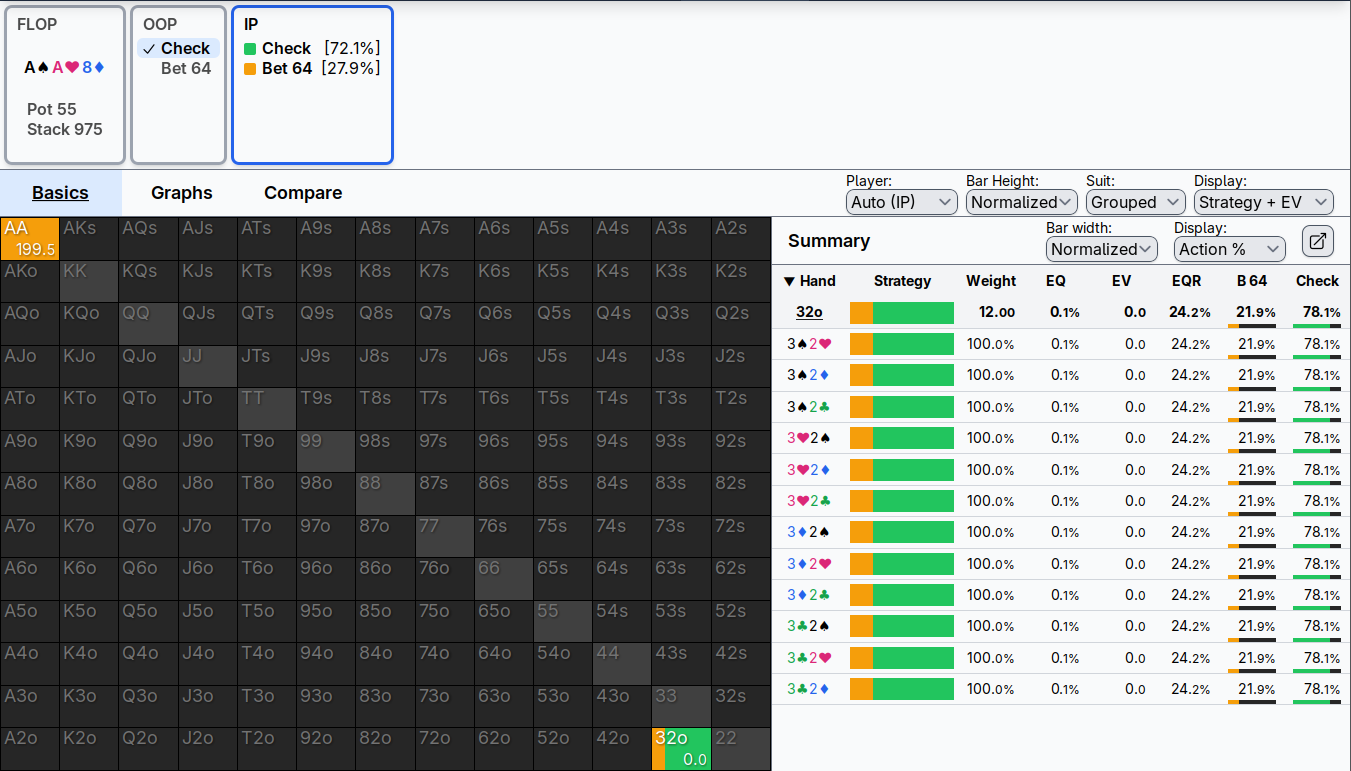
When we bet geometric, we are allowed to bet 21.9% of our air on the flop.
IP EV: 15.35
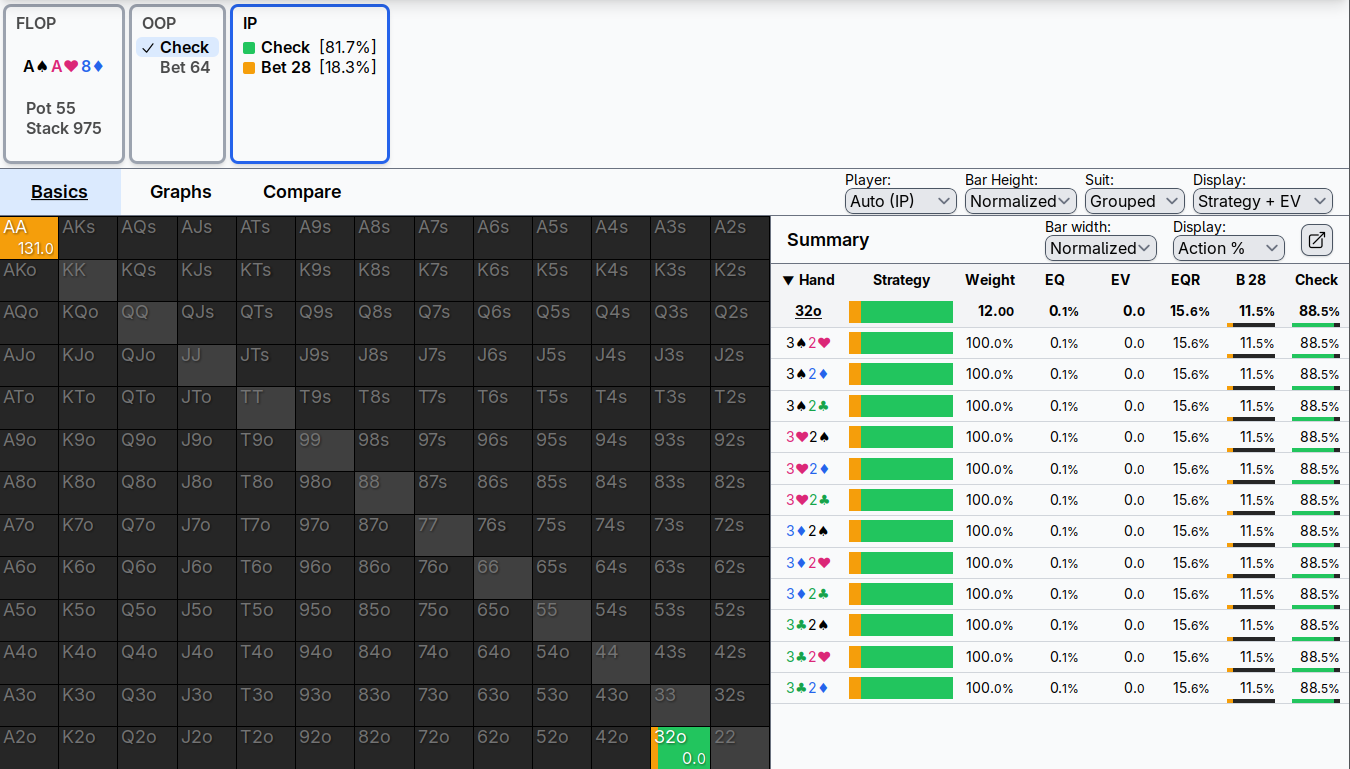
50% pot on every street allows us to bet 11.5% of our air on the flop.
IP EV: 10.08
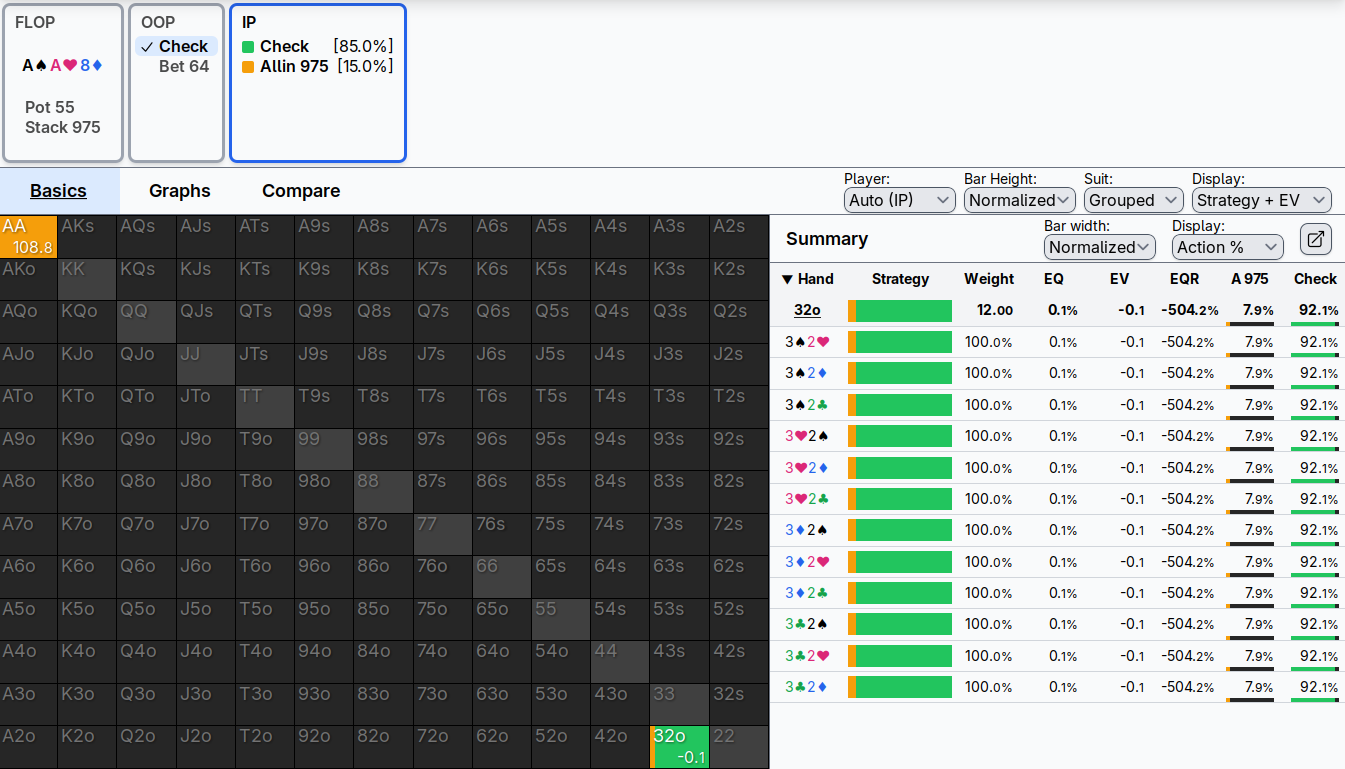
Going all-in on the flop allows us to bet only 7.9% of our air.
IP EV: 8.24

Define information really.
In biological game theory Donald Hoffman wrote an interesting book proofing how nature doesn't necessarily 'solve' for truth per se, it solves for fitness (propagation, environmental success etc). So by that logic it is at least conceivable that an edge could be created in poker by being a complete dunce who just figures out the correct way to crush his home game accidentally and then never plays again his whole life.
Or take a room of infinity monkeys, for example. Is time information? If your opponent is mortal it is!
Define information really. In biological game theory Donald Hoffman wrote an interesting book proofing how nature doesn't necessarily 'solve' for truth per se, it solves for fitness (propagation, environmental success etc). So by that logic it is at least conceivable that an edge could be created in poker by being a complete dunce who just figures out the correct way to crush h
I think the differentiation between poker and evolutionary solutions here is computational ability and what I would call "frame of reference". We can assume nature at large (not human engineered) has computational ability (I mean we've essentially proven it: theory of evolution via natural selection, quantum mechanics, etc.), but it lacks a frame of reference for what it's actually looking for in terms of an optimal, or any, solution. Evolution in this sense is like one big computing machine just spitting out random answers, throwing them at the wall, and by definition only what "sticks" (continues to exist within the confines of the universe), can be re-entered into the "machine", and all further "hardening" for fitness is based upon this already "proven" creature, and therefore must continue down a particular line of logic. But nature was never considering it's own goals (or lack thereof), nor was it considering it's own process and generalizations about truth at large. In poker, as in the rest of life, we can do all of that. So I wouldn't say that nature does not utilize information, but our own ability to possess a reference frame for information is 1. Qualitatively different, 2. Quantitatively different, and 3. Rather ironically, but quite logically, built upon this blind computing algorithm that is natural selection. In essence, it is quite possible that our home game idiot can crush the game via nothing but random chance, and the universe would reward this, and it in fact would be based upon his ability to process some amount of information, even if it is just some nonsense like "I saw Player A move his chips into pot like this so I bluff", but it is nonetheless fundamentally different than a higher order of informational processing that is essentially defined by goal recognition and mathematical universal abstraction. So information here as opposed to in our home game idiots strategy is defined as just: more and better and generalized.
As an interesting aside, considering what Hoffman showed, how crazily spot on was Nietzsche?



If edge is information asymmetry, what defines the "information symmetry" then ?
I think the main characteristic of NLHE is that it has countless anchor points. I don't know where this comes from, but it refers to theory, concentration, but also tilt.
Someone may have edge in information, but you can never be aware of that due to the fact that the game information is infinite in general.
That's all true, but being able to utilize that information is more where the edge lies. I don't know if that is semantics or not really, but yeah. I think you boiling it down to first principles and arriving at this conclusion is really nice though as I never really thought about it from this point of view.
100% agree. I'm being a bit clickbaity with this title. It's one thing to have more info about your opponent's cards, it's another thing to act on that information correctly.
For me this was kind of a eureka moment because it tied together a bunch of disparate concepts I had floating around in my head.
Yes, it's great to bring it all back to the first principles every now and then.Saulo Costa made a good video about this as well.*****************************Is "knowledge advantage" included in "information advantage" here?Because information about our opponent's range alone doesn't automatically lead to optimal play without knowledge how to leverage this information.For examp
Yeah same as above, I think there's a case to be made that there's a difference between having more information and using it correct. Like one is a signal the other is application.
Now that I think about, I guess the geometric sizing sequence is actually the sizing sequence that gives away the least total information.Although there are infinite sizing sequences that can be made balanced when betting, they still give away more information in total, through our checking range.When we bet, we always have a balanced range of nuts and air (villain is uncertain
Oh nice one! Yeah this theory encapsulates geometric sizing as well because you give up (turning your hand face up) less often.
Read an interesting article today that frames this nicely:
Edge = (My Information × My Knowledge) − (Opponent’s Information × Opponent’s Knowledge)
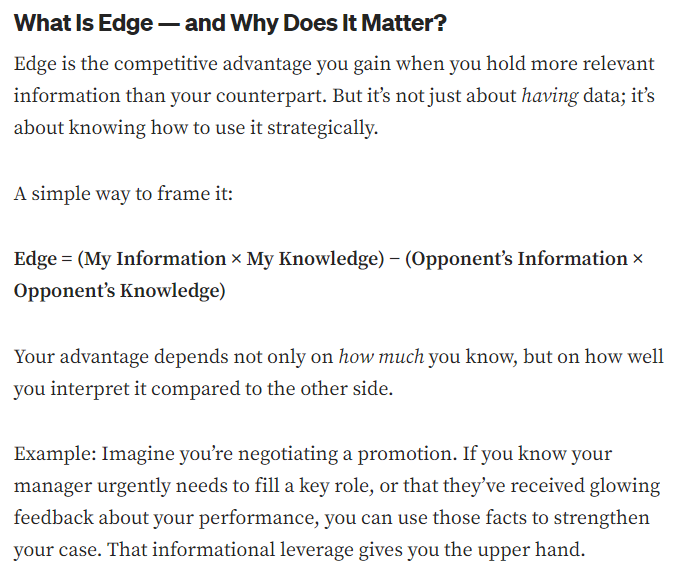
The equation you posted will be much more complex when you include and differentiate all 6 factors from post #1 in it.
The problem with listing categories or conditions is that it's very difficult to find a confirmation point that will tell you that the list is complete and not even 1 more category can be added to that list (of course, a very precise formula or equation could theoretically do that).
For example, I could add one more category to your list: "Reading and recognizing repeatable patterns in your opponent's style of play".
The equation you posted will be much more complex when you include and differentiate all 6 factors from post #1 in it.
It's an abstraction. No one is literally trying to calculate this, it's just a framework for thinking about where edge comes from.
The problem with listing categories or conditions is that it's very difficult to find a confirmation point that will tell you that the list is complete and not even 1 more category can be added to that list (of course, a very precise formula or equation could theoretically do that).
For example, I could add one more category to your list: "Reading and recognizing repeatable patterns in your opponent's style of play".
Sure, it's not a conclusive list. It's just examples of how information advantage manifests in poker. There are clearly other ways to leak info about your hand.
I'm not sure why you think it needs to encompass every possible example?
I feel you're missing the point.
Plus, the longer the list the more combinations there are for someone to choose from when he wants to adapt to it more accurately.
When you have 20 categories listed then someone has a ton of options which categories he can choose that interest him the most and precisely fit to his thinking. So then he can choose from that list for example number 4, 9, 12 and 18 because these are his strongest abilities which he's good at.
More options = more flexibility.
When i think about asymmetrical edge I think about this:

He looks like someone has jammed with a 4-bet right into his face.

I look at it like this. GTO ranges give off minimal amount of information by making a move ( calling raising or betting).
In reality, practical ranges are not perfectly balanced, so they give off more information abot what their likely hand is. This gives opportunity to use this extra info to gain an edge on your opponent.
Having polarized range or position is not truly an advantage, because player that is oop one hand will be ip next so he can regain all ev he lost. It's zerosum game at the end of the day.
Ofc you can gain an edge on opponents that just play badly. I guess you could argue this is also due to information asymmetry, but even if you put two random players that only know rules of the game and nothing else. One probably would have an edge based on IQ, talent risk, aversion ect, there is no information asymmetry in that case.
Real task for the player is to choose at which point he should sink in into the game analysis with strategic approach. And at which point come back to relaxed game. You can play a couple of hands just properly and on the flop of the next hand turn on your next gear. It's impossible to have that next gear switched on all the time.
What I mean by "next gear" - for example you can call pre-flop with some garbage hand that you should have folded and then on the flop / turn / river play it perfectly. Even if you lose this hand you can't blame your pre-flop call. Or you can play badly first two streets and then on the turn make a great play accompanied by a hero call on the river. These kind of situations can be caused either by the board cards or your opponent's mistake(s).
I would call this skill switching from A to B and from B to A game.
But there are so many anchor points to choose from that it gives me a headache.


