Villains Donking Into My Best Boards
Currently playing anonymous tables 5/10NL on Ignition. I’ve noticed a very popular strategy is for ppl to donk into flops that are theoretically my best flops when I raise Preflop and they call OOP. I’m uncertain about what the best way to punish this is, with no long term info on my opponents. I’m caught between three alternatives, and idk if some or all of them are correct/incorrect
1.) just play very strong and nutted hands and punish them with raises on later streets
2.) call down a bit lighter
3.) bluff raise flop more often
8 Replies
I just made a post that in short, is very similar to this in the NL online cash. I'm at an entire loss as to what to do in this. I'm basically even-ish for this entire calendar year (slightly ahead) as far as NL cash games because I keep running into this.
My theory is the way the REAL math is, its you vs the entire table, not you vs that one villain. And its near impossible to beat 5:1 or 4:1, however many are at your table. You can sit there and spot a plethora of mistakes their making and it doesn't seem to matter, because you have to get lucky that they are going to do that with you when you have it and they don't redraw out on you.
If you figure out how to do this, I'm all ears. Because I've been hammering at this for all of 2025
In addition, I've gone as far as to run my hands through ChatGPT and I'll have the vast majority of my hands rated perfect for human play or near it which is a 8 out of 10 or 7 out of 10. Nine and Ten are perfect for a computer. And my villains will be 6 or below. And I asked it, how can this be? If every time I run my hands and its perfect for a human, how can I keep losing? This doesn't make sense. All it does is spit back a dry answer "try playing premium hands" etc. It was of no help.
Thats when I came up with the "its actually me vs the whole table" theory.
I've dropped ALL the way to the bottom and played 2NL and I crushed the crap out of it. So the universe still works properly lol. Its just............theres something else going on here, something new. At leas to me it is.
I don’t play online but in my live games, it’s almost always villain declaring I’ve got top pair. They donk so it won’t check thru. It’s really exploitable as they turn their cards face up.
So, flop comes A5Q - villain donks, he’s got an ace. It could be any Ax but he has an ace. A small probe donk often is a weak ace that can be forced to fold.
When you float the donk, do they keep charging - I find they often check the turn, I bet pot and they fold. They are telling a story with the donk bet that should not throw you off your game. Keep looking for weaknesses.
I guess maybe there are some players online with no idea who has the nut advantage or range advantage on various run-outs.

Their strategy only works if you respect their donk bet. Their range is typically wide and full of nonsense.
1) Stand your ground. Call light, and bluff-raise aggressively over multiple streets.
2) Attack their checking ranges relentlessly. They cap themselves by leading strong hands sometimes.
Echoing Tombos' post, but also that you should pay attention to the donk size they go with - a small donk is likely attackable, but large donks could just be them telling you they ain't folding even to a flop re-raise and barrel off.
Once you get a read on what you think population is doing with their betsizing during the donk (e.g small donk = they will fold at some point to large aggression), it will tell you what to do with your value. It's certainly rarer for them to be small donking extremely strong hands, so to maximise value you probably want to keep aggression on future streets to something they could still call with a top pair (unless you somehow know they're a station), balanced against not giving them too good odds with any draw they might have.
This is an interesting question, and I've spent a lot of time thinking about it as well. I actually figured I should check what I've been doing facing flop donks myself, all boards included. I've basically been executing Tombos advice in practice, but mostly without any range heuristics, just making shit up on the spot. These have been in very soft games though.
[image]sYAo2YQ.PNG[/im
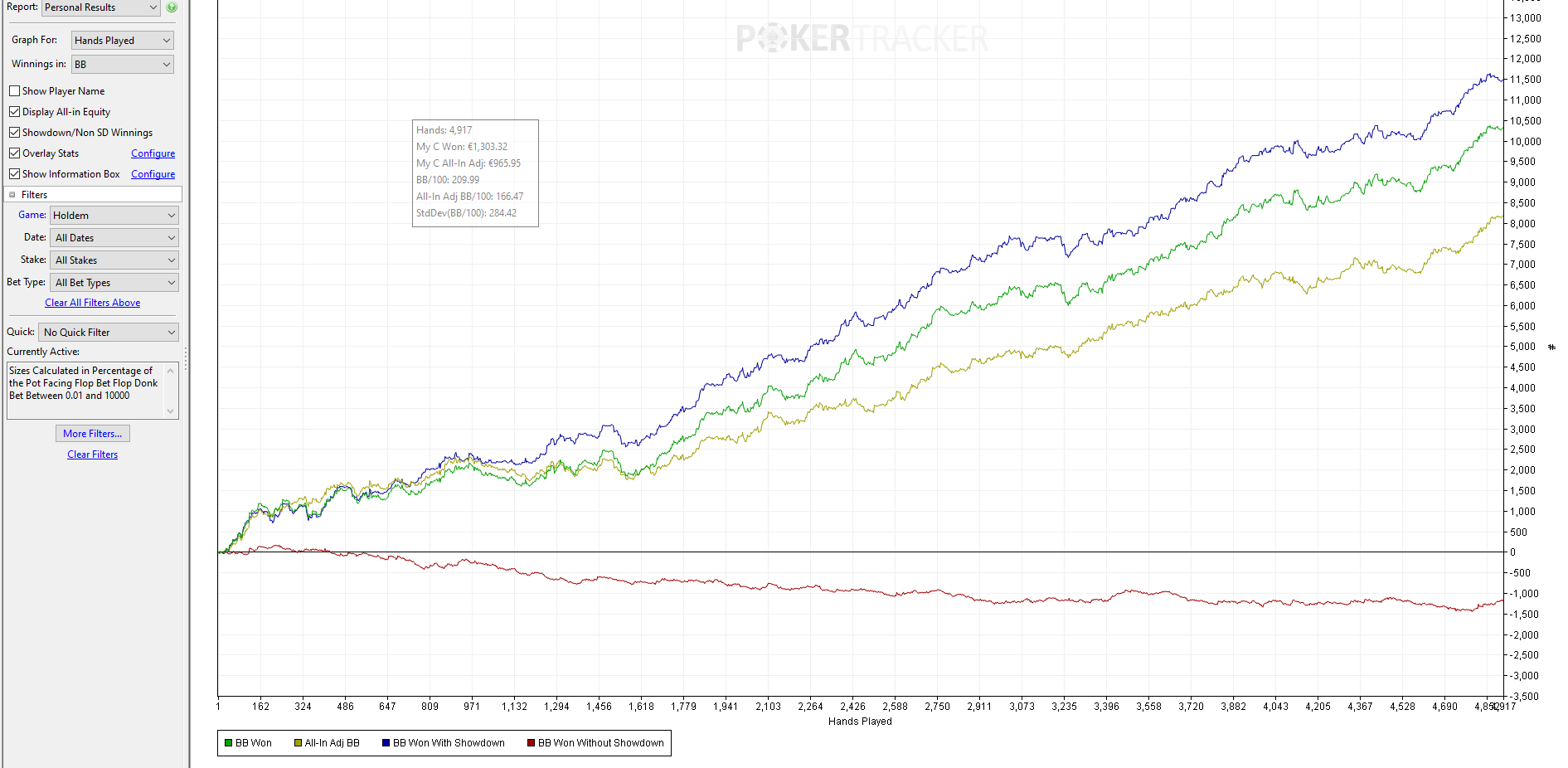
..]
Here are my response stats.
[image]9UxmHoN.PNG[/im
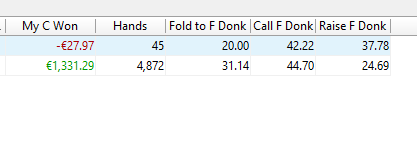
..]
I'm sure the raise percentage is closer to 50, probably even more on boards that are clearly "mine". Also higher in 3bet pots in general than SRP's due to an obviously stronger average range. There was a time when I did some node locking on maybe 20 or so different flops where leading any sizes should't be a thing, SRP or 3b+. What I noticed is that the IP charts go very red. Even more red if we node lock more folds against raises.
I didn't go into that rabbit hole much more after that, it just confirmed to me that pretty relentless aggression against them is justified, often with literal air, and decided I'll continue doing that.
Often just calling with a plan of bombing or just check backing to realize equity on later streets can be good as well.
I do pay attention to sizes and timings though, not every single pot is worth a fight.
Let them cook and put chips into the pot for free.
If the field is full of maniacs, I think it is better not to bluff raise unless you have a read that that opponent fold to raises like a normal person. Worse maniacs often just behave like calling stations or even go jamming when raised, so call by default and bluff based on an individual read.
Unless, of course, you have a hand that wants more chips into the pot, then of course raise and the opponent bets small. If the field is weak you generally are not required to balance those properly and even discouraged from doing so.
1 vs 2 depends on the donk bet sizing. Against larger donks go for 1, against smaller donks go for 2.

Replying mainly just to subscribe. I understand the theory like Tombos described, but in practice these spots are challenging.
I think it's just hard for humans to continue enough facing aggression. If you node lock a solver to see what the response should be facing a donking range in spots where there shouldn't be one, the response often involves aggressive raising, lots of calling and little folding. This is hard for humans to execute, especially with their weaker combos.
Add to this that we oftentimes don't know what the donk means, and that makes it especially challenging. Does the donk range include bluffs? Weak top pairs? Nutted hands? These things tend to vary opponent to opponent.
Anyway against weak opponents these weird donk bets are easy enough to combat, but I've started to see them occasionally from better players and I suspect some players are making these plays as exploits based on MDA. Like if they identify a spot where the field defends less than MDF vs a small donk bet it could become profitable to start donking even with a lot of trashy hands.
I'm hoping someone on here will have seen the type of thing I'm referencing and have some additional insights from MDA or their own analysis or whatever. In these situations a solver only has limited utility. The crux of the issue is that we have to identify what the donk range is to node lock it or whatever, but oftentimes the reality is that we just don't know.


