Better Understand Incentives to Bet Small and More Often vs Overbetting
Q - Why does As7d2s UTG vs BB overbets frequently but A72r doesn't?
UTG vs BB A72r:
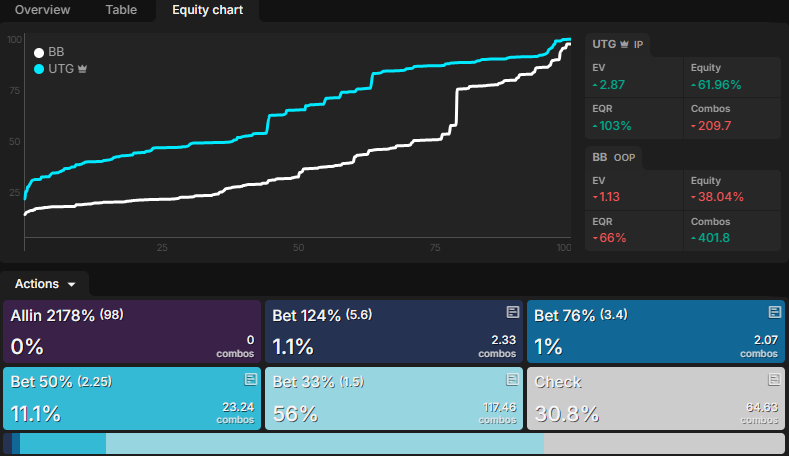
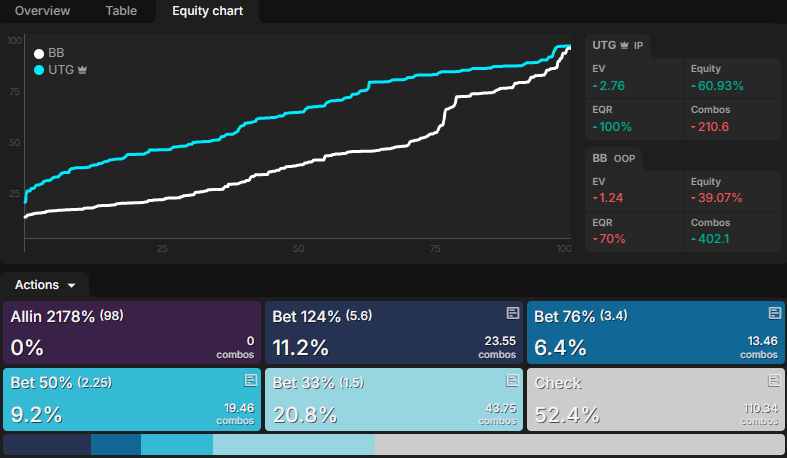
UTG vs BB A72tt:
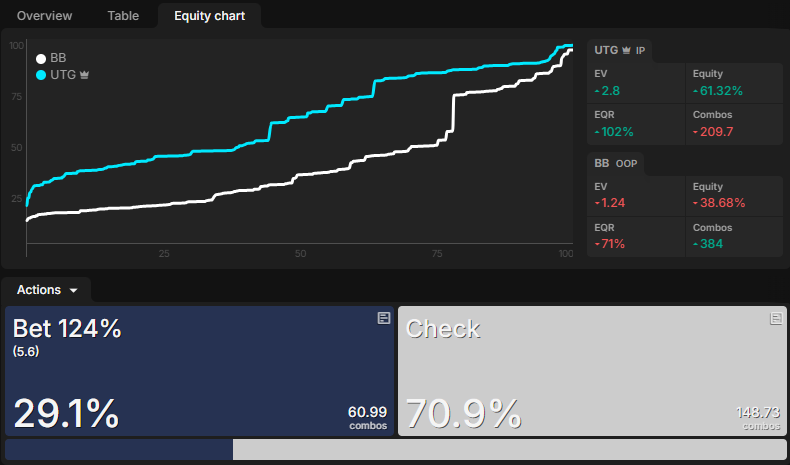
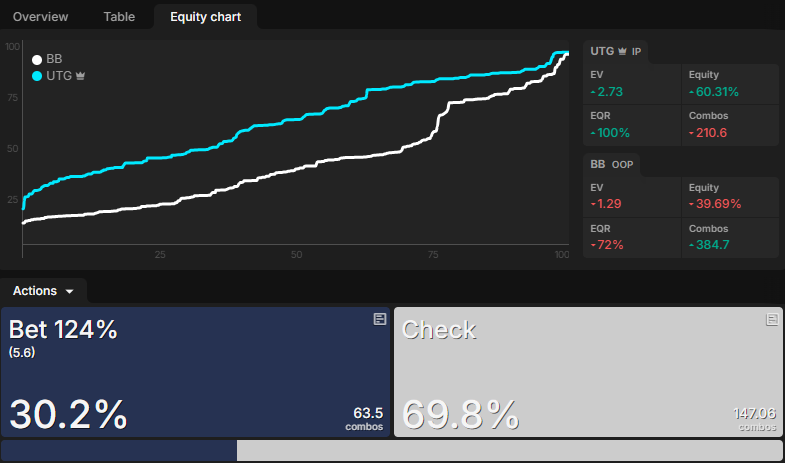
I tested what happens when you only let the solver overbet and not allow it to play any other sizes:
- The rainbow board and tt boards actually overbet at the same frequency. The tt board overbets 0.5% more often.
- The EV of the rainbow board for UTG drops by 0.03bbs while his EV on the tt board remains the same.
UTG vs BB A72r B125-only:
UTG vs BB A72tt B125-only:
We can come to the conclusion that it’s not that UTG can’t bet bigger on the rainbow board for whatever reason but rather that the smaller size has a higher EV- let’s try to test why.
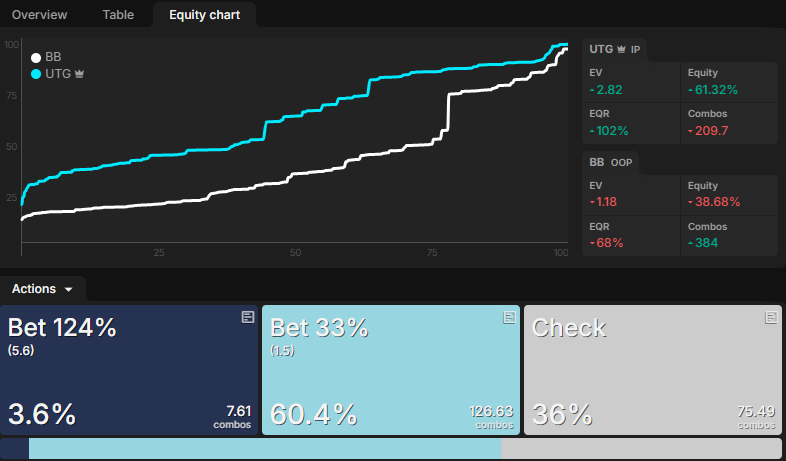
Seems like the size with the biggest difference in usage between the rainbow and tt board is B33. The rainbow board B33 50% of the time while the tt board only 20%.
I tested what happens when you let the solver overbet or B33:
UTG vs BB A72r B125/B33:
UTG vs BB A72tt B125/B33:
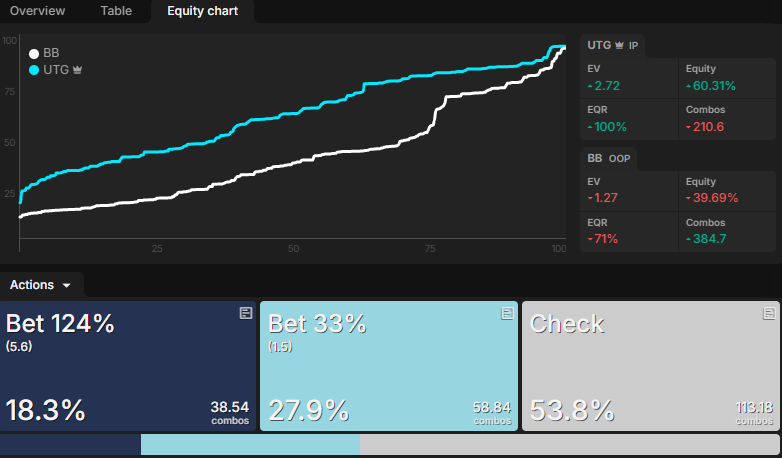
Here is my hypothesis regarding this behavior:
- The difference is that on the tt board the betting scheme is geometric while on the rainbow board the solver 2x pot the turn after B33 flop.
- On the tt boards, the solver prefers to put as much money as possible early because on part of the game tree a flush will hit which will prevent him from betting big later.
- On the rainbow board, this is a non issue so the solver prefers taking a small bet strategy that allows him to force Villain to see less turn - denying his equity.
I checked my hypothesis and in the tt Overbet/B33 line BB sees a turn 75.5% of the time after UTG's action and on the rainbow Overbet/B33 line BB sees a turn 69.7% of the time.
I also tried to see what happens when you reduce BB's nutted combos, I removed 22 and A2s from his range and BTN still only overbets the rainbow texture at a 1.8% frequency.
Insight - On textures where the IP player has a significant enough nut advantage where he can overbet he might still choose not to overbet if it will allow him to force Villain to see the turn less often. This however might not be the case in the presence of a FD that might make IP want to bet bigger so it grows the pot before the flush hits.
This made me doubt why BTN vs BB AT2r overbets often rather than using B33 more often, increasing his overall betting frequency and forcing Villain to reach the turn less often. So, I tried to see the solver output BTN vs BB when you nodelock it to use only B33 on the flop vs B33/B125 on the flop. Villain actually sees the turn more frequently when you only B33 the flop, making the overbetting strategy more attractive even on the rainbow board.
That leaves me with 2 questions:
1. Is my hypothesis correct on the A72 example?
2. If my hypothesis is correct, from what I can see, choosing not to overbet AT2r increases BTN’s betting frequency a lot less than it does in the UTG vs BB A72 scenario. However, I don't understand why that is the case and I can't seem to figure out how I can change BB or BTN rangess to make BTN prefer a smaller size.
4 Replies

I think part of the reason is equity and equity realization when called.
On A72r, villain needs to defend marginal hands like 66-33 and some pretty weak backdoor flush draw hands versus a small bet.
On A72tt, villain has a lot of flush draws he can defend with and can fold the random weak bdfd hands and 66-33 without a bdfd.
This means that our marginal hands (like 7x and 55) have better equity when called on the rainbow board, so they have more incentive to bet.
But when the incentive to bet marginal hands go down, we instead focus on extracting the maximum from our nut advantage.
Qing Yang made an interesting video:
Maybe this is saying the same thing as others have already said, but your cbet sizing (and cbet range) is different in these spots because villains continuing range is different. With the rainbow board, villain will continue with fewer hands but will have a stronger overall range (fewer draws and more made hands). Since villain will fold more frequently we want to bet more frequently. At the same time, when villain does call, we are more likely to have lower equity, so betting smaller makes sense.
As an extreme example, suppose you are playing heads up with a player who tells you outright - “it makes no sense to play garbage hands. I am folding everything but AA”. If you’re playing heads up against him, what’s your optimal SB strategy PF? Obviously it would be to raise ATC. He is folding 220/221 hands. Over those 221 hands you win 220BB. What about sizing? Well, since you know you will be folding if he reraises and winning if he doesn’t, only a minraise makes sense - it minimizes the loss when he does have AA.
Obviously thatÂ’s overly extreme and the difference in villains continuing ranges will be much more subtle than that, but the same principle applies. We bet more often because villain folds more frequently, but smaller to minimize losses when he does continue with a stronger range.
I think part of the reason is equity and equity realization when called.On A72r, villain needs to defend marginal hands like 66-33 and some pretty weak backdoor flush draw hands versus a small bet.On A72tt, villain has a lot of flush draws he can defend with and can fold the random weak bdfd hands and 66-33 without a bdfd.This means that our marginal hands (like 7x and 55) have
Wow, I wished I watched this video before. Yeah it answers my question exactly and throws my hypothesis out the window. Thank you for sharing!
Phrasing it simply, betting B33 isn't profitable with as much hands on the tt board as opposed to the rainbow board. The abundance of hands that want to go small on the rainbow board due to the fact they benefit from protection, drag the strongest hands of the range to the smaller size for protection.
Interestingly I tried to see if I can manipulate AT2r BTN vs BB to prefer B33 over B125 by adding more Tx to the BTN's range but the BTN mostly checks his Tx and still massively prefers to overbet. I compared AT2r to A92r and saw that A92 rainbow prefers B33, which was confusing to me but you see that the solver does bet his 9x combos rather than checking them (like it does Tx on AT2). I then removed 99 from BB's range (to make it function like AT2 in terms of nut advantage) and the solver started over-betting 1.9%, as opposed to 0.3%, but still way less than AT2. I then removed all 9x from BTN's range and solver started over-betting 8.8%. This supports the case in the video, the more middling hands you have that gain by betting and folding out your opponent the more you want to bet small which drags your top of range to the smaller sizes.
However, why protecting a 9-pair is more important than a T-pair? If anyone has any idea why that is, it would be much appreciated if you could share. However, I'll still try to hypothesize... Perhaps there is "vulnerability threshold" between 9 and T, 9x holding are considered vulnerable while Tx aren't as much, this is why the presence of T-pair has a lesser impact on the overbet strategy.
Also, while 8.8% overbeting is a decent frequency, it still doesn't compare to the 19.2% that the BTN overbets on AT2r (in my custom solve, only B33/B125) without meddling with the ranges. This is despite I the but advantage in my custom ranges make BTN's nut advantage similar to what it was on AT2r. Again if anyone has any idea why that is it would be great.
Maybe this is saying the same thing as others have already said, but your cbet sizing (and cbet range) is different in these spots because villains continuing range is different. With the rainbow board, villain will continue with fewer hands but will have a stronger overall range (fewer draws and more made hands). Since villain will fold more frequently we want to bet more freq
If I'm interpreting the video sent here correctly, I think the idea is a bit different.
BB defends at the same frequency when you B33 on both the tt and rainbow board. Betting small on the rainbow board doesn't force him to fold more frequently because he doesn't have enough good hands. The solver will just call with weaker hands.
Rather, some of the hands I can bet profitable on the rainbow board can't bet profitably on the tt board - "enabling" the best hands in my range to go big.
In the AA example you gave it makes sense to go as small as possible because we don't need to go bigger to make him fold so it makes sense to risk as less as possible.

