How to study rivers?

Do you guys have any systematic approach to study rivers? What lines, textures and formations are most important?
River mybe is most important street to study, yet me and it seems most regs spent very little time studying in comparison with other streets.
6 Replies

I think all streets have the same importance. Maybe people study rivers less precisely because they appear less often than other streets, plus the number of combinations is much bigger than other streets - almost impossible to control. Too many scenarios possible.
I think qualifying each river card as "good" or "bad" or "safe" or "not safe" is a skill that is very helpful and can be fully controlled.

Do you guys have any systematic approach to study rivers? What lines, textures and formations are most important?
River mybe is most important street to study, yet me and it seems most regs spent very little time studying in comparison with other streets.
If we ignore raises or the bet is all-in, a called river bet will be a closing bet so there is no need to think “what if?” for the hand, You will either win or lose.
Therefore, if a reasonable estimate of your card equity can be made!!!!, does not the call/fold decision be a purely EV one, adjusted, if necessary, by such factors as stack size, villain type, tournament standing, etc.?
If hero is the bettor, he should bet an amount, if possible, to make villain indifferent to calling or folding, or not give him the pot odds to make a profitable call.
EVfold = 0
EVbet = eq*(Pot + Bet +Call) - Call, (Call <= Bet)
Call if EVbet > 0 or eq > Call / (Pot + Bet + Call)
Including a raise in response to an opponent bet adds complexity that I’d rather not deal with.

Scattered aggression lines probably, like B-X-B or X-B-B, where ranges are annoying and having some muscle memory of how to split and adapt would be useful. Also 3bps where ranges are more defined.
But I don't really understand the concept of isolating streets to drill in isolation. Spots and lines, yes, but then you're going to want to mix up turns and player types/ranges or you're just learning increasingly less relevant GTO for no great reason.

The best approach I've tried is to separate spots by the importance of the lines (avg pot size * frequency of spot). That gives you a nice quantitative way to rank the relative importance of different betting lines that lead to the river.
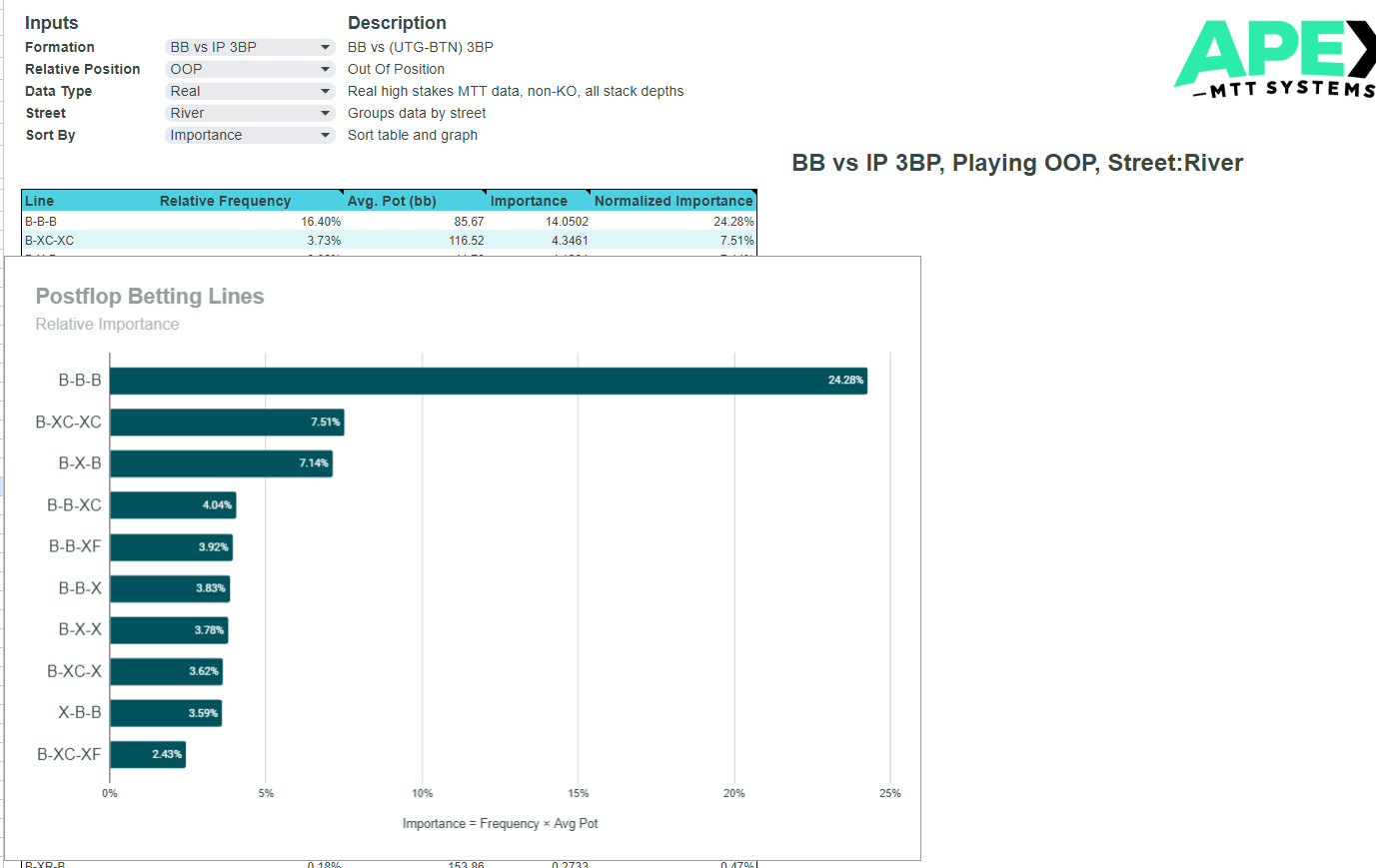
From there I create a GTO Wizard drill customized for that specific betting line. Then I can study a ton of spots quickly until I find trends.
I've been meaning to try systematically categorizing river textures as well. There are a few nice ways to do this using standard bucketing methods. But I've never really tried to formalize it. Hopefully one day soon.
The best approach I've tried is to separate spots by the importance of the lines (avg pot size * frequency of spot). That gives you a nice quantitative way to rank the relative importance of different betting lines that lead to the river. From there I create a GTO Wizard drill customized for that specific betting line. Then I can study a ton of spots quickly until I find tren
This is what I looked fore. Ty TB. It somewhat confirms what I thought most important lines are.
For river texture is not super important but that is one way of looking at it. ALMOST all river dynamic is determined by Equity distribution, blocker effects and SPR.

The above is a great way to start.
1. Break it down by line
2. Break it down by archetype (fish/reg)
3. Break it down by sizing
4. Break it down by texture
Your options vs. a bet on a river are call, fold, or raise so the simplest way to study facing a river bet is asking yourself if they bluff enough to call everything (go through 1-4), then evaluate if they fold enough vs. raise to justify bluffing everything with 0 equity.
Your options as the aggressor OOP or when they check to you are either to bet or check behind. You go through 1-4 again and identify if they are overfolded or not.
I'd focus on (1) and (2) primarily as (3) and (4) have a lot of variables. For some of (3) and (4) you can draw broad conclusions and make simplified strategies as long as they pertain to ~90% of the situations. What I mean to say is that maybe they over bluff on flush completing rivers, but not when X Y Z was turn or if exact action went a specific way, etc. it's a bit easier to simplify your thought process to always call in this scenario rather than really get very granular in the specifics because it is very easy to get lost in the sauce.


