Why Does the OOP Aggressor Bet Larger on Average Than the IP Aggressor in K-High Board 3BPs?
I have been studying K-High boards in 3BPs and noticed an interesting trend.
It seems like the SB in SB vs LJ 3BP, utilizes on average more large sizes in its c-bet strategy than CO in CO vs LJ 3BPs on K-High, disconnected, non-paired boards - K/9-2/9-2.
What I found interesting is while you can clearly see larger sizes being used at a higher frequency, the overall betting frequency doesn't drop at the same magnitude. It would have made sense to me if the SB as the aggressor would have less hands that can bet small due to being OOP so less hands can bet small thus "freeing" more value hands to bet bigger and get more value. But, like I said the shift towards bigger sizes isn't reflected in the checking frequency.
Additionally, intuitively there is only a slight difference in the range vs range morphology of SB vs LJ 3BP and CO vs LJ 3BP. This makes me believe that position is the main factor that changes the bet size frequencies.
Essentially what I am claiming is that on K/9-2/9-2 (Disconnected, not-paired) boards bets the same hands but bigger when OOP as opposed to IP.
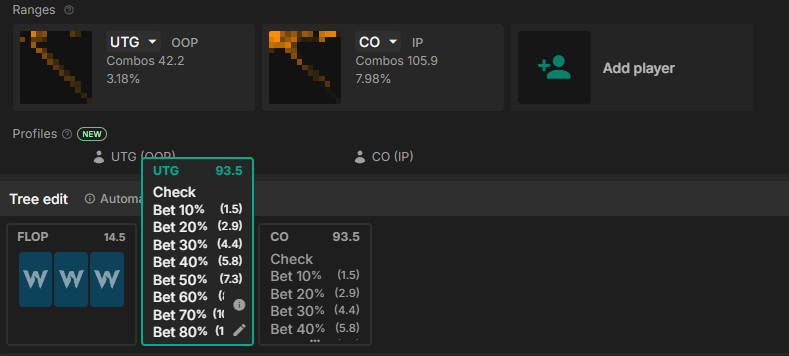
Here is an experiment I ran. I used GTOW AI, took the NL50 GG GTO solution CO vs LJ 3BP.
I custom solved this spot on K52r, using the automatic option. I allowed the CO and LJ to pick any flop bet size out of: B10/B20/B30/B40/B50/B60/B70/B80:
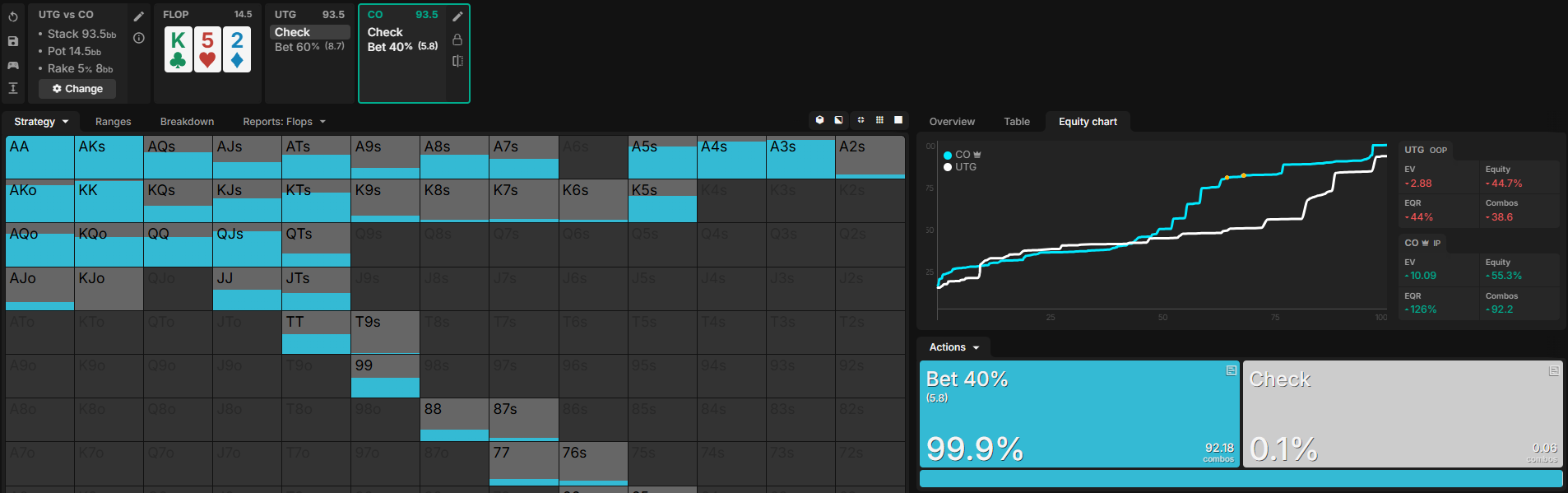
LJ checks range and CO bets range for B40:
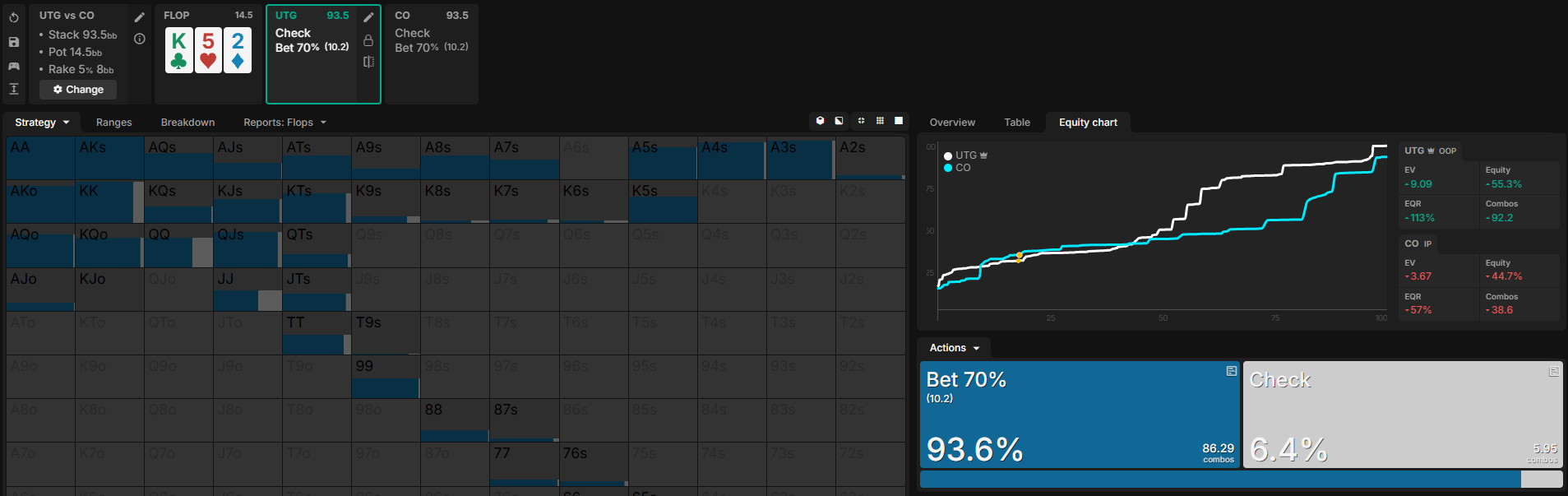
Now using the same configuration I switched between CO's and LJ's ranges, now the OOP player has the CO's 3B range and the IP player has LJ's call-vs-3B range. Here is the c-bet strategy for OOP, OOP now bets B70 instead of B40 but only checks 6.3% more often:
I would appreciate help with understanding why the solver is more incentivized to bet big OOP because I can't come up with reasons behind why the solver behaves the way it does in this experiment.

