I don't understand why GTO Wizard fasts plays sets...
I'm new to solvers and a long term crusher at LLSNL. The main question I ask is what is my bet getting value from?
Solvers will fast play top sets on dry boards and now I'm at a loss of reasoning. Does are opponent often have enough equity to handle immense aggression early on when we block a lot of what they could have?
here's a Negreanu video of him slow playing a set, and his logic to me is 100% correct, it was 15 years ago, and it is still true today, at least to my logical game playing brain.
Daniel Negreanu slow plays a set and gives logic:
https://youtu.be/RkLFZAGO7HA?si=XpILvitJMJsQx8af
but the solver would tell us both we're neophytes at poker...
slow playing disguises our hand, allows players with strong hands to build pots for us, with weak hands to bluff us, and we're not worried about blocking potential value hands.
I was playing clubwpt recently, and it seemed like when I ever fast play sets, I lose value and people fold hands with equity, and when I slow play them, I get super paid. same as always. I'll keep experimenting with fast playing sets, but I don't see why I'm fast playing or what is the point.
6 Replies

The old school logic was that you should slow play because you don't have natural semibluffs. If you raise, you're only representing strong hands, so you don't extract enough money.
- But here's the issue with this logic: if your opponents are over-folding to a check-raise, then you should start check-raising with all your bluffs instead.
- Ok, but if you constantly check-raise bluff, then they should start defending more.
- Ok, but if they're defending more, then you should start check-raising your sets and two pair more.
- ...and round and round it goes until you achieve a balanced strategy.
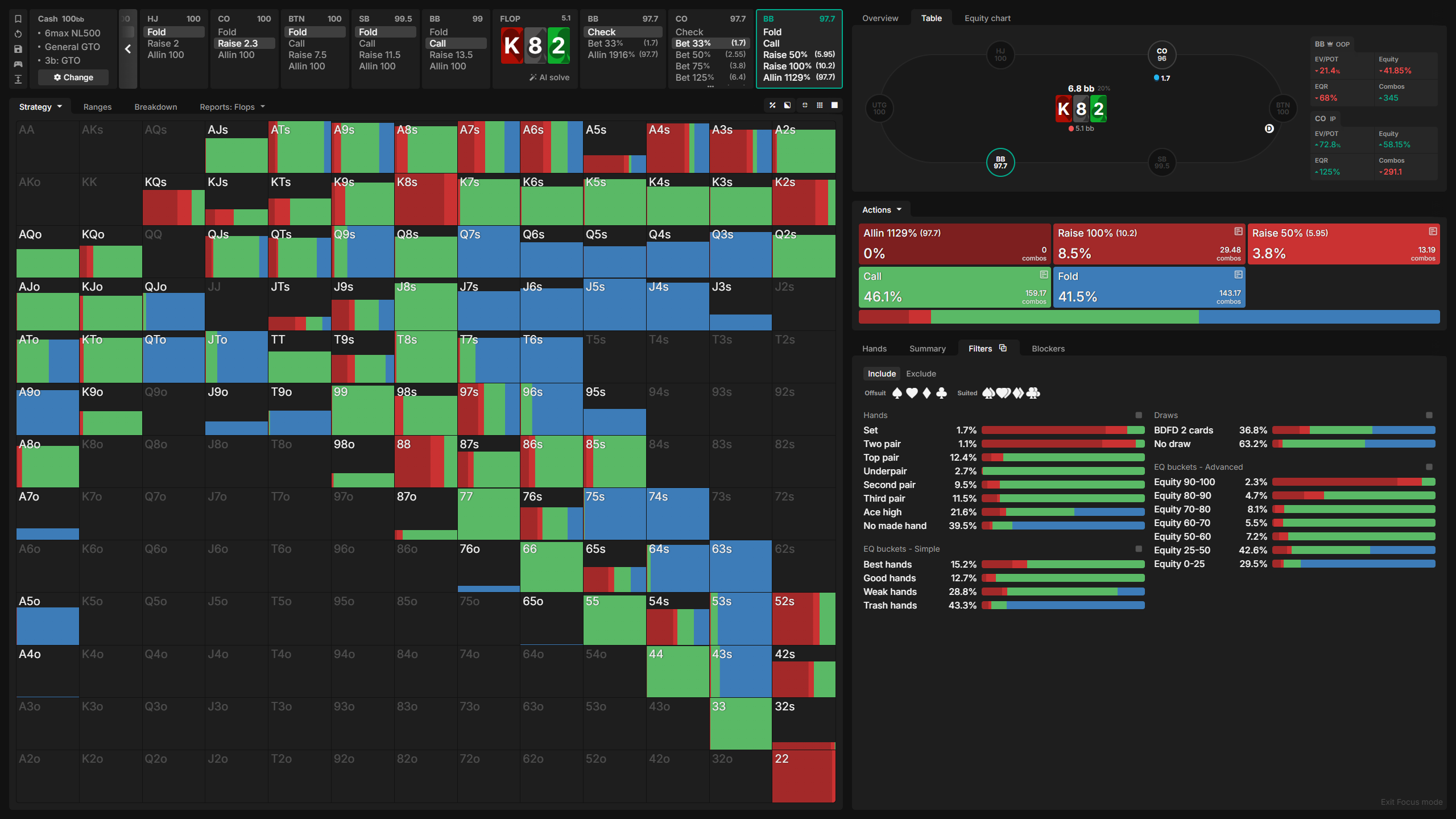
The trick is to get creative with your bluffs. Bottom pair can be a semi-bluff (drawing to trips and two pair). Ace high with a BDFD can be a bluff. BDSD+BDFD like 65hh or JTcc in this example, can be a bluff.
thank you. great explanation and even a beautiful description of the process of obtaining equilibrium through trying to exploit each other in the context of having sets and bluffs in our range.
So in GTO land I can still ask the question, what is my hand getting value from? and the answer is from my "my bluffs, and we got em!".
For humans who still overfold to aggression in lower stakes, to maximize value from our current set, we still can slow play much more than the solver, because until opponents adapt, they will continue their overfolding tendency. This is our imbalance to maximize value from them.
thank you. great explanation and even a beautiful description of the process of obtaining equilibrium through trying to exploit each other in the context of having sets and bluffs in our range.So in GTO land I can still ask the question, what is my hand getting value from? and the answer is from my "my bluffs, and we got em!". For humans who still overfold to aggression in lowe
This is a perfect summation. Ideally, your bluffing percentage should be high enough that you are getting called on dry boards with a set.
That said..... at lower limits (or at tables where players are less adept at adjusting), slow playing might be more profitable.
Ultimately, this is where the difference shows up between players who play pure basic GTO and those who are skilled enough to make adjustments.
As explained to me, the idea is you target the next best hand and use big sizes that hand would call. Though they will fold much of the time, when they do have a strong hand you win enough to make up for all the small pots previously.
That’s the logic, and I guess you don’t get coolered as often when making big bets. Maybe that makes it worth it.
I think you have to ask what does solver expect villain to do and is that even close to what the population would do. Sometimes slow playing seems so clever, when fast playing just prints more in the long run.
New GTO Wizard video out about this topic. Uri's always a treat.
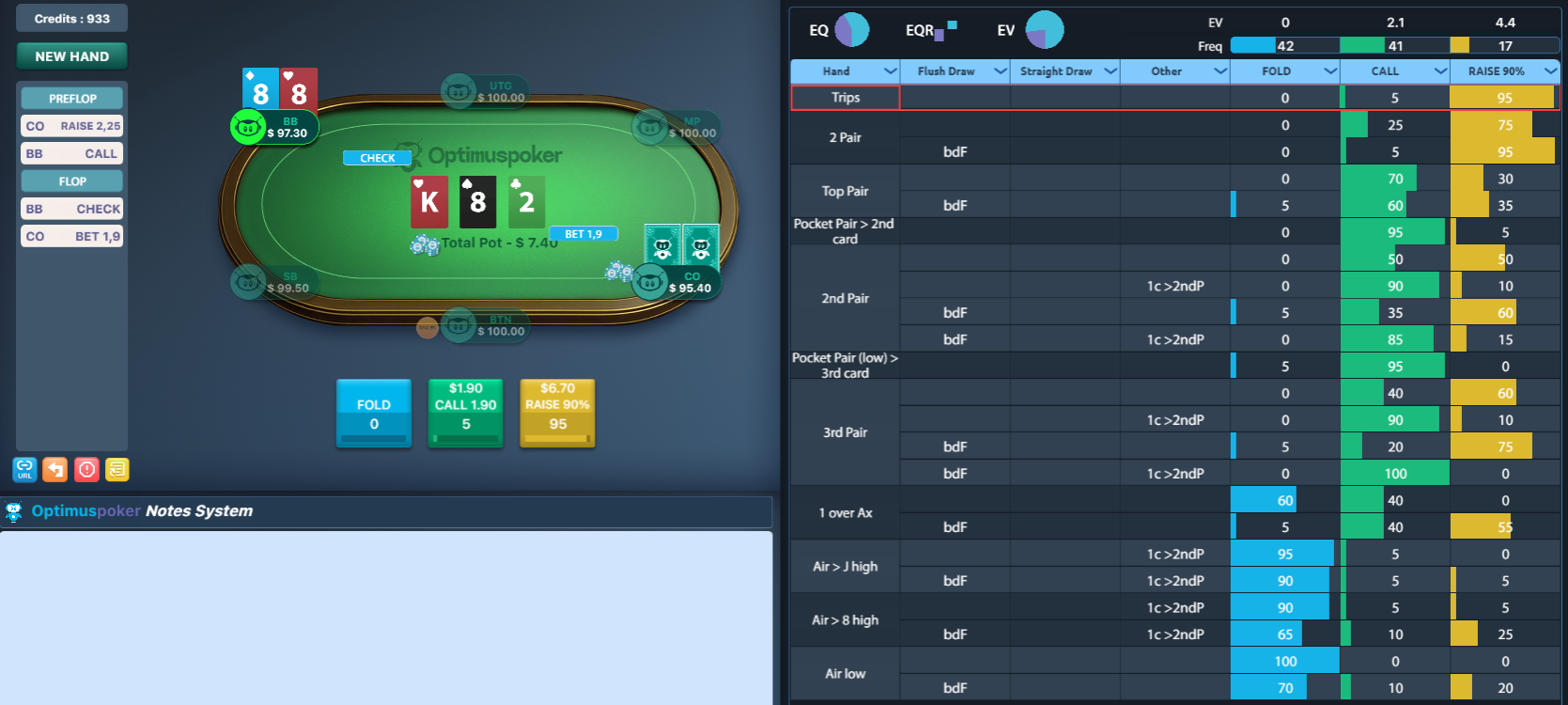
Yo! So, check this out : when you're sitting in the BB on a bone-dry board like K♥ 8♠ 2♣ and you flop middle set with 8♦ 8♥, you're basically in "lockdown" mode. Since there aren't any real straight or flush draws to worry about, your main goal is to start building a massive pot immediately.
If the In-Position player stabs with a small 33% pot c-bet, the solver says you should be check-raising (XR) that set almost every single time (like 95%). You're looking to get max value from their Top Pairs like K♣ T♠ or even some sticky Ace-high hands before the board gets more coordinated on later streets.
But here’s the cool part: you aren't just doing this with the nuts. To really punish those small bets, you’ve gotta balance things out. The strategy uses a polarized XR range. You’re raising "mercy" protection hands like 8♣ 5♣ or even 4♦ 2♦ at a high frequency (50–60%) just to deny equity to their overcards. Toss in some bluffs with backdoor potential, like A♣ 3♣ or low air with backdoor flush draws (around 20–55% of the time), and you’ve got them in a real blender. They’re stuck deciding whether to float with marginal garbage or just fold and hand you the pot. It’s a great way to take back the initiative!


