Why is the solver doing this?
I am relatively new to solvers and came across a sport that has left me confused. The scenario is UTG vs BB SRP 100bb, flop is 654r. Although BB has a high frequency bet in this spot (67%) I was interested in looking at what happens when BB checks and how UTG responds. On simplifying slightly, UTG takes a strategy of 50% check, 50% 1/3 pot. What left me confused was the choice of hands UTG is choosing to bet at a high frequency. Apart from stuff such as sets, 77-99 and A6s - A3s, UTG also chooses hands such as KQo, KJo, QTs, Q9s, JTs, J9s, which to me seems quite strange. I then had a look to see what BB response is to a 1/3 pot bet from UTG, and almost all the hands that are folded are exactly these sort of hands, all done at almost a 100% frequency. I was wondering if this had anything to do with it, or rather is it just a matter of pulling from the bottom of their range for hands to throw in the bet bucket alongside their value hands? Any help would be appreciated.
4 Replies

What would you expect UTG to use as their bluffs? They have few hands that connect with this board, but still have a strong overall range with all the overpairs.
So it makes sense to balance betting their strong overpair+ hands by also bluffing with overcards that have little showdown value and six outs to BB's one pair hands.
In this case blockers are not entirely relevant. Basically any hand bad enough for UTG to use as a bluff is going to be something BB likely folds to a bet.
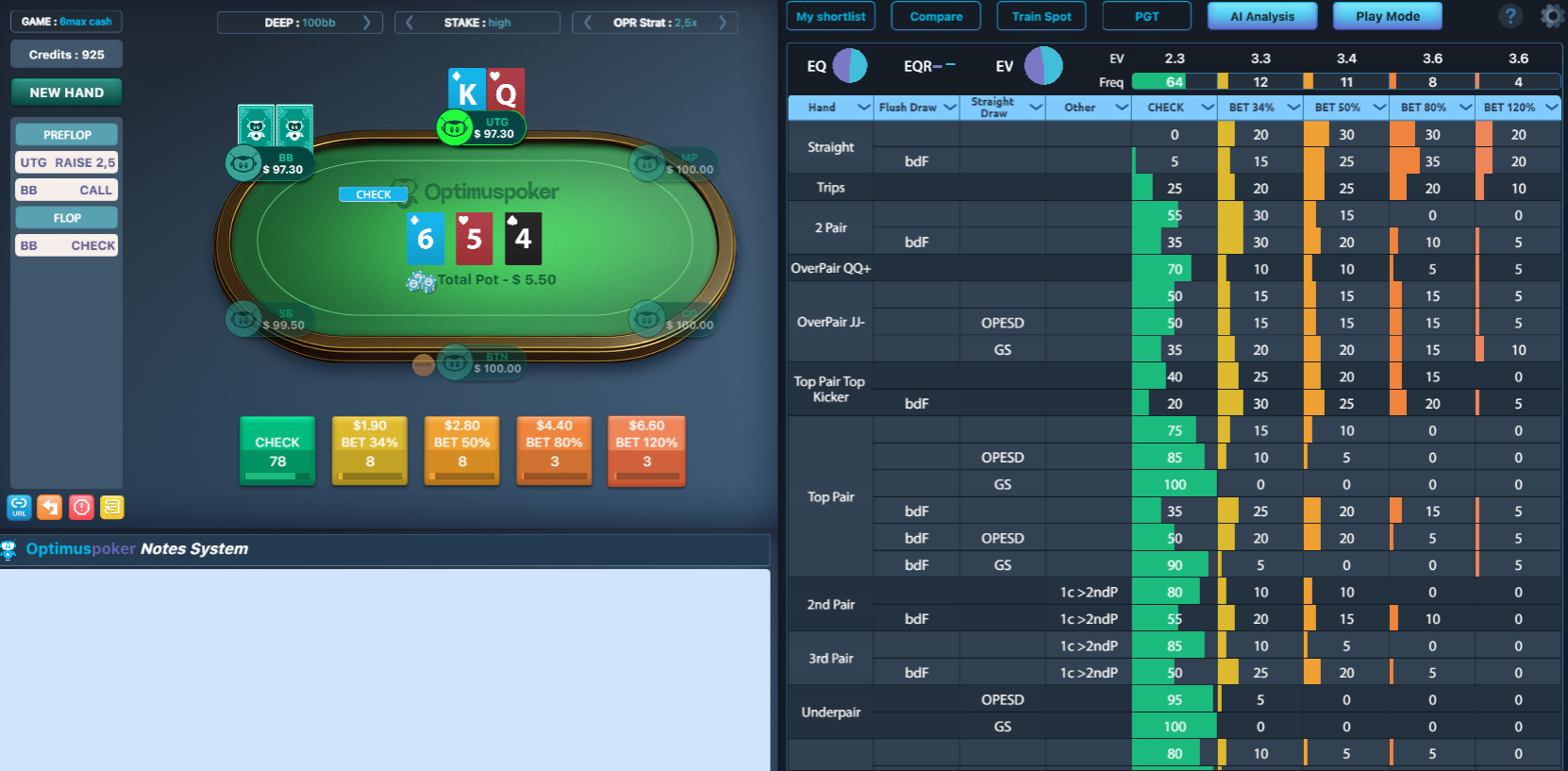
CB strat in 654rb UTG vs BB SRP (source : optimuspoker.com solver)
UTG player faces a low, connected flop of 6 5 4 rb after being called by the Big Blind. This specific board texture is significantly more favorable for the defender's range than for the initial raiser. While the UTG player retains a "nut advantage" with the strongest overpairs (AA, KK), the Big Blind possesses a much higher density of straights (87s), sets, and two-pair combinations that connect with a standard defending range. Due to this range disadvantage on low, "middling" textures, the optimal strategy for UTG is to check back at a very high frequency (78%) to protect their range and avoid being over-exploited by aggressive check-raises.
For this specific hand KQ, categorized as "2 overs Kx, " the strategy is primarily to check. This hand has two overcards and a backdoor flush draw but lacks the immediate strength to bet for value or the raw equity of a direct straight draw to be used as a primary bluff. By checking back, the UTG player realizes equity by seeing a turn card for free and can potentially improve to a top pair that functions as a strong bluff-catcher or a thin value bet on later streets. When the solver does choose to bet on this texture, it utilizes a wide variety of sizes, including large "polar" bets of 80% or 120% pot, to maximize the pressure on the Big Blind.
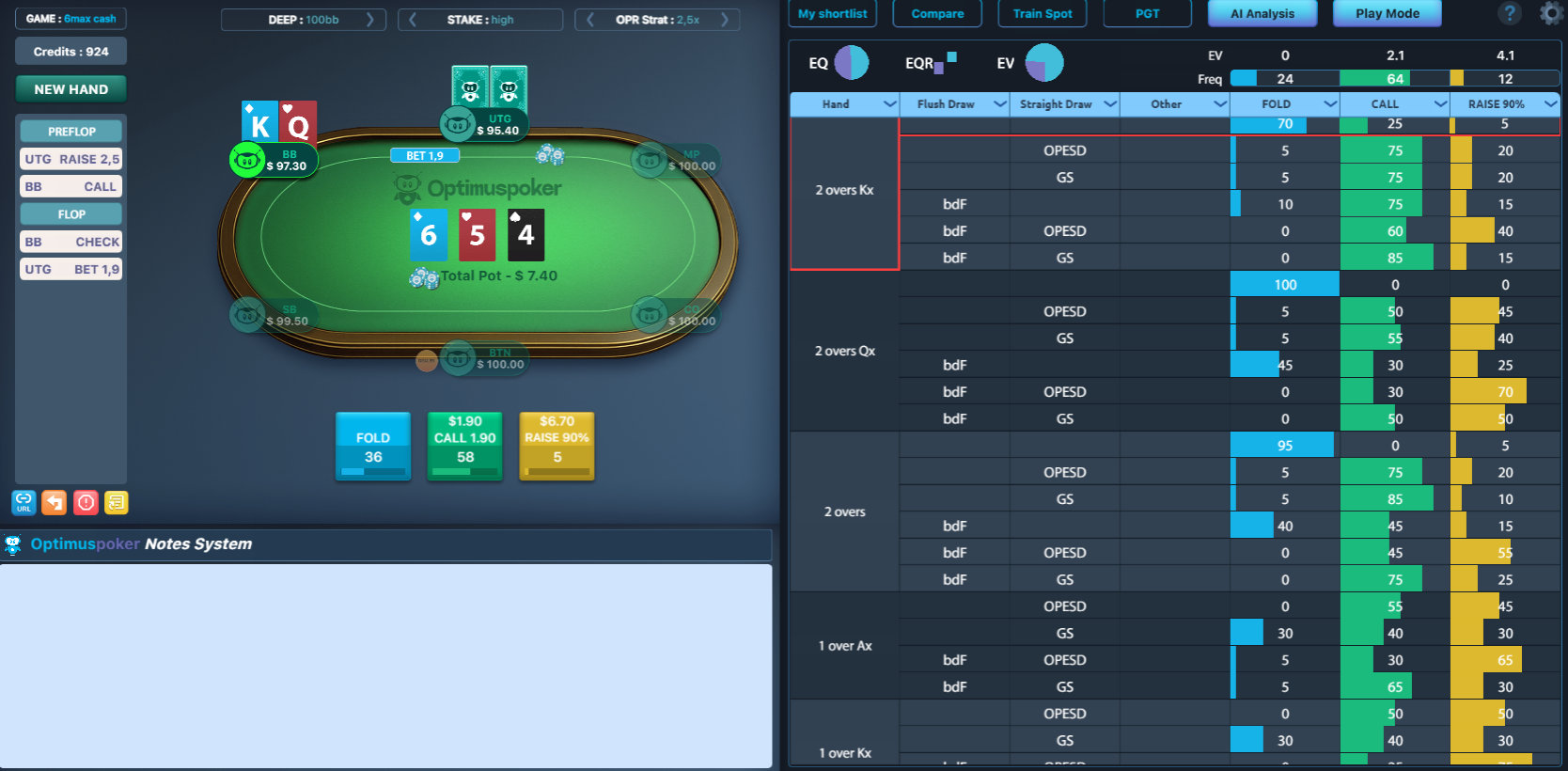
same spot BB vs CB33%,
Optimuspoker says BB has a "nut advantage" because their range contains many combinations of straights, sets, and two-pairs that a standard UTG opening range typically lacks. To capitalize on this, the BB strategy employs a highly polarized raising range. Nutted hands like straights (3♣2♣) and trips (6♥6♠) raise at frequencies of 95% and 55% respectively to build the pot immediately and protect against the many "scare cards" that can shift equity on the turn.
To balance these value raises, the strategy selects semi-bluffs from hands with significant drawing potential. Hands such as Qx or Kx combinations that hold an Open-Ended Straight Draw (OESD) or a Gutshot (GS) are used to pressure the UTG's overcards. For example, Q♠7♠, which has both an OESD and a backdoor flush draw, raises 70% of the time. Medium-strength hands like overpairs (9♥9♠) and top pairs (A♠6♣) primarily call (90–95%) to protect the BB's checking range and prevent the opponent from over-bluffing.
CB strat in 654rb UTG vs BB SRP (source : optimuspoker.com solver)UTG player faces a low, connected flop of 6 5 4 rb after being called by the Big Blind. This specific board texture is significantly more favorable for the defender's range than for the initial raiser. While the UTG player retains a "nut advantage" with the strongest overpairs (AA, KK), the Big Blind possesses a
Did you have AI write a response, and then "humanize" it? Haha.
Not that I'm disagreeing with most of what you posted. Your explanation just seems a little TOO cogent.
To the OP, you do want to be checking a lot as the pre flop aggressor here due to the board connecting well with the BB range. Hands with showdown value such as strong Ax and KQ are going to be checking more compared to weaker overcard hands that will have more incentive to bet as a bluff.


