Block betting OOP

Does it ever make sense to make a value block bet OTR OOP with a hand that has less than 50% equity when called? IE we voluntarily value-own ourself to reduce the frequency of checking and facing a bet from a polarized range that would give us a 0EV or less bluff catch?
I believe this is easily true when the SPR is less than 1 (since blocking might be all in), but let’s ignore the case where stacks are very short.
Let’s set it up so that can still raise our block bet with a balanced range and put us in a 0EV bluff catching spot.
Let’s say the block bet size is 10p
So either way, we can get put in a 0EV bluff catching spot. Yet, block betting surely reduces the frequency at which we get put in the spot (but we have to pay a price, in this case 10p).
4 Replies

Yes, happens all the time.
The decision to check/bet is really about expected value, not equity. Being OOP lowers the value of checking, which makes your alternative options (betting) increase in value, relatively speaking.
IP on the river also doesn't cleanly reduce to "need > 50% equity when called", though that's a good heuristic. It comes down to "does bet EV > check EV ?".
If villain can raise and make you indifferent, then you can have 100% equity when called and still prefer checking, if they raise often enough.

Yeah. As an example, sometimes your block betting range is significantly stronger than your checking range, such that when you check the in position player can make a large value bet with many thin value hands.
However when you block bet, many of the hands that would have been their "thin value" bets are only strong enough to call when facing a block bet. So by making a block bet you minimize your losses against their thin value hands even though you may lose more than 50% of the time when called. You may still be losing less than you would have if you had checked and called a larger bet.
Like Tombos said, the overall EV is what is relevant. It makes sense, especially in the context of mostly capped checking ranges vs uncapped betting ranges.
How would you model a toy game in pio solver to demonstrate when you would block bet and have less than 50% equity when called?

How would you model a toy game in pio solver to demonstrate when you would block bet and have less than 50% equity when called?
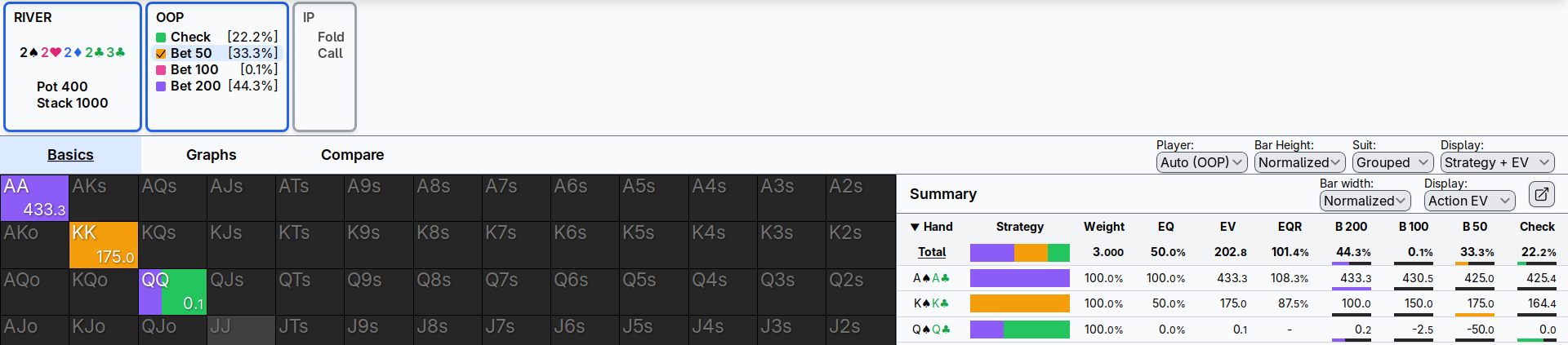
I guess the most famous example is the AKQ toy game, where you bet KK despite never getting called by worse and never folding out better.
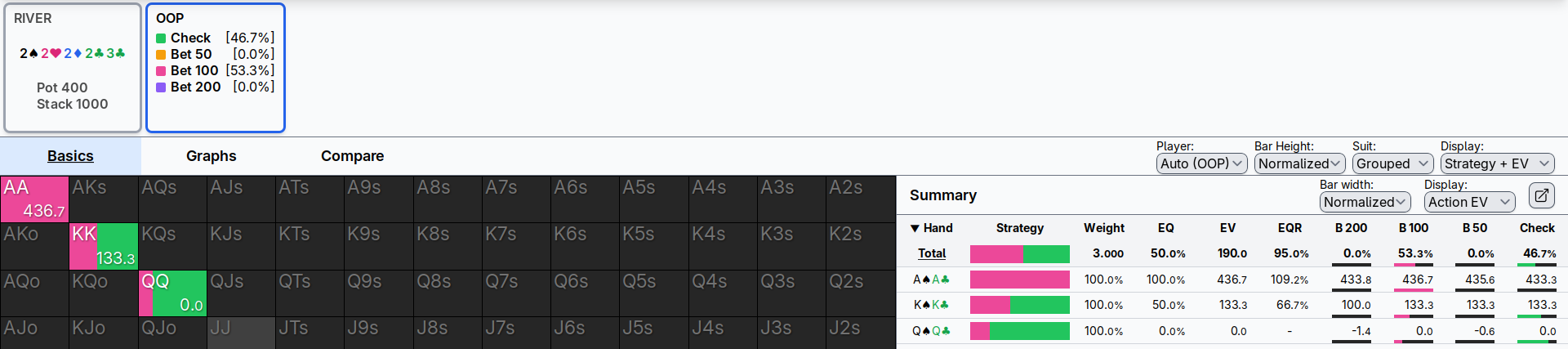
And if you prevent IP from raising, OOP always bets KK for small sizing and goes large with nuts and air.