Splash pot theory

How do you guys approach study splash pots?
Splash pot is rakeback mechanism where sote will drop some amount of dead money before hand starts.
Should we think of them as effectively playing short stack? Let's say the splash is 10bb and there is 1.5bb form bb. Do we play like our stack is 100bb/7.67?
3 Replies

Fun question!
Playing 13bb deep with 1.5bb in the middle preserves the SPR.
- In a normal short-stack spot, limping requires you to win 1 / (1 + 1.5) = 40% of the pot to breakeven.
- In a 10bb splash pot, limping only requires you to win 1 / (1 + 1.5 + 10) = 8% of the pot to breakeven.
Your minimum investment relative to the pot is much smaller in splash pots, which means you can enter the pot much wider. You could make the same case for open raising 2bb rather than limping.
Here you can see the GTO strategy has UTG limping in with 46.3% of hands into a 10bb splash pot, despite the high rake (5% with 3bb cap).
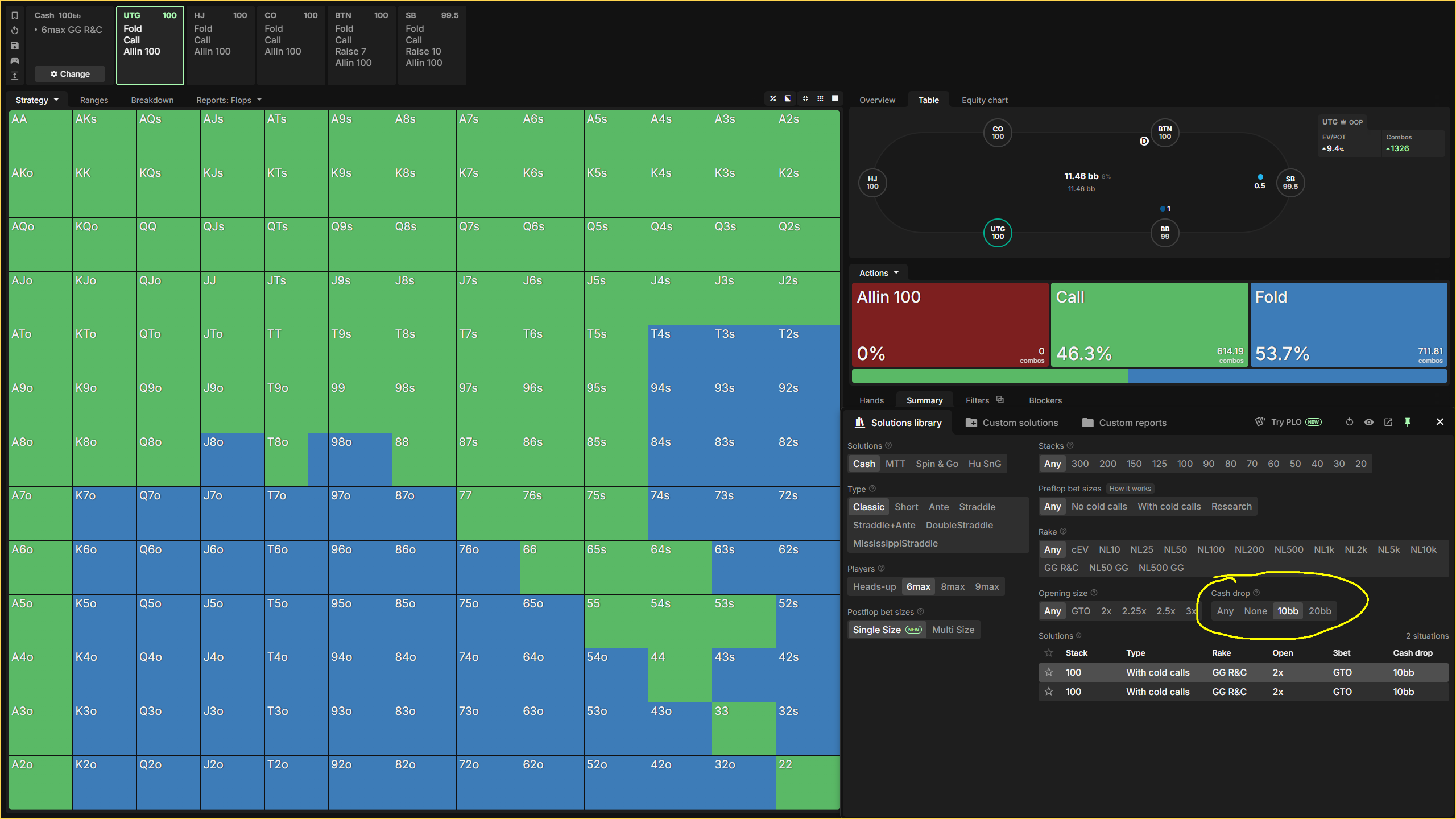
Not exactly a short stack situation since your absolute stack depth still affects things like turn and river playability once the pot balloons. The way I think about it is SPR-based: with 11.5bb already in the middle before anyone acts, a 100bb stack gives you SPR around 8.7 vs that pot, so you're playing more like a mid-depth game in terms of commitment thresholds. Practically that means I'm widening my calling and 3bet ranges preflop since there's already free equity to win, and I'm less willing to fold decent equity on the flop knowing the pot was inflated before I even saw my cards.
Curious what you mean by this, TournamentDataGuy?
Not exactly a short stack situation since your absolute stack depth still affects things like turn and river playability once the pot balloons.
Why do you think absolute stack depth affects "turn and river playability"?
Let's simplify to a HU SnG. Would anything change if [Pot = 5, Eff Stack = 50] compared to [Pot = 10, Eff Stack = 100] ?


