The ICM Doubling Conjecture

You double up the very first hand of an MTT. How much $EV did you gain?
Naturally, you'd ask me about the payout structure and field size. How many places are paid? How much do they get paid?
But there's a more interesting generalization:
ICM Doubling Conjecture:
Let 'P' be the portion of field that gets paid. When you double up the very first hand, your ICM stack value multiplies by a factor 'M' between:
2 - P ≤ M ≤ 2
- You approach the lower bound (2-p) in large fields with flat payout structures. For example, in a satellite paying 20% of the field, M approaches 1.8x as the field gets very large.
- You approach the upper bound when the payouts become more top heavy and chip EV. For example, in a winner-take-all, M = 2
Assumptions:
1) Calculate ICM as if we have 2x the starting stack, everyone else has 1x the starting stack, and one player has been eliminated.
2) This is a standard MTT, no bounties or landmarks or other shenanigans.
3) Prizes are monotonic (non-decreasing as you approach 1st)
6 Replies
In most MTTs with a normal 15% payout structure, the bubble factor on hand 1 is about ~1.07. That means losing hurts 1.07x more than winning. So doubling up is worth (1 + 1/1.07) = 1.93x your starting stack.
Note that 1.93x is smack dap in the middle of our upper (2x) and lower (1.85x) bounds.
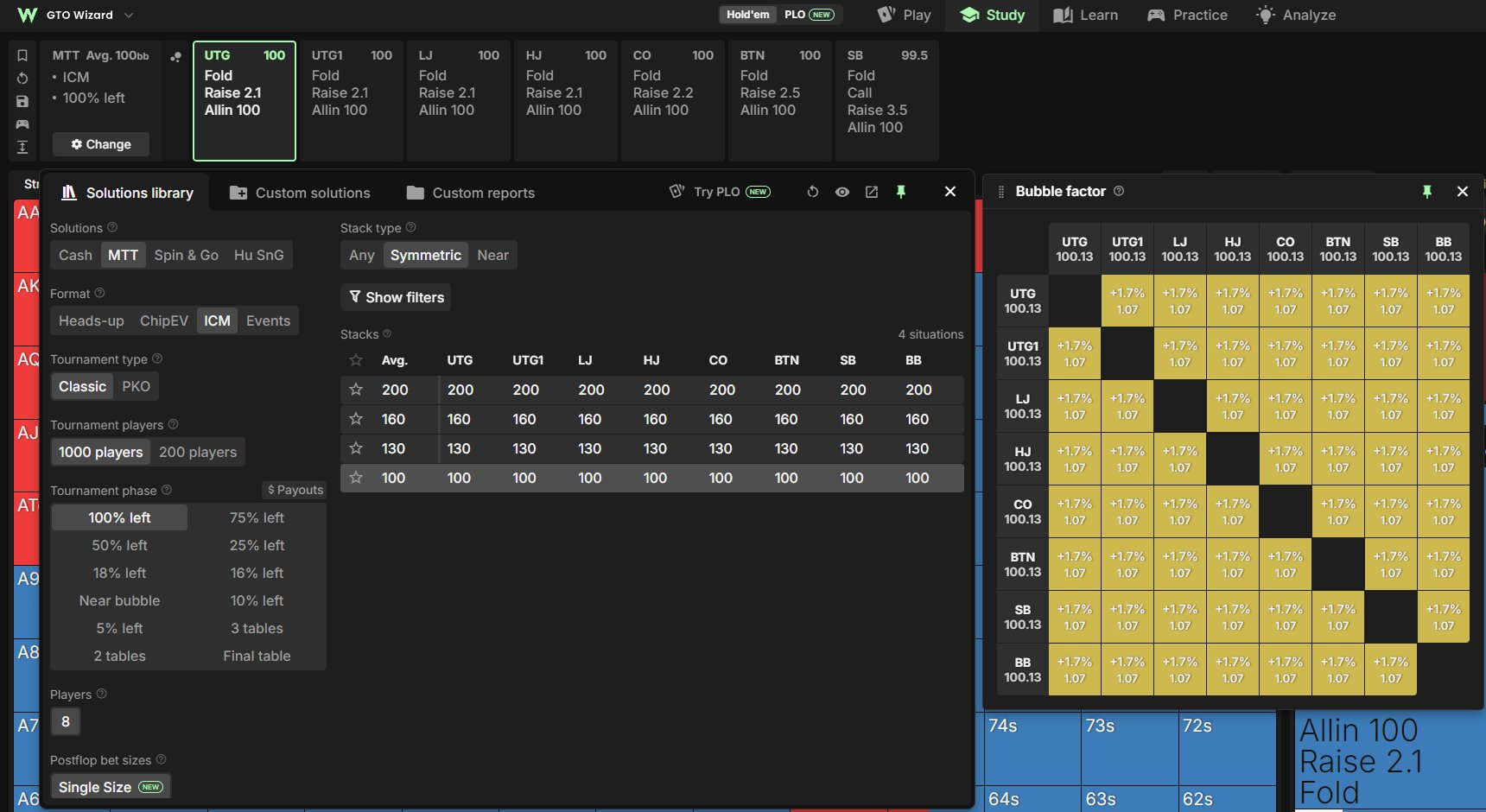
The general formula if the bubble factor (BF) is known: M = 1 + 1 / BF
Another proof, this time from David Chen, which predicts the exact bubble factor, risk premium, and $EV multiplier, directly from the payout structure.

Thanks for the posts Tombos! Genius is often underappreciated, but I know I'm not the only one thankful for your efforts.
I'm actually surprised that the ICM effect is as pronounced as it is even at the start of an event with a 15% payout structure (like the WSOP). I suppose that I should be adjusting more than I am, as I typically play something like a chip EV strategy until about half the field is eliminated. Food for thought.
Appreciate that!
Funny thing is I get such a range of responses. Some people think ICM on the first hand would be way more pronounced, others think way less. I think cEV is still a decent approximation until about 50-30% of the field remains. At 30%, the ICM pressure is about as high as it will be after the bubble pops
The satellite case is the most interesting one here. In a 20%-pay sat you double first hand and your ICM equity only went up ~1.8x, meaning roughly 10% of those chips are phantom value from payout compression. I've always felt this intuitively when playing sats but never had the bounds spelled out this cleanly.


