A thread for unboxing AI

The rapid progression of AI chatbots made me think that we need a thread devoted to a discussion of the impact that AI i
When good faithed people like chezlaw define problems in society which are *already happened* an di believe are entirely caused by leftism, as being something that *will* happen with AI, I have to be able to make my claims.
When good faithed people like chezlaw define problems in society which are *already happened* an di believe are entirely caused by leftism, as being something that *will* happen with AI, I have to be able to make my claims.
Bolded is exactly why you irritate so many people.
Chat GPT (4.0) at the end of 2023 already perfomed a lot better than trained physicians at diagnosis (90% vs 75%), while trained physicians using chatgpt gained nothing.
We could *already* do the vast majority of diagnosis with AI for close to 0 $ achieving *better results* with technology that is already significantly outdated.
This is kinda mindblowing for 2 reasons:
1) i didn't think we were there already, but it looks quite clear that we are
2) it's basically insane not to be using this already at mass scale everywhere
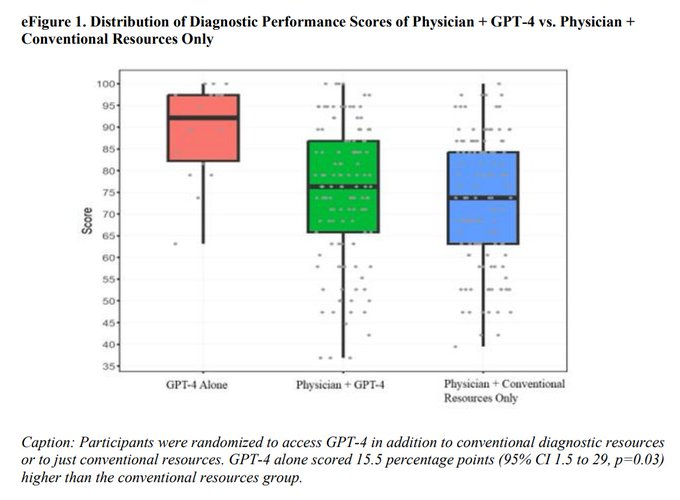
https://jamanetwork.com/journals/jamanet...
This should relatively tranquilize people who fear jobs will get destroyed fast, because if not even savings of orders of magnitude while achieving measurably better results are enough to get a race started to substitute human labor with AI *ASAP*, then the timeframe this will happen will be longer than expected i guess.
And btw any regulatory reason making it harder or impossible to substitute physicians with LLMs for those tasks is literally killing people, both because of worse diagnosis, and because the time spent by physicians doing diagnosis isn't spent treating people.
DeepSeek's impact on the stock price of Nvidia and others really highlights the financial instability of companies that are highly dependent on AI developing in one direction or another.

DeepSeek's impact on the stock price of Nvidia and others really highlights the financial instability of companies that are highly dependent on AI developing in one direction or another.
that doesn't even make sense.


The Google owner, Alphabet, has dropped its pledge not to use artificial intelligence for purposes such as developing weapons and surveillance tools.
The US technology company said on Tuesday, just before it reported lower than forecast earnings, that it had updated its ethical guidelines around AI, and they no longer refer to not pursuing technologies that could “cause or are likely to cause overall harm”.


A complex problem that took microbiologists a decade to get to the bottom of has been solved in just two days by a new artificial intelligence (AI) tool.
Professor José R Penadés and his team at Imperial College London had spent years working out and proving why some superbugs are immune to antibiotics.
He gave "co-scientist" - a tool made by Google - a short prompt asking it about the core problem he had been investigating and it reached the same conclusion in 48 hours.
He told the BBC of his shock when he found what it had done, given his research was not published so could not have been found by the AI system in the public domain.
"I was shopping with somebody, I said, 'please leave me alone for an hour, I need to digest this thing,'" he told the Today programme, on BBC Radio Four.
"I wrote an email to Google to say, 'you have access to my computer, is that right?'", he added.
The tech giant confirmed it had not.
The full decade spent by the scientists also includes the time it took to prove the research, which itself was multiple years.
But they say, had they had the hypothesis at the start of the project, it would have saved years of work.

lol he is a self-identifying socialist and has been for a while
I should hope so. The alternative of 'Kings' is pretty bad
He says he realised the problem in 2023. Which isn't great but still but way ahead of most people.

A more realistic scenario is how industrialization affected things.
By disrupting the entire economy, creating a time of unfettered capitalist opportunity which went so completely off the rails in its disregard for the common worker that the backlash empowered labor unions for nearly a century, resulting in an enormous increase in worker rights.
Of course, AI needs to get a lot better before that happens. AI as a tool can replace dabblers and people hired solely on their capacity to be semi-intelligent for brief periods at a time, but it is still a far cry from being able to replace experts. It can assist experts, however.
A more realistic scenario is how industrialization affected things. By disrupting the entire economy, creating a time of unfettered capitalist opportunity which went so completely off the rails in its disregard for the common worker that the backlash empowered labor unions for nearly a century, resulting in an enormous increase in worker rights. Of course, AI needs to get a l
the "common worker" wasn't living worse than in the farm by any means, what empowered unions was the physical proximity of workers in the same place every day. they also often lived in employer provided housing allowing for basically unlimited encounters by people of the same exact class under the same pressure
if farmers had to work in the same fashion in the preceding millennia the same would have happened.
the "class consciousness" arose exclusively because of that. which is why service workers don't unionize nowadays as they don't work closely with thousands of their peers nor they live in buildings exclusively among themselves.
also, factory workers realized that if they striked that could work, which isn't something farmers can coordinate (especially of some of them own their own land/production like it was the case).
again service workers outside of stuff like Amazon logistic centers or the like can't cause any significant disruption to capital so they are toothless.
early capitalism boosted the quality of life of workers massively (which is why people fled the disgusting life on the farms to hope they got a job in factories) but people never have enough anyway, even when it's clear that the totality of the improvement is entirely generated by other people, not them.
you aren't worthy of absolutely anything at all as a farmer except what you produce, if industrialization happens anything better than what you did before, you owe to the people that made industrialization possible.
the same is true today, normal people do not deserve in any meaningful sense any improvement in their quality of life at all, those are generated by the few people who carry society forward (capitalists), the workers are just benefiting from other people execution and they still never have enough.
the "common worker" wasn't living worse than in the farm by any means, what empowered unions was the physical proximity of workers in the same place every day. they also often lived in employer provided housing allowing for basically unlimited encounters by people of the same exact class under the same pressure if farmers had to work in the same fashion in the preceding millenn
First of all, you are describing peasants, not farmers. A distinction we in developed economies often fail, because we now tend to use the term "unskilled labor". A term which comes with its own problems, but that is a discussion for another day.
And if you think peasants could not change society through collective action, you really need to start re-opening those history books you claim to have been reading. While the outcomes of peasant uprisings is a mixed bag, the threat of peasant uprisings is behind a lot of the rights you and I enjoy today.
But it is certainly true that proximity, the ownership of your own labor and the demand for the skilled worker allowed for collective bargaining on a completely different level. However, it is also true that the early days of industrialization and modern capitalism was exploitative to the extreme, with people often being treated as expendable machines worked to an early grave, children and adults alike. Anyone who read accounts of the large cities of early industrialization with an open mind would realize that.
I think your last section, where you channel your inner Ayn Rand, is just useless idolization. I prefer market-based economies, but I find takes like that to be destructive. A market which can't recognize its pitfalls, bad players and poor directions is making a big mistake.
Another difference is that humanity became a lot wealthier with the industrial revolution. Previously refusing to work meant no food pretty much immediately. Factory workers could organise to strike for a period of time before they starved and the owners could survive letting them.
It was still always the case that the bosses needed the workers which meant economic pressure could be applied to redistribute as well as social pressure. This time the workers wont be needed, or where they are, the supply will increasingly swamp the demand. At the same time humanity will become much wealthier. This leads to the point that democratic socoialism is needed if we're going to avoid authoritarianism.
Of course, AI needs to get a lot better before that happens. AI as a tool can replace dabblers and people hired solely on their capacity to be semi-intelligent for brief periods at a time, but it is still a far cry from being able to replace experts. It can assist experts, however.
A lot better doesn't imply much time.
I dont really agree on your expertise point. Few jobs require experts and the expertise that is required is usually for small parts of the job that will be increasingly squeezed. There is also the bit that most seem to miss which is that jobs are changed to meet the technology because it is vastly cheaper even if in some ways not quite as a good.

Another difference is that humanity became a lot wealthier with the industrial revolution. Previously refusing to work meant no food pretty much immediately. Factory workers could organise to strike for a period of time before they starved and the owners could survive letting them.It was still always the case that the bosses needed the workers which meant economic pressure coul
I think there are a few particular issues here that you aren't giving credence to.
1) AI was expected to replace radiologists and doctors by better interpreting medical scans more correctly, but it still makes mistakes which requires human doctors to confirm/check for errors + make crucial complex decisions like ethical factors.
2_ AI was supposed to place customer service chatbots, but people complained and preferred to speak to a human. We don't know how long it will be beofre the majority of people accept AI in each field.
3) A combination of the two is AI still struggles to with self driving cars in unsuspected situations and people still aren't comfortable enough to put themselves or their family in the hands of AI in certain situations like that. That could take decades. It also, isn't working as expected in the construction business as planned.
I think where I would agree with you is that companies are going to force in fully automated positions for their own self benefit, and design accordingly to cut out any need for human interaction for simplification. That will certainly happen and thats a problem. But they are still at the mercy of the political and social pushback who will correctly demand for economic security for lack of employment + affording enough disposable income for the people to then that spend that money on these new products. This is going to take a long time.
1) What is hyped isn't relevant to me as I never bought the hype. The failure of the hype doesn't imply it's not coming or imply anyhting about anyhting - it's jusy hype. Concluding it's not happening from the failure of hype would be a blockbuster of a mistake.
2) people do currently prefer talking to humans but an awful lot of the time you get a chatbot. The chatbots are only getting better and the humans left are increasingly just reading out loud..
3) this is amisunderstanding between us. I'm not saying that humans necessarily wont have jobs. Rather than the value of jobs in creating wealth is going. We may well try a digging ditches to fill them in approach. That's just too sad and even more than now we will wonder why people who seem to be well off are so disastisfied and voting for anything different.
Also decades is not long. Another misconception is how long is long. For an old git like me it's going to take a long time. For anyone recently or starting out in the job market they are being sold a pup if they're being told they will have a long fullfilling career as radiologist or as a lawyer or a truck driver etc etc. Physically looking after old stuff (including humans) might have some longevity.
We're at the leading edge of profound change - the biggest humanity has faced. We can ignore it or face up to it. It's a bit like climate change except this has a massive upside we can chose to embrace or die by.
I think there are a few particular issues here that you aren't giving credence to. 1) AI was expected to replace radiologists and doctors by better interpreting medical scans more correctly, but it still makes mistakes which requires human doctors to confirm/check for errors + make crucial complex decisions like ethical factors.2_ AI was supposed to place customer service cha
1) AI is already a lot better than the median radiologist at interpreting medical scans. Like a lot better, and it was already 24 months ago. And that's from generalist models open to the public (!!).
And that's with the specific subtopic being worked on only marginally: spend 10 billions exclusively toward that (like say google did for alphafold) and we would already have an AI better than the best human at that.
And keep in mind that improves in time *automatically* and *necessarily*, like you already know for a certainty it will become better and better, unlike your trained physician at 35, who won't necessarily be far better at 55 (he could slightly improve, maybe, on average, but not necessarily).
That better than median or the best human doesn't mean 100% success rate is obvious. But human radiologists make errors as well, more than the AI. Your "but" isn't a reason not to use AI for all radiological scans.
The only reasons we can't deploy that at scale everywhere already are regulatory and logistical. Regulatory, for various reasons we know about. Logistical, because introducing new technologies in the productive process always takes time, often more time than from the outside would seem reasonable. Just think about how many companies use outdated IT in their processes currently.
2) AI chatbots already substitute human operators more and more in every customer support setting. Not sure why human possible preference for human service matters here: people will probably prefer handcrafted shoes still they buy the industrially manufactured ones because they cost a fraction of the handmade ones.
3) Self driving cars are already better than the median driver by a significant margin. Where Waymo is offered as a service, it is used a lot by people. Problems are only regulatory. Perhaps costs would be a tad too high yet as well for mass use, but it's expected as with every other technology for costs to go down in time (see solar panels and everything else). No idea about construction.
It is possible adoption of AI automation will take a long time, humans are experts at destroying value through regulations to protect narrow interests. But it's not because the technology is lacking or massive consumer demand isn't there.
Also decades is not long. Another misconception is how long is long. For an old git like me it's going to take a long time. For anyone recently or starting out in the job market they are being sold a pup if they're being told they will have a long fullfilling career as radiologist or as a lawyer or a truck driver etc etc. Physically looking after old stuff (including humans) m
Bold isn't necessarily true. Demand for those services will explode with lower cost. Imagine everyone having access to legal advise routinely, and a "lawyer of the future" being a coordinator of tens or hundreds of AI legal experts.
Or a radiologist performing 5, 10 , 20 times the analysis he does today. Like AI automatically flags 3 or 5% of the masses of people who scanned for prostate or ovarian cancer , and a single radiologist coordinating AI or human second opinions can perform like a team of 5 or 10 would today.
We can have everyone checking for everything every year with AI , at 1/10 or less the cost it would require today, with humans employed in that process, just fewer humans per output, but still a large amount of humans.
Some rich people already do full radiological check ups every year or 2. With AI deployed properly normal people can as well. Potential demand is there.
Like where Waymo is operative , it is used A LOT to ferry kids to and from schools and to activities. It's more demand thanks to the availibity of the service. That will happen with all services.
I don't doubt we will have far more checkups. Near continuous monitoring for a great deal of stuff as well. Demand will be massive.
No idea what you think the all the radiologists will be doing in this scenario.

