Moderation Questions

The last iteration of the moderation discussion thread was a complete disaster. Numerous attempts to keep it on topic fa

This thread has turned into garbage. Don't you people have homes?
Well I don’t want to be committed to saying that “all unicorns have horns” is meaningless, for instance. It seems like the tool is just too strong for the problem it’s trying to fix.
The reason d2 wants to get rid of the excluded middle is so that he can inject a fourth term and still maintain the inferential ability of the syllogism.
As Im sure you know, Classical Logic is the only framework that lets us reliably infer new truths from known truths.
P1: All men are mortal.
P2: Socrates is a man.
C: Socrates is mortal.
If the premises are true, we’ve just added knowledge. But this is what d2 wants to do:
P1: All men are mortal.
P2′: Socrates is a man or undefined.
C': Socrates is mortal or undefined.
Granted, that keeps the system from crashing but a logical quadraped is a formal fallacy for a reason.
Well I don’t want to be committed to saying that “all unicorns have horns” is meaningless, for instance. It seems like the tool is just too strong for the problem it’s trying to fix.
I was noting an important difference between classical and modern syllogistic logic: existential import assumptions.
In modern predicate logic the following syllogism would NOT be valid:
p1 Every M is P
p2 Every S is M
c Some S is P
In classical logic, the above form is valid. (AAI-1)

The reason d2 wants to get rid of the excluded middle is so that he can inject a fourth term and still maintain the inferential ability of the syllogism.As Im sure you know, Classical Logic is the only framework that lets us reliably infer new truths from known truths. P1: All men are mortal.P2: Socrates is a man.C: Socrates is mortal.If the premises are true, we’ve just
Hmm, not sure about this. Can you convert your "King of France" example into P1, P2 and C like this? Won't you have something that evaluates to false, hence to need to have anything undefined? For example, "The King of France is a [unique] man" evaluates to false, not undefined/null.
I was noting an important difference between classical and modern syllogistic logic: existential import assumptions.
In modern predicate logic the following syllogism would NOT be valid:
p1 Every M is P
p2 Every S is M
c Some S is P
In classical logic, the above form is valid. (AAI-1)
I don't get why this isn't valid. Is it because the cardinality of set S might be zero?
ETA: Wait, is it because it should be "Every S is P"?
Luckily for your posts, the 2+2 forum software is so antiquated that it doesn't have that feature.
Totally on-brand that you find discussing logic 'garbage.'
In my opinion, this is far more interesting than discussing how you get ladies drunk so you can have sex with them.
Yes, I live in a beautiful home in Orange County (California).
full disclosure: it's someone else's house, but I have permission to live here.
I was noting an important difference between classical and modern syllogistic logic: existential import assumptions.
In modern predicate logic the following syllogism would NOT be valid:
p1 Every M is P
p2 Every S is M
c Some S is P
In classical logic, the above form is valid. (AAI-1)
Is this valid?
P1. Every sperm is sacred.
P2. Every sperm is great.
C. If a sperm gets wasted, god gets quite irate.
I don't get why this isn't valid. Is it because the cardinality of set S might be zero?
ETA: Wait, is it because it should be "Every S is P"?
The conclusion 'Every S is P' would make the syllogism valid.
In classical logic, the syllogism is also valid if the conclusion is "Some S is P."
That's because in classical logic, all predicates in an argument are assumed to apply to at least one thing in the universe-of-discourse.
Hmm, not sure about this. Can you convert your "King of France" example into P1, P2 and C like this? Won't you have something that evaluates to false, hence to need to have anything undefined? For example, "The King of France is a [unique] man" evaluates to false, not undefined/null.
Well I can create a valid argument:
P1: Bald is beautiful.
P2: The king of France is bald.
C. Therefore, the king of France is beautiful.
But assuming P1 is true, no one can assert P2 as true, so it's sort of moot.
The reason d2 wants to get rid of the excluded middle is so that he can inject a fourth term and still maintain the inferential ability of the syllogism.As Im sure you know, Classical Logic is the only framework that lets us reliably infer new truths from known truths. P1: All men are mortal.P2: Socrates is a man.C: Socrates is mortal.If the premises are true, we’ve just added
Is that what D2 wants to do? I didn’t catch that part.
I mean I don’t think that the “all unicorns have horns” thing is quite the same issue as introducing a fourth term. The thing that Frege and others seem to want to do is fight against the non-existing entity problem and not wanting to refer to a non-existent entity as if you are committed to its existence. But then by saying its not propositional, well it seems like now sentences that ordinary people seem to understand the meaning of you are calling meaningless. That seems like it’s more of an empirical question and not to be solved from the armchair.
But if there really is a word that you don’t know what it means, then it’s epistemically possible that the sentence is not propositional because the word could be something meaningless or that lacks a definition or that is being improperly used etc. But there seems to be something different about those two claims.
Anyway, all that aside, I’m not sure if I really share your worry about knowledge there, because I take it that we’re not talking about infallible knowledge here, and it would be really hard to always move from a justified true belief to another, give most people bottom out at some axiom in their system. So I feel like we want to leave room for lack of certitude in our inferential justification.

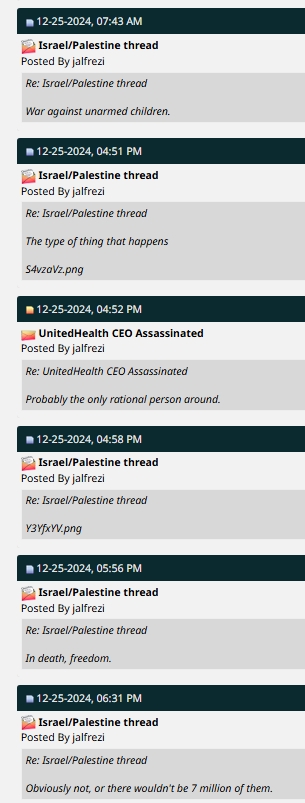
The irony of you posting that before 5am is clearly lost on you, but at least this time it wasn't another anti immigrant rant.
This from the man who just spent their Christmas day posting on 2+2 from 7am to 11pm .
Still, unlike last year, at least you didn't spend all day posting about Jews.
Well I can create a valid argument:
P1: Bald is beautiful.
P2: The king of France is bald.
C. Therefore, the king of France is beautiful.
But assuming P1 is true, no one can assert P2 as true, so it's sort of moot.
Actually I think maybe the present king of france is not bald may actually be true, because that just means that bald is not predicated on the present king of france (because there is none) 😉
Anyway, all that aside, I’m not sure if I really share your worry about knowledge there, because I take it that we’re not talking about infallible knowledge here, and it would be really hard to always move from a justified true belief to another, give most people bottom out at some axiom in their system. So I feel like we want to leave room for lack of certitude in our inferent
I don't see it so much as a failure of our logics as much as the inherent ambiguity of human language. As you said infallible or incomplete knowledge is behind it all and that's why we came up with schemas like modalities or whatnot to deal that. Really our logical systems are more like scaffolding for ignorance. In fact I'm thinking an omniscient being wouldn’t even need inference rules to get from truths to truths because it would already have them.
I don't see it so much as a failure of our logics as much as the inherent ambiguity of human language. As you said infallible or incomplete knowledge is behind it all and that's why we came up with schemas like modalities or whatnot to deal that. Really our logical systems are more like scaffolding for ignorance. In fact I'm thinking an omniscient being wouldn’t even need infer
In that case God’s knowledge might be too different from ours to meaningfully analogize it to the way we use the word “knowledge”.
In any case even if I could understand non-inferential justification it still makes me wonder how God would deal with the liar’s paradox. Like does he have knowledge of what the right truth semantics is and whether it evaluates as true, false, both, or neither? It seems like we’re just saying something trivial that doesn’t apply to us if we remove God too far from our own modes of reasoning.
(P) God is omniscient.
True or false? Under classical logic a proposition must be one or the other. The caveat being every properly formed proposition. Not sure how that renders with the other examples because we know they're fictional people, which doesn't neatly fit with undefined either.
(P) God is omniscient.
True or false? Under classical logic a proposition must be one or the other. The caveat being every properly formed proposition. Not sure how that renders with the other examples because we know they're fictional people, which doesn't neatly fit with undefined either.
It depends what you mean by true or false.
I could evaluate the proposition as true by stipulation if I wanted to include it as a property of God for the purposes of evaluating a theistic argument or as a conceptual analysis, so I have no problem with affirming the proposition in that context.
But when we start to get so far away from everyday notions of truth I want to know more about what people mean by truth.

This from the man who just spent their Christmas day posting on 2+2 from 7am to 11pm .
Still, unlike last year, at least you didn't spend all day posting about Jews.
"All day" in Elracist's desperate lies = for an hour after Christmas dinner.
"Posting about Jews" in Elracist's desperate lies = posting about the Israeli government and IDF
I spent the time posting relevant news items. You just got up at 5am in another weirdo rage to search my posting history and rage post about me, you sad stalking weirdo.


