Saeculum
I would like to introduce a concept to the forum for discussion. Here is the Wikipedia explanation of the term
https://en.wikipedia.org/wiki/Saeculum
It has its roots in the Roman empire and basically refers to the typical lifespan of a human being and a cycle of renewal. Think of it as an 80 year circle that goes round and round.
I have a personal metaphor for the cycle which looks like this ...
Hard Times ==> Strong People ==> Good Times ==> Weak People ==> Hard Times (repeat)
In the USA, we have had 3 complete cycles in roughly 80 year intervals between the American Revolution, Civil War and Depression / WW2 and the pattern suggests that we and the world are in for an imminent and major upheaval in the near term.
One of the attributes of the Saeculum is that people who are alive today did not experience the hardship of the Great Depression and sacrifice associated with WW2 and have lost touch with the possibility that those difficult conditions will re-emerge. Our relationship to the Holocaust is abstract and we have lost touch with the conditions which led to it and therefore can't imagine that something similar would happen again. History is an abstraction for us because we haven't ever experienced those conditions ourselves.
I would like to invite people to discuss the parallels between this moment in time and those that preceded the tumultuous historical transitions referred to above.

While it is certainly true that we tend to forget the lessons of history the further removed we are from them, I do not put much stock in strict cyclical interpretations of history, especially interpretations that focus on a single country. IMO such interpretations (i) are built on a foundation of retrospective determinism; (ii) fail to account for the complex dynamics of globalism; and (iii) tend to underestimate the potential impact of wheel-breaking forces such as rapid technological change.
While it is certainly true that we tend to forget the lessons of history the further removed we are from them, I do not put much stock in strict cyclical interpretations of history, especially interpretations that focus on a single country. IMO such interpretations (i) are built on a foundation of retrospective determinism; (ii) fail to account for the complex dynamics of glob
But part of The Cycle is skeptics like you discrediting the validity of The Cycle!
See how this works?
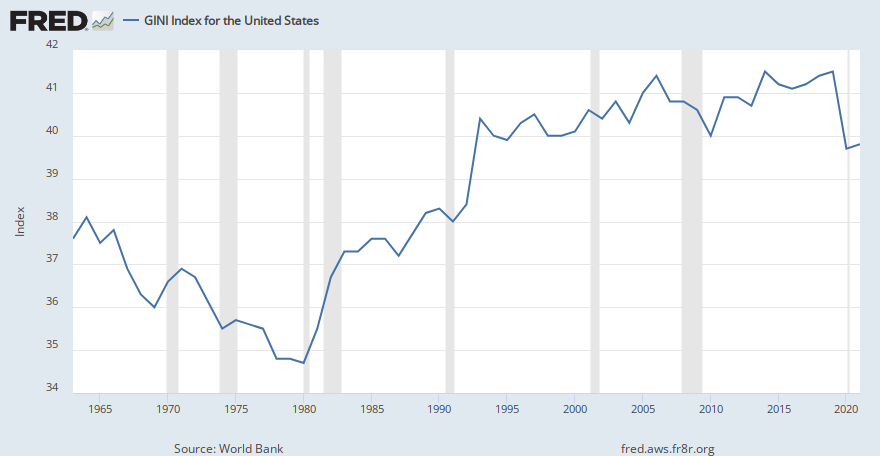
To me the historical parallel that we are observing today is the unsustainable gap between "have's" and "have-not's". This seems to be the recipe for revolutions and are at the root of conflicts like the American, French and Russian revolutions as well as the Civil War.
Economists attempt to quantify this inequality with a term called gini coefficient.
https://en.wikipedia.org/wiki/Gini_coeff...
Attached is a chart of US gini coefficient from the Federal Reserve over the last 60 years.
It is an observation that been repeated so often that it no no longer has any punch, but it is nevertheless being presented as original and profound. That's pretty much the definition of a platitude.
It is not my objective to be either original or profound.
My objective is to communicate in terms which are simple for a layperson to grasp.
The paradigm of
(Hard Times ==> Strong People ==> Good Times =-> Weak People == > Hard Times)
is a simple one for people to get their minds around and I believe is a useful metaphor to reinforce the cyclical nature of human societal experience.
If you have a more original and profound way of expressing the cyclical nature of human societal experience .... I'd be happy to hear how you would communicate such a concept.
It is not my objective to be either original or profound. My objective is to communicate in terms which are simple for a layperson to grasp. The paradigm of (Hard Times ==> Strong People ==> Good Times =-> Weak People == > Hard Times)is a simple one for people to get their minds around and I believe is a useful metaphor to reinforce the cyclical nature of human societal experie
Except that it doesn't even reflect the cycle that you claim is occurring. The cycle you want to talk about is:
To me the historical parallel that we are observing today is the unsustainable gap between "have's" and "have-not's". This seems to be the recipe for revolutions and are at the root of conflicts like the American, French and Russian revolutions as well as the Civil War.

Maybe your cyclical idea was working a few years/decades ago but I think things changed radically with the information age.
Yes people tend to forget but in the past, all they had was stories/legends and could only rely on books and paintings to get an idea of how it was.
Nowadays anyone can check a video or pic of how it was, and this connect us more than before to the representation of the past.
Otherwise nuclear bombs and what not would be in the realm of legends, yet everybody has an idea of how it looks.
It is not my objective to be either original or profound. My objective is to communicate in terms which are simple for a layperson to grasp. The paradigm of (Hard Times ==> Strong People ==> Good Times =-> Weak People == > Hard Times)is a simple one for people to get their minds around and I believe is a useful metaphor to reinforce the cyclical nature of human societal experie
If it's cyclical. Along with Marx, this is the most influential theory phase wise:
Capitalism, Socialism, and Democracy is a book on economics, sociology, and history by Joseph Schumpeter, arguably his most famous, controversial, and important work. It is also one of the most famous, controversial, and important books on social theory, social sciences, and economics—in which Schumpeter deals with capitalism, socialism, and creative destruction. It is the third most cited book in the social sciences published before 1950, behind Marx's Capital and The Wealth of Nations by Adam Smith.
Schumpeter's theory is that the success of capitalism will lead to a form of corporatism and a fostering of values hostile to capitalism, especially among intellectuals. The intellectual and social climate needed to allow entrepreneurship to thrive will not exist in advanced capitalism; it will be replaced by socialism in some form. There will not be a revolution, but merely a trend for social democratic parties to be elected to parliaments as part of the democratic process. He argued that capitalism's collapse from within will come about as majorities vote for the creation of a welfare state and place restrictions upon entrepreneurship that will burden and eventually destroy the capitalist structure. Schumpeter emphasizes throughout this book that he is analyzing trends, not engaging in political advocacy (more precisely, he was engaging in political advocacy for the contrary).
In his vision, the intellectual class will play an important role in capitalism's demise. The term "intellectuals" denotes a class of persons in a position to develop critiques of societal matters for which they are not directly responsible and able to stand up for the interests of strata to which they themselves do not belong. One of the great advantages of capitalism, he argues, is that as compared with pre-capitalist periods, when education was a privilege of the few, more and more people acquire (higher) education. The availability of fulfilling work is however limited and this, coupled with the experience of unemployment, produces discontent. The intellectual class is then able to organise protest and develop critical ideas against free markets and private property.
Kind of along the lines of what you're saying, less the rinse and repeat.
Well ... things are not panning out at the moment in synch with that theory.
What we see at the moment in the US is regression to economic feudalism led by weak people such as Trump who is an obnoxious trust-fund baby who didn't have to rely on merit to come into his wealth.
Capital has purchased all three branches of government and the media.
Frankly .... I consider it a blessing that we are still little corners of the internet where conversations such as this are still possible.
I'll try to offer my intuition of the mass psychology which drives the Saeculum. It's like a mass psychology respiratory cycle. Instinctive competitive hoarding behaviors lead to perpetual increase in inequality until wealth concentration passes an unsustainable imbalance and the social foundation of the system crashes.
The gap between slaves and free people was too great and led to a Civil War.
The gap between Germans and citizens of other neighbor nations was too great.
In America, we glorify the best hoarders. Everyone knows the name of Elon Musk because he's got the biggest balance sheet. His pile grows bigger and bigger while the homeless population grows and Project 2025 eliminates Medicaid benefits for 16M people.
We've had a half century of interrupted wealth concentration in America. What I see in terms of people with their backs to the wall .... it's not a recipe for stability.
I think that there are plenty of hard men that create hard times, and plenty of weak men that create good times, and the other way around as well.
A better explanation for this “pattern” is that humans have a pattern-seeking bias that has allowed us to do many great things and commit many great errors.
A better explanation for this “pattern” is that humans have a pattern-seeking bias that has allowed us to do many great things and commit many great errors.
Is hoarding part of the recurring human pattern ?
Is it possible that we force ourselves into periodic survival of the fittest crises as a means of culling the herd of weak members and keeping the survival edge sharp ?
I don't know the answers. I just know that I would prefer to be part of a more proactive species instead of being like zombies who do the same thing over and over. The Saeculum is the period of time over which we seem to forget the mistakes of the past and repeat them.
I see a concentration camp built in Florida. They call it Alligator Alcatraz. The associations with such a development are not warm and fuzzy.
Is hoarding part of the recurring human pattern ? Is it possible that we force ourselves into periodic survival of the fittest crises as a means of culling the herd of weak members and keeping the survival edge sharp ? I don't know the answers. I just know that I would prefer to be part of a more proactive species instead of being like zombies who do the same thing over and ove
What you see is a detention center that only needs to exist because of the *rights* the USA give to those people, to be heard before being deported, otherwise there would be no need for any center and they will all be out of the country already.
So you see a concentration camp when you should see an excess of goodwill on the side of the people dealing with a problem entirely caused by foreigners (their unwanted presence in the country).
A problem that in most places and times in history would have been fixed with mass slaughters, as it happened everywhere countless of times.
Yet you see a "concentration camp". Maybe you should just look better.
What you see is a detention center that only needs to exist because of the *rights* the USA give to those people, to be heard before being deported, otherwise there would be no need for any center and they will all be out of the country already.So you see a concentration camp when you should see an excess of goodwill on the side of the people dealing with a problem entirely cau
Summary: Nazi-Lucy loves concentration camps and gas chambers. Why, you ask? Because he hates Jews even more than radical Leftists.
Is hoarding part of the recurring human pattern ? Is it possible that we force ourselves into periodic survival of the fittest crises as a means of culling the herd of weak members and keeping the survival edge sharp ? I don't know the answers. I just know that I would prefer to be part of a more proactive species instead of being like zombies who do the same thing over and ove
If survival is the primary driver, why is it that so much of humanity act like zombies even after existential threats have been brought to their attention?
If survival is the primary driver, why is it that so much of humanity act like zombies even after existential threats have been brought to their attention?
They don't believe the people who "brought the threats to their attention" at all, and they have perfectly fine reasons not to.
Survival is a primary driver but it's unclear why you believe people actually believe politicians and the rest enough to bet their lives on what they say
They don't believe the people who "brought the threats to their attention" at all, and they have perfectly fine reasons not to.
Survival is a primary driver but it's unclear why you believe people actually believe politicians and the rest enough to bet their lives on what they say
You can view it more locally. The patient who knowingly ignores the instructions of their trusted doctor after a few days.
Take any example of the ever present self destructive behaviors.
You guys will be spinning your wheels until you are willing to accept that there is more to reality than your current model of it.
If survival is the primary driver, why is it that so much of humanity act like zombies even after existential threats have been brought to their attention?
Because there is a profound conflict of interest between two thing things.
1) Short-term personal survival interest
2) Long-term collective survival interest
The government doesn't offer the citizens a path to surviving the short-term which is compatible with long-term survival.
It's the same reason why Jews consented to get in trains destined for Auschwitz. If they didn't, they would have been shot on sight. When given a choice, humans overwhelmingly choose to defer death. That's just our nature.


