Are these the most tilting questions ?
Today we live in a social structure which puts no limits whatsoever on our liberty to add CO2 to the shared environment. This dynamic is not limited to just CO2. It pertains to a host of environmental toxins like plastics as well. The only gatekeeper is money. So long as we have enough money ..... we can pollute as much as we like.
So the first titling question I am proposing is this ....
Should we have the liberty to engage in unlimited pollution of shared resources ?
fyi - my inference that this question is tilting is based upon the apparent fact that we don't seem to ask it.
Why do we not ask it ? It seems that we can't cope with it. Hene the inference that it's tilting.
I'd be curious to learn about other's perspectives of other issues that we are seemingly incapable of discussing.
My secondary tilting question is this ....
If Earth's carrying capacity for human's declines as a result of environmental overshoot, how should we decide who lives and who dies ?
22 Replies

At least in the US and other western countries, no one has the ability to "engage in unlimited pollution".
We are not all going to die anytime soon. So there is no need to be on tilt.
If we were ALL going to die, then it would make no sense to ask the question how we would decide WHO will live and die.
For example, at this moment .... the decision to allow a few million people in Gaza to die seems to be being made by the powers that be. It's worthwhile to reflect on that decision and reflect on what makes us different than the citizens of Gaza.
If at some point we find that we have something in common with those people .... it might make us feel a little differently about the precedent which may one day come walking up to our doorsteps.
Edit: To frame it differently .... what is the difference between ourselves and the people in Gaza which makes them expendable and ourselves necessary ?

That's simply false. If there were a law you could point to which caps our pollution, I'd love to read it.
But your response is not unexpected.
There are many state and federal laws addressing pollutions (way too many for my taste but that's subjective). You can claim those aren't enough for your taste but you can't lie about the objective, uncontroversial fact that anti-pollution rules exist for a myriad of things in every single western society.
If at some point we find that we have something in common with those people .... it might make us feel a little differently about the precedent which may one day come walking up to our doorsteps.
Edit: To frame it differently .... what is the difference between ourselves and the people in Gaza which makes them expendable and ourselves necessary ?
Go ahead. What do Americans and Gazans have in common if it’s not the soul?
It’s not lineage or culture.. so what then?

If Earth's carrying capacity for human's declines as a result of environmental overshoot, how should we decide who lives and who dies ?
I think you're going down the route of tyranny again which you seem to like and have done so in a few threads but you mentioned then that the old and the sick could be an option. But more importantly, I wouldn't want to be under the control of anyone who had enough power to make those decisions.
But you also have far better options than figuring out who needs to get got like managing birthrate and contraception - a rather less tyrannical iron fist approach.
You already are.
People are making those decisions as we speak. They may not be doing it intentionally .... but they are.
Yes, people have been inadvertently and often times deliberately causing the suffering and deaths of others for thousands of years, through systems that they were born into, that involved survival or just simple ignorance - still a far cry from a conscious decision on who should die, when, and by whom. It's rough world out there.
Again, if you want to improve the system, layout some ideas that could work, because in modern times, the global system now, by almost every measurable standard, is better at saving lives than any system in the past.
There is a long history of people seeking power through fear. They are not the good guys.
There's a long history of people maintaining power through fear. It's always the same. Doesn't make them either good or bad. No one rules effectively without some element of fear.
If we're going to fear something .... societal collapse and a reduction in the food supply seems as valid an outcome to fear as any, no ?
Hope must be primary. Fear is unavoidable, but it should be situated within hope.
Your outlook on reality is hopeless because you’ve eliminated the unseen / unknown.
Omniscience must be sacrificed for hope. It’s the only way.
My feelings about hope ....
When we let go of hope, we have nothing. When we have nothing, we have nothing to lose. When we have nothing to lose, we have space for courageous action.
I don't traffic in hope. I don't sell hope.
What I recommend is living courageously and authentically without clinging to the outcome.
I have not eliminated the unseen / unknown ..... I am embracing the unknown. I can't promise that any amount of effort is going to result in a happy ending ..... I can only promise that no effort will result in misery.
My feelings about hope .... When we let go of hope, we have nothing. When we have nothing, we have nothing to lose. When we have nothing to lose, we have space for courageous action. I don't traffic in hope. I don't sell hope. What I recommend is living courageously and authentically without clinging to the outcome. I have not eliminated the unseen / unknown ..... I am embracin
Hope + rejection is what summons the rejected one who is capable of what is required. It polarizes you in the way that allows for progress.
Without hope + rejection, people will cling to the nothing which they falsely believe is something.
Hope in something great shames the nothing they are attached to and allows for the freedom required for courageous action.
Hope + rejection is what summons the rejected one who is capable of what is required. It polarizes you in the way that allows for progress.
Without hope + rejection, people will cling to the nothing which they falsely believe is something.
Hope in something great shames the nothing they are attached to and allows for the freedom required for courageous action.
Maybe I'm too influenced by buddhist advice.
Hope is about the future.
I'm trying to live in the moment while making space for the impermanence of the current paradigm.
If / when the **** hits the fan, I want to be prepared. I don't want to be in shock when **** falls apart .... I'll need to be present and make good decisions in order to survive.
Part of the purpose of my contribution here is to alert people to the ground shifting under our feet. I don't want to be the only calm one in a world where everyone else is freaking out. A wave of fear and shock isn't the recipe for good decision making.
Nut Nut if worldwide food production declines 50% in the next 10 years (not a scenario i believe is possible, but you seem to believe something like this will happen soon correct?), then a lot of people will die.
Who? almost certainly mostly poor people in poor countries.
In general with resource scarcity, it's poor people who suffer the scarcity worst effects including eventually the ultimate price. That's normal and that's what having money and real assets is meant to mean in essence.
That's how it worked everywhere everytime in human history. If the scarcity is local and within a population, myriad different redistributive efforts, or attempts to change the rules of society to achieve redistribution, will be tried.
But worldwide? rich places will lock out poor places and people in poor places will die in droves. And that's it. Not sure why you ask that question as if it was a "tilting" one, it isn't. If there is less food than necessary for everyone to live, poor people will die as much as necessary to bring the worldwide population to a size that can be fed.
And no , refusing to sacrifice yourself is not "killing them", if you are rich enough not to die. Refusing to help someone in need is not killing in general.
One possible solution to address not just the environmental crisis but the housing crisis as well is The People seizing - not the means of production - but the literal foundation upon which they're built and from which they operate: the land.
As with the environmental issue, where the problem isn’t what corporations are producing but the destructive means they’re using to produce it, the housing crisis isn’t really about where people live but the means of employment that concentrates them in overpriced clusters of land. Corporations are basically free riding by not paying workers more to offset the housing costs their own job clustering inflates and by not paying anything toward the environmental costs they profit from.
Not sure how it would work out in practice but it could be corporations based in places like New York or Silicon Valley paying higher land or location taxes, reflecting the actual cost to workers of concentrating jobs in areas where housing has become unaffordable. And with land reclaimed for public use, housing prices would be mostly the actual cost of dwellings or the scenery, not the artificial scarcity of location. Much of this land was public to begin with; granted, sold off, or privatized, etc under policies that served corporate interests, not the public good. So reclaiming it is less of a radical socialist measure and more a corrective one. And the legal precedent is already set with eminent domain.
Nut Nut if worldwide food production declines 50% in the next 10 years (not a scenario i believe is possible, but you seem to believe something like this will happen soon correct?), then a lot of people will die.Who? almost certainly mostly poor people in poor countries. In general with resource scarcity, it's poor people who suffer the scarcity worst effects including eventual
I don't agree with your post Luciom, but at least it's worth replying to.
First, I don't have a crystal ball which informs the exact timing of Peak Food and the rate of post-peak descent. Some of that is a function of weather (a short term phenomena) vs climate (a long term phenomena). We can't predict the weather far in advance so we can't predict a synchronized global breadbasket failure or the exact timing of something like an AMOC shutdown.
What I can say is this .... within ten years, we're going to have pretty high confidence that such an event is imminent just as it will become obvious that coastal real estate around the globe is in jeopardy from sea level rise. The awareness of a decline in carrying capacity will become relatively ubiquitous.
I agree with you that poor people will bear the brunt of the problem.
The key difference between out perspectives is that you somehow have jumped to the conclusion that it will be "[I][poor people in poor countries/I]."
The 18% increase in US homelessness in 2024 tells a story that poor people in a "rich country" like the US are grasping that they too are expendable. That's a recipe for social chaos and governing challenges.
I agree with you that refusing to help someone who is dying is not the same as killing them. But I would offer two points in rebuttal.
1) First the alteration of the environment is what is killing people and that's largely the work of rich countries. So technically, those poor people in poor countries are being killed.
2) We are ignorant if we think our fates are not intertwined with those of poor people. The French and the British who allowed the Germans to starve in the 1920's learned that lesson the hard way.
Thank you for illuminating a perspective that many people share.
We currently don't produce the max food we could produce lol. Especially not the most calories. By a monstrous margin, more than an order of magnitude.
We employ 1% of the population in food production in rich countries and we are currently not using all available land by a large margin in europe, and even less in the USA
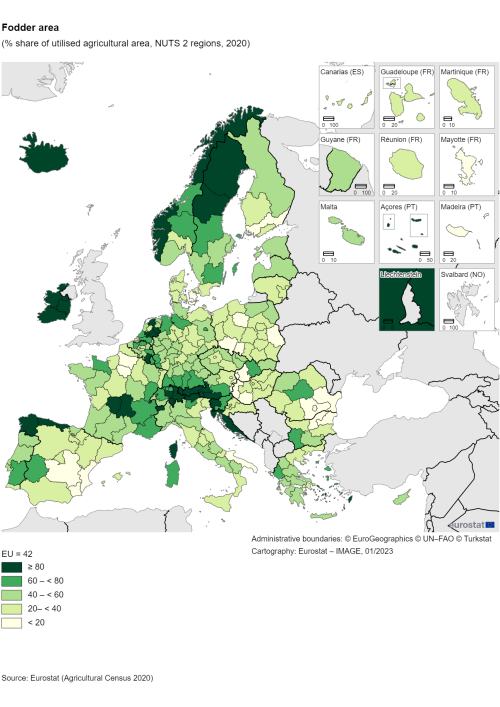
So if our lives literally depended on it we could massively increase food production (and especially calorie production) , like very easily by a factor of 10, just employing more people and capital in and squeezing out every piece of land that could grow food (+ hydroponic and indoor farming could increase as much as we want to spend on it). And changing what we grow ofc.
Even if yields went dramatically down (and they can't indoor) , like -50% or more, we could VERY EASILY feed everyone just by employing more capital and people.
Also ofc if food was a lot more expensive
1) food waste would be far less common (that's up to a +40% increase in available food right there)
2) we would eat less meat which gives less calories per input invested
There would simply be no scenario in which rich countries can ever have an actual "you die of starvation" moment even with the most dramatic climate scenarios you can envision. Literally even if we could ONLY grow indoor we would be able to feed ourselves anyway lol.
So we can put to rest any notion that rich countries will ever have mass starvation at all because of the climate. Claiming so is simply absurd, an attempt of scaring people into action and so on and on.
Can't address the rest until we start from reality, which is first world country don't risk any mass starvation event at all from the climate.
There would simply be no scenario in which rich countries can ever have an actual "you die of starvation" moment even with the most dramatic climate scenarios you can envision. Literally even if we could ONLY grow indoor we would be able to feed ourselves anyway lol.
Roughly half the world's calories come from 3 crops. Wheat, maize and rice. They can't be grown in mass quantities indoors.
The only way you could make the statement regarding "no scenario" would be as a result of becoming a subject matter expert on all scenarios. You would need to be a subject matter expert on the consequences of an ocean circulation shutdown or major changes in the Earth's wind circulation.
Your "lol" is a defense mechanism. A manifestation of anxiety and a sign that this subject matter is unsettling.

