Freedom of Speech in the Era of Social Media
I think I am definitely a free speech absolutist, as long as exercising this right comes with responsibilities. In my vi
I think social media has purposefully positioned themselves to be the new public sphere. They have done this in order to spy, monitor and editorialize expression in this sphere so they can sell ads, influence, data and behavioral patterns. In recent times we have also increasingly seen entities and individuals exploit this level of control to further their own agenda. They figh
It's easy to suggest regulation as a magic bandaid solution here, but it's impossible for myriad reasons. First any regulations would lock out competitors. These are private companies and they can do whatever they want with their data. Legislation is very slow, tech isn't. There are no global regulators. They can easily close shop and spin up a new service.
If you want there to be an open public platform for people to communicate, the government should build and maintain a utility for us. I personally think this is a good idea for political discourse and potentially elections.
The power we have against private software is the power of choice. If you use it, you give up whatever they say. The services aren't free and they monetize in many ways.

Here's some free advice: treat everything you put online as public because it is. There's no privacy online. If you want secure or private services online, start sourcing hardware and then make your own software for it. It's practically impossible. The best option is to lobby for a paid service that would respect privacy prior to bankruptcy/ acquisition or don't participate.I u
This was not really a discussion on the status quo, it was a discussion on the principles of free speech and how they extend into the digital communications sphere.
Other than that, it is indeed very little privacy on the surface web, which is the reason this debate exists in the first place.
This was not really a discussion on the status quo, it was a discussion on the principles of free speech and how they extend into the digital communications sphere.
Other than that, it is indeed very little privacy on the surface web, which is the reason this debate exists in the first place.
There's no limit to free speech online. What's restricted? I'm not aware of any limits that don't exist everywhere else. You really want to dictate business decisions of private companies by regulation?
Again, there's no privacy on the web. Eventually everything will become public.
It's easy to suggest regulation as a magic bandaid solution here, but it's impossible for myriad reasons. First any regulations would lock out competitors. These are private companies and they can do whatever they want with their data. Legislation is very slow, tech isn't. There are no global regulators. They can easily close shop and spin up a new service. If you want there to
I certainly don't think governments want to regulate, because even so-called liberal governments rarely like to ensure the privacy of their citizens. However, to say that they can't regulate is misguided.
I worked for about a decade in an industry with a history of risk and deaths, and historically (bit before my time, but I started in the tail-end of those times) regulation was stymied using this exact same argument: "If we regulate, operators will just purchase the services from foreign companies". However, as it turns out, once enough movers and shakers in the industry started making tougher demands, regulation could not only be passed, it also worked just fine - and similar efforts in other countries meant bare-bone standards could be agreed upon across borders.
Also, this is not a debate against "private software". Private software works great. In fact, the best current solutions for those who seek privacy and anonymity online is private. Most of it (almost all) is even free and open source. A lot of the people and groups who take it upon themselves to develop such software and solutions rarely accept government funds. Not because the money wouldn't be welcome, but because government funds has a tendency to come issued with the tendrils of government. It can also taint the effort. "Secure communications protocol sponsored by country X" is not all that appealing.
This is largely a debate that revolves around monolithic communications companies, big data, social media giants and governments outsourcing gray-zone intelligence work to companies in under to bypass their own constitutional and legal limitations.
I certainly don't think governments want to regulate, because even so-called liberal governments rarely like to ensure the privacy of their citizens. However, to say that they can't regulate is misguided. I worked for about a decade in an industry with a history of risk and deaths, and historically (bit before my time, but I started in the tail-end of those times) regulation wa
It's very clear you aren't familiar with the context except as a consumer. For example private software is the opposite of free open source software. This will be my final post on the subject. You should talk with people who create these products to learn why and think critically for yourself.
There's no limit to free speech online. What's restricted? I'm not aware of any limits that don't exist everywhere else. You really want to dictate business decisions of private companies by regulation?
Again, there's no privacy on the web. Eventually everything will become public.
This is a common technical misunderstanding. It is correct that you can't really have privacy on the surface web, or the portion of the web which is indexable. Because if it is indexable, it can be found and scraped. And even if encrypted, it can be decrypted later.
However, on the non-indexable web you can indeed have privacy. Because your data won't be found, or rather it is so statistically unlikely to find it by chance that the possibility can be safely discounted. And protecting encrypted data from future decryption is simply a matter of turning the server off before it is found through other means.
It gets trickier if somebody is actively monitoring your traffic in real time, but that is whole other ballgame. Especially if we assume the traffic itself is also protected, routed and encrypted.
It's very clear you aren't familiar with the context except as a consumer. For example private software is the opposite of free open source software. This will be my final post on the subject. You should talk with people who create these products to learn why and think critically for yourself.
Making a couple of posts largely irrelevant to the discussion at hand, displaying technically limited knowledge and then huffing and puffing your own brilliance is certainly a way to approach a subject.
The OG post in this thread is insane. Let's assume we're based in the United States for simplicity. In the US private companies can technically do whatever the terms of service they write and you agree to with your data. The web itself is a public platform, Instagram and Discord are not. There's no free speech on their platform.
If we want a system of verification, it should be implemented at a lower level and have zero bearing on private companies. It should be maintained by the government and not a private entity. In the scenario outlined in the initial post, as I stated before, the biggest problem would be stifling competition. And then, with regard to free speech, you might be unaware but software is speech. It's insane to dictate a real ID verification be implemented by the private party, this infringing on their speech
this is what the technocratic centerleft, ie the democratic party, von der leyen in the EU and so on, are about on the topic: i hope we can all agree they are our enemies and they have to be fought as enemies
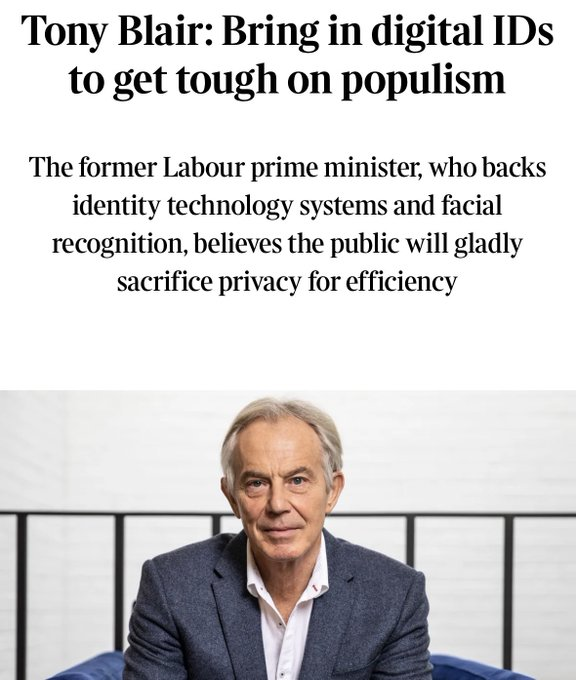
Except Luciom wasn't 'screeching hysterically', and he was criticizing the 'center-left', who by definition are not 'leftists.'
Actual leftists would typically agree with Luciom on this topic.
yep a good portion of the radical left would agree with me about censorship more than with Blair. I know it's only because they are the minority right now and are ready to censor everyone else the instant they get in power (which is why it is a moral imperative to never let them reach power) , but until they aren't , they can be allies on this.
Too funny how the child molester and the Nazi pig became BFFs (and some "moderator" did not like this fact at all)

crazy we had people legit gone through tough times back in the day because a few people or persons thought the eart revolves around the sun..such a crazy idea ...

Freedom of seach doesn't exist on SM, you just get impeached by those with a bigger following who show hatred or those with a bigger network who want to hurt you. Like everything, the biggest gang/community always wins.
I’d be happy to try it out here if you don’t mind OP. /. So, after careful consideration, I came to the conclusion that MOST of poker players are: parasites, borderline thieves and egomaniacs, especially the ones I knew live. Here however, there are lots of decent people contributing to the community and some (a lot actually) MAGA idiots who are worms and mental xxxxxxxx Thank you
so the xxxxxxxx is the limit. glad we know it

