On Coercing and Threats

Coercing
1
: to compel to an act or choice
was coerced into agreeing
abusers who coerce their victims into silence
2
: to achieve by force or threat
coerce compliance
coerce obedience
3
: to restrain or dominate by force
Threat
1
: an expression of intention to inflict evil, injury, or damage
2
: one that threatens
3
: an indication of something impending
Issue
The intention behind any threat should be to protect well-being—whether it's body, mind, or rights—and to stop harm from occurring.
The purpose of the threat should be to defend and neutralize the immediate danger, rather than escalate the situation further or provoke more harm.
Do yall agree with the quote about when threatening is acceptable vs unacceptable?
Is it the same for coercing? I.e. "only acceptable to protect well-being—whether it's body, mind, or rights—and to stop harm from occurring"
I think most parents coerce their children. Is this okay?
I think some parents threaten their children. Is this okay?
12 Replies

Where is your quote from?
It needs unpacking. Why should a threat be to protect well-being? Are we counting all well-being as equal, or can I threaten your well-being significantly in order for a small gain in my well-being?
Even hippy parents use coercion and threats, even if they might do so far less frequently than regular parents.
The fact that parents need to use coercion and threats on their children shows that you can't just apply a binary value judgment on whether threats and coercion are kosher. That is, unless you believe in moral absolutes.
Half ai generated (before my self-imposed boycott)
Even hippy parents use coercion and threats, even if they might do so far less frequently than regular parents.
Is there a way to raise children without them?
The fact that parents need to use coercion and threats on their children shows that you can't just apply a binary value judgment on whether threats and coercion are kosher. That is, unless you believe in moral absolutes.
I'm not saying I agree with the quote, I'd like to discuss it.
Revision
When talking about adult to adult communication:
A threat would be acceptable:
Assuming the threat is meant to protect rights being infringed upon that are more severe than the threat itself (a threat to stave off a battery)
Assuming a less harmful option than a threat is not applicable (cant be done, was done but didn't work, etc)
Assuming harm minimization is practiced (a guy is robbing your store so you pull a gun and threaten to shoot him in the leg, not the heart, because the leg threat is sufficient to scare him into stopping his actions)
Note that the threat itself is arguably more powerful than the execution. You sometimes fold strong hands on the turn because you know there's a threat of an all-in on the river. You threaten a checkmate in chess not expecting that your opponent will fall for the trap, but because the alternative isn't very appealing either. A threat represents an attempt to change the current balance of power - lots of workers rights, including the weekend, and child labor laws, are a result of the threat of mass protest and violence by the working class. Belgium today has strong workers' rights, but ~150 years ago the opposite was true. For ~50-60 years the working class protested, sometimes violently, and little by little they gained stronger protections through their threats, some of which they needed to follow through on just to make sure the bourgeoisie didn't see them as empty threats to be ignored.
It may be useful for you to zoom out of just threats as they relate to physical violence. An employee might tolerate worse conditions and lower pay because they see that there is lots of demand for their job, and they need to work. A tenant might pay over the odds because the threat is homelessness.
AI is useful for lots of stuff, but it is phenomenally bad at the most fundamental parts of being human - ethics, feelings, etc. Please let's all collectively boycott AI for the sakes of philosophical discussion.
I often find it very useful to look at analogues within the animal world, and I found this, which may be of interest:
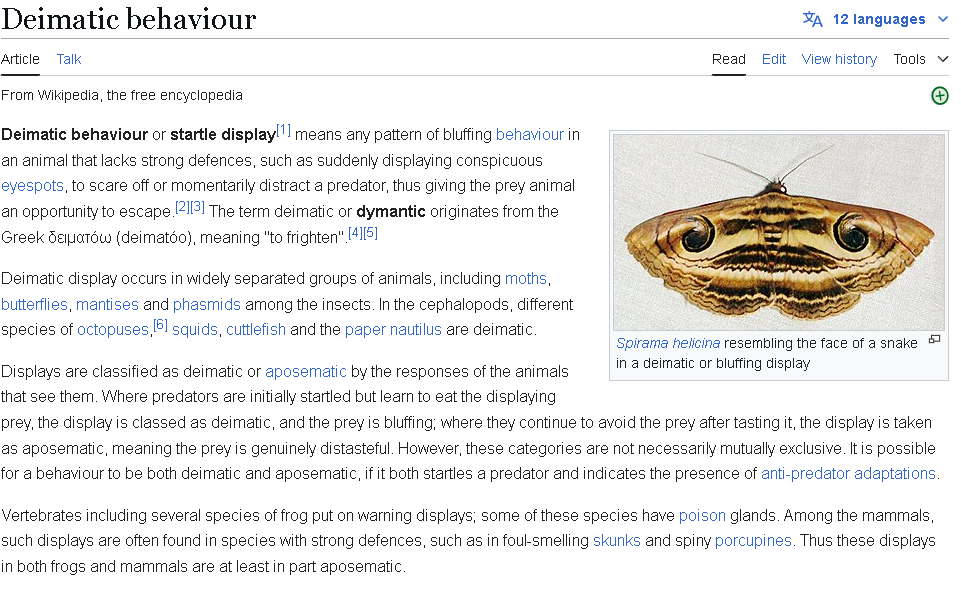
I note that in the rest of that entry, there is no mention of animals like cats or bears that make themselves taller in order to warn off potential dangers. This is probably because such a behaviour is not a bluff, in that they will get pretty serious if the danger gets closer. But: it is still a threat.
In the absence of moral absolutism, yes, my answer is that sometimes threats are justified, as are empty bluffs. If Kant had been alive ~150 years later, he might have seen that his categorical imperative idea is routinely ignored by nature, that gets by plenty on bluff and deception. In the case of threatening your child, I'm not okay with many versions where you the adult are threatening retaliation if they piss you off; but I am okay with a modified version which says 'if you run into the road, you may die'. I am even okay with exposing a child to scary visuals in order to make sure they understand the nature of the threat, where necessary.
As for plain coercion, again, as I'm not a moral absolutist, yes, if I could bad people into not doing bad things anymore, I would wield that weapon with glee.
Question: why did the USA drop the bomb on hiroshima and nagasaki rather than just threatening it?
Answer: the justification given at the time and commonly-held view today was that Japan wasn't going to surrender, and so this would save lives, but many historians do not agree that the bomb was the straw that broke the camels back - Japan's back was already broken, and the USSR was on the way. The threat itself wouldn't have been very believable: 'hey please trust us but we've invented a big explosive that will kill everyone in your cities, we don't want to use it but we will!' Instead, they played the long game in showing the rest of the world a) that USA had that power and b) that it was willing to use it. Thus they gave power to all their future threats. 'Holy f*** these guys are psychos and are willing to kill hundreds of thousands of people. We'd better just do what they say.' Geopolitics as the highest stakes form of bluff and gambling.
It may be easy to mistake boundary-setting and description of consequences as threats. While they may appear similar, to the point that some can't tell them apart, they are very different. EG if you keep turning up to my house, expecting sex without having showered, my boundary of 'I'm not willing to have sex with you unless you get yourself clean' may sound like a threat. Which speaks to the idea of privilege, in that when you've been on top, equality feels like a downgrade.
Question: why did the USA drop the bomb on hiroshima and nagasaki rather than just threatening it?Answer: the justification given at the time and commonly-held view today was that Japan wasn't going to surrender, and so this would save lives, but many historians do not agree that the bomb was the straw that broke the camels back - Japan's back was already broken, and the USSR w
Do you think murdering innocent men, women, and children in order to gain influence and power in the world is something a country aligned with Christian values would do?
Do you think murdering innocent men, women, and children in order to gain influence and power in the world is something a country aligned with Satanic or Evil values would do?
Do you think America says that she prays to Jesus when her actions reflect the nature of a country worshiping Satan?
Do you think the American government is lying to the American people about its nature and its intentions?

I'm Japanese...

Yes. Not just would do, but have done consistently for at least ~500 years.
No. Not sure why you're capitalizing Evil. Perhaps you misunderstand what satanism is. I'd like to hear more about your conceptions of good and evil.
I can't work out what you're trying to ask in the third question. I'm afraid it sounds like word salad to me. Yes, america and christianity are beyond the pale when it comes to the divergence between the teachings of jesus and their actual behaviour.
Lol. Yes. From the word go. America was built on a foundation of lies, by slaveholders. I doubt there's a single president I'd look at and think 'nah you're not in the top 1% evil a***oles ever to exist'.
What is the purpose of this line of questioning?
Do you ever actually answer questions posed to you, or do you just deflect with more questions?
Do you ever actually answer questions posed to you, or do you just deflect with more questions?
Assuming America dropped the bombs for power and influence over the world:
Do you think murdering innocent men, women, and children in order to gain influence and power in the world is something a country aligned with Christian values would do? Nope Do you think murdering innocent men, women, and children in order to gain influence and power in the world is something a country aligned with Satanic or Evil values would do? Yup Do you think America s
There's some answers for you. It wasn't hard. I don't ask hard questions.
Yes. Not just would do, but have done consistently for at least ~500 years.No. Not sure why you're capitalizing Evil. Perhaps you misunderstand what satanism is. I'd like to hear more about your conceptions of good and evil.I can't work out what you're trying to ask in the third question. I'm afraid it sounds like word salad to me. Yes, america and christianity are beyond the p
Interesting perspective.
I think these kinds of discussions benefit from clearly defining terms and staying focused on the main points.
The historical and ethical aspects raised here are complex, and probably worth unpacking one step at a time rather than jumping across several topics at once.


