Dreams: What Sigmund Freud didn't know and what could be the key

IMPORTANT: All 3 cards refer only to those dreams that don't give you an answer to the question.
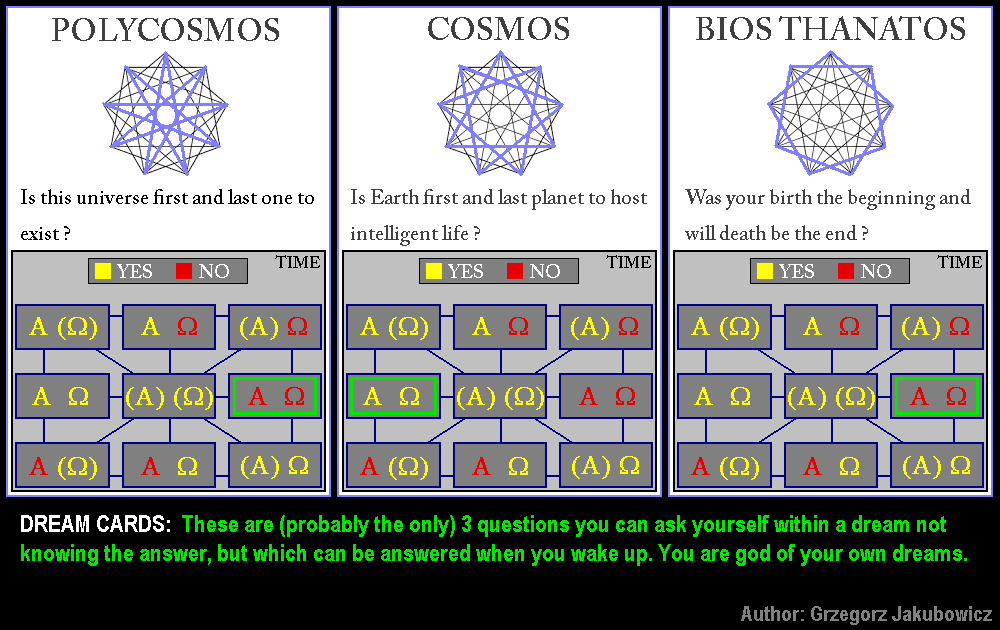
"POLYCOSMOS" card ( Wake Up Answer: neither Alpha nor Omega) - When being inside a dream, the dream becomes the universe. When you wake up from the dream, the dream you're going to get next day is going to be the next universe. Same thing with the dream you had the previous day. You don't know that when you're still inside your dream, but you will when you'll wake up.
"COSMOS" card (Wake Up Answer: both Alpha and Omega) - When being inside a dream, your brain "renders" only a certain 3D area - mostly the area you are seeing at that time. For example, when you dream you're on vacation in Monte Carlo, your brain doesn't render (nor know) what is happening in Tokyo at that moment. So when you dream you're sitting on a bench and looking at the night sky, your brain doesn't create events that are happening at that moment on other planets and doesn't know what was happening there in the past or will be happening in the future. The question will remain unanswered for you because you neither see nor know that, too. Until you wake up and realize that the area your question referred to didn't even exist in that dream.
"BIOS THANATOS" card (Wake Up Answer: neither Alpha nor Omega) - When being inside a dream, the moment your dream started was your birth and the moment when it ends will become your death. Your real life reality was there before your birth and will be after your death. You don't know that when you're still inside your dream, but you will when you'll wake up.
GRAPHIC:
Sigmund Freud (6 May 1856 – 23 September 1939) was an Austrian neurologist and the founder of psychoanalysis, a clinical method for evaluating and treating pathologies seen as originating from conflicts in the psyche, through dialogue between patient and psychoanalyst, and the distinctive theory of mind and human agency derived from it. [source: Wikipedia]
Sigmund Freud’s "The Interpretation of Dreams" was one of the most important books of the 20th century.
First published in 1900, it provides a groundbreaking theory of dreams and an innovative method for interpreting them that captivates readers to this day. The book represents Freud’s first major attempt to set out his theory of a dynamic unconscious, created in childhood, which operates continuously in every human mind. For Freud, dreaming is a mental activity that follows its own logic. By identifying its mechanisms, Freud also shed new light on the workings of the unconscious and its powerful role in human life. [source: FREUD MUSEUM LONDON]


