Any advice for shortstack strategy?

Hi all,
I've found an unbelievably juicy $5/$10/$25 Omaha game. I played it last weekend and did well. However sitting do
There's 26 posts in that thread, I don't recognise any of the posters in it, it's specific for NLHE, and I don't see what we need to settle this argument-based tie: data. I've shortstacked PLO live cash games for maybe ~5-10% of my live play the last 20 years. I've been on some swings you wouldn't believe. 50 buyins in a session? You may well be right overall, but to find out t
I'd argue that you can show the variance is lower playing a 20bb stack in comparison to a 100bb stack with math (as DrTJO has down above) and that actual data isn't strictly necessary (although I'm confident it would confirm it).
Finding data will be tricky, since it's difficult to calculate standard deviation accurately, but I understand that it can be estimated (see a recent Mason Malmuth interview on the the Poker Zoo podcast:
). I have zero background in statistics, aside from reading stuff on 2+2 (of course), but the gist is that you'd need to log your

Interesting post, thanks - agreed.
I could short stack on Stars for 40bbs and keep a track of hands in Poker Tracker - but for now I'm going to train with 20bb stacks on GG as my first live session will be next weekend and I need to get as much practice as possible in between now and then. I'll see about doing a 40bb session on Stars at some point after that though.
My post will not be nearly as technical but still holds true. The street with the most fold equity is the river followed by the turn. Playing short removes these 2 streets. It is very hard to get players to fold pre or on the flop which are the 2 highest variance / equities run closest together parts of the hand. I am not saying that playing short is not profitable but its not
Sure, these are fair points, and definitely playing with a short stack massively decreases our fold equity. But the flipside is that we get to realize a lot more of our equity too. Playing with 20bb stacks on GG I've found that there is some fold equity when jamming flops - of course, when players have whiffed, they can hardly continue, and there is no promise of implied odds for them either. Many advanced PLO players including JNandez seem to maintain that shortstacking PLO is hugely profitable and advantageous, especially when the other players in the game aren't adjusting.
The reason I'm short stacking is mostly simply due to bankroll management (but also because it's fun to experiment). I can afford many $500 bullets in this crazy $5/$10/$25 game I've found, but to sit down with 100bbs ($2500) with the intention of regularly getting the money in ahead in 60/40 flips etc is likely going to be too much for my bankroll to handle. One of the main strategies when playing the short stack is to limp-reraise and in those cases, as long as it's executed carefully, it's usually possible to get the money in heads up or at worst three ways - which is the goal, and what I've found to be the case when practicing on GG.
Sure, I don't expect it to be as easy as it sounds. Worst case scenario - I lose some buyins but have an enjoyable experiment; it's not the end of the world. Best case scenario - it's a hugely profitable setup and I can milk the game for months/years on end.
Sure, these are fair points, and definitely playing with a short stack massively decreases our fold equity. But the flipside is that we get to realize a lot more of our equity too. Playing with 20bb stacks on GG I've found that there is some fold equity when jamming flops - of course, when players have whiffed, they can hardly continue, and there is no promise of implied odds f
Your original question was about live play. You can be highly profitable in any situation where players aren't adjusting to what you're doing.
The reason I'm short stacking is mostly simply due to bankroll management (but also because it's fun to experiment). I can afford many $500 bullets in this crazy $5/$10/$25 game I've found, but to sit down with 100bbs ($2500) with the intention of regularly getting the money in ahead in 60/40 flips etc is likely going to be too much for my bankroll to handle. One of the main strategies when playing the short stack is to limp-reraise and in those cases, as long as it's executed carefully, it's usually possible to get the money in heads up or at worst three ways - which is the goal, and what I've found to be the case when practicing on GG.
Sure, I don't expect it to be as easy as it sounds. Worst case scenario - I lose some buyins but have an enjoyable experiment; it's not the end of the world. Best case scenario - it's a hugely profitable setup and I can milk the game for months/years on end.
You are comparing online to live and topping it off with that statement at the end. For someone asking for advice you seem to already have all the answers. Just the juxtaposition of admitting you have a low bankroll + playing PLO + playing an even higher variance of PLO with short buyins is hilarious.
Your original question was about live play. You can be highly profitable in any situation where players aren't adjusting to what you're doing.
The point is that many PLO recs do not adjust when there is a short stack in play and that creates a situation that can be exploited by short stack players.
You are comparing online to live and topping it off with that statement at the end. For someone asking for advice you seem to already have all the answers. Just the juxtaposition of admitting you have a low bankroll + playing PLO + playing an even higher variance of PLO with short buyins is hilarious.
Live has always been far softer than online in my experience. I'm going into this with an open mind and as long as I play well I don't mind if I win or lose; I'm prepared for any variance. I have a fine bankroll for the stakes I usually play; $1/$3 and $2/$5, and I've beaten those stakes consistently for many years. Obviously there is a massive difference between those stakes and stepping up two levels to $5/$10/$25, and consequently a massive difference in bankroll requirements. If I really wanted to devote my life to this juicy PLO game then yes, I could roll myself for it. But I have a full-time job, many people who depend on me, and many interests besides poker - so for now at least short stacking is the best option for me in this game, as buying in deep is more money (and a greater time investment with studying etc) than I want to commit to this game at the moment.
Playing with shorter buyins is not higher variance.

Would you at least agree that it's far higher variance per $?
Yes I do know what you mean and I agree that's it's probably higher expected variance per buy-in, but lower actual variance compared to buying in for 100bbs. This is because variance is measured in a dollar amount and not measured relative to one's buy-in.
It can be measured according to anything you like. That's the beauty of maths. But that actually doesn't mean much. It is not as cut and dry as the arguments you've presented, when there are good arguments going the other way. 5 times the buyin therefore 25 times the variance is not quite a slam dunk, because the variance in pot size is not going to follow the same distribution at all. The only weapon that can end this argument-fight is a database analysis. Until then we're just yelling past each other. Which can be fun, ofc
It can be measured according to anything you like. That's the beauty of maths. But that actually doesn't mean much. It is not as cut and dry as the arguments you've presented, when there are good arguments going the other way. 5 times the buyin therefore 25 times the variance is not quite a slam dunk, because the variance in pot size is not going to follow the same distribution
Regardless of how you measure it, the variance is still going to be much smaller when playing with a 20bb stack in a 100bb game than it is when playing with a 100bb stack in a 100bb game. In order to have an accurate assessment of the variance involved it's essential to see the 20bb stack in the context of a 100bb game and there is no mathematical way for that variance to be larger than playing with a 100bb stack in the same game (assuming all players are playing reasonably rationally). I think it's pretty clear for all to see that naturally playing with a 5x larger stack is going to result in greater deviations up and down from zero, and that's ultimately what variance is measuring.
How do you conclude that the variance in pot size is not going to be directly proportional to the relative stack size as far as the short stacker is concerned? This may be true once he doubles his stack, but I don't see how it's true before then. But I could be wrong - I'm genuinely interested to hear what you think.
There are issues with using database analysis too, unless you have a gigantic sample.
I dont understand the whole variance discussion.
Yes of course you’re going to swing less in Total dollar amounts if you buyin 20bbs compared to 100bbs, even a monkey can figure that out.
However the only reason to buyin short is because you can play a bigger game, there is absolutely no reason to buyin 20bb in a splashy live game if you are rolled to buyin for 100+bb.
Regardless of how you measure it, the variance is still going to be much smaller when playing with a 20bb stack in a 100bb game than it is when playing with a 100bb stack in a 100bb game. In order to have an accurate assessment of the variance involved it's essential to see the 20bb stack in the context of a 100bb game and there is no mathematical way for that variance to be la
I'm sorry but you don't gain correctness by asserting it, and you're just asserting that it's obvious and stands to reason and that to question that is unmathematical. It is not clear. You are trying to dress up your arguments as watertight and ours as questionable. Unless you have something stronger to bring to the table that Jnandez and some arguments, this issue will remain unresolved.
I'm sorry but you don't gain correctness by asserting it, and you're just asserting that it's obvious and stands to reason and that to question that is unmathematical. It is not clear. You are trying to dress up your arguments as watertight and ours as questionable. Unless you have something stronger to bring to the table that Jnandez and some arguments, this issue will remain
I think we just have different definitions of what variance is my dude.
I dont understand the whole variance discussion.
Yes of course you’re going to swing less in Total dollar amounts if you buyin 20bbs compared to 100bbs, even a monkey can figure that out.
However the only reason to buyin short is because you can play a bigger game, there is absolutely no reason to buyin 20bb in a splashy live game if you are rolled to buyin for 100+bb.
Agreed, and that is indeed the reason why I'm short stacking in this game (i.e. that I'm unwilling to sit down and blast with multiple $2500 bullets in an insane monkeydonk game).

Ok, anyway, so what ranges are we playing 20bb from sb/bb as per first post?
Juicy live cash game, straddles constantly
Ok, anyway, so what ranges are we playing 20bb from sb/bb as per first post?
Juicy live cash game, straddles constantly
It depends on the action before it gets to us but in general 3betting a linear range and defending a sensible range given that we'll be going into very low SPR situations postlop, with more emphasis on high cards than when playing with 100bbs.

Regardless of how you measure it, the variance is still going to be much smaller when playing with a 20bb stack in a 100bb game than it is when playing with a 100bb stack in a 100bb game. In order to have an accurate assessment of the variance involved it's essential to see the 20bb stack in the context of a 100bb game and there is no mathematical way for that variance to be la
In the space of 30 hands, if a 20bb (SS) player is AI 3 times (losing all 3), while a nitty 100bb (DS) player loses/wins 10bb 3 times (e.g. raises pre, c-bets, opponents fold), then the SD will be higher for the SS player. The mean for the SS player, over 30 hands, would be 2bb, compared to 1bb for the DS. The SD per hand for the SS player is 5.91bb, while for the DS player it is 2.96. If just 1 of the 3 10bb hands for the DS player is changed to 40bb then their standard deviation rises to 7.4bb per hand. Of course if the DS player loses 100bb in one hand their SD rises dramatically to 17.8bb.
These are extreme examples but I think much of this argument depends on how often a DS player is involved in pots over, say, 40bb. Generally, because 40bb+ pots are relatively common I'd suggest the DS player will likely have a higher SD and therefore experience greater variance, measured in bbs per hand. Even if they are a nit, it doesn't matter that much, since they are still going to win 100bb+ pots with the nuts v 2nd nuts etc, and the difference between winning and losing isn't relevant to variance (deviation from the mean = variance).
From what I've gathered in my research (i.e. 10 min search on google) you don't need a large sample to calculate standard deviation (unlike win-rate). A 30 data-point sample is sufficient to be 90% confident as a rule of thumb. I hope someone with a background in statistics can elaborate or just tell me I'm plain wrong.
The question that interests me is whether a data-point includes folds as well as vpips. Anyway, you could at least calculate your SD playing 20bb for a session online. Even if you recorded how many BBs you won or lost for your individual vpips, you could work out how many times you folded by deducting your vpips from number of hands played.
The reason I believe folds are important as potential data-points is because a short-stack will probably fold more preflop than a 100bb+ stack.
In the space of 30 hands, if a 20bb (SS) player is AI 3 times (losing all 3), while a nitty 100bb (DS) player loses/wins 10bb 3 times (e.g. raises pre, c-bets, opponents fold), then the SD will be higher for the SS player. The mean for the SS player, over 30 hands, would be 2bb, compared to 1bb for the DS. The SD per hand for the SS player is 5.91bb, while for the DS player it
we need a 1000 hand sample vpip size to follow SD. using your method as a starting guide, rather than a definitive conclusion.
In the space of 30 hands, if a 20bb (SS) player is AI 3 times (losing all 3), while a nitty 100bb (DS) player loses/wins 10bb 3 times (e.g. raises pre, c-bets, opponents fold), then the SD will be higher for the SS player. The mean for the SS player, over 30 hands, would be 2bb, compared to 1bb for the DS. The SD per hand for the SS player is 5.91bb, while for the DS player it
Yes sure that's fair and perhaps I should have specified that we need a large sample size in order to get accurate results.
These are extreme examples but I think much of this argument depends on how often a DS player is involved in pots over, say, 40bb. Generally, because 40bb+ pots are relatively common I'd suggest the DS player will likely have a higher SD and therefore experience greater variance, measured in bbs per hand. Even if they are a nit, it doesn't matter that much, since they are still going to win 100bb+ pots with the nuts v 2nd nuts etc, and the difference between winning and losing isn't relevant to variance (deviation from the mean = variance).
Sure, agreed.
From what I've gathered in my research (i.e. 10 min search on google) you don't need a large sample to calculate standard deviation (unlike win-rate). A 30 data-point sample is sufficient to be 90% confident as a rule of thumb. I hope someone with a background in statistics can elaborate or just tell me I'm plain wrong.
I'm not sure about this either but of course would assume that more data = more accuracy. We also have to assume that it's a "normal" game is we're trying to work out means etc. And how do we account for the fact that some games are tight, some are loose, etc? If for example all our data comes from tight games, it's not going to be reliable, especially if it's a small sample of say 30 hands. If we instead included 30 million hands, then it's likely to include many more styles of players etc and the data (I assume) should be more accurate as a result.
The question that interests me is whether a data-point includes folds as well as vpips. Anyway, you could at least calculate your SD playing 20bb for a session online. Even if you recorded how many BBs you won or lost for your individual vpips, you could work out how many times you folded by deducting your vpips from number of hands played.
The reason I believe folds are important as potential data-points is because a short-stack will probably fold more preflop than a 100bb+ stack.
I imagine folds should be included and that they will simply have the effect of bringing the standard deviation down (but I could be wrong on both counts, I'm just speculating and I haven't studied math formally in 25 years). And I guess if short stacks are folding more preflop (which I agree should be the case) then it is of course going to bring their standard deviation down.
microsoft copilot is pretty good at an interesting range of things but I don't think we can take its analysis very seriously here, though i asked the question neutrally (seems to be important with AI prompts to avoid it trying to please you by telling you you're right)
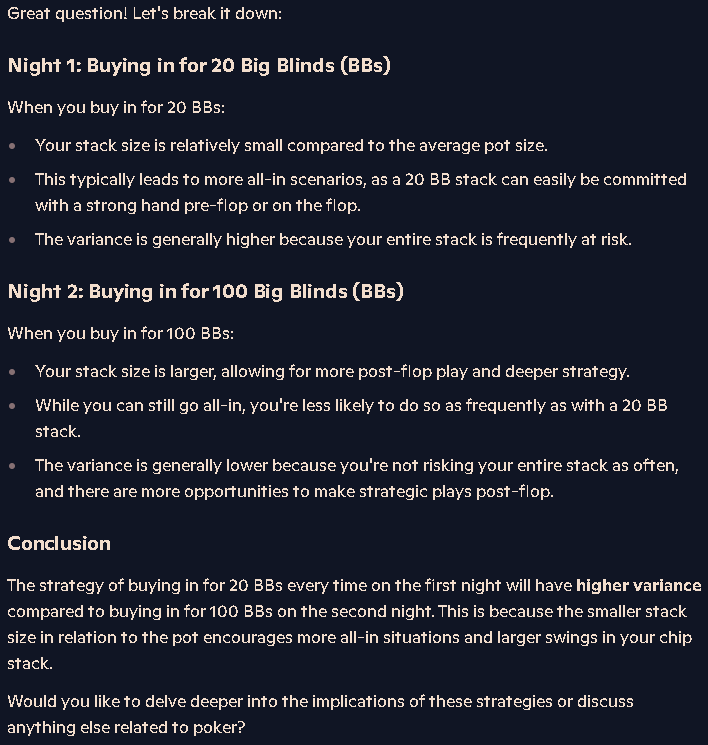
Mmm co-pilot seems to be under the impression that the degree to which your stack is “at risk” is proportional to variance rather than deviation of bbs from the mean.
I wonder if co-pilot is cognisant of the difference between cash games and tournaments?
What was the wording of the question co-pilot so diligently answered?
Mmm co-pilot seems to be under the impression that the degree to which your stack is “at risk” is proportional to variance rather than deviation of bbs from the mean.
I wonder if co-pilot is cognisant of the difference between cash games and tournaments?
What was the wording of the question co-pilot so diligently answered?
Yes that was my conclusion too.
Almost certainly.
'there is a pot limit omaha live cash game where we can buy in for 20 big blinds (bbs) or 100. i want you to imagine playing out two nights of hands (say, 150 hands played on each night). In both games, everyone else has a bigger stack than us. On the first night, we buy in for 20 bbs every time, and on the second night 100 bbs. Which strategy has the higher variance?'
I’m hoping co-pilot didn’t charge you for this advice, particularly as the question seems appropriate enough. Maybe co-pilot thinks that all you got is what’s on table. Doesn’t co-pilot know that serious players are rolled?


