How much ROI do you sacrifice playing for the win?

Wins are nice, so some 1%ish may feel like a worthy tradeoff. No one wants to cut his winnings by 20% for ignoring personal Icm implications.
You've heard of the idea of beautiful future game chipleading the final table. In ICM, the chipleader gets to realize nice +chipEV spots against the rest. However it's already his "natural" baseline strategy in ICM. The question if one should actively pursue to get the biggest stack would imo require exploitative potential of pressuring the table that goes beyond of what the chipleader already has as his strategic baseline in Icm.
On final tables that are filled with more (weakish) regulars than fish, is that additional exploitative potential realistic?
Some fish may even play anti Icm, so your ability to realise through them tightening and overfolding may be lower. In Icm, if people, being bad, nervous, or tired, just drop out left and right on finals, you get to be incentivised to tighten even more.
Are players who play purely for the win and know how to play big stack practically winning more? Or is Icm to be trusted and realizes you more dollars?
11 Replies
Some fish may even play anti Icm, so your ability to realise through them tightening and overfolding may be lower.
Welp, in this case you can just tighten up and overfold yourself, especially if you have a small stack. Deeper stack maniacs will bust against each other basically giving you away free ICM money.

In experiments, chip EV players win 1st slightly more often, but cash less often and make significantly less money than ICM.

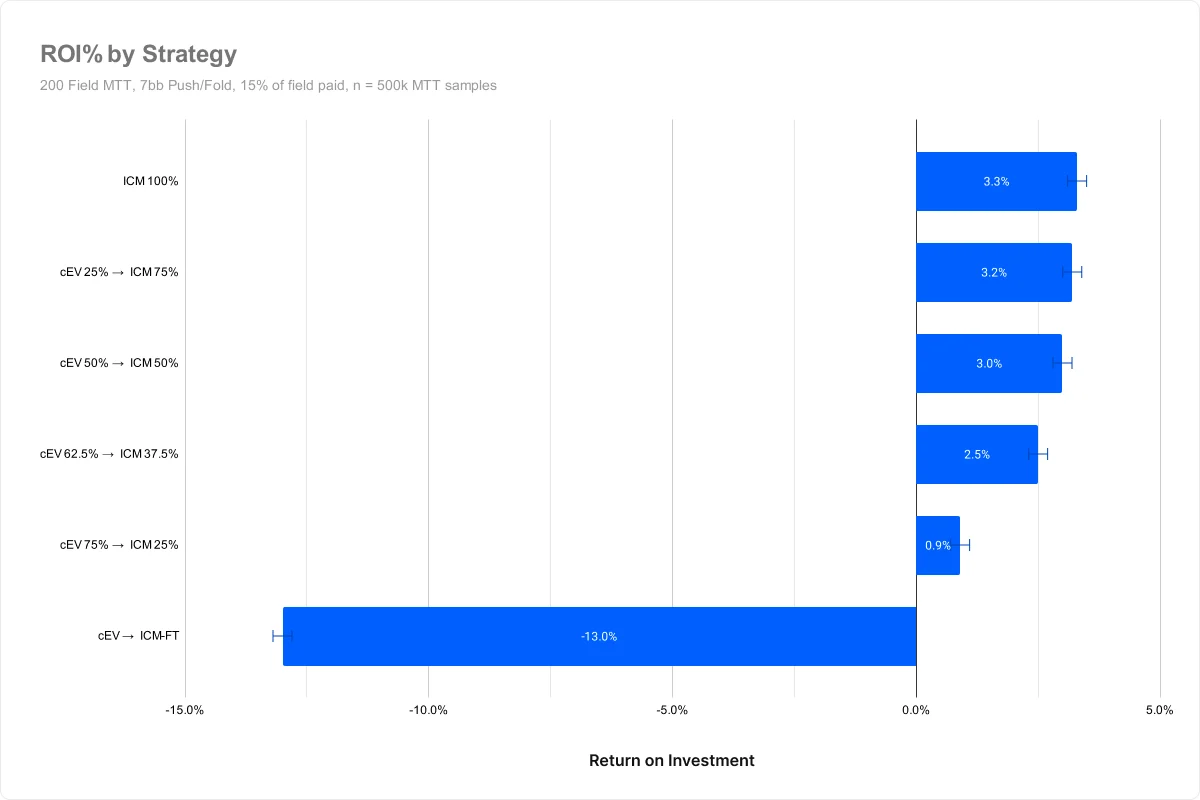
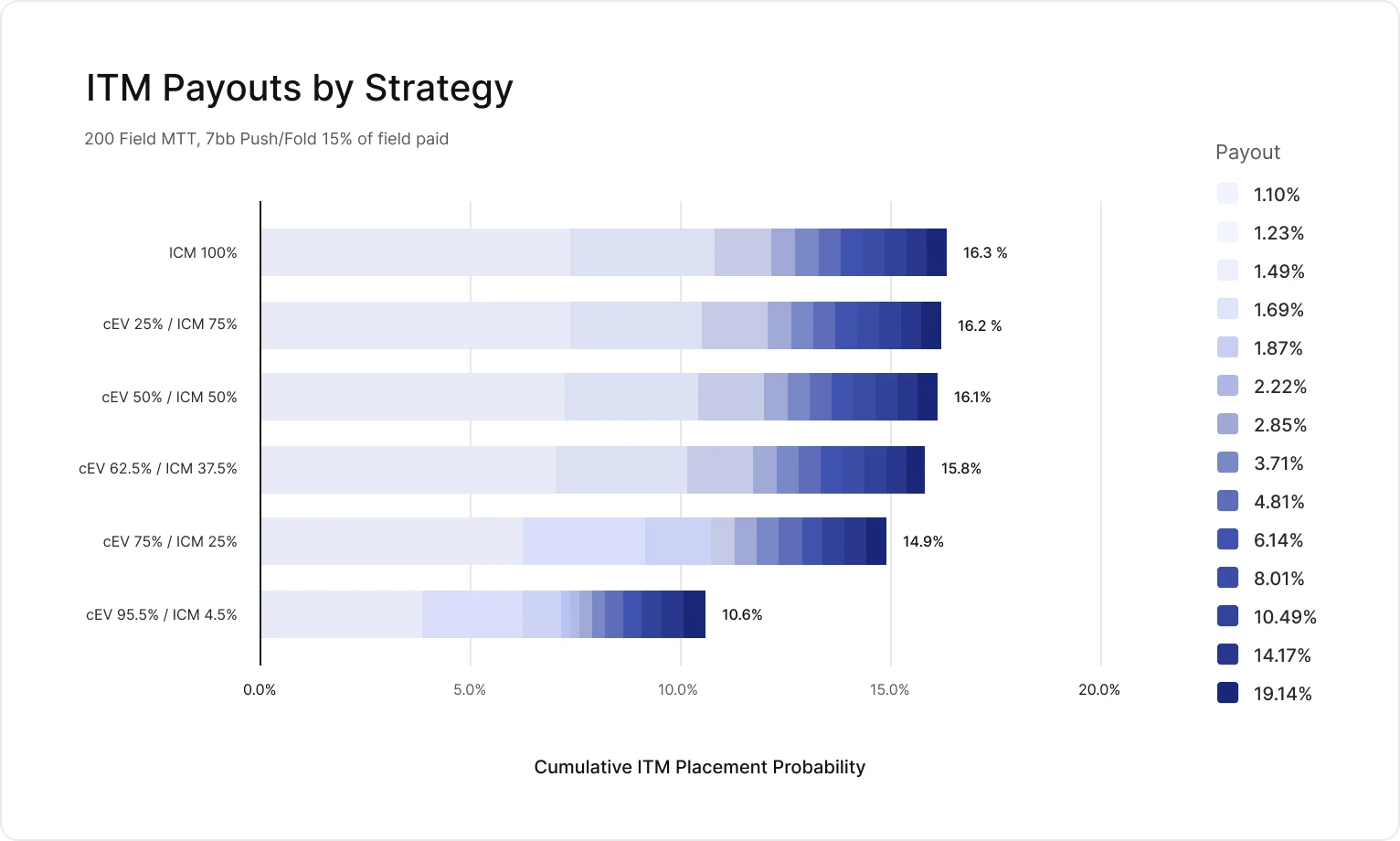
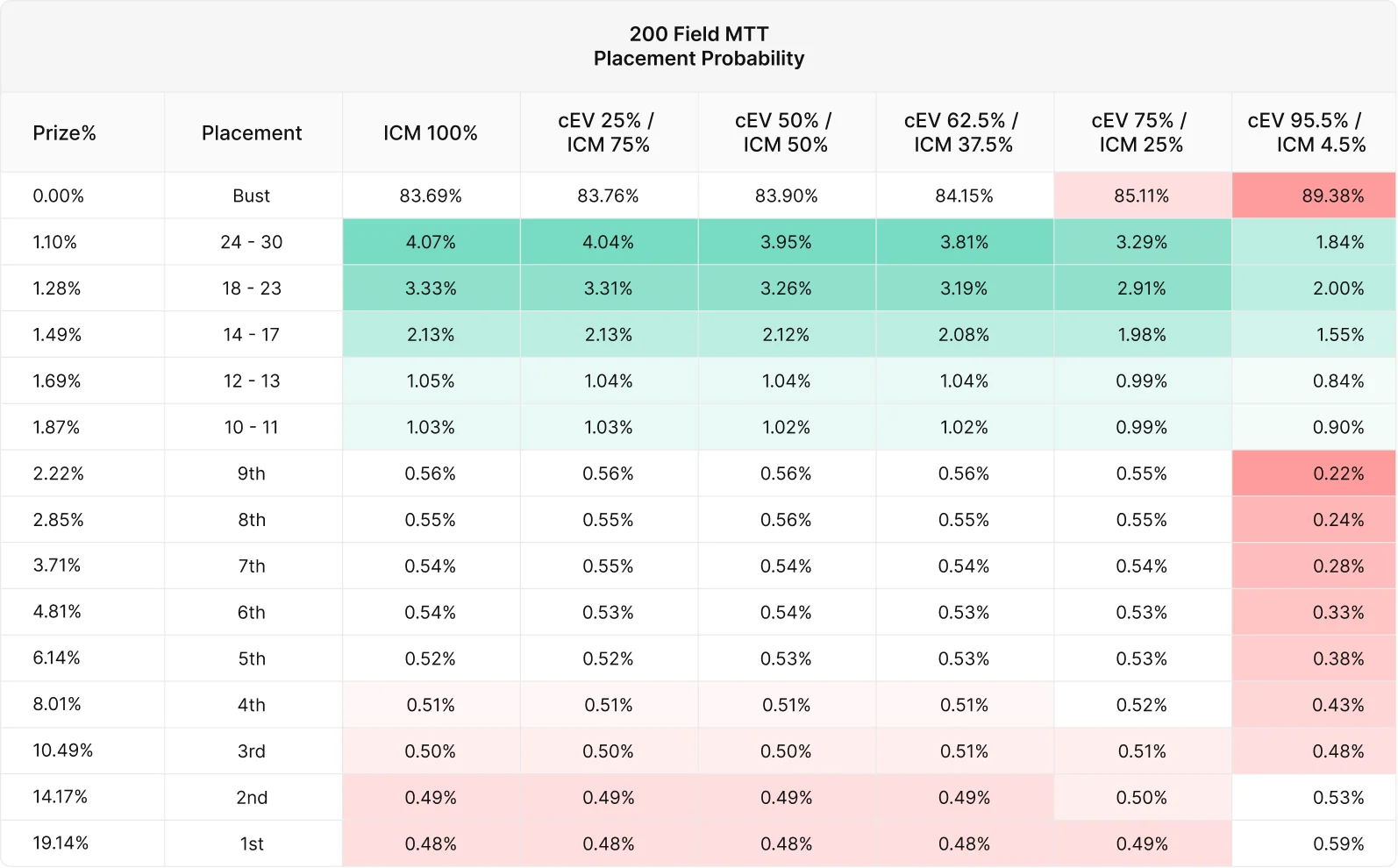
All tournament equity models predict that your probability of getting 1st is equal to your chip portion. So any strategy that tries to maximize chips (AKA chip EV), *should* place 1st more often, (at the expense of their ROI).
How much ROI do you sacrifice playing for the win?
None, you're trading money for ego. The only exception would be if 1st has some prestigious value that you could leverage into future EV, e.g. winning the WSOP Main Event for example.

My approach to poker is that I strive in every decision to make the decision that will make me the most money, period.
That's an oversimplification in terms of what doing so actually entails, but when we talk about ICM and things like that, that's what it amounts to for me. I don't try to "play for the win" if doing so will cost me money in the long run. I don't try to get to a specific stack size if I have to make a -EV gamble to try to get there. I try to take every spot as it comes and make the best decision each time I have a decision, with the idea that "the best decision" is the most profitable one.
In experiments, chip EV players win 1st slightly more often, but cash less often and make significantly less money than ICM.
All tournament equity models predict that your probability of getting 1st is equal to your chip portion. So any strategy that tries to maximize chips (AKA chip EV), *should* place 1st more often, (at the expeBut people 'playing for the win' doesn't always means playing pure chipEV across all spots/situations (Why would you take the 'riskier spots' even if not using ICM at all or pushing the edges of range to make sure you are 'taking every spot +EV)) which is what you are comparing to ICM here.
(This is hard to quantify as these are really the only tools we have to use - so it becomes more of a 'feel game' with some back up of +chipEV and some risk factor based on stacks / stage of game / player setups / stack depth / many more factors).
I realize this is the only way to really compare anything meaningfully across many spots with the current models / math / programs, but ICM has its flaws, and clearly pure chipEV will mean going out more often - so i don't disagree with what is presented if you were to either do one or the other. (or a mix). But maybe the overarching conclusions.
How would you steelman the conclusions from data you have provided? I assume based on this you would say to use ICM (which on the surface is correct, vs pure chipEV for example). But what about a player who plays 'the better chipEV spots' but not pure chipEV (and also values not busting from tournament start. (So not a 'take every spot (+EV) guy).
(I have a very large sample not using ICM 60k+ sngs and 10k+ mtts. (But generally understanding how others are using it, based on stack relationships, especially late game - and have done plenty of sims myself over the years).
Maybe this has worked because I am nittier /risk adverse personality (And value tournament life throughout the entire game - so never 'take every +EV spot) so overlaps more with ICM like ideas/hands in many spots, but I am also not making huge folds or shying away from busting in certain setups or common spots that a solid EV, where in ICM sims it tells me to fold (but this again is not just going full chipEV over all spots - it is situationally based, and has many factors). Which also means other tools or ideas about judging the risk (and payoff) in spots/situations.
(This isn't to say not using programs or doing some ICM sims (mostly to see what my opponent if a reg 'might do'), as i have used just about all of them over the years starting poker in 07. But have sort of reverted to using chipEV evaluations, solvers (often with nodelocks) and i guess 'feel' for risk and backing this over using ICM (which in my mind is just not a good picture of the game in reality, just a useful overlay of a model vs pure chipEV especially if wanting to use program comparisons across spots) So ended up with more feel game than 'take every spot' (chipEV) or pure ICM.
Like what would 'ICM 2.0' look like, what things would this incorporate to make this more accurate than current ICM. (What in your mind is the main flaws in ICM) - Do you know of anyone trying to do this or incorporate more variables to make it a more true picture of reality?
Thanks (Is it worth opening a thread in poker theory to go deeper into this?)
ps: Really enjoy all the work you put into poker theory / GTO wiz, cheers.
I guess not taking marginal +chipEV spots is legit. by +chipEV I mean your personal chipEV evaluation or feeling of a practical [exploitative] situation [not +chipEV in a solver, which is for GTO vs GTO].
what flaws do you see with ICM? @G-Englar
can you somehow show that you have a strategy that makes more dollars [besides more wins] than if you played ICMish, through your personal data?
@tombos
imo it's still possible that things play out differently in practical [exploitative] reality, because people play like people and these models don't account for it. I don't have enough personal experience or data though to have a good enough feeling for what's going on, so as of now ICM seems to be an adequate model.
I guess not taking marginal +chipEV spots is legit. by +chipEV I mean your personal chipEV evaluation or feeling of a practical [exploitative] situation [not +chipEV in a solver, which is for GTO vs GTO]. what flaws do you see with ICM @G-Englarcan you somehow show that you have a strategy that makes more dollars [besides more wins] than if you played ICMish, through your perso
Look at my Hendon mob:
https://pokerdb.thehendonmob.com/player....
I have only 2 firsts, and a sea of 2d=4ths.
I think I might be a little too ladder conscious to be honest, but there are several spots in there where I never had above average chips at the FT, and finished 2d/3d/4th.
Thanks for the thoughtful reply G-Englar. I'll do my best to answer.
But people 'playing for the win' doesn't always means playing pure chipEV across all spots/situations (Why would you take the 'riskier spots' even if not using ICM at all or pushing the edges of range to make sure you are 'taking every spot +EV)) which is what you are comparing to ICM here.
(This is hard to quantify as these are really the only tools we have to use - so it becomes more of a 'feel game' with some back up of +chipEV and some risk factor based on stacks / stage of game / player setups / stack depth / many more factors).
I realize this is the only way to really compare anything meaningfully across many spots with the current models / math / programs, but ICM has it flaws, and clearly pure chipEV will mean going out more often - so i don't disagree with what is presented if you were to either do one or the other. (or a mix). But maybe the overarching conclusions.
How would you steelman the conclusions from data you have provided? I assume based on this you would say to use ICM (which on the surface is correct, vs pure chipEV for example). But what about a player who plays 'the better chipEV spots' but not pure chipEV (and also values not busting from tournament start. (So not a 'take every spot (+EV) guy).
Let's set aside ICM and only focus on chip EV.
Chip portion = 1st place% is true under the assumption that players are equally skilled. Therefore a strategy that attempts to maximize chips will max your win%.
Things get very complicated once you throw in skill edges though. Then your true "chip EV" isn't just a matter of maximizing chips this hand. It becomes a function of maximizing your skill edge over the entire tournament. That's where concepts like edge passing come into play - you're passing on chips now to win more chips later. But I'd argue that some hypothetical perfect edge-preserving chip-maximizing strategy is still cEV.
If you're really curious about modelling skill edge in tournaments, Mathematics of Poker did a nice treatment of it in the chapter "The Theory of Doubling Up".
https://forumserver.twoplustwo.com/15/poker-theory-amp-gto/factoring-skill-edge-mtts-1823235/?highlight=
However, I've come to believe that real "skill edge" is too complicated to model in a solver. Skill edge isn't just some flat number like a loaded dice in your favor. It's a complicated thing that changes depending on your stack depth, how deep you are relative to others, and who you're playing against. Skill edge isn't transitive either - you can end up with rock-paper-scissors effects where 3 players have the edge on each other yet none of them is outright superior.
---
Food for thought:
If skilled players are incentivized to trade immediate cEV for lower variance, then does that mean unskilled players should pass up cEV in exchange for higher variance?
Like what would 'ICM 2.0' look like, what things would this incorporate to make this more accurate than current ICM. (What in your mind is the main flaws in ICM) - Do you know of anyone trying to do this or incorporate more variables to make it a more true picture of reality?
That's a really interesting question and I think would make for an interesting discussion on the theory forum. Off the top of my head, empirical tournament equity models based on training AI on real MTT data is likely the next step.
I guess not taking marginal +chipEV spots is legit. by +chipEV I mean your personal chipEV evaluation or feeling of a practical [exploitative] situation [not +chipEV in a solver, which is for GTO vs GTO]. what flaws do you see with ICM @G-Englarcan you somehow show that you have a strategy that makes more dollars [besides more wins] than if you played ICMish, through your perso
Sorry for the wall of text (and slightly hijacking the thread)
Yeah it would end up being the exploitative chipEVs (but also passing +EV in higher risk spots. (Which are again just heuristics) - Like deeper stacks clashing, early position opens/shoves, 3bets vs early position, player type adjustments (nits) etc to name a few which are there because of the weakness of the player pool. (human players in general)
(Also sometimes taking slightly -ev spots for future playability (chance of folds still or double up when called) - this gets into the weeds a bit, so can ignore.
An example would be UTG 5bb inflection points in freezeouts (taking a slightly wider than +ev shove as it is last chance for fold equity before getting hit with blinds+antes and heading toward 3-3.5bb once we are on the button) - especially if blinds will go up say next hand when you are UTG. (Also in turn once you are past this inflection point (under 5bb) and say in the BB and get a 1v1 call, it should also be wider (potentially slightly -ev).
Basically playing the overall 'tournament' (linking spots), over the just treating it 'spot by spot', but having some heuristics why/when - these spots were very common in SNGs setups (but also apply to MTTs) as a way not to just blind out as often. (And a clear upside of a double).
(Any thoughts on this tombos21? - might add this to list of potential theory threads).
Just as a side note as the last post was 'playing for first' - The strategy I implement isn't really going for this in all setups as it would cost you money - it is more judging my best options from the setup I am in based on multiple factors to accomplish placing as high as I can (Not just going all out to get first).
(My stack size, stack size relative to others, position relative to others (and stacks), skill edge based on my stack, skill edge based on relative positions to others, hand strength etc)
(I have issues with just playing 'pure GTO' as well in general(especially multiway), at minimum should make 'obvious' adjustments from 'GTO', not even based on the exact player type but just how humans play. (basically field/human tendencies / bad 'GTO' application). Hands in reality people will often fold by the look of hand strength, or the nuance needed (like weird hands to balance, or lower kickers of certain hands for example.)
(But again it is better to know 'GTO' ideas or sims even so, because other players will tend to use this, just like needing to still know ICM principles in the past for myself in sngs /and now, as it is the main strategies 'regs' are using or looking into to compare spots within their own games).
The thing is, when you don't use ICM there is no real way of checking thoroughly/accurately so becomes a bit of a guess (and other factors might have more weight on why this works/doesn't work than not using ICM, good or bad, like exploitative adjustments from either base strategy).
--Same thing with skill edge, it changes so radically based on many things. (Hence why simplification of the game is the current models we have - which are powerful but don't capture the game 'correctly' when it is human vs human imo).
So a lot of it becomes solid heuristics (and then I guess the backing I had was results over decent samples / coaches or people trying/working on similar things/thoughts, and most of the time I was on the top end of ROIs across many different SNG types/ MTTs - but I only played/play up to mid stakes (sngs up to 33s at the time, and MTTs up to 55 (109 215)) online, so the better players/hardest games were at higher stakes. Also had a few friends approaching the game the same way / some great mentors. (Who now don't play, Matt Meo, Glitlr being one of the main ones).
-And more recently due to solvers being able to 'back up' some more of the exploitative lines. (Still not completely as can't nodelock all streets, starting from preflop), where in the past it was even further into 'feel game' - while using whatever tools were there, and some simple math.
The main flaw to me is the skill edge (Which again is so hard to quantify or even judge), but it would include things around - Positions, blinds, position in relation to blinds, skill edge of your own stack, skill edge relative to your opponents stacks, position in relation to your opponents position etc
Just as an exploitative side note, these things compound with how you view the game, as players get weaker anytime you assume they will react 'correctly' it can be a mistake as you will pass spots assuming 'they are better than they are'. (Or never try/think to take these spots in the first place and the roll on effect).
In the sense that, say you don't open a spot because ICM dictates not too (or it wants you to shove vs open raise ever), the next layer is why ICM is telling you to fold (or only shove not open). So the original 'ICM sim' might be true in theory but not apply to your actual table/players without adjustments (basically everybody isn't the same), so it limits your options.
So if you adjust ranges (modern day terms nodelock) to these players to not playing ICM correctly against your open (skill edge), then you now get to abuse certain spots/setups (which then allows you to often take even more 'good spots'). - You only reach this with exploitative thinking over just reading a base ICM / GTO sim with no adjustments.
In these types of setups, think lower stakes final tables, it can allow for exploits like later position steals (lower risk if only opening vs needing to shove) going up in value heavily (as say the blinds don't 3bet enough to make you fold 'correctly' or adjust poorly by calling/folding). Which then allows you to pass even more 'bad spots' yourself on the table setup as you are getting this 'less risky +ev' from late position-an over simplification but that sort of thinking).
(This can obviously apply to when you are using ICM as your base, or 'edge style' chipEV and then adjusting/nodelocking to your table setup / assumptions).
As a practical thing to do, say you are using ICM, is when you look at a spot check into how players are supposed to be reacting to you if they are playing 'correctly' under the model, making you forced to do said actions. (Is this what you are seeing in reality? - if you don't believe so, make an adjustment to the sim and see how that effects the output / what you can now do). I would also be careful making overarching assumptions based on many ICM sims, as slightly changes in relative stacks can change the output quite significantly.
Thanks for the thoughtful reply G-Englar. I'll do my best to answer.Let's set aside ICM and only focus on chip EV. Chip portion = 1st place% is true under the assumption that players are equally skilled. Therefore a strategy that attempts to maximize chips will max your win%. Things get very complicated once you throw in skill edges though. Then your true "chip EV" isn't just a
Thanks for the response. I have sort of half replied with the other wall of text. (so will try not too overlap).
"perfect edge-preserving chip-maximizing strategy"
If you treat it that way it does end up being a cEV strategy as a base still but more a middle ground between ICM and pure chipEV. (It still incorporates stack relationships among other factors as part of this 'edge', maybe just different weighting).
(I assume with this hypothetical it covers things like being on a final table passing EP opens which are marginal in a setup, where say you button spots is into two tight players, so can be wider on the button opens - this may not be "maximizing" chipEV in a sense (as you could take both spots - but risk factors now come in, falling more into an edge passing spot) where the lost "EP ev" is at least made up for by take the less risky ev from the button spot).
(I guess the hope is to gain more usable chipEV than ICM (by being wider than ICM in some spots (or tighter)) - so 'win / ladder higher more games' than just ICM, but not spew as much as pure chipEV (don't go out as much costing you $ for cEV).
It may not be ICM vs edge 'chipEV' thing more so a exploitative approach which is possible due to players weaknesses as to why this works. (And is more of a feel than knowing ICM is better or worse than doing it this way).
But yeah as you state it then becomes more of linking the tournament spots together (not just playing spot by spot in isolation), with then so many factors on top which could be called 'skill edge'. I really don't see a solver being able to do this meaningfully because as you say it fluctuates so radically based on many factors - you basically need the simplification for a model. I am sure there will be small ways to push results in a solvers to account for some flaws / edge, but it is more of a ballpark towards an assumption over it being a solid set in stone result. (Like adding things like FGS to account for future hands in ICM, or 'edge' overlays on already solved spots, or things like having extra incentive to take certain betting lines on a solve, vs an 'edge factor' which incorporates many factors as one single variable).
If you're really curious about modelling skill edge in tournaments, Mathematics of Poker did a nice treatment of it in the chapter "The Theory of Doubling Up".
Cheers, haven't read that so will get that and check it out.
"If skilled players are incentivized to trade immediate cEV for lower variance, then does that mean unskilled players should pass up cEV in exchange for higher variance"
Yes I would agree with this as a general statement. (assuming you mean unskilled = take higher risk). This can also come into play in your own setups as relative to certain factors you might be 'the unskilled player' (not because you are worse, but the table setup - like a good regular having stack size or position on you), so 'higher variance' might be worth it in certain close spots (an oversimplification).
That's a really interesting question and I think would make for an interesting discussion on the theory forum. Off the top of my head, empirical tournament equity models based on training AI on real MTT data is likely the next step.
Interesting, I might try and open a few theory posts on here around this in the near future.
Mostly around ICM (would like to go into weaknesses) - and future things which might be able to account for these.
Future chip utility mostly for 'late game' (This also applies to exploitative snowballing where if you get 1-2 spots through it opens up more based on weak table setups for example) or the utility in the things below (likely slight adjustments, take slightly more risk now for future):
-Risking to take chip lead vs not (if spot is close) - (This isn't just stacking off)
-Or spots where there is a certain hand which is going to snowball for that player who takes it by getting chip lead (and you are 2nd in chips with the ability to say 3bet and stop this snowball by taking the CL)
-Or knocking out good players in bad setups for you if there is a chance (Good reg has position on you, and you are just below your clashing range with him in a spot)- allowing for you to now have an easier table + chip advantage in all future spots).
Other modeling (also things like chip flow).
Future ways to explore theory in the game.
Things around solvers / study (treating the game as 'spot by spot' vs overall tournament (linked spots)
Nodelocking/equity realisation.
GTO / exploitative approaches.
Be interested in your takes.
ps: That thread link relating to the book chapter is missing the end of it, so won't open. (Also if you have any links to articles on anything relevant (or papers) would love to have a read. Cheers.
This is a good discussion and I want to remind myself to revisit it when I have more time.


