[extracted] New(?) 9-11 stuff
KSM got a plea deal. The guy who supposedly masterminded the 9/11 attacks is not getting the death penalty.
If you still


Billy does Nasa know about this? Does anyone?
Interesting little article here:
https://carteancienne.com/en/blogs/histo...
Cliffs:
Triangulation is the key methodology historically for map making, and still in use today.
Triangulation is based on Euclidean geometry.
Angles in a triangle add up to 180 degrees.
Sent from my SM-A366B using Tapatalk

Interesting little article here:
https://carteancienne.com/en/blogs/histo...
Cliffs:
Triangulation is the key methodology historically for map making, and still in use today.
Triangulation is based on Euclidean geometry.
Angles in a triangle add up to 180 degrees.
Sent from my SM-A366B using Tapatalk
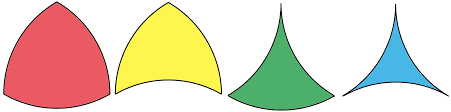
A triangle on a sphere does not have straight sides when it is projected onto a flat map. It has convex curved sides making the angles add up to more than 180 degrees. However, those are in fact the "lines" between those 3 points, i.e. the shortest distance between them, which are great circles on the sphere. A 3 sided shape on the surface of a sphere with angles adding up to 180 degrees is not a triangle, any more than these shapes in the plane are triangles (but the first one is what a triangle from a spherical surface would look like on most planar projections):
As you're probably aware, the shortest distance between 2 points on a map which assumes the Earth to be spherical is not a straight line, it is a curve. You've probably seen this if you've ever looked at any flight paths. In terms of the lat-long system, if two points are on the same longitude, that longitude is the shortest distance between them (i.e. it is "the line" connecting them); however, this is not true of latitudes except the equator.
So, if I have understood your point correctly, it's just wrong. If I haven't, please elaborate.
I'll respond to your feedback on the paper in the week, I need to read it myself first...
A triangle on a sphere does not have straight sides when it is projected onto a flat map. It has convex curved sides making the angles add up to more than 180 degrees. However, those are in fact the "lines" between those 3 points, i.e. the shortest distance between them, which are great circles on the sphere. A 3 sided shape on the surface of a sphere with angles adding up to 1
Exactly my point, good follow up.
Spherical triangles are not plane triangles. Map making via triangulation applies plane geometry. Angles, triangles and straight lines. Angle sum is 180 no more no less.
So it must be explained how the spherical earth map is built from a series of interconnected triangles. Less work for me then, mine is the raw data without the hassle of converting it to a sphere and back again.
Sent from my SM-A366B using Tapatalk
Exactly my point, good follow up.Spherical triangles are not plane triangles. Map making via triangulation applies plane geometry. Angles, triangles and straight lines. Angle sum is 180 no more no less.So it must be explained how the spherical earth map is built from a series of interconnected triangles. Less work for me then, mine is the raw data without the hassle of converti
Some cursory research suggests that the article you linked is missing some information, specifically that for projects large enough that the curvature of the Earth comes into play, a correction is applied for the sum of angles of a triangle.
See here: https://en.wikipedia.org/wiki/Surveying#...
Plane vs. geodetic surveying
Based on the considerations and true shape of the Earth, surveying is broadly classified into two types.
Plane surveying assumes the Earth is flat. Curvature and spheroidal shape of the Earth is neglected. In this type of surveying all triangles formed by joining survey lines are considered as plane triangles. It is employed for small survey works where errors due to the Earth's shape are too small to matter.
In geodetic surveying the curvature of the Earth is taken into account while calculating reduced levels, angles, bearings and distances. This type of surveying is usually employed for large survey works. Survey works up to 100 square miles (260 square kilometers ) are treated as plane and beyond that are treated as geodetic. In geodetic surveying necessary corrections are applied to reduced levels, bearings and other observations.
And from ChatGPT:
Cartography via triangulation corrects for the curvature of the Earth by using geodetic surveying techniques, which transition from plane trigonometry to spherical trigonometry (or ellipsoidal calculations) as the area being surveyed increases. For large-scale maps, surveyors do not assume the Earth is flat; instead, they treat triangles as having sides that follow the curved surface and internal angles that sum to more than 180 degrees.
More generally, Billy, I've noticed that a few your points/arguments rest on the fact that you simply assume that techniques or observations at small scales where the curvature of the Earth is too immaterial to matter just automatically scale up and it still doesn't matter. They don't and it does.
As I have pointed out to you before, a construction project the size of a football field subtends something like 3 arcseconds of angle. That's about 1/1000th of a degree, or 1/360,000 of the circle. Curvature indeed doesn't matter at that scale for most purposes.
Some cursory research suggests that the article you linked is missing some information, specifically that for projects large enough that the curvature of the Earth comes into play, a correction is applied for the sum of angles of a triangle.
See here: https://en.wikipedia.org/wiki/Surveying#...
And from ChatGPT:
Ok so what projects are greater than 100 square miles? This is arbitrary ofc. Recall vertical drop. 8 inches (refraction is not a factor here) of vertical drop per mile squared. Curvature quickly comes into play.
Let's have specific instances where curvature needs to be accounted for.
Sent from my SM-A366B using Tapatalk
More generally, Billy, I've noticed that a few your points/arguments rest on the fact that you simply assume that techniques or observations at small scales where the curvature of the Earth is too immaterial to matter just automatically scale up and it still doesn't matter. They don't and it does. As I have pointed out to you before, a construction project the size of a footbal
Ok which purposes does it matter for? How about the Suez canal?
Sent from my SM-A366B using Tapatalk
Ok so what projects are greater than 100 square miles? This is arbitrary ofc. Recall vertical drop. 8 inches (refraction is not a factor here) of vertical drop per mile squared. Curvature quickly comes into play.
Let's have specific instances where curvature needs to be accounted for.
Sent from my SM-A366B using Tapatalk
What ChatGPT is tellng us here is that when using the triangulation method for cartography, 100 miles is around the threshold when you need to start adjusting for the fact that the angles in a triangle are not going to add up to 180 degrees. I meant projects as in surveying projects, not construction projects.
As for construction projects - long bridges. Towers of long suspension bridges are not parallel. But you were told this already and simply dismissed it.
Also, remember that construction projects on land have to deal with variations in surface relief anyway. I don't see why dealing with curvature would be any different than dealing with other variations in surface relief. I suspect that in most places, hills or bumps and valleys on the surface are a lot more pronounced than the gentle curvature gradient.
What ChatGPT is tellng us here is that when using the triangulation method for cartography, 100 miles is around the threshold when you need to start adjusting for the fact that the angles in a triangle are not going to add up to 180 degrees. I meant projects as in surveying projects, not construction projects.As for construction projects - long bridges. Towers of long suspensi
I recall this now, i have spoken with a surveyor some time ago. They cited a textbook and sure enough plane surveying does not account for curvature. Geodesy is mentioned but no practical application is given, just a nod to it.
For map making or anything else 100 miles is far to great a distance not to account for curvature. If drawing a spherical map an adjustment needs to be made ofc, but this has no bearing on how the measurements are taken, which is by triangulation. We see how triangulation works for local map making - physical measurements, linear distances and angles, plane geometry. Not so much when accounting for curvature, this appears to be no more than a transformation of a function, abstract mathematics.
You must surely be unsatisfied with the abritrary and sudden cut off where a plane needs to be considered a curve.
Re towers/bridges, where curvature is considered (not often) the towers simply and bizarrely intersect the surface obliquely.
Sent from my SM-A366B using Tapatalk
You must surely be unsatisfied with the abritrary and sudden cut off where a plane needs to be considered a curve.
This sort of phenomenon is bound to occur where a different methodology needs to be applied at different scales. If you have two different methodologies, and a smooth scale gradient, you need an arbitrary threshold somewhere. At what point do you switch from a magnifying glass to a microscope? Depends on what you are trying to do, I'd guess. I would imagine that projects requiring more precision have this threshold set lower. But I am not pretending to know anything about surveying, this is just what I found with a few minutes of research.
I recall this now, i have spoken with a surveyor some time ago. They cited a textbook and sure enough plane surveying does not account for curvature. Geodesy is mentioned but no practical application is given, just a nod to it.For map making or anything else 100 miles is far to great a distance not to account for curvature. If drawing a spherical map an adjustment needs to be m
Sounds to me like this triangulation method is used primarily for mapping out local features and not at any scale.
See here.
From here - https://www.mezzacotta.net/100proofs/arc...
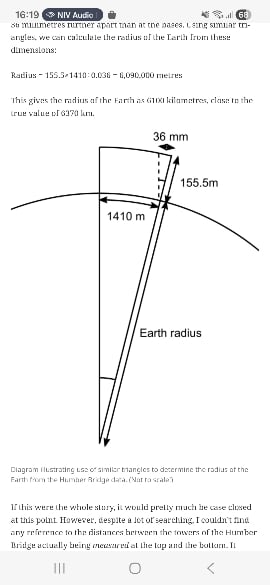
Another interesting tidbit, he claims in the above that LIGO is built slightly higher up at each end to account for earth curve. An excellent ball proof.
However when you go to the reference page at LIGO there is no mention of this. They merely state that they levelled it properly. The guy above defines level as not straight, hence interprets 'level' as 'curved'. The tangled webs they weave...
(Cannot post more than one screenshot on tapatalk, to follow)
Sent from my SM-A366B using Tapatalk
Claim.
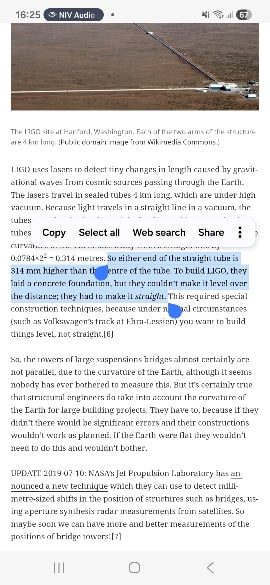
Sent from my SM-A366B using Tapatalk
Citation.
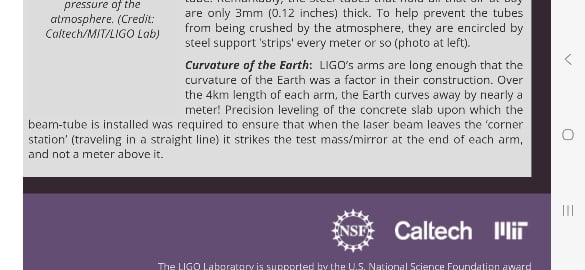
Sent from my SM-A366B using Tapatalk
So the Earth does curve. Right. Good.
See here.
From here - https://www.mezzacotta.net/100proofs/arc...
Eh? You said the towers meet the ground at an "oblique angle", which means not perpendicular to the ground. I asked you how you know this. You sent me a link saying they are built "vertically", which means perpendicular to the ground. What am I missing here?
I don't even understand what point you're making with the LIGO stuff. Seems like your point is that a guy on a web site made a claim that you couldn't personally verify by looking on the LIGO site. Is that about the size of it?
Billy, I understand that for some god unknown reason it's very important to you to think it's not round. But you're literally hand waving away mountains of evidence that it is round for very, very tenuous reasons. You don't like the wording. You couldn't personally find a citation for the claim. It's not reproducible. It works over 10 metres so it must work over 1,000 kilometres. Etc. etc. etc. And finally when there is something you can't hand wave away, like the pictures from space I showed you, you just say "well, it's irreconcilable with horizon dip" and ignore it.
It seems that for you, horizon dip is the ultimate arbiter. I could take you up into space tomorrow and show you it's round and you'd refuse to believe your own lying eyes coz horizon dip. Even though it's abundantly clear that horizon dip is not an exact science due to complicated physics related to optical effects.


