I don't get this chart
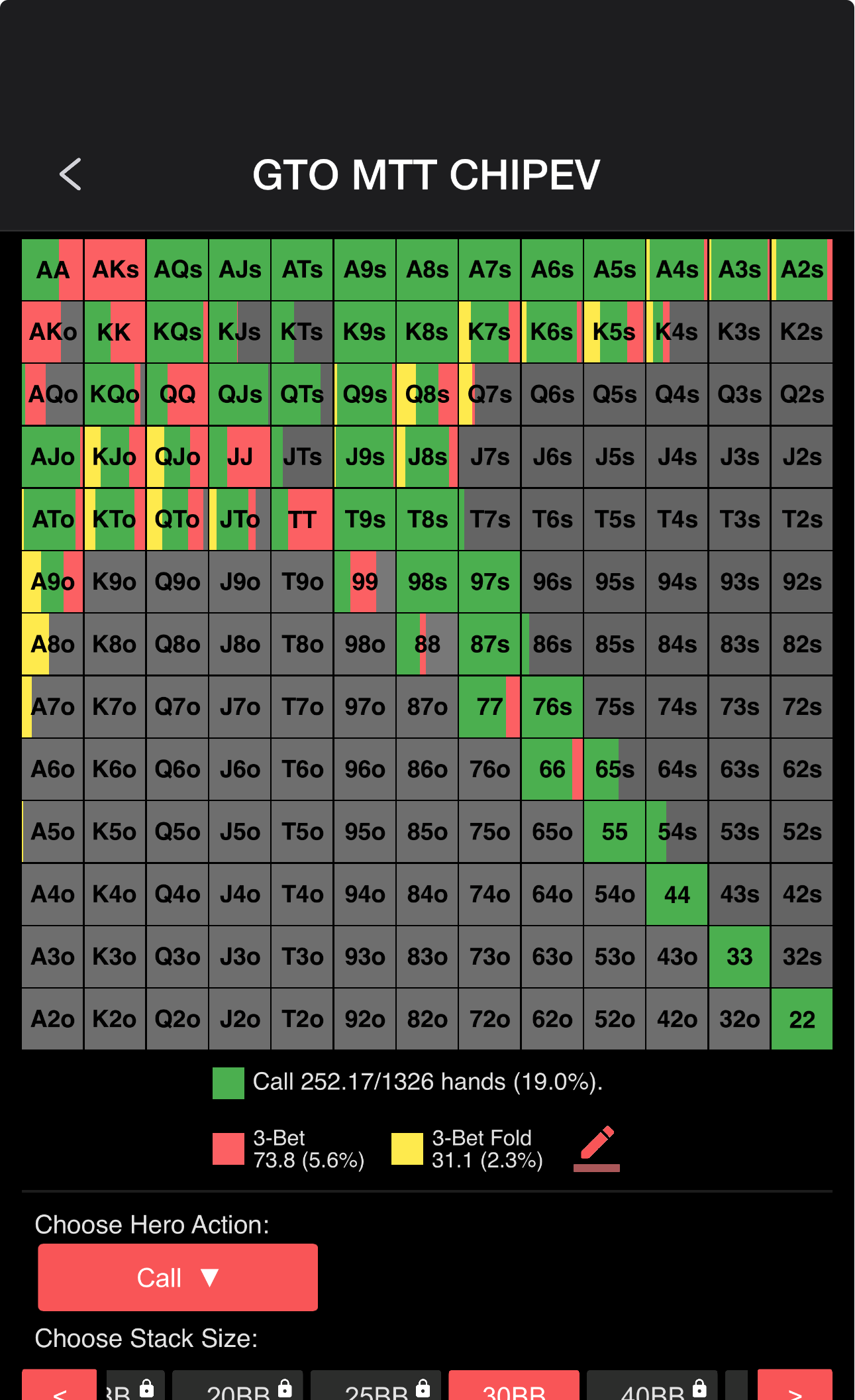
This is a 30 bb MTT ChipEV GTO chart from Preflop+ BTN response from a CO Open. For the life of me, I can't figure out why we would why the solver has us folding AQo about 50% and AKo about 33%. And why are we somtimes folding KJs and KTs, but never folding KJo and KTo off. And JTs vs. JTo looks crazy too. Don't think I ever fold JTs suited here without a read. Does anyone have an explanation?
9 Replies

I'll be honest, this doesn't make sense to me either. I feel like something must be off in the settings.
I'll be honest, this doesn't make sense to me either. I feel like something must be off in the settings.
Possible, but I didn't change the settings, so they are the default on the app. Also, the charts look correct for all other position combinations as far as I can tell. It's just the CO open vs. BTN that is really weird.

I think the problem is the app hasn't coded a color for all-in, so GTO pre flop jams are showing as folds. Here's the chart from poker coaching.com:
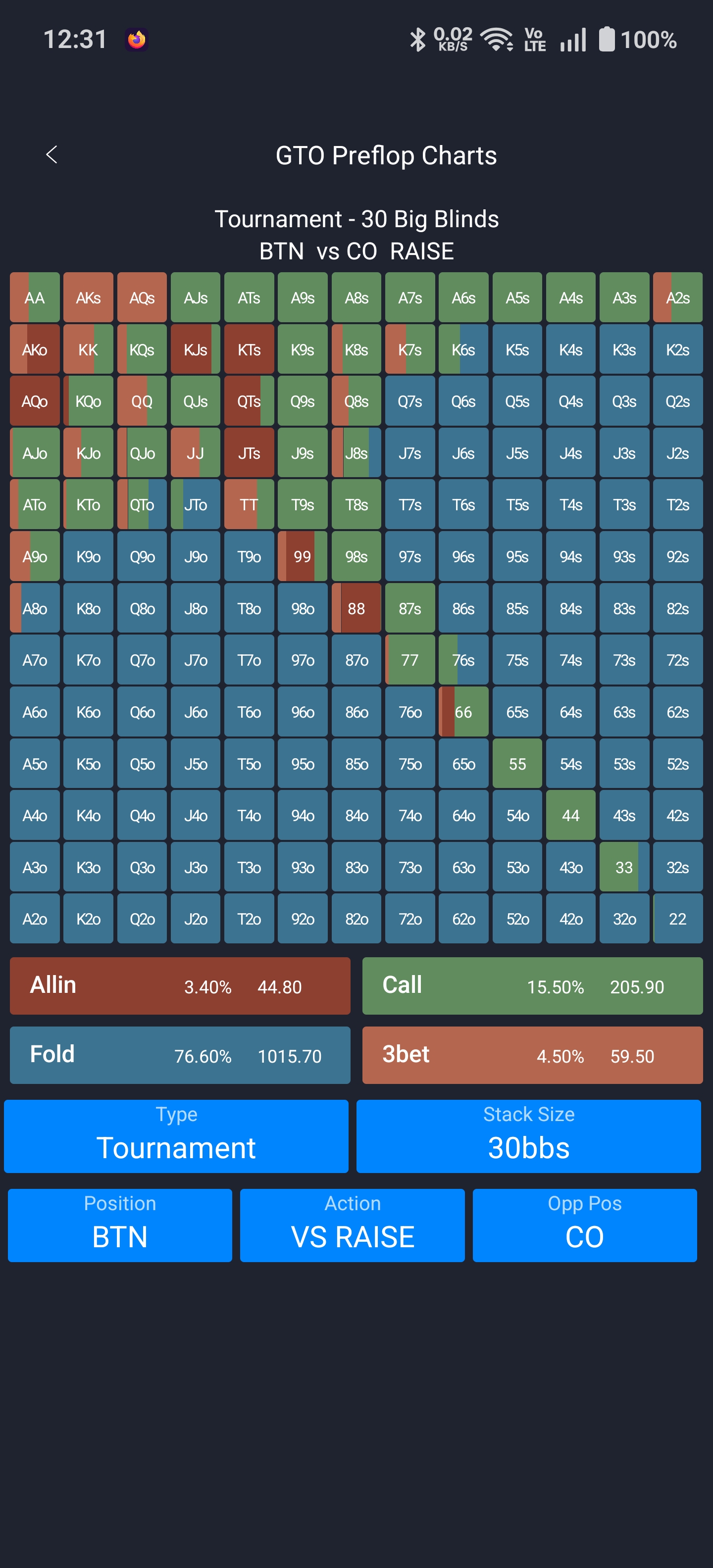
Some of the differences observed likely have to do with slightly different parameters (different open sizes, 3-bet sizes, etc.), but the hands you brought up are not really folds.
Ah, well, "no color used for all-ins, " I'll call that "something off in the settings."
That makes perfect sense. Thank you.

I am just stunned that with 30 bb's effective stack a GTO solver would 3-bet jam on the BTN with KJs/KTs/QTs/JTs/99/88/66 after a CO open. I get not wanting to 3-bet and then have to fold to a jam. But at 30 bb's it is just wrong to 3-bet jam.
Knowing this means that GTO/Solver people are 3-bet jamming with these type of hands about 75% of the time. Because the only other jams are coming from AKo/AQo. So with a hand like AJ/AT where I would have folded in the past, I will now always call the jam especially because we are blocking AK/AQ hands.
This is just another reason why I love GTO Solvers...
I am just stunned that with 30 bb's effective stack a GTO solver would 3-bet jam on the BTN with KJs/KTs/QTs/JTs/99/88/66 after a CO open. I get not wanting to 3-bet and then have to fold to a jam. But at 30 bb's it is just wrong to 3-bet jam. Knowing this means that GTO/Solver people are 3-bet jamming with these type of hands about 75% of the time. Because the only other j
Your math is off. There are 3x more offsuit combos than suited ones.
So jamming AQo pure is 12 combos and jamming AKo two thirds of the time is 8 combos. That's 20 total offsuit combos.
If you jam KTs pure that's 4 combos + JTs is 4 combos. Mixing jams 3/4 of the time with KJs and QTs is 3 combos each for 6 total. That's only 14 suited combos. So you're jamming the suited hands less often than AK and AQ.
Even after adding in mixed frequencies of the pocket pairs for about 6 total combos, AKo and AQo are still about half of your total jamming range.
You're still supposed to call a 30 bb 3bet shove with AJs CO vs BTN though. The wide shoves and calls at 30 bb make more sense when you see how wide we're supposed to be opening in late position.
CO response to BTN 3-bet shove:
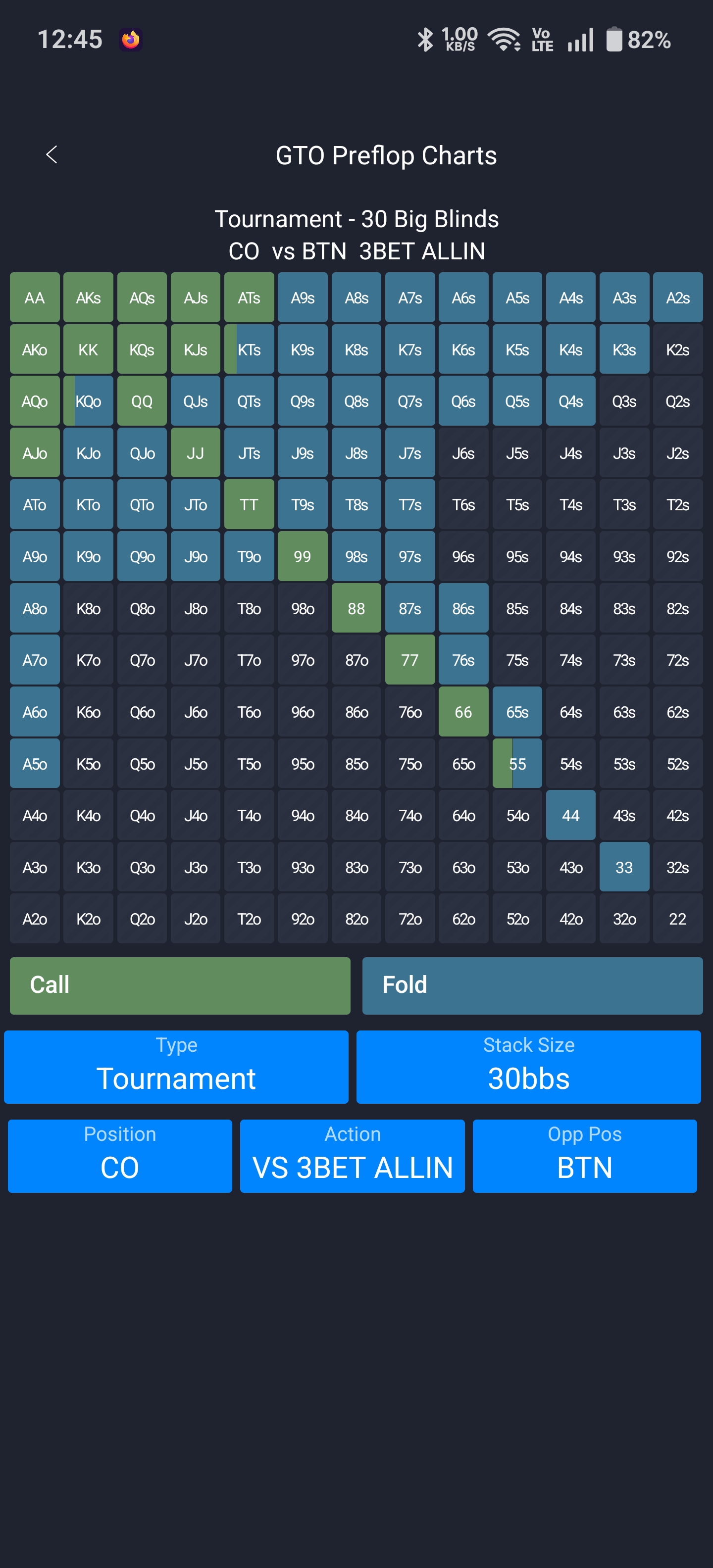
There's nothing much you can do if BTN shoves this range. You're supposed to call fairly wide as is and if you overfold BTN profits more by picking up the dead money with no risk.
My math was off for the reasons you gave.
The primary reason why I think shoving with 30 bb's is very wrong here is that people will mostly fold vs the balanced range that includes AK/AQ. But given this range, where I wouldn't fold is with hands like TT+/AT+. We would be at a huge advantage with those hands (though AJ & AT would be at about 50% to win) and to risk 30 bb's to win just 5 1/2 bb's is not good. Given that the BTN has postflop position against the CO I would 3x 3-bet with all my raising ranges (which are balanced). CO will fold to some (for which we gain exactly the same amount as when we would have jammed) but will call with many and we then have a huge advantage post flop for pots that will be large. And when CO 4 bet jams we can let go of the hands like AT/AJ/TT so that we can save about 21 bb's when we are up against hands like JJ+/AK.
There is another problem with this situation and that is if I know that the player is a GTO/Solver. In those cases I will be opening in the CO much tighter and the doomsday situation where I have TT+/AT+ will be more frequent than the original AI GTO/Solver is taking into account because they think that the billions of hands that they have to analyze are going to represent what happens in the real world...
There have been 3 times (in 2 tournaments) where somebody has jammed against me with ~30 blinds preflop (not counting 4-bet jams here). In these spots they also weren't 3 betting (twice they open jammed in the SB and once I had limped in as SB and the BB then jammed). I won all 3 of those hands with AQ, AK, and 99 and as a result won both of the tournaments. The one where it happened 2 times on day 2 was an EPT tournament.
The only situation where I will jam with 30+ blinds is when I am in the BB and there have been a bunch of limpers and I have an A to block AA. And even then I won't do it unless the original limper has limped before.
I agree with you that in practice these massive jams aren't the most profitable way to play. Assuming you have an edge on your opponent, seeing flops in position and allowing your opponent to make mistakes postflop will make you more money. That's exploitative poker.
That being said, the GTO math is the math. In the spot we're discussing the button is only jamming 3.4% of hands. If the CO adjusts by opening tighter, yes the button will lose EV when they jam. However that EV lost will be more than offset by all the EV they gain by being able to play more hands profitably in position. They'll be able to profitably open with a wide button range every time the CO folds hands they should be opening.
There's no adjustment you can make to exploit the equilibrium strategy. That's the definition of a nash equilibrium strategy. It's not bad. It's just counterintuitive to our weak human minds. We feel bad if we jam JTs and get snapped off by aces, and forget about all the times we steal 5 bb uncontested or get called by AJ when we are jamming AK or AQ.

At 30bb effective we will generally be at 50% to 25% field remaining at which point icm is relevant. We should be using a icm adjusted chart.


