KK facing reg's LRR
Simple-ish spot with not a whole lot of options, but curious where people come down on the available ones.
Villain is a p
this is an area where i'm admittedly unsure of myselfhowever, what gives me my largest advantage in poker is i play a tighter range than my opponents but not a range too tight where people can just auto fold to mewe lose this advantage when we decide to play for stacks with >100bb with KK or worseAA and AK are the only two hands I'm happily getting it in >100bb - specifically
I mean it's def nitty but also mathematically an error. I agree with the not shoving bit, I think shove is the worst option by far, but it's simply never a fold either.
i r still convinced most of the forum spends more time posting than playing on a yearly basis
I think you're right.

You’d stick it in with AK but not KK cause blocker? How many bb would you put in with AK?
yes, because assuming villain always has AA/AK/KK/QQ with a little bit of random spazz we very much prefer blocking aces and kings to flip against the rest and have strong equity vs the spazz
if there's no spazz it does indeed look pretty grim
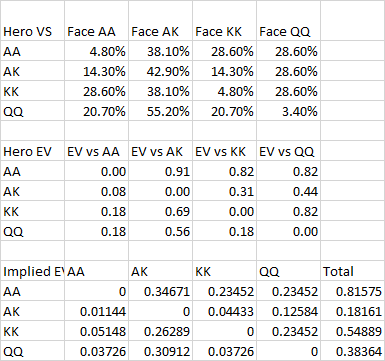
but... although KK and QQ crush the spazz much better than AK, they are also crushed far more often
in a sim where there's no spazz, AK, despite blocking AK, is facing against another AK 43% of the time
it's only dominated 28% of the time by AA or KK - which is the same frequency at which KK runs into AA
QQ has it by far the worst, getting run over by AA or KK 42% of the time
if we know villain only has those 4 hands, we can easily fold all our AK and QQ - but importantly, KK, while playable if villain plays all QQ and AK for stacks, is nothing more than a bluff catcher, barely being +EV and only due to the fact that you absolutely crush QQ when it happens enough to cancel out getting crushed by AA - so the real EV come from breaking even vs AA and QQ and gaining some small equity the rare times it is up against AK
but... a lot of people don't play QQ for stacks, so when you factor that in, it's a losing play as well - it also looks worse if we narrowed the AK range to only include suited hands as a lot of people don't play AK for stacks, particularly AKo
and then there's the random spazz - which you are far more frequently to be running into when you have AK simply because AA and KK are the gold standards by which noobs play for stacks, so we're far more likely to be engaging with the long tail of outcomes ie they are just blasting off with Q9s here than they are with AA or KK
like i said in my earlier post, i am admittedly still a bit lost and don't claim to have the answers, but this is my guiding mantra towards these hands in llsnl in USA#1
perhaps it's a bit of ptsd, but i kinda feel like whenever you see KK aipf it's usually vs AA and when it's AK aipf the other hand is more likely to be something weird like QJs or deuces than it is to be AA or KK - the only real holdings we are genuinely afraid of running into
I mean it's def nitty but also mathematically an error. I agree with the not shoving bit, I think shove is the worst option by far, but it's simply never a fold either.
we're oop, only have 10bb committed and facing a villain doing something we've never seen before
agree it's a nitty fold, but we're going to be playing the entire way uncomfortably unless we spike a king on the flop and even then, it'll be tough for us to realize our equity oop against a good player who is unlikely to stack off with just an overpair
and i want to be clear at 100bb etc this is just a get it in situation - but we're far deeper than that - hence the caution
this logic goes out the door when you consider we've played with this guy a lot and never once seen him do this
if he's done this before at any frequency then that dramatically changes our gameplan, but he's specifically telling us "I have AA" and it's a very credible claim and we have one of the worst possible hands to go up against it with
Do you think he's limping AK just to fold in this spot To call, even
You may not have seen it with your own eyes yet, but it's a reasonable extrapolation to assume his range is wider than AA only.
Or perhaps villain just has 22 combos of Aces here and we never profit...hmm.
you misunderstand, i never said he never has AK here - you see in my posts i too attribute a wider range and even include some random spazz
he could in all seriousness be doing this with 99 thinking he has the best hand
i'm just saying we've never seen him do this before, we're out of position, he's a good player, we don't have much committed, there's no reason to rock paper scissor for stacks here - we can find much better spots
just look at the major uncertainty hero faces postflop - a flop he should love and want to get it in on and yet we're still uncertain and scared
if we're in position it's never a fold for me btw - i'm always calling
I don't think this makes much sense when you consider the range you assign him and the fact we're 200bb deep.First of the jam is entirely too big but that's not a big deal, the lack of logic seems to be that his range could be something like ''55-88, AQo, AJo, ATo, KQo, QJs, and maybe some other "I want to play but let's not go too crazy" type of hands'' but he will also call a
We're only starting out $444 effective. As soon as we put more than $148 into the pot, we should just jam, because we can't fold at that point.
V has taken an absurdly small 3B size, leaving us with the options of A) flatting and letting V realize his equity for an absurdly cheap price, B) raising less than 1/3 of our stack, giving V a good price to continue but maybe inducing a light 4B, C) raising more than 1/3 of our stack, but less than all-in, giving V a worse price to continue, but pot-committing ourselves regardless of what V does or what comes on the flop, or D) jamming.
Of those choices, my preferences would be jam >> flat >>> 4B less than all in.
Part of the reason is that when we jam, V could level himself into thinking we're jamming light because his limp / small 3B with over-limpers behind looks FOS, and he might call us down wider than he would if he just opened for a raise, it folded to us, and we 3B him from the BB. When we 4B less than all-in, it just looks like what it is - a big PP that would be happy to get it in if V 5B-jams.
If we flat, yeah, we're disguising our hand strength and going to the flop with a higher SPR, but we lose value and have to play the rest of the hand OOP against whatever the hell this cat's limp-3B'ing range looks like. If we 4B less than all-in, we're just letting V get a cheap look at the flop, and opening the door for him to play perfectly against us.
As played, we get to the flop with 1 SPR, so there's not a whole lot of room to maneuver. Now we're just trying to choose between the GTO-approved line of range-betting for a small size and hoping our hand is good and holds, or the pray-to-the-poker-gods line of jamming and hoping our hand is good and holds.
Again, my preference would be to jam, because our hand was already face up, and I'd rather not give V yet another cheap card and another chance to play perfectly against us.
We're only starting out $444 effective. As soon as we put more than $148 into the pot, we should just jam, because we can't fold at that point.V has taken an absurdly small 3B size, leaving us with the options of A) flatting and letting V realize his equity for an absurdly cheap price, B) raising less than 1/3 of our stack, giving V a good price to continue but maybe inducing a
222bb effective. Iso to 10bb, get 3b to 25bb. It's just never a shove, it's way too big and again this idea that villain will level himself into calling with the top range of ''55-88, AQo, AJo, ATo, KQo, QJs, and maybe some other "I want to play but let's not go too crazy" type of hands'' is based on nothing but hope. There's no reason to assume villain would make calls this bad other than that he's playing 1/2.
Anyways at this point don't think either one is convincing the other but shove is the worst option imho.
As played with an SPR of 1 I would just shove but I don't think postflop is interesting at all because the SPR is 1 and we have KK on a t-high board.
Final results are somewhat of a screwball so apologies to anyone it annoys.
I always post my HHs as 1/2 NL because it's the familiar format and I think the strategy rarely differs, but my room is subject to local law setting a $100 bet/raise limit so it's technically 2-100 spread here. I think the discussion of it in a NL context is more interesting anyway, and best I can see from playing with the solver I don't really think it makes a substantial strategic difference even here. (In particular, it's only rarely shoving flop versus b20 and still like b20 when I gave it b20 along with b33 for $100 and tried to set the tree accordingly, and also solved with a $100 fixed-limit tree.)
The existence of the limit definitely colored my sizing choices, ironically I think in a way that induces mistakes as the 4b preflop should probably be a bit smaller and the solver agrees that removing options bigger than b33 is no reason to size up from b20. But it's really easy to only think in terms of $100 limit in big pots post.
After thinking about it, I think I like a small re-raise both in NL and in the actual game, just because V should be wide enough for KK to press the advantage. Chart flats are only occurring in situations where Villain's raise is really tight (for example, GTOW 200bb BB vs LJ mixes min 5-bet and call with KK, but LJ 4b range is very tight, majority-calling AK and KK).
At the table: Hero bets $100, Villain raises, Hero 3-bets all-in, Villain calls. The board runs out...
River ($889): Th 6h 4h 3h Jc
Spoiler
Villain shows JhJd and we lose this one.
With all but the widest ranges (with more flushes), V shouldn't have any raises on this node, and the only interesting thing to me about the solve is that in response it actually mixes 3b and call and will check-fold the actual turn (for $94 into $701) if not all-in at this point.
when you're using a solver for live play - are you node locking for how people actually play live?

This probably is affected by the format. V might be limp reraising in an attempt to get around the limits by making bigger pots pre.
Do other players do this?
I don't think I've ever seen someone limp rr JJ then 5 bet jam for 200+bigs in NL.
The only way I can try to view this as not terrible by V is is the limp RR is common due to format and, knowing this, people have much wider ranges than in NL.
you got strong opinions about how the population plays 4b pots at spr 1 with spread limit on monotone boards and how that differs from equilibrium play?
yes, it's dramatically different because an out of the box solve would never properly adjust to real world live player strategies - for example gtowizard doesn't even give you an option to put in limping
a solver out of the box will never fully account for the very unique aspects of live play spazz outs, let alone lrr and unless you node lock in those player tendencies then you're using a bazooka to kill a mosquito
Do other players do this?
I don't think I've ever seen someone limp rr JJ then 5 bet jam for 200+bigs in NL.
The only way I can try to view this as not terrible by V is is the limp RR is common due to format and, knowing this, people have much wider ranges than in NL.
No, this is not common. Other than nits doing it with AA (as they do), the only other player I have seen LRR a real range in this room is me, and I have reasons unrelated to the limit (in short, I think most people make huge mistakes versus tight open limps).
My honest best guess is that he was hapazardly choosing to limp his opening range sometimes whenever he didn't "feel" like it was a good time to open. I didn't mean to imply too much by labeling him as a "reg" but he is easily better than 85-90 percent of the players in the room. Whether that's bad on the fish or good on him can be left to discussion 😀
Looking at V's play I think calling my 4b with JJ is sketchy especially for 3x but once he flops the overpair plus flush draw with SPR 1 it seems like money is getting in by the turn? Regardless, at the table I decided to 3b the flop precisely to charge hands drawing the flush while I had the chance.
yes, it's dramatically different because an out of the box solve would never properly adjust to real world live player strategies - for example gtowizard doesn't even give you an option to put in limpinga solver out of the box will never fully account for the very unique aspects of live play spazz outs, let alone lrr and unless you node lock in those player tendencies then you
Well said and 100% agreed.
No, this is not common. Other than nits doing it with AA (as they do), the only other player I have seen LRR a real range in this room is me, and I have reasons unrelated to the limit (in short, I think most people make huge mistakes versus tight open limps).My honest best guess is that he was hapazardly choosing to limp his opening range sometimes whenever he didn't "feel" li
Yeah that means nothing lol. Lets be real. Someone limp raising JJ and calling off 4bets is not very good at all.
Post flop plays itself and he's obv never fold JJ with the Jh.
when you're using a solver for live play - are you node locking for how people actually play live?
Yes, I do employ nodelocks when analyzing although for preflop play, note that a solver is generally taking provided ranges and a flop and working from there so any provided range is an input from the user (usually based on a mix of solved preflop charts and population tendencies).
IME nodelocks in postflop analysis have limited use most of the time, just because the correct exploit is usually obvious if you already know what range your opponent is using for each action and that range isn't a balanced equilibrium-ish one. For example, on this hand, messing around with V's raising range OTF generally biases H to call instead of 3b (which might be an argument for my 3b being a mistake) but almost regardless of the strategy given to V it's rarely more than a few bb of error to 3b and the solver is always range betting on the lead. The nodelock usually exposes obvious facts, like "if V only raises with one or more hearts, H trivially gives up with the fourth heart peels" but does analyze whether charging the draw with perfect information is still worthwhile (actually, apparently not).
On the broader topic, I think solvers are most useful for identifying behavior that is very unlikely for live players to follow, because this is where major exploits happen. For example, Marc Goone of HHP fame likes to mock GTO but he also makes a fairly recurring point on his channel that his strategy of "range bet in position on all flops" is generally supported by (a) noting that an equilibrium OOP range-checker typically finds check-raises that are implausible for a LLSNL player, and (b) node-locking a range bet requires OOP to find even more x/r combos, and they simply won't. Therefore, range-betting as a c-bet is profitable.
Yeah that means nothing lol. Lets be real. Someone limp raising JJ and calling off 4bets is not very good at all.
Yeah for all sub wants me to be a redliner, I print almost all of my money from the fact that people - even somewhat decent players - just cannot fold once they start aggressing for value. I do think the limit format and lack of massive, massive shoves (or the threat of them) encourages that behavior too.
For comparison, this is what the fish in the room do:
LJ opens to $10, HJ calls, CO calls. BN raises to $80, SB calls. Hero wakes up in the BB with AA and max raises to $180.
LJ calls all-in for $160-something, HJ folds, CO folds, BN calls all-in for a similar $160-ish, SB calls.
Flop is some not terribly connected bunch of low cards. SB checks, H bets, SB folds. LJ has JJ, BN has 99, and AA holds up.
yes, it's dramatically different because an out of the box solve would never properly adjust to real world live player strategies - for example gtowizard doesn't even give you an option to put in limpinga solver out of the box will never fully account for the very unique aspects of live play spazz outs, let alone lrr and unless you node lock in those player tendencies then you
ok so how do u think the population is diverging from equliibrium here
do you remove the typical bluffs a solver will give him like A5s which real world live players never 3bet?
Yeah for all sub wants me to be a redliner, I print almost all of my money from the fact that people - even somewhat decent players - just cannot fold once they start aggressing for value. I do think the limit format and lack of massive, massive shoves (or the threat of them) encourages that behavior too.For comparison, this is what the fish in the room do:LJ opens to $10, HJ
be a wswfer not a redliner
everyday log in to acr and try to keep ur wswf > 50

Villain is a pretty decent reg, along with far too much of the table
V open limps the LJ, HJ (tight passive fish) calls, CO (trying rec) calls, BN and SB regs call. Hero in the BB ?
Family game? I’ve never seen decent regs call 7-way.
No, this is not common. Other than nits doing it with AA (as they do), the only other player I have seen LRR a real range in this room is me, and I have reasons unrelated to the limit (in short, I think most people make huge mistakes versus tight open limps).My honest best guess is that he was hapazardly choosing to limp his opening range sometimes whenever he didn't "feel" li
Oh yeah. I got confused and thought he jammed pre for some reason.
do you remove the typical bluffs a solver will give him like A5s which real world live players never 3bet?
It really depends. Younger players these days have seen solver charts and definitely do 3b A5s in particular and an active 3-better may in general have a decent frequency of suited Aces in range. What I am much more likely to do is pull from a solved chart for a radically different position, as most live players tend to vary their ranges very little based on position and will 3b BN vs CO not too differently from LJ vs MP (for example).
The type of player who 3-bets very tight I'm rather unlikely to be playing a 3bp against or running a sim, but sure in that case I would draw a tighter range. Also keep in mind that the solver fractional bluffs for board coverage are actually approximated annoyingly well by "there's a slight chance this fish just had a lucky feeling about this hand". No one is actually mixing pre like a solver does, but the mixes work equally well to represent Hero's relative uncertainty about Villain's range.
In particular, I posted the range I used for solving this HH and it did not include any "bluff" combos.
Villain is the story, and shall we say the open limp is "irregular".
The next two overlimps are the non-regs at the table, at which point overlimping the button and then completing the SB getting 11:1 with only one behind are both perfectly good choices with hands that play well multiway. It's done with a capped range but my ability to attack that from the BB is heavily restricted by the suspicious reg open limp and the two fish behind that who will call a lot. I'm checking my option the vast majority of the time.

