Ask me about being an airline pilot or flying in general

I wasn't even aware of OOT until someone recently suggested I start this thread here. (I had posted a question about Ve

Haha. I think people would be surprised to know that most of the fresh cut flowers you see in your local grocery stores come from Bogota.
Actually saw a long article on this subject in a magazine a few years back. IIRC, one of the throwaway lines in there is that fresh-cut flowers have surpassed cocaine as Columbia's #1 cash crop.
[QUOTE= fresh-cut flowers have surpassed cocaine as Columbia's #1 cash crop.[/QUOTE]
What a line!! 😃 (no pun intended!)
It was probably going to enable on its own shortly, but I went ahead and manually enabled it for [strike]him[/strike] her.
Thanks Videopro.


Heard a report on the radio this AM that the audio contained one pilot asking the other why he cut fuel, and the other saying he didn't. Mechanical failure?

I have followed this fairly closely. There is no shortage of YouTube videos, many of them by pilots. My two favorite channels for this kind of thing are "Captain Steeevee" and "Mentour Now!"
Within days of the accident, it was becoming clear that this aircraft suffered a dual engine failure. There are several things that can cause an engine (or both engines) to fail:
° Ingestion of something that affects the mechanical function of the engine or has the effect of disturbing airflow
Examples: bird ingestion (e.g. Sully's twin engine failure due to geese); flying through a volcanic cloud. Volcanic ash can adhere to turbine blades which affects their balance and ability to properly function (this famously caused a 4-engine flameout in a British Airways 747 in 1982); flying through EXTREME rain. In this case, SOP is to turn on the engine igniters during such an event so that the engine will re-light immediately if the heavy rain causes it to burp. For the record, I've never heard of a dual engine failure due to rain.
° contaminated fuel
The plane is refueled prior to departure so if the fuel is bad it will affect both engines. It's also possible for the engines to run normally for a while as the contaminants work their way through the system, so the scenario we witnessed would be possible with bad fuel. But if bad fuel was an issue, we would expect reports of other aircraft affected at that location. There were none.
° A system/computer glitch in the flight control software.
The 787 has been flying for over a decade now and is a proven platform. I only include this for completeness, but I consider it to be an insignificant possibility.
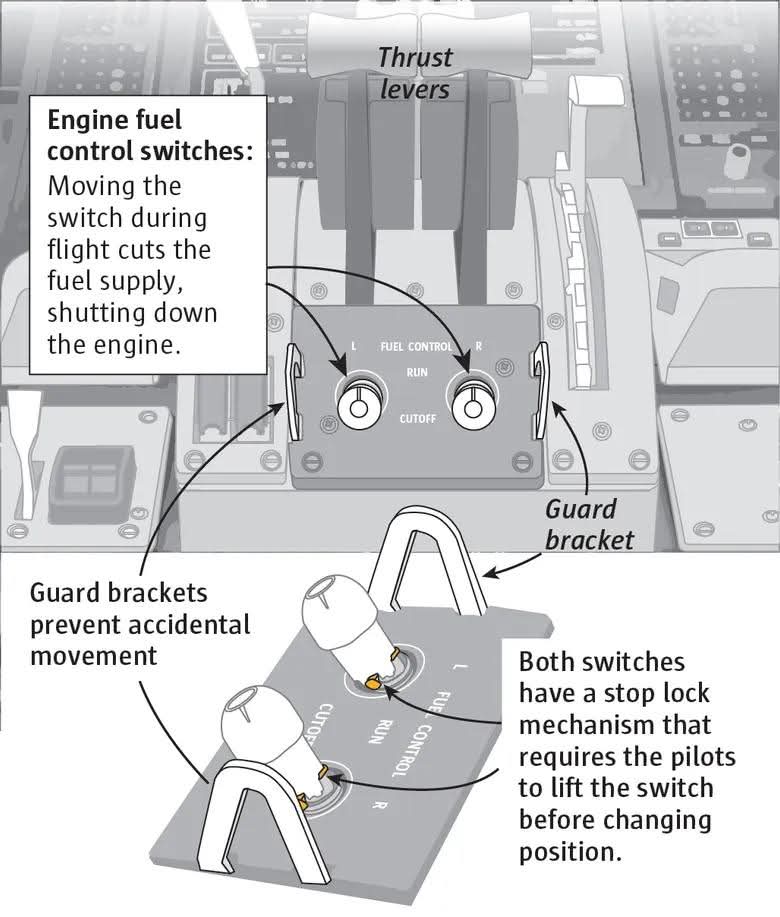
° Willful movement of the fuel cutoff switches to the cutoff position.
This would have to be intentional. There is no way to just "knock" these switches. The two positions are separated by a gate and the switches are held in position by a spring. To operate, the user must grasp the switch (actually a knob) and pull slightly up against the spring pressure to raise the switch out of the detent. Then the switch is moved over the gate to the other position and released. The spring pops the switch into the detent where it remains until purposely moved again.
It's now looking like this last possibility is what caused this accident. We don't know (yet) which pilot moved the switches. The First Officer was the Pilot Flying. At the start of the takeoff roll, he will have one hand on the control yoke and one hand on the power levers (aka thrust levers...different airlines use different terminology). At V1, the decision speed, the Pilot Monitoring will call out "V1" and the Pilot Flying moves his hand from the power levers to the yoke (i.e. both hands on the yoke now).
It's looking like those fuel control switches were moved to CUTOFF almost immediately after getting airborne. Hard to even imagine either pilot doing this and I am reluctant to speculate further. But there have been cases of pilots committing suicide in this most selfish manner. Perhaps the most recent was Germanwings 9525. The mentally disturbed FO purposefully crashed the plane after locking the Captain out of the cockpit...a truly horrifying scenario.
I think a lot of the investigation now will focus on the lives and backgrounds of the two pilots. The Captain was 56 years old with over 8000 hours in type...very experienced. The FO was only 22 but had over 1000 in type, iirc.
The final report will probably be a long time coming, perhaps a year.
(The Cockpit Voice Recorder does record one of the pilots asking the other why he cutoff the fuel. I don't have the exact words. The other pilot denied doing that. No futher conversation on that issue which is understandable considering the dire circumstance and need to focus on the problem at hand. However, the fuel control switches were found in the RUN position post-crash. So they were moved to CUTOFF and then back to RUN. There is no way to know which pilot initiated either action.)

Did you ever again hear from the poster who, on a dare and having only MS Simulator experience, successfully flew around the pattern in North LV?

Just came upon this take on the possibility that the cutoff switches were worn out/defective:
Did you ever again hear from the poster who, on a dare and having only MS Simulator experience, successfully flew around the pattern in North LV?
That was Tyler Sparks and, no, I haven't heard from him since then.
On the Air India crash, why would one pilot ask the other why he cut the fuel off unless he saw him do it? You don't just get to say that out of the blue because there is a shut off, do you? Loss of power is not immediately assumed to be an intentional cutoff, ever, but way, way down the list of "engine failure" possibilities. Right or wrong?
Unless (conspiracy theory), the pilot asking the question shut it off himself and wants the other pilot blamed for it. Seems more than a stretch because don't most of the suicide pilots want the notoriety for it??
The ways and protocols that pilots use to interact can't be neglected here. How do you say that if you didn't see it??

On the Air India crash, why would one pilot ask the other why he cut the fuel off unless he saw him do it?
Maybe he just saw the switch turned off?
You don't accuse your fellow pilot of such an egregious act unless you saw them do it. Final answer. It is of course possible that it was done unintentionally. Anything you do thousands of times you eventually do wrong. So that if thinks he is setting some other control he mistakenly hit the death button. I've never even heard this possibility of cutting the fuel flow discussed in regard to an accident before.
You don't accuse your fellow pilot of such an egregious act unless you saw them do it. Final answer. It is of course possible that it was done unintentionally. Anything you do thousands of times you eventually do wrong. So that if thinks he is setting some other control he mistakenly hit the death button. I've never even heard this possibility of cutting the fuel flow discussed
I can easily seeing that question being asked during a crisis.
My college roommate (years later) landed a Cessna 337 on Peachtree Blvd in Atlanta due to him and the guy in the right seat accidentally cutting off the fuel line. To make it even worse, they sequentially cut off different fuel lines several times during the process. (Apologies if I have already posted that previously earlier itt.) Incidentally, they dodged all traffic with wheels up and no injuries or fatalities.
On the Air India crash, why would one pilot ask the other why he cut the fuel off unless he saw him do it? You don't just get to say that out of the blue because there is a shut off, do you? Loss of power is not immediately assumed to be an intentional cutoff, ever, but way, way down the list of "engine failure" possibilities. Right or wrong?
The fuel control switches aren't in the pilot's scan during takeoff. A double engine failure calls for cycling the fuel control switches from RUN to CUTOFF and then back to RUN. But in every scenario where we do this in the simulator, it's during flight and not within a few hundred feet of the ground. But let's say this is a pilot not easily flustered and the engine failure caused him to turn his attention to the fuel control switches. He's not expecting them to already be off so this would be a startling find (to say the least) and would almost certainly prompt some sort of statement or exclamation. Unless he saw the other pilot move the switches, I think the most likely remark, if there is any remark at all, would be along the lines of "Holy F---, how did that happen?!"
As I said, the switches are not in the normal scan, but that's not to say we're not aware of the other pilot's movements. A hand moving to the fuel control switches would be easily noticeable in one's peripheral vision. The comment made by the pilot directed to the other pilot makes me think that he was aware of some hand movement by the other guy.
Unless (conspiracy theory), the pilot asking the question shut it off himself and wants the other pilot blamed for it. Seems more than a stretch because don't most of the suicide pilots want the notoriety for it??
Interesting theory and I won't say it's completely impossible (though I don't subscribe to it). Perhaps casting doubt about who was responsible would eliminate the possibility of his family's ineveitable insurance claim being denied. But as for notoriety, I've never heard that being a goal or desire of any of the suicides on record.
I flew with a Captain at ACA (30 years ago now) who had the habit of saying "Ken Latour sucks c--k" when at about 400' on short final (Ken Latour was our Director of Operations and not widely loved). His idea was that if we encounted some fatal disaster on landing, this gem would be there for the accident investigators and ultimately the public to enjoy when the CVR was included in the NTSB report. For the record, I never adopted this peculiar habit.
Possible. After all, how else could they have moved to the CUTOFF position? But I know that even during takeoff, I'm still aware of movements by the other pilot.
You don't accuse your fellow pilot of such an egregious act unless you saw them do it. Final answer.It is of course possible that it was done unintentionally. Anything you do thousands of times you eventually do wrong. So that if thinks he is setting some other control he mistakenly hit the death button. I've never even heard this possibility of cutting the fuel flow discussed
This seems extremely far fetched to me. Movement of these particular switches requires a very deliberate action, pulling the switch up out of the detent and then moving it.
Having said that, i am aware of one instance where they were moved to CUTOFF by mistake. This incident occurred on a 757 taking off from LAX headed to CVG. This happened in the 90's before I got to Delta, but I heard the story from some pilots who were at Delta at the time.
Back then, Delta's 757s had the ship's EEC switches located in proximity to the fuel control switches. They were positioned either just above or just below the fuel control switches. The EEC is the Electronic Engine Control and the switches are simple ON/OFF switches with no guard (because they aren't a "safety of flight" switch like the fuel control switches).
The EEC is essentially a small computer that governs much of the engine operation. It is essential during the start sequence and after start it provides overspeed and overtemp protection. If an EEC fails during flight, the engine keeps running but we have procedures to ensure we protect against exceeding engine limits.
In this case, the engine burped or ran rough right after takeoff and the Captain remarked something to the effect that he knew what the problem was. He thought one of the EECs had malfunctioned and so, in an attempt to rectify the situation, he decided to cycle the EECs to OFF and back ON.
(There are so many things wrong with this response, namely that we use checklists for abnormal or emergency procedures. We don't just start moving switches and levers, unless it is a designated memory item.)
Anyway, his hands went to the fuel cutoff switches instead of the EEC. And yes, they operated differently, which should have given him pause. But his hands just went with the muscle memory associated with grasping those switches and he moved both fuel control switches to CUTOFF.
I'm not sure how high they had gotten when the engines quit, but it was over 1000' headed west over the Pacific. The FO saved the day, as the story was told to me, by instinctively and correctly moving both switches back to RUN. There is still quite a while for a big turbofan to quit and then restart, and I'm not sure how low they were when the engines relit, but they then proceeded to CVG!
This was years before planes were equipped with FOQA which would automatically record report such an event so it would have been possible that no one would ever hear of this. But someone dropped a dime (passenger, FA, FO?) and it became known. I'm not sure what disciplinary measures ensued, but at a minimum it would have required some retraining in Atlanta and probably also some unpaid time off. It's also possible the FAA took some enforcement action, but I don't know.
One of the first results was to relocate the EEC switches to the overhead panel on the entire fleet, which is where they resided when I got my type rating in the 757
That question has never been asked in the history of black box recordings, and probably in the history of aviation. Pretty much a key fact in my book. Not, "WTF happened to our power? ... but "Why did you cut the fuel off?"
Also, there are dozens of millions of flights per year, so the fact that it is very unlikely for it to happen by accident is not a problem for the inevitable eventuality of it happening.
My two cents.
Also, there are dozens of millions of flights per year, so the fact that it is very unlikely for it to happen by accident is not a problem for the inevitable eventuality of it happening.
Right, humans are really bad at evaluating the likelihood of low probability events when high probability events don't happen. By far the most likely event is that nothing goes wrong and we never hear anything about this flight. That didn't happen so we're stuck with trying to choose between absurdly unlikely events (someone just decided to kill everyone, particularly improbable type of pilot error, and so on)
That question has never been asked in the history of black box recordings, and probably in the history of aviation. Pretty much a key fact in my book. Not, "WTF happened to our power? ... but "Why did you cut the fuel off?"
Investigators have not publicly identified the two voices on the CPR, even though there must be witnesses who can identify them. But, since pilots are aware of the CPR, it is possible that the culprit who moved the switches then asked the other pilot why he had done it, to confuse the record and the insurance issues. For various reasons it seems more likely that the culprit was the captain, taking advantage of the fact that the attention of the first officer, as flying pilot, was elsewhere during take-off.
Have you read much about the infamous Tenerife Los Rodeos Airport monster crash? Talk about a chain action of factors lining up to create the disaster. Neither plane was even scheduled to be at that airport. 583 dead ... still the worst all-time crash.
Have you read much about the infamous Tenerife Los Rodeos Airport monster crash? Talk about a chain action of factors lining up to create the disaster. Neither plane was even scheduled to be at that airport. 583 dead ... still the worst all-time crash.
Yes, I remember it well. It was so tragic because there was plenty of opportunity to avoid it. As with many (most?) accidents, there was an error chain which resulted in this collision. The weather was a major factor with nearly zero visibility, making it impossible for the controllers to see the aircraft from the tower so they had to rely on position reports from the pilots. There was some ambiguity in some of the clearances issued which led to confusion also. This confusion, given the poor visibility, should have caused the pilots to press for clarification of the instructions. But they were under a time crunch due to duty limits and the KLM Captain was adamant that they takeoff and he heard the instructions the way he wanted to hear them.
The KLM Captain was extremely experienced and, in fact, he was the face of KLM at the time. He was known by reputation throughout the company and was used in advertisements. The First Officer did speak up, but was perhaps not assertive enough in the face of the Captain's seeming certainty.
This was long before airlines implemented CRM (Crew Resource Management) training and the airline culture had long been that the Captain was King and should not be questioned. (This same culture was a huge contributing factor in the crash of TWA 514 in 1974.)
This accident was a little over 38 years ago and remains the worst civil aviation disaster in history.
W0X0F, when you are at cruising altitude between cities, discounting winds, what determines the cruising speed? Is it a percentage of engine power, ATC, something else or a combination of factors?
Are you trying to get to your destination as fast as possible or is fuel economy or other factors involved in not going max speed?

W0X0F, when you are at cruising altitude between cities, discounting winds, what determines the cruising speed? Is it a percentage of engine power, ATC, something else or a combination of factors?
Are you trying to get to your destination as fast as possible or is fuel economy or other factors involved in not going max speed?
Dispatchers plan the cruise speed depending mostly on winds aloft forecasts and best fuel economy to maintain schedules. For 757/767, we usually cruised at somewhere near .80 Mach +/-.01. iirc, we cruised just a little slower in the MD-88, maybe around .78 or .79. Diferent aircraft have different capabilities of course. The 747 was one of the fastest commercial jetliners for many years, normally cruising at .84M (I could be slightly off on these numbers...it's already starting to fade a little).
There are several faster civilian biz jets. The Citation 10 holds the record for fastest cruise speed. It can cruise at .92M but the additional fuel to go this fast is usually not worth it and most of them flight plan for a more economical speed.
ATC can assign a speed and this is usually for metering into an arrival flow, but speed reductions can be issued hundreds of miles from the destination when there are known delays. When the delays are really significant, usually due to weather or runway closures, holding patterns will be mixed in.

