Chasing Mastery in HUNL
Hello, I’m a university student trying to break into and climb the stakes in HUNL online. I’ve been a fan of the format
Hello everyone, I wanted to give you guys an update since it has been a while. To begin, I did not understand how draining work would be especially a traditional 9-5, which is why my posting fell off during the summer. Then when I returned to school, I took on a health prop bet which took up most of my time and energy. For anyone curious after the summer I had became a reasonably unhealthy 210lb (95kg) at around 5 10 (177cm) and was not quite happy with it so in September I took 3:1 odds on reaching 175lb by end of November. I am proud to announce that I won the wager and started incorporating fitness and diet consciousness into my daily lifestyle. In November, I also began following and streaming action from coin poker cash game world championship, and was really motivated again hearing the pros talk about the game on the PokerStrategy streams. It was also during this period I started playing 50NL HU again and started look at solver solutions a bit differently and incorporating alot bigger adjustments (i.e. overfold, manage bluffs in spots I believed my opp was sticky) this sort of mindset where I was constantly adjusting to my opponents strategy led to I felt a big shift in my strategy. I only played around 8K hands which isn't a huge sample, but I hope gives some insight on this new play style. If you can see there is a few stretches where I am a massive loser in the redline, but I looked it over and I am starting to handle the problem. A few take aways that I have started to incorporate is how little adjustments are made against me in some spots and how easy decision become when you start referring to theory strategy as a guide to adjust instead of as an instruction manual. I am also at this point am not a expert on theory in fact I have done little work in the solver since, expect for some exploitative preflop work, however after reviewing some strategies I remembered I did start to understand them a bit more after hearing some pros talk about how they approach the subject of study. I do plan on studying theory for the next couple months (rest of December entirety of January) with some supplemental play (1 - 2ish hours) in between study sessions just to practice implementing and recalling spots live, I will go over what I will be studying but first here is my graph for those 8k hands.
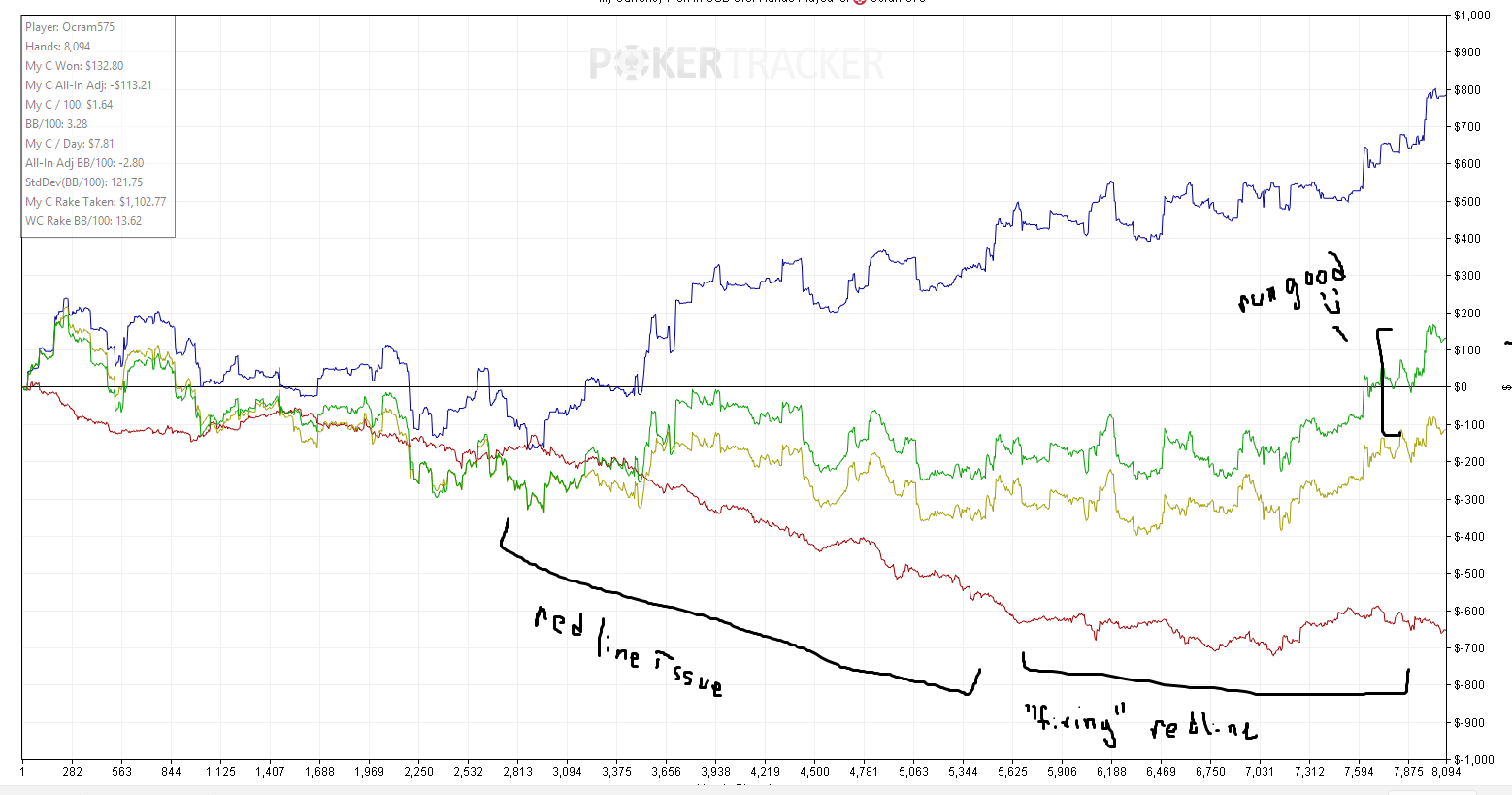
My WR realized was 3.28 bb/100 and my winrate in EV was -2.8 bb/100 after a whopping 13.62 bb/100 paid in rake. A lot of the EV discrepancy was derived from massive flips. Anyway, I was listening to Deeerp talk about studying where he talked about investigating 1 board type for an entire week, and looking at all the lines for that board texture for all the different turns and river and really forcing yourself to understand how different turns and rivers affect your range and therefore your actions. I am going to start with Qhigh TT boards in SRPs, and will hopefully give you guys a solid report about interesting strategy on the board as well as what I believe the underlying reason for these strategies are.
Anyway its nice to be back, when I start playing solid volume again I hope to record a few sessions with audio commentary so I can play and explain a few spots (not educationally lol).
I made a video sharing my thoughts on a few of the hands played in the 1K/2K 200K HUNL match between PencilArms and Cardsforfun that happened on coin. Here is the link if you're interested in checking it out: https://youtu.be/yAwhtMfpSl0
I was also streaming around 2 hours of the match on my twitch,I plan on doing more of these streams where I discuss what I think about the spot live drop a follow if you're interested in joining that discussion when it happens.

Hello everyone, Today I played a session I was not very happy about the today I went through a standard session where I really only lost 1 BI. Then I keep playing and face a guy who very quickly dusted 2 BIs to me, this ofc was very nice and I continued to play, eventually we were around 150bb deep and I made a huge mistake 3 bet bluffing this player after it was very apparent he stopped bluffing me a while ago. This really got me mentally and I played like **** punted 2 BIs and quit the match. This is definitely a flaw mentally from me where I get tunnel vision after a big mistake on my end and don't really sit and think when I play a big pot from then on out leading to many stupid decision given the context of the match, these 2 BIs after the mistake is what I am really upset about and I didnt really mind the 3 bet bluff mistake as much . I am still doing alright and in reality probably only lost 3 EV BIs (4 realized BIs) for the day which isn't horrible at all. I think when a big mistake like this happens I need to systematically come up with a way to remind myself to think in big spots instead of rushing to click call lol.
On the bright side, It is nice to know now that this is an issue now and not higher in the stakes where these BIs could be worth alot more.
I also think this was a good lesson against that exact player archetype, I think so far most of my opponents leaned very one way or another the entire match. Understanding when to update my priors on a player was worth the 2 BIs. This is all copium tbh

Whats ur name on coin
Ocram575
Here is something I was discussing with a friend of mine and my thoughts on some of the underlying factors that effect the introduction of a thin value range on rivers.
CoinPoker Hand : Hold'em No Limit (0.25/0.50 ante 0.10 )
Table 'NL ₮50 HU I' 2-max Seat #1 is the button
Seat 1: Ocram575 (50.60 in chips)
Seat 2: Villain (58.46 in chips)
Ocram575: posts the ante 0.10
Villain: posts the ante 0.10
Ocram575: posts small blind 0.25
Villain: posts big blind 0.50
*** HOLE CARDS ***
Dealt to Ocram575 [Ad As]
Ocram575: raises 0.75 to 1.25
Villain: calls 0.75
*** FLOP *** [7d Js Kc]
Villain: checks
Ocram575: bets 0.90
Villain: calls 0.90
*** TURN *** [7d Js Kc] [5c]
Villain: checks
Ocram575: bets 6.00
Villain: calls 6.00
*** RIVER *** [7d Js Kc 5c] [8s]
Villain: checks
Ocram575: bets 10.00
Villain: calls 10.00
*** SHOW DOWN ***
Ocram575: shows [Ad As] (a pair of Aces)
Villain: mucks hand
Ocram575 collected 35.50 from pot
*** SUMMARY ***
Total pot 36.50 | Rake 1.00
Board [ 7d Js Kc 5c 8s ]
Game ended: 2025/12/17 20:14:19 GMT
Seat 1: Ocram575 (button) showed [Ad As] and won (35.50) with a pair of Aces
Seat 2: Villain (big blind) mucked
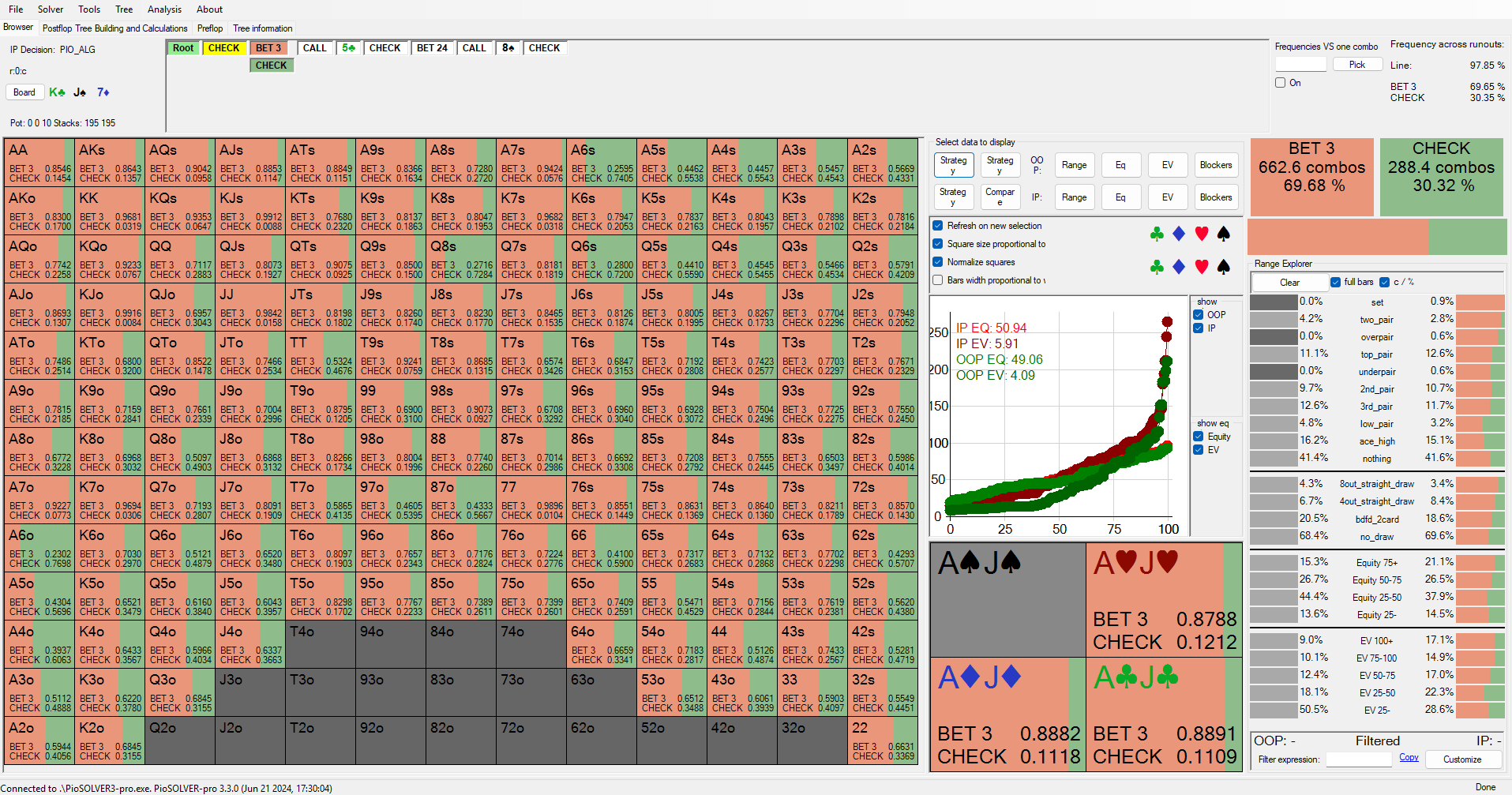
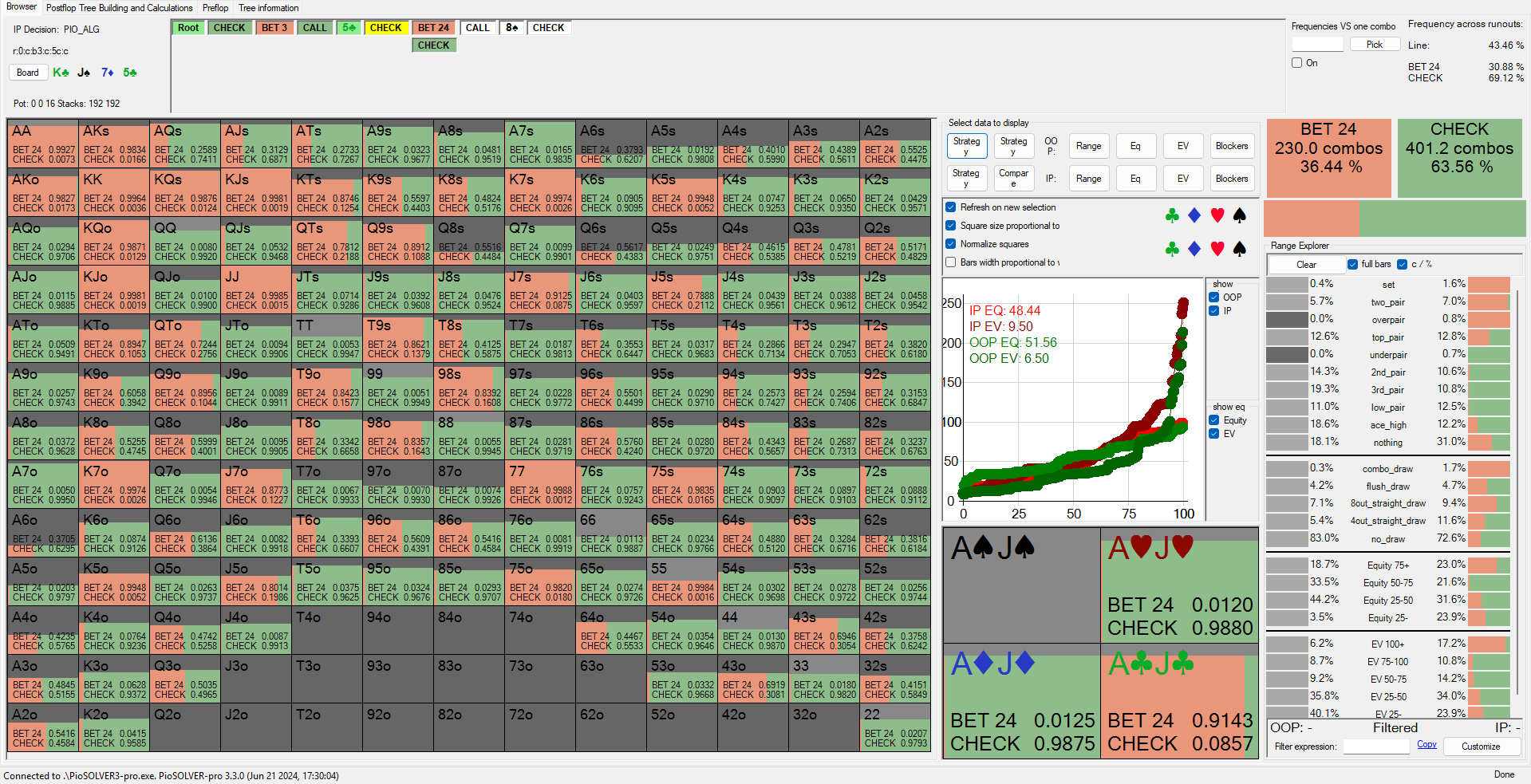
In this spot I knew the flop single size strategy and the turn single size strategy were pretty standard. You could develop a strategy with an even bigger overbet size on the turn but I just know what this sizing's strategy sort of looks like on the river so I decided to run it. Trying to figure out which single size turn strategy to use completely depends on how your opponent reacts to it in these spots.
IP single size Flop Strategy
IP single size Turn Strategy
IP river strategy:
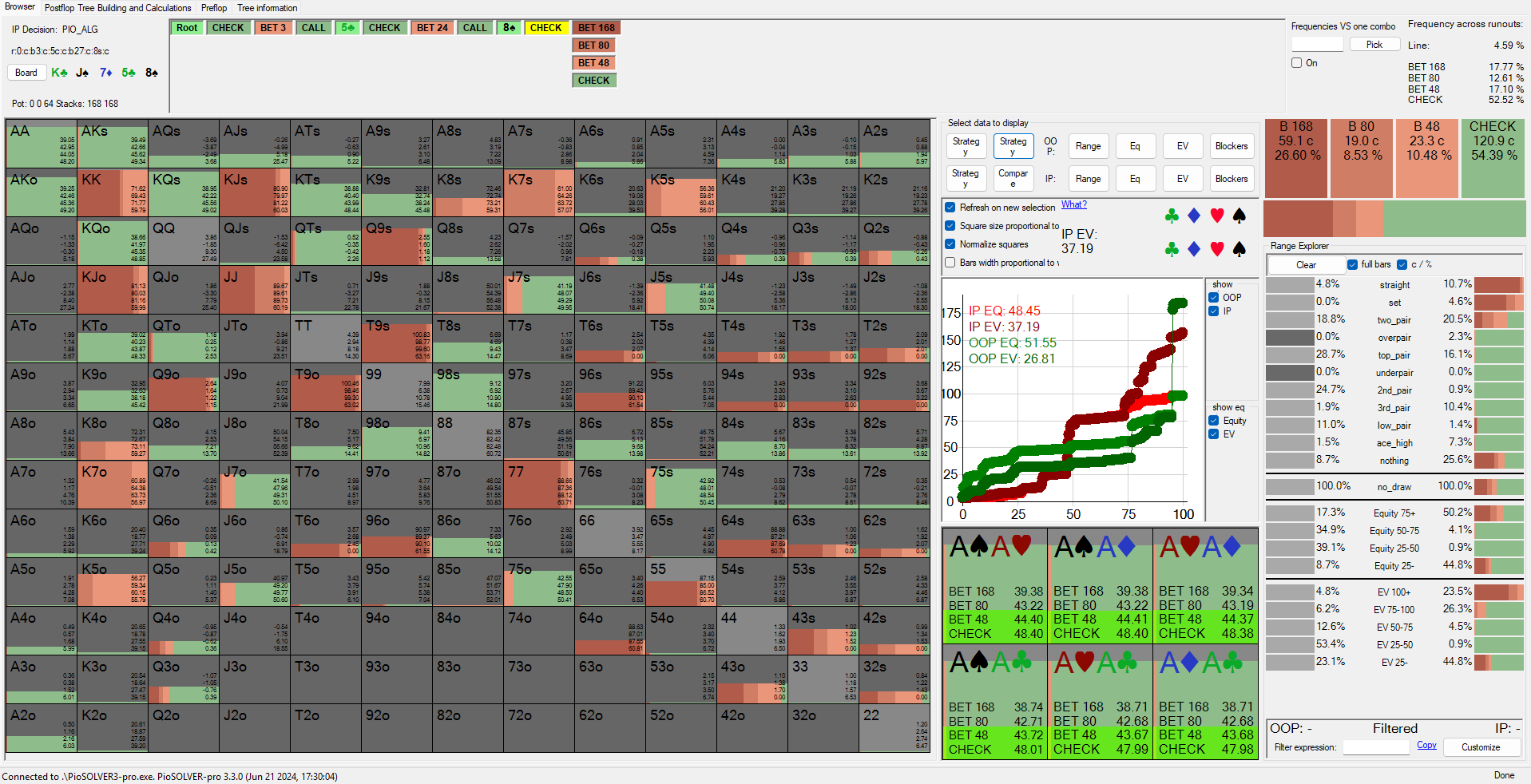
We can see in this equilibrium solution that, we prefer basically a all in or check strategy completely polarizing, in the moment I understood that OOP has alot of two pairs on this river and we aren't really too happy holding KQ,KT,K9 and a overbet would be very thin especially since I wasn't confident in my opponent to thin out their suited and off suited combos of K and J two pairs with 3 betting pre and AA is way thinner than AKo since I don't block K two pairs, . So I wanted to construct a "thin value" B75 range which solver doesn't like doing very much. Instead of calling this a mistake we can instead use some node lock copium to ask ourselves why and when do we have a thin value range where a hand like top and second set could mix in as a trap. I tanked a bit here and ask myself when is a B75 range feasible here and a few ideas came to mind in the moment and I will share what I thought about in the moment and new discoveries after I did a bit of digging.
When is a thin value range even better than theory (initial ideas):
1. When Villian has no to very few bluff check raises
2. When Villian fast plays better hands on earlier streets (less traps i.e. check raises 2 pairs on earlier streets)
When we check this out in pio it turns out this that this first assumption is pretty incorrect in this spot particularly, in fact we can see it in the pio solver EQ and EV graph, we can see that we only have an advantage on the super nutted hands (where I imagine the All in or check strategy comes from [toy game spot]) but not really our other hands in fact they sort of got us on this, and if we check the EQ of AA,AK,KQ,KT we only have 75%,77%,76%,76% respectively (notice AA worse in EQ) even our Jx 2 pairs have only around 78-79% EQ. When we check out which hands are in our small B75 sizing in theory, we see that its its usually hands around 80% EQ plus and is composed of good two pairs and the two pair that block our opponents rivered two pair (all 8x two pairs have over 80% equity).
This does lead to the 2nd point which is if we cant thin value bet because our hand doesn't have enough equity on the river then maybe if we think our opponent fast plays on the flop then we can extrapolate that we must have higher equity on this river right? Turns out this is not true, because if we check our opponents river range, all the two pairs which OOP develops are made on the turn and river, on the turn the polarize sizing leads to less raising and there are no leads on this river in theory (if we know our opponent does develop a leading range which includes value on rivers this then thin value betting is trivial). This also assumes that our opponent 3 bets some of the off suited two pair combos, not sure how much a 0.25/0.50 HU player is doing this, so we have even lower EQ than expected. I ran a sim using these 3 bet ranges where they stopped 3 betting middling off suited Kx,Qx,Jx with ~15% frequency and the K8s,J8s,J7s with complete frequency and our EQ with AA,AK,KQ,KT goes to 74%,75%,75%,74% respectively, and our EV difference between check and bet B75 going from ~2-3bb to ~4-5bb which might be a bit harder to make up for using exploits.
Can we ever thinly value bet here with AA, AK, or KQ?
Turns out yes we can, but it might be a bit of a stretch in practice. We can achieve this by reducing the number of bluff raises to 0 and making them call every Kx as a bluff catcher even the K(2,3,4) region which mixes folds in theory as well as having the theory 3 betting range which thins some of the off suited 2 pairs. By doing this the EV of AA is higher than AK and KQ (because we don't block calls from Kx region) and we make this play a higher EV play than checking.
So it seems like EQ isn't the only factor at play because I think what's happening is yes we have 75% EQ with AA but this check assumes are opponent realizes they have way better hands in their range so they can be a bit more careful with being sticky around their Kxs when facing this bet and understanding that they have a large 2 pair range on this river. But if we are playing versus anyone who calls every Kx a bluff catcher and better yet assumes this size is only Kx or bluff then maybe we can print EV versus sticky opponents. I would even imagine when we stop 3 bet mixing our suited and off suited combos of our two pairs then we can even afford to straight up fold these lower Kxo as OOP making this a massive mistake. This node lock even assumes our opponent does not have a massive blocker fetish and folds the Jx pairs which have straight blockers so if you're playing against someone with a blocker fetish thin value seems a lot more viable here in practice.
let me know if you guys have any thoughts on this, I could just be completely misinterepting ideas here and making sense out of complete noise. I also want to cover some SRP IP probe calling strategies so stay tuned for that particularly how river probe defense changes when you understand your opponents flop defense.
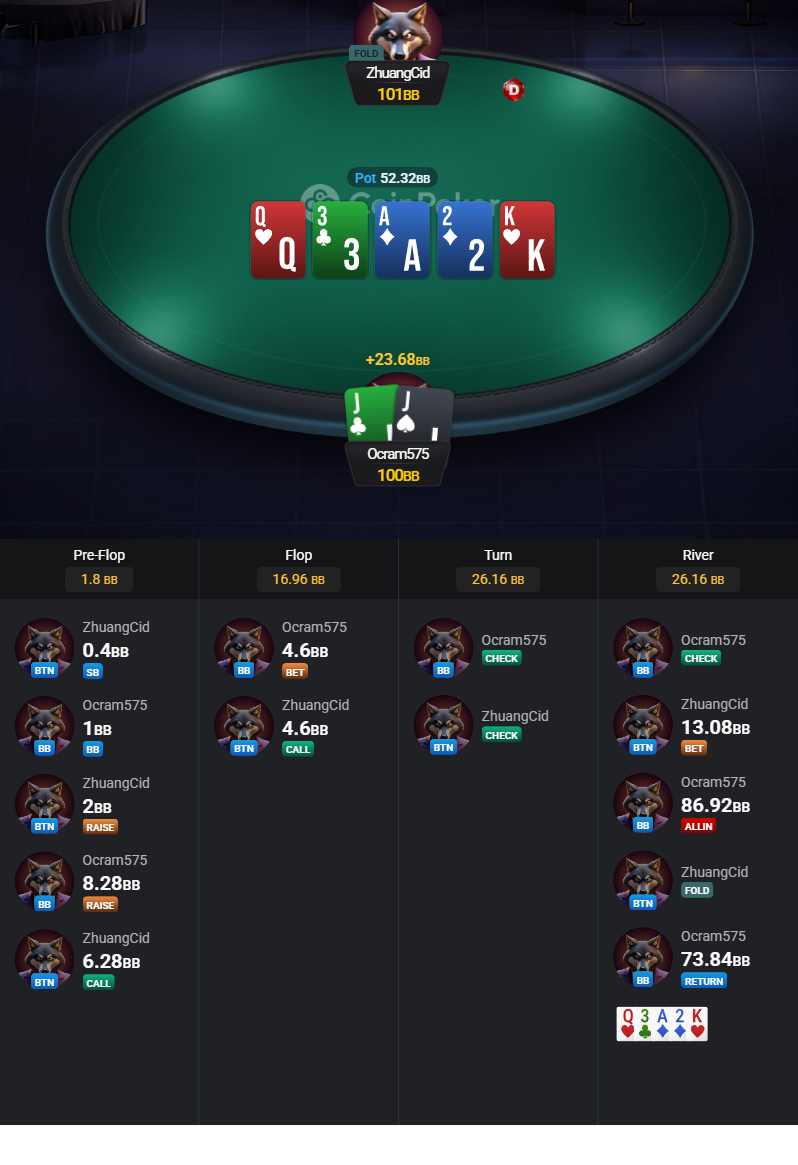
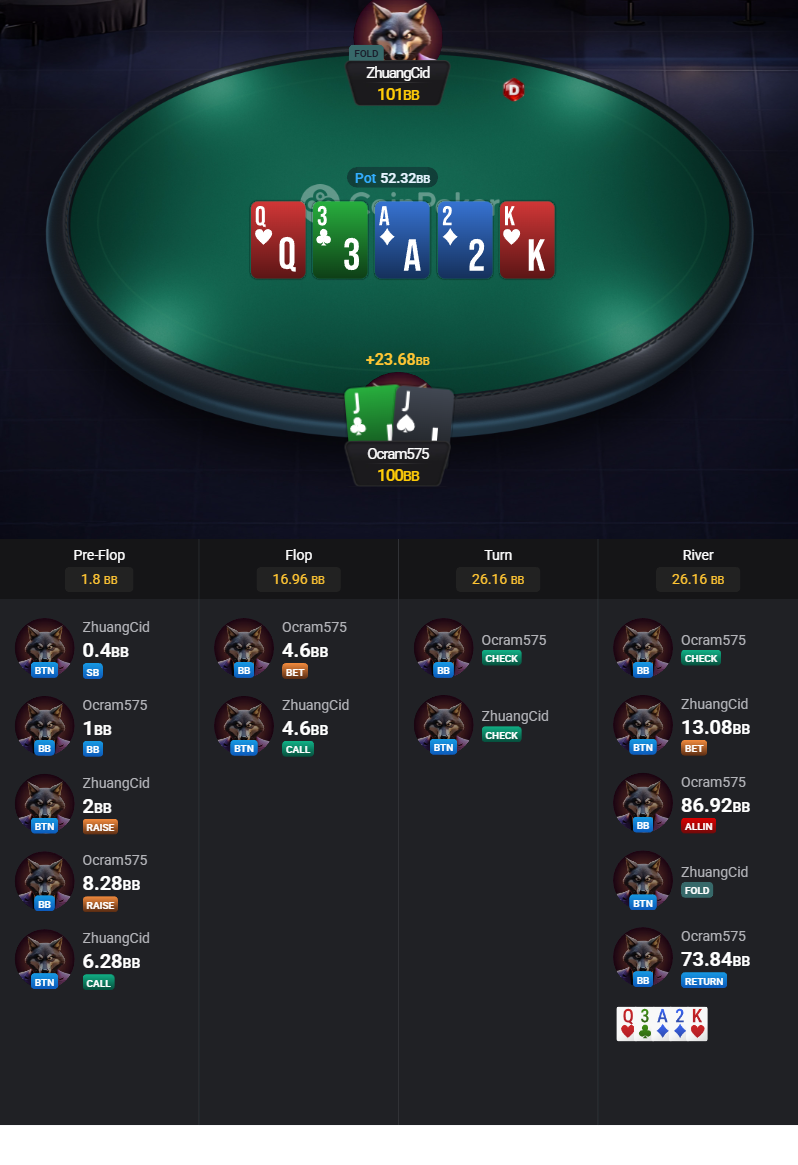
Proof of "Bluff" for ZhuangCid


