If there a merit not to follow GTO in poker tournaments?
Early after the bubble, CU 17bb opens, and Hero (BU) jams 20bb with AQo. Both SB and BB cover Hero.
BB re-jams with JJ, and CU calls with QQ. Of course I lose that hand and go home @@.
I saw in GTO Wizard that BU should jam 100% with AQo and KTs/KJs.
I was wondering — what if I 3-bet my strong hands to 4.5bb instead? If both BB and CU jam, I could just fold and live for another day.
Or does GTO already consider these hands strong enough even when facing potential 3–4-way all-ins, assuming I have a decent chance to double or even triple up?
What do you think?
31 Replies

If you never get caught bluffing, you aren't bluffing enough.
If you never value own yourself, you aren't value betting enough.
If you never value shove into a better hand, you aren't value shoving enough.
There may be times when what you're describing is more appropriate, but they would be deep in the tournament, when ICM is a strong factor and when even a small 3-bet will get more respect. Right after the bubble bursts is a good time to take more gambles for chips and make a deep run.
If you're doing it here, it's because you think you can induce a bluff-shove from a worse Ax. (Even then, we don't really like to do it with our offsuit hands because they don't flop as well. Too likely you get a flat call when you 3-bet that small at this stage.)
Also, your post says cutoff opens to 17bb, which I assume is a typo since you're talking about 3-betting to 4.5x.

I would guess GTO would think the range of hands you don't want to see is extremely narrow and also blocked by you. I'm sure GTO factors in players behind you, but from these opening positions and with two left to act, the odds of running into it are very slim.

ICM creates a dynamic where we sometimes have to call off extremely tight. So sometimes it's better in theory to go all in with our strong but not super premium hands, otherwise big stacks can re-raise us all in and basically bully us. In theory in ICM-heavy spots they can do this with a wide range. We often have to fold relatively strong hands due to ICM.
Now that's not necessarily true in your example hand, but it might be with the KJs and KTs. The concept I'm talking about is most relevant on the money bubble and is also highly relevant near the final table "bubble."
You don't really want to put in 4.5 bigs and then have to fold to a single shove when you have a good amount of equity.
Now that's the theory part but in practice some players who could theoretically bully us won't in practice. They might just play nitty and straight forward. In that case it can make sense to exploitatively use a strategy similar to what you suggested.
All that being said it's just best to jam with AQo in your example hand. You really want to see all five cards with AQ. You don't want to raise to 4.5 BB, get called, miss the flop, then someone goes all in and what do you do? Also the hand is strong enough that you really don't want to raise fold. You just got unlucky running into two very strong hands.
Jamming is designed to fold out tons of equity from hands like KTo, JTs, 55 etc.
3 bet small just give CO the chance to flat everything and see the flop.
In a chip EV sim AQo is actually the worst hand to do this compared to hands like K9s, ATo and in ICM land AQo is also too weak to induce.
This seems to be an excellent example of the “chips you can win are almost never worth as much as the chips you can lose” rule, but that’s probably outdated—if it was ever correct to begin with—in our Brave New GTO World.
Ditto for the “people especially the short stacks tend to play much tighter near the bubble, so you can raise more often with marginal hands e.g. AQo; contrariwise, the short stacks are very likely to gamble more once they’re in the money, so be less inclined to play those same hands, especially if someone has entered the pot in front of you” rule, i’m supposin’.
I do wonder what BB might’ve done with the hooks if the bubble hadn’t burst yet…
All that being said it's just best to jam with AQo in your example hand. You really want to see all five cards with AQ.
So AQo is the new AKo? ; )
It seems unclear if CO limped with QQ after it was folded to him (alarm bell?), or what he raised to otherwise, but on the button with meh, two big stacks in the blinds during post bubble mayhem and an 8-orbit stack, how wrong can folding be?
All that being said it's just best to jam with AQo in your example hand. You really want to see all five cards with AQ.
So AQo is the new AKo? ; )It seems unclear if CO limped with QQ after it was folded to him (alarm bell?), or what he raised to otherwise, but on the button with meh, two big stacks in the blinds during post bubble mayhem and an 8-orbit stack, how wrong can fold
You're advocating folding AQo on the button to a cutoff raise?
Yes you are.

I'd be interested to know what range you are putting CO on to consider folding AQo here. When we go all-in, the ICM goes on those left to act. Forget the hands that were actually turned over, and think about the ranges we are likely dealing with here......
To answer your question - in my opinion, very wrong unless we have some insane reads.....
I'd be interested to know what range you are putting CO on to consider folding AQo here. When we go all-in, the ICM goes on those left to act. Forget the hands that were actually turned over, and think about the ranges we are likely dealing with here......
To answer your question - in my opinion, very wrong unless we have some insane reads.....
Well, he min raises 12% of his stack when it’s folded to him in the CO with three big stacks left to act. It would seem to me that he wouldn’t want to do that with KTo & 55 for the same stated reasons that BU shouldn’t min 3bet 23% of his stack with AQo.
Suppose the blinds had folded after BU jams. What do the sims say CO’s calling (AI) range is?
And what’s CO’s range to raise initially to only 2x with a 17x stack after everyone folds to him and the BU & blinds all cover him?
CO's range? Should be all the suited aces, most of the offsuit aces, basically any broadway combo, lots of suited kings, bigger suited connectors, most of the pairs. If there are jams, they may come from hands like small pairs, decent suited broadways, and wheel suited aces.
I'm not sure what range you think CO has here, because most of your posts read like you're trying to construct a range that justifies folding AQo here because OP lost the hand.
But you’re right, certainly some results oriented commentary by me. Even if the jam was somewhat ‘wrong’ it wouldn’t be by much, and it’s certainly better than a miniraise.
That’s ITM, long way from FT, folded to CO min raise, BU covers, blinds cover both.
Impossible to argue with that, I guess.
What’s CO’s calling range if the blinds fold? Pretty similar? (I promise I have a point, which arose over Leo’s bustout hand at the ME FT).
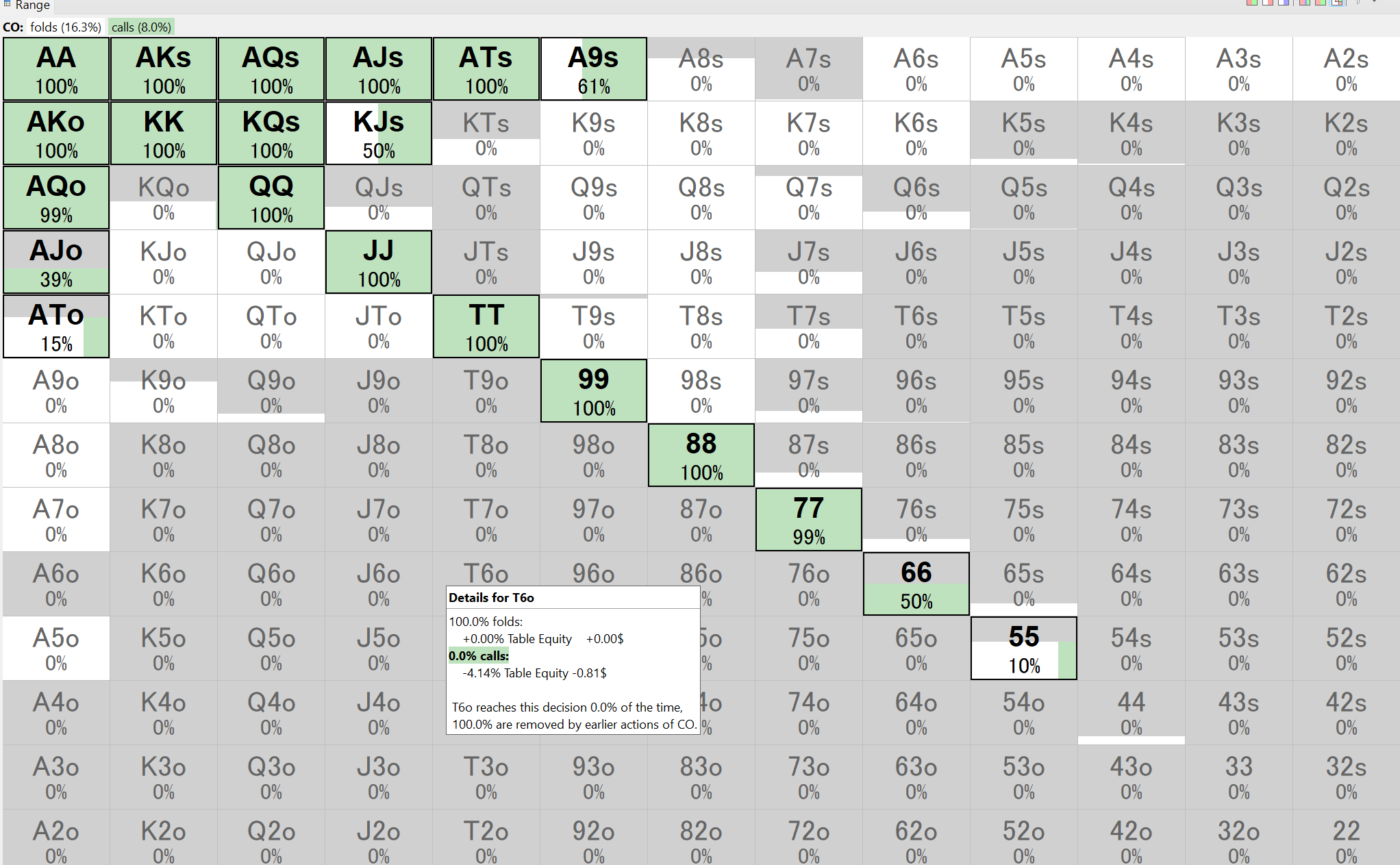
That’s an ICM sim already and the green part is CO calling range vs Btn jam and blinds folds.
Stacks are assumed to be 17, 20, 35, 35
25/180man just in the money.
Under even moderate ICM pressure there is much less calling and more raising and jamming. When you are raising nai with this stack size you are trying to induce or trying a cheap bluff, and AQo is not exactly a bluffing hand.
That’s an ICM sim already and the green part is CO calling range vs Btn jam and blinds folds.Stacks are assumed to be 17, 20, 35, 3525/180man just in the money.Under even moderate ICM pressure there is much less calling and more raising and jamming. When you are raising nai with this stack size you are trying to induce or trying a cheap bluff, and AQo is not exactly a bluffing
Thanks, I thought the green part was BU jamming range after CO min raise lol.
There's some missing information here. If it was a small tournament where there will be new pay jumps very soon after bubble there will be bigger ICM pressure.
But in a larger tournament with say next 50 bustouts will receive the same payout it won't be that big. Under such circumstances AQo should mostly be played as a shove for reasons already mentioned above. That doesn't mean it's a very profitable hand when called. But it's strong enough to put maximum pressure here. Plus I think we will benefit a bit at least from players on lower buyins who calls to much with worse AX-hands.
Better get used to the fact AQ is a typical bustout hand, both before and after the money
Your computations will always have the contours of something that looks like counterfactual regret minimization. Yeah you probably aren't mindful of this, but it doesn't matter, even if you're also unmindful AND doing a crappy job.
Doesn't matter how poor your expected ROI is: you're always making risky assumptions about your opponents as is required in games of imperfect information
Doesn't matter how bored you tend to get, or how tilted you tend to get: You're always, at least you probably feel like you always, approach the game with competitiveness and a desire to win and crush your opposition.
That's what GTO is. It's a framework or computing strategies based on assumptions with the whole thing circumscribed with steely competitiveness. GTO is not a strategy. You're always "following GTO" whether you know it or not, or whether you like it or not, or whether you're actually skillful at it or not.
You're conflating Nash equilibrium with the GTO framework.
[QUOTE=SwedishNit] Better get used to the fact AQ is a typical bustout hand, both before and after the money [/QUOTE]
OK, this is what Ive been wanting to clarify since the ME FT. If at any point >5-handed, in any NLHE tournament, if it folds to the CO (or maybe even the LJ) and any two players have above average but not Group 1 hands—we’ll give CO KJs to OP’s AQo on BU ith; Leo had AT in SB & Kenny 66 in BB at ME—all the chips are going in preflop, BUT, first to act is better off to call or min raise and then call a shove, rather than just shove, because that will fold hands that would otherwise shove and we would call as a small favorite.
As for the next guy, it’s almost always better to shove than call or a smaller 3bet, and if we run into a big pair, that’s gambling, get used to it.
Because that seems to be I’m reading.
[QUOTE=SwedishNit] Better get used to the fact AQ is a typical bustout hand, both before and after the money
OK, this is what Ive been wanting to clarify since the ME FT. If at any point >5-handed, in any NLHE tournament, if it folds to the CO (or maybe even the LJ) and any two players have above average but not Group 1 hands—we’ll give CO KJs to OP’s AQo on BU ith; Leo had AT in SB & Kenny 66 in BB at ME—all the chips are going in preflop, BUT, first to act is better off to call or min raise and then call a shove, rather than just shove, because that will fold hands that would otherwise shove and we would call as a small favorite.
As for the next guy, it’s almost always better to shove than call or a smaller 3bet, and if we run into a big pair, that’s gambling, get used to it.
Because that seems to be I’m reading.[/QUOTE]
That's not necessarily true.
Yes for the most part hands like KJs+ and 66+ are just going to be strong enough to get it in at <20 BB in late position, assuming ICM is not a factor.
However the preferred action is going to vary based on the position, exact hand and action you're facing. For example if it folds to the button they're going to be open jamming 20 BB with some hands like small pocket pairs and small Axs. Those hands benefit more from folding out some dominating hands and hands with strong equity. However the strongest pocket pairs and Ax prefer to raise small to hopefully induce a light jam.
Another example: Certain hands like KQs are called by the big blind vs a raise even though they might be strong enough to jam. The EV can just be higher as a call.
Also once ICM comes into play all bets are off. In some configurations it can be correct to make some VERY nitty folds.
This new twoplustwo software sucks. I click quote and it quotes the person being quoted by the person I was trying to quote. Since the software will be confused by an emoji, I will just type: face palm.
Yeah the site redesign was a total punt
GTO is all about EV, which can get weird when you are in a tournament, as many "correct" plays have nothing to do with even the cards you hold. Situational poker, at least for me, is far more important in a tourney. And once you play a few and recognize a few players, it unwraps a whole new layer.
Stealing blinds late in a tournament on the button doesn't even involve the actual cards you hold, etc. Same goes for any point when you realize the players in the blind are likely to fold, or when you can no longer jam since the two blinds are super low on chips and will more than likely go all in with another bet.
I was heads-up last night for the win and I don't have time for GTO. Dude got super meek and I guess he was happy with the payout, first or second. So I was just jamming and raising almost everything, calling him down with any pair, even bottom. This has nothing to do with GTO and everything to do with tournament experience I would build up a huge chip lead then lose a coin flip, rinse and repeat until I finally held up.
I'm just coming back from the blackout of internet poker after the first boom. Started reading about ICM and GTO expecting some major breakthroughs in poker strategy but its more or less the same, just backed up with specific math and concerned about exploitation. At least from what I have learned. Seems to be a great learning tool but maybe not an active tool for tournaments.

GTO is EQUILIBRIUM - a simulation of millions of hands played by a computer versus computer to come up with a zero "indifferent" outcome. As people, our job is to figure out how we and our opponents DEVIATE from equilibrium (also known as "baseline strategy"). IOW, I first check what a solver would do in a spot, then I ask myself and my friends how far we deviate from that play to come up with the most rational move.
For example: I am in the sb with KJo and a 6bb stack. UTG, who has been very active shoving every hand even with a 20bb plus stack suddenly quietly min opens. It folds to me - what is my move?
Of course GTO is shoving. But here's the kicker: is he really doing this with anything less than AK KQs maybe and QQ+? I didn't think so, and I made a highly deviant exploitive fold there. As it were, the bb called and he showed down with AKs - I would have been out of the tournament there where I otherwise finished 2nd.
What GTO is excellent for is learning opening, push and shove ranges at <30bb and subsequent 3-betting and 4-betting ranges versus tough opposition who are familiar with these strategies. It is also excellent for learning and practicing continue betting on different flop board textures. These are spots that don't require much deviation as opposed to being out of position facing tough spots or playing versus a sticky opponent on later streets.
The other danger with GTO is I hear and see in big events all the time dudes saying "all I care about is if I make the 'correct' play". What these GTO-BROs are doing is using the solver as a comforting tool to rationalize their bad play and decisions. They make a shitty play, based on a bad read, and the solver says it's correct not taking into consideration player dynamics and these poor fellas are robbing themselves of a learning opportunity... don't do this!
very good post, simon. I'll add that GTO is also good for finding patterns in different spots and learning the whys behind them-- why similar flops or hands might call for a small bet vs. a big bet, why certain hands have the blockers we want to bluff or bluff catch with vs. others, etc.
In the moment, you need to trust your reasoning and what you know and have observed to make the best decision, but it's important to have a strong theoretical basis from which to act.

