If dealer conducted and players approved all actions

I came across this concept totally by accident. It's very simple, but I think it's worth your time to think of it. As fa

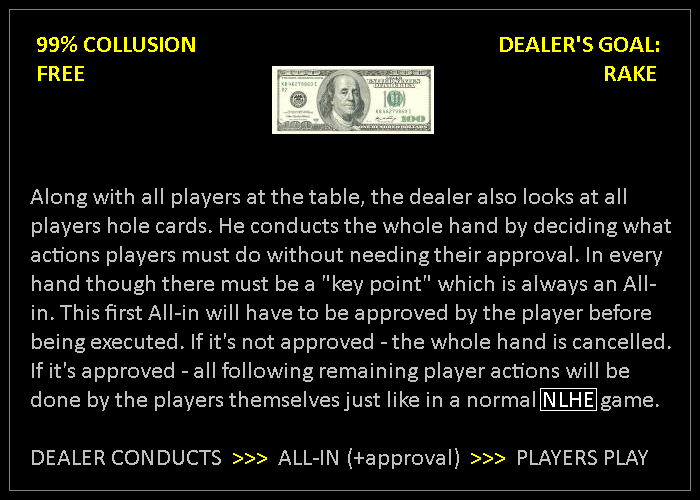
This doesn't resolve the issues, and it removes almost all player decision-making. There's no skill edge or enjoyment left. It's also extremely prone to the dealer's mood. I don't see any reason why you'd want to have the dealer making player decisions. I don't understand how or why that is an improvement over regular poker.
But ok, if you really want to force this concept to work, all you need to do is amend the original rules such that you can't "cancel". The dealer will suggest an action, and the player can either agree or fold.
Any poker mechanic that lets people play without committing to the risk of losing the money they've already put in is 100% doomed to fail. This was the problem with your last dozen games or so.
in all seriousness, i'm very supportive of your work to try to develop new games of pokeri think it would be really awesome if you invented a new variant that became popularbut... in your quest to find a unique spin, you make the games unplayableevery game you design requires the players to be absolutely braindead in order to consider playingyou continually design games where t
^^ I couldn't agree more. ^^
ITryDueces, you are so invested in making new variants - and that's a cool hobby, but you never consider basic strategy principles. You never consider the ways your game could be exploited, or the player's incentives to play.

This doesn't resolve the issues, and it removes almost all player decision-making. There's no skill edge or enjoyment left. It's also extremely prone to the dealer's mood. I don't see any reason why you'd want to have the dealer making player decisions. I don't understand how or why that is an improvement over regular poker. But ok, if you really want to force this concept to w
Let's focus on the dealer's mood you mentioned. The dealer's mood is: "I want to collect as much rake as possible and never collude with players, so that I can be seen as a good dealer, I won't lose my job and maybe I'll get some bonus in the future from the casino owner." To do that (precisely - to collect more rake), the dealer will have to conduct EVERY HAND in a way so that the first phase ends with a reasonable All-in play that will be APPROVED by the player. Only then he can collect the rake. Of course the All-in is mandatory in each hand according to the new rules. So, this means that in the first (conducted) phase, dealer will play the hand in a way to build the pot as big as possible and let the player with the best hand at that moment to go All-in. He can also bluff, but he can't do this too often.
This means that the potential caller(s) will very often face a difficult decision, since the All-in will look super strong every time. You may say that it's not good for the game to force players to do particular actions, but the dealer has to follow a certain path of thinking. He can't do anything he wants, it's purely theoretical.
There might be some bias connected to the dealer's will, but he conducts every hand only to a certain point.
As far as theoretically possible collusion with any of the players, to be successful it would have to be:
- undetectable
- always profitable
And both of those will fail, because it would be relatively easy to detect (or maybe even outplay when detected) and it will never guarantee profits (if undetectable). Plus, it would be super difficult to do physically (tells).
Letting the dealer play so that it makes sense would definitely be an improvement for the game, because you never see stuff like this happen at the table. It would attract a lot of people to the game.
Now, let's focus on the skill edge. In normal NLHE, a good player can read opponent's range and bases his decisions on his opponent's previous actions. For example, when he has a dilemma on the turn and isn't sure what to do, he should recall what actions his opponent did earlier in this hand (pre-flop and flop).
Since in my game the dealer plays the first phase of each hand, it will be DEALER'S ACTIONS that will be recalled and read by players who are about to act. Yes, it may seem absurd at the beginning, but it's truth because the dealer must follow a certain path to achieve his own goal (collect maximum rake every hand). I've already explained that in my previous post.
Dealer's goal then will be to make an All-in that will look strong. Most of the time he will choose a better hand for this, but sometimes he may choose a weaker hand if the player who has a weaker hand "did" actions that looked strong. The dealer must play properly and quite loose to always finish with a smart All-in. Since this All-in has to be first approved, it must have some good fold equity most of the time. So the pot shouldn't be too big (and not too small).
Starting from the pre-flop, the dealer tries to keep all good hands in the game and never fold them, because they may hit a good board and be obvious to go All-in. He will fold weaker hands to not make the pot too big. Besides, the more players in the hand, the smaller the fold equity will be. Also, with his decisions he builds his own image from each player's perspective and this will be important, too.
As you can see, there are really a lot of factors that will shape dealer's decisions. I might have skipped something, because there are really a lot of those. Obviously there is a skill edge in this game, so this will be a good incentive for the players and it should be fun to play, too.
Adjusting the rake type for this game could be the key thing.
For example if you rake the game this way:
# folded pots: the rake is 3% (with cap)
# showdown pots: the rake is 6% (with cap)
It should all work then.

