GTO Wizard for Live No-Limit Players

Can anyone advise how to improve your live-cash game studying with GTO Wizard? I want to believe that this powerful prog
Everyone is talking about the countless ways they deviate from GTO but I think there are two things you can easily implement in low stakes live to improve your win rate: 1) get very good at drilling preflop ranges and adopt the GTO preflop range for every position. This significantly increased my win rate and with a bit of fine tuning I've even adapted the range and sizing to accommodate for limps ahead of me. 2) regardless of the actual size used in live game, understand the board textures GTO likes to bet small on and the flop or turns GTO likes to overbet on and build heuristics for why it's doing it with a particular range/hand/etc. I don't always use the recommended sizing but even having over bets and polarizing bets in my play has significantly increased my win rate against both regs and fish.
Disclaimer: I am no game theory expert, so please do not take what follows for granted.The computational effort for multiway simulations increases exponentially, therefore it is not so obvious that a reasonably comprehensive multiway solver will come out anytime soon. For instance, as far as I have understood, already in the available solvers, the absence of a preflop calling r
Existence, yes. Uniqueness, no. And it is also not known whether solver solutions are GTO or how close they are.

Everyone is talking about the countless ways they deviate from GTO but I think there are two things you can easily implement in low stakes live to improve your win rate: 1) get very good at drilling preflop ranges and adopt the GTO preflop range for every position. This significantly increased my win rate and with a bit of fine tuning I've even adapted the range and sizing to a
I would say that (2) is more significant than (1) because it involves considering strategies you might not otherwise think about it. Looking at how a solver plays a flop/turn spot and seeking to understand why it does so is not the same simply adopting that strategy (when some key variables such as # of players in the hand and their range compositions differ from GTO).
In respect of (1) I wonder whether the benefit largely derives from being decisive about having a range for each position. Understanding that a MP range should differ from a CO range, in terms of frequency and composition, is likely the key point. Shouldn't the actual GTO preflop range be modified for the same reason as GTO post-flop strategy? What happens if you're in a game where you have position on weaker players who are limping a bunch, for instance. Shouldn't you widen your MP range a little in these cases (and even widen your 4bet range too if better regs 3bet you more)? If, for instance, you're in the SB with a combo that's a GTO 3b v a BN RFI, but the BB is a weak player is there perhaps more EV to be gained from calling rather than 3betting to keep the weaker reg in the hand?
I mean, I understand why it's useful to use GTO preflop ranges as a default but if we're not adapting these to game conditions then we might be losing EV. Of course, we can easily fall for the trick of modifying our ranges in a way that's not to our advantage (e.g. overestimate our edge over weaker players and leave ourselves open to exploits by stronger regs).
Is this the hand? Can you solve with multiple callers in the Elite version? Shall I blow another $60? I haven't yet cancelled my subscription.
1/2. V is loose passive. Hero UTG raises 10. V on BTN calls.
Flop (20): K72r
Correct me if I'm wrong, GTO says bet your whole range here (if you bet 2.5 BB). Do you bet your whole range 1/3 pot against a loose-passive live?

Is this the hand? Can you solve with multiple callers in the Elite version? Shall I blow another $60? I haven't yet cancelled my subscription.
1/2. V is loose passive. Hero UTG raises 10. V on BTN calls.
Flop (20): K72r
Correct me if I'm wrong, GTO says bet your whole range here (if you bet 2.5 BB). Do you bet your whole range 1/3 pot against a loose-passive live?
Since the K obviously smashes our range, a basic 1/3 psb could get Villain to fold whiffed cards that might have significant equity against our hand.
I could see taking a b-x-x line with whiffed Ax and still sometimes winning at showdown. Keep in mind that betting on nearly any board HU at any time is rarely going to be terrible if the risk of a bluff-raise is miniscule.

Is this the hand? Can you solve with multiple callers in the Elite version? Shall I blow another $60? I haven't yet cancelled my subscription.
1/2. V is loose passive. Hero UTG raises 10. V on BTN calls.
Flop (20): K72r
Correct me if I'm wrong, GTO says bet your whole range here (if you bet 2.5 BB). Do you bet your whole range 1/3 pot against a loose-passive live?
Gto doesnt say to range bet here at 6 max anyway.
Also this is yet another spot you cant realistically trust gto. You shouldnt trust their 9 max stuff PERIOD, because its all 3b or fold strats that arent realistic, you should just use 6 max and approximate all the EP as being UTG range. I also do not like the results of gto in hands where V is an IP cold caller, because their preflop range isnt realistic to live play. This is btn’s calling range:
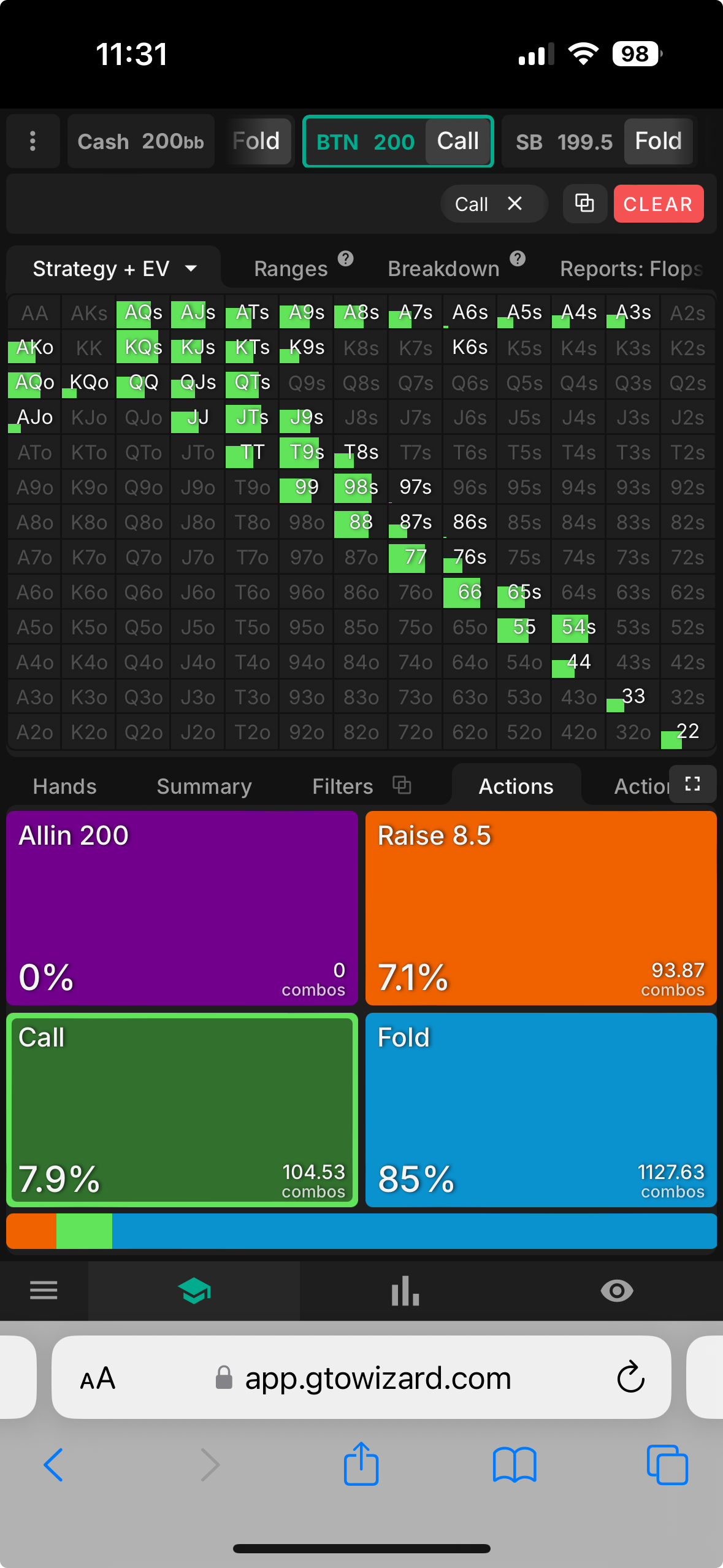
No fish is open folding AJo or KQo or A6s, and they also arent 3 betting A8s or whatever.
GTO tends to do a ton of checking to the in position player when they raise and get cold called IP, because the cold caller is supposed to have a very tight strong range, which simply isnt true in practice.
so i am down for a range bet despite GTO not saying so.
I honestly think the two most important drills in GTO are:
CO vs BB (youre CO) single raised pot. BB is a great approximation of a fish’s limp/calling range, and a decent approximation of their sb/bb calling range
CO vs SB (youre SB) 3 bet pots. You can realistically just use the same 3b range from sb and bb, there are reasons not to but itd be fine to do, and CO is a decent approximation of regs and decent players raising range.
I think GTO strategy in these spots is amazing and extremely relevant to live poker. Sure it wont teach you how to do even close to everything, but with those two drills you can learn how to effectively play HU pots IP as the PFR, and OOP as the 3 bettor to a point that youre head and shoulders better than everyone else in these specific spots. These are the spots where i generate the majority of my profit and edge.
CO vs BB (youre CO) single raised pot. BB is a great approximation of a fish’s limp/calling range, and a decent approximation of their sb/bb calling range
CO vs SB (youre SB) 3 bet pots. You can realistically just use the same 3b range from sb and bb, there are reasons not to but itd be fine to do, and CO is a decent approximation of regs and decent players raising range.
I was looking for exactly this advice. I think I got my 89 dollars worth reviewing these two spots. Thanks.
Hell yeah, good luck dude.
Why does KQo have more value in GTO than AKo with this runout?
Hero in CO raises 2.5. V in BB calls.
Flop is Tc8s2s.
V checks. Hero?
GTO is cbetting 80 percent of the time with KQo and just 30 percent with AKo.
Hero bets half pot. V calls.
Turn is 2d. V checks. Hero?
GTO is betting 50 percent of the time with KQo and just 20 percent with AKo.
It's more important for KQ to fold out AK than vice versa?
Why does KQo have more value in GTO than AKo with this runout?
Hero in CO raises 2.5. V in BB calls.
Flop is Tc8s2s.
V checks. Hero?
GTO is cbetting 80 percent of the time with KQo and just 30 percent with AKo.
Hero bets half pot. V calls.
Turn is 2d. V checks. Hero?
GTO is betting 50 percent of the time with KQo and just 20 percent with AKo.
My guess:
1. AK has more showdown value, so less need to bluff. I think this holds on both flop and turn.
2. KQ has some BDSDs, which AK hasn't. Obviously this holds on the flop only, in this case.
So if you’re looking at simply theoretical optimal vs opponents who also play at that level then the standard options and results will give you a depiction of performance on that level.
Problem though is no live reg at 1/3-5/10+ is truly playing close to optimal and majority of opponents are not either.
The solvers results will only be as applicable to YOUR situation if the assumptions made at the outset regarding ranges match opponents and you also must define or limit specific post flop options for an opponent such that the solver is unable to select an option your opponents are probability close to 0% going to do / recognize.
In other words, the solver brute forces optimal play given assumptions and decision tree limitations.
To elucidate this via example:
You have AA UTG, Opponent has J7 on Button. You raise 2.5 BB button calls.
Eff stacks 100BB
(6.5BB)
Flop: J92r
You check, villain bets _____
Here we have a decision tree point the solver will find optimal path for villain given the options they are able to select. You can set it so solver has multiple betting options here from checking, 20%bet 33% etc on up to open shoving.
Given options I don’t think the solver would ever choose to shove this spot but your opponents in game might do something absolutely absurd here.
So if you’d like to analyze what range of hands you should call off this shove with you have to direct the solver by limiting the betting options to shoving as a response to your action on this flop.
But prior to this, a solver starts with range assumptions and J7o would always be considered a fold preflop, so if opponent is a play any two from button type, you have to assign that range that calls up front raises that isn’t 3bettinf (say even the worst loose opponent would 3bet QQ+ so the range assigned now must be everything but AA-QQ
tl;dr a solver isn’t clairvoyant and if you want to analyze against your specific villain archetypes you must also have proper range and post flop decision tree assumptions inserted such that the solver won’t deviate away from bad/incorrect play.
If you run the solver without locking the shoves all flops option in our above example, the solver will spit out a skewed result that is only applicable if opponent plays more rationally say in these spots.
Herein lies the strength of your ability to derive solutions - they’re only as good as the assumptions your able to make about preflop ranges to go off and decision tree options the solver is allowed to take.
AK doesn't need to fold out weak A highs that KQ does. when we turn or river an A with AK we get nice value vs Ax. when we turn or river an A with KQ we're dead against Ax. when it gets checked down we lose vs Ax. AK has just enough showdown value that it wants to play pot control at this stage on this texture.
Yeah one thing i learned from gto is that ace high is a decent amount stronger than I thought, in fact gto usually will peel a card with ace high. So betting AK is akin to betting second pair or 3rd pair, where youre folding out the worse hands and getting called by better hands and youre really looking for cheap showdown.
Just a quick point since the main question was answered:
Frequency of action with a hand /= its value or EV or Equity or Equity Realization% etc etc.
If you conflate frueqency of an action (eg. AKo not betting as much on the river vs another hand) with value or anything similar to value, it will really cloud your perception of finding an intuitive structure to the overall pure strategy.
I'm really tempted to make a GTO thread because I see a lot of responses that say something like "run it on a solver" but fail to address rather important in game differences between theoretical solution and real life applicability.
or more importantly - while a solver might suggest 100% checking a specific hand, it is doing so because of input assumptions at the outset that DETERMINE that frequency. So when comparing a solution to a live hand, if your opponent is deviating in ANY WAY from how a solver plays, the reliability deteriorates.
That isnt to say the advice is bad or "wrong". And I guess this is a bit more difficult territory to really explain in a brief amount of time with clarity. If you were able to magically alter how the solver runs its solution so it's approch is a GTO vs sub-optimal Opponent as well as other controlled inputs such as EXACT range live villain would play being used for the solutions and then of course a host of other unaccountable **** humans do because try as we might: for the same reason a human cannot substitute for a RNG, we also cannot substitute for pure consistent behavior in line with a strategy especially when the complexity of that strategy reaches a threshold without decades of continued practice. and even if you had a perfect GTO strategy memorized in every single way, you'd STILL alter and deviate from it when your opponents are NOT playing a perfect GTO strategy themselves.
But here's why its not "wrong" as stated at the outset: your deviations from GTO strategy in that last sentence is NO LONGER worrying about opponent finding angles of exploitability BUT done so to capitalize MORE on the mistakes made by an opponent whose strategy falls short of GTO.
same thing said differently: GTO is always a solid strat. against bad players it wont lose money over the long run but it will not MAKE THE MOST MONEY against their mistakes because its entirely built as a defensive strategy. GTO strat is structured such that every decision point will not yield any EV in favor of opponents action. its a zero sum solution.
think of it like tug of war where both sides pull in their direction with equal force so that the center never moves in either direction. the analogy falls apart after this pretty quickly though.
So here's a hand I think does simulate a typical live low-stakes scenario. Thanks to Tomark for suggesting it.
6Max NL100
Folds to V on the BTN, who raises 2.5. Hero in SB 3bets to 11. V calls.
Flop (23): As7d6d
Hero bets for value with AX at 75 percent frequency. Hero c-bets about half the time with his other holdings, including many backdoor draws.
Hero checks. V bets 11.5. Hero?
Hero is here calling AX, AA-88, T9s, T8s; raising 77 and 66; and folding everything else.
Hero calls.
Turn (46): Jc
Hero mostly checks his range now with the plan of now check-raising all the sets. Hero bets AX with only 30 percent frequency.
Hero checks. V bets 23. Hero?
Hero is re-raising JJ, calling all AX, calling most KK, calling half QQ, folding 88-TT.
Hero calls.
River (92): 2h
Hero checks his whole range. V bets 32. Hero?
Hero is raising AJ, calling most AX, mostly calling and some folding KK, calling/folding QQ at 50/50.
I just cancelled my subscription. My current subscription expires on 12/9. If I studied GTO 15 hours a month instead of 5, I would renew my subscription. For now, the $89 monthly goes into my bankroll. I'll spend my monthly 10 extra hours on the tables.
BTN calls hero's 3b in SB. Flop: As7d6d
Live, unless I see a tell, I'm betting all my AX, KK, QQ, 77, 66 and checking my pairs JJ-88. I'm c-betting with all my one-card draws and many higher backdoor ones too. I think checking 25 percent of AX here is just GTO's defensive strategy takes a "knowing" opponent. Slow-playing bottom sets is also a GTO defensive strategy in a game with no calling stations. Even if the live villain pays attention, with this simplified-live betting range, the hero remains unexploitable against all but the best.
Edit: Is my live betting range too wide? Do you check QQ and KK? Check most backdoor draws? Edit: I'm probably never 3betting 77 and 66 in the SB live.
BTN calls hero's 3b in SB. Flop: As7d6d. Hero checks. V bets.
Live, at this point, I thinking I'm folding or check-raising only. Live, it now really depends on stack sizes and implied odds. If we get this far, it's mostly multiway. GTO now has minimal application.

BTN calls hero's 3b in SB. Flop: As7d6dLive, unless I see a tell, I'm betting all my AX, KK, QQ, 77, 66 and checking my pairs JJ-88. I'm c-betting with all my one-card draws and many higher backdoor ones too. I think checking 25 percent of AX here is just GTO's defensive strategy takes a "knowing" opponent. Slow-playing bottom sets is also a GTO defensive strategy in a game w
You understand that A4s and KK need a _lot_ less protection than 88, right?
Also I don't think it takes "all but the best" to see you bet A4s here and understand V can bet any Ax (also 3bet pot or not most low stakes players will just bet any Ax on the flop anyway).
I resubscribed, this time $149 for the Elite version. Trying to work on it every day for a month to get max value. I locked down the nodes and used AI. Hand to study:
Hero raises 2.5 in the CO with AhQc. V in the BB calls. Two ways.
Flop (5.5): QsTs7c
V checks. Hero bets 3.7. V calls
Turn (12.9): 6s
V donks 9. Hero?
Solver calls 60 percent and folds 40 percent (note it raises AsQx ). Consider these exploits in a live game:
V1 a typical loose-passive calling station. He calls too wide.
V2 is a bad LAG, usually 3bets in position, but plays too many hands, calls too wide, likes to defend his big blind.
Are you calling V1 here? V2? My instinct is to sigh fold to V1 and sweat call V2.
I resubscribed, this time $149 for the Elite version. Trying to work on it every day for a month to get max value. I locked down the nodes and used AI. Hand to study:Hero raises 2.5 in the CO with AhQc. V in the BB calls. Two ways. Flop (5.5): QsTs7cV checks. Hero bets 3.7. V callsTurn (12.9): 6sV donks 9. Hero?Solver calls 60 percent and folds 40 percent (note it raises AsQx
typical 1/2 or 1/3 villains? I'm just folding everything except flushes or at the minimum drawing to the nut flush.
Villain just donked 2/3 pot on a nut changing card after you've shown nothing but strength. They have a flush here 12 times out of 10.
If I call and they put out a big bet on the river, I'm folding everything but the nut flush.
Hero raises 2.5 in the CO with AhQc. V in the BB calls. Two ways.
Flop (5.5): QsTs7c
V checks. Hero bets 3.7. V calls
Turn (12.9): 6s
V donks 9. Hero?
Solver calls 60 percent and folds 40 percent (note it raises AsQx ).
First off taking a quick look (free 100bb GTOw) V as solver donks for 20% only like 4%, checking 96% ... so we are in the weeds already. I'm not sure what the AI part is but I wouldn't trust it to get any live V's range correct here, or the responses (it does never fold AQ vs. 20% donk, so it's doing something I'm just not sure how close to correct it'll be). Would be esp. sus of the range it's giving V because if you look at the "range" V donks (for 20% pot) and it's some kind of genius merged range that no human will ever do.
So it's not obvious to me that this is a useful thing to spend time training on ... or even worth $5 a day.
Consider these exploits in a live game:
V1 a typical loose-passive calling station. He calls too wide.
V2 is a bad LAG, usually 3bets in position, but plays too many hands, calls too wide, likes to defend his big blind.
Are you calling V1 here? V2? My instinct is to sigh fold to V1 and sweat call V2.
Seems mostly reasonable, depending on any live reads ... and like the solver I'd be tempted to raise with nut flush blocker ... although probably not when I have top pair (but GTO is almost pure calling AsJx so wtf do I know).

Solver calls 60 percent and folds 40 percent (note it raises AsQx ). Consider these exploits in a live game:
V1 a typical loose-passive calling station. He calls too wide.
V2 is a bad LAG, usually 3bets in position, but plays too many hands, calls too wide, likes to defend his big blind.
Are you calling V1 here? V2? My instinct is to sigh fold to V1 and sweat call V2.
Well, no one's value dunking 3/4p with bare KQ-, so I'm going to consider this a bluff catcher with no blockers and no outs against the range they're repping.
So it's a fold against anyone remotely passive. And basically everyone, including most regs, are too passive to meet indifference threshold in non-standard spots.
Even a "LAG" in a live game mostly means they're just aggressive enough to start to approximate a bot's bluffing frequency (as a raw frequency, obviously their ranges are too wide overall, so relative to that we are playing lighter overall). In that case, I would also sweat call but be happy to fold the hand at any point with any kind of tell or anything.
In reply to the general thread topic, I would try to walk before you run.
I would not seek to use GTOw as a comprehensive tool that solves every poker question you have, and start very low level with where GTOw IS useful. In that case, its value is undeniable in specific areas.
So I would NOT start by plunking down $150 per month to get access to the most advanced features.
I mean, *I* haven't been able to justify paying 4-figures a year for GTOw's most advanced package even though solvers are MUCH more useful for the games I play in and based on this thread (no offense) I'm better set up to use solvers effectively.
Of course, I also have a few terabytes of PIO and Simple 3-way solves so I'm not as desperate for every bell and whistle it offers, but still: I'd start with baby steps.


