Basic math question regardings Outs & Odds
Hey guys:
Example: Our hand has 20% Chance to hit on the next street. (9 outs flushdraw with rounded numbers for simplicity)
500 in the pot and Villan bets 125 ...(1/4 or 25%)
Is this calculation correct? 0.20 (20%) x 625 (pot) = 125.
Assumption: I can call 125 to break even. Below 125 is always +EV.
If I call more than 125 it is -EV.
This calculation was once on a poker strategy homepage.
Now
Lets see a 50%, (1/2 Pot) bet with this calculation:
Villan bets 250 into 500. Pot 750.
Charts say Hero needs to win 25% of the time to make this profitable call so 187,5 in chips.
According to the calculation above for the 20% chance to hit the card I calculate:
0.20 x 750 = 150, to break even. So calling 150 and above with a 20% chance is - EV and below is profitable.
So a 50% pot bet always denies the equity for a flushdraw on the spot (ignoring implied odds).
I want to verify this, because this is imao the best and easiest way to calculate outs and odds on the spot.
Lets say I have 6 outs which is 12 % to hit one of my overcards, I will just use the formula: 0.12 x Pot and I have the correct amount that I can call for a break even spot.
In the last case if the Pot is 1000, I do 0.12 x 1000 = 120 and I have my result.
22 Replies

To profitably call a bet under the assumption there are no other bets on future streets, then Hero needs to have equity greater than his pot odds (bet/(bet+bet+pot)).
For the situation in which you have 9 outs or further simplified to 20% chance to hit your hand and also assuming that when you hit it you always win, then your pot odds must be <20% to have a profitable call. If villain is betting 125 chips into 500 pot, then your pot odds are equal to 125/(500+125+125) or 125/750 or ~17%. Because equity (~20%) is > pot odds (~17%), then this is a profitable call.
Obviously there is an issue with this simplification when there is more betting to be done on future streets... This is often called "implied odds".
Hope this helps, gl.

You have to factor in the chips you put in as well.
Pot is 500, they bet 125, you have to put 125. If you win you get 750. Pot odds need to be 1 in 6 (16.66%)
Pot is 500, villain bets 250, you need to call 250, the pot would be 1000. So you invest 250 to win 1000 potentially, including your original 250. Pot odds need to be 1 in 4 (25%)
You can definitely calculate in a different manner, but the correct result is 16.66% and 25% for those scenarios
Assumption: I can call 125 to break even. Below 125 is always +EV.
If I call more than 125 it is -EV.
If you want to calculate the maximum call size given pot odds (the payout given a probability that would yield EV 0). You would have to do some algebra.
Brokenstars is onto it with bet/(2xbet+pot)=p
For p=0.2 and pot=500, you will find that bet size is 150
Edit:actually 166.666
Of course I don't do algebra on the table, it's best to have some rough checkpoints.
Pot size bet -> 1/3 odds needed
Half size bet -> 1/4 odds
Third size bet -> 1/5 odds
Quarter bet -> 1/6 odds
So you are looking at a third pot bet for p=0.2 actually, my bad.
This is why the american odds system is so popular, you can express odds and ev neutral probabilities by the same ratio, but it should always be defined as investment/total payout.
You have to factor in the chips you put in as well.Pot is 500, they bet 125, you have to put 125. If you win you get 750. Pot odds need to be 1 in 6 (16.66%)Pot is 500, villain bets 250, you need to call 250, the pot would be 1000. So you invest 250 to win 1000 potentially, including your original 250. Pot odds need to be 1 in 4 (25%)You can definitely calculate in a different
Hey Love,
thx for the reply. I thought about this for a second, but came to the conclusion that it wouldn't make sense to include my own money, that isn't in the pot yet.
The idea is purely there is a pot and a bet, and what amount is profitable to call with certain equity like 20%.
If I would add my own money, it would make the calculation inaccurate, because that money does not belong to the pot yet.
I want to calculate the right amount before my money goes in.
I do have the chats but I don't like memorizing, I want to calculate everything to stay sharp.
[Uploading Image...]
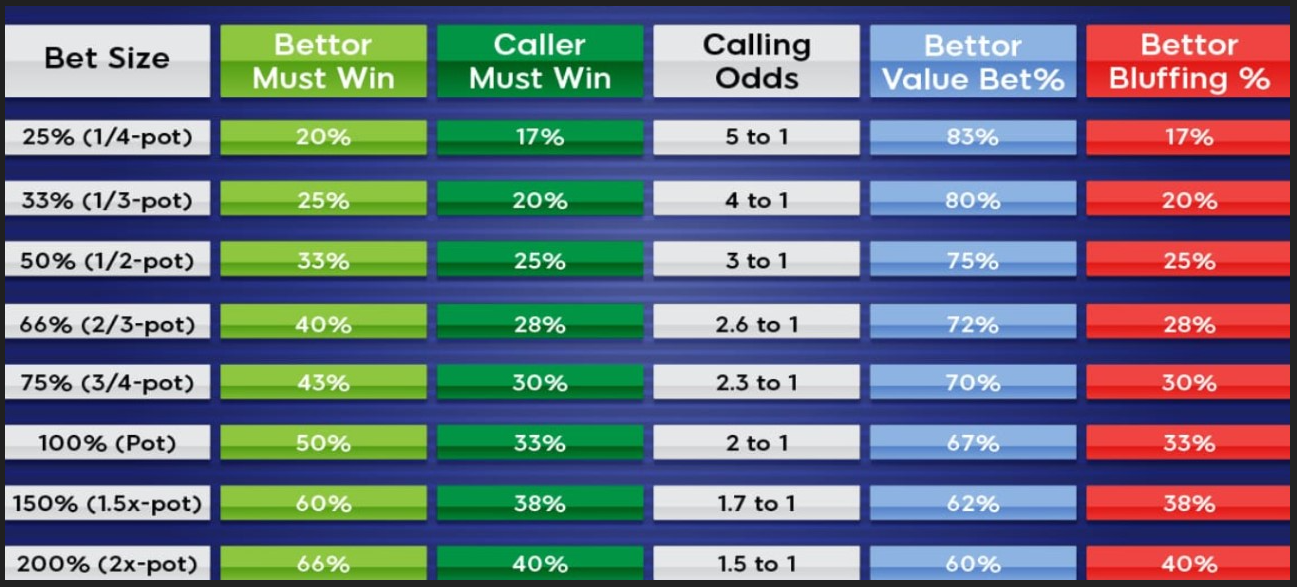
The problem is, that I hate to think in therms of: 4:1, 3:1 etc.
I am always inaccurate and make misstakes, because I sucked in math in school during that time, and these terms are too abstract for me.
I need the exact amount by using a % calculation so there is no room for errors 😀
The calculation is bet/(bet+bet+pot). You include the amount you're calling. For example... think of the pot sized bet situation. It would be pot/(pot+pot+pot) = 33%. If you win 1/3rd of the time, you're just getting the amount your putting in right back (breakeven point). That is the easiest example to think about to make it make sense.
Hey guys: Example: Our hand has 20% Chance to hit on the next street. (9 outs flushdraw with rounded numbers for simplicity)500 in the pot and Villan bets 125 ...(1/4 or 25%)Is this calculation correct? 0.20 (20%) x 625 (pot) = 125. Assumption: I can call 125 to break even. Below 125 is always +EV. If I call more than 125 it is -EV.This calculation was once on a poker strategy
do it backwards to check each street for potential EV miscalculation's.
Hey guys, thank you for the effort and all the replies, I really apprechiate the help.
@Broken, I didn't see your first posting yesterday, I somehow overlooked it.
@Love + Broken:
Lets just focus on my calculation because:
Pot size bet -> 1/3 odds needed
Half size bet -> 1/4 odds
Third size bet -> 1/5 odds
Quarter bet -> 1/6 odds
is like chinese to me. 😀 My brain just can not grab that, sorry. My brain seems to have a problem with this kind of representation.
This is why I would never do prob bets. I don't understand the math behind it with the odds-representation.
Which is funny because I have 1 M winnings in online poker.
And grinded it for a living for years. But this one calculation always itched in the back of my mind and I want to finally solve this
after all the years, and openly reveal my math dumbness.
So lets take my calculation and yours.
And lets use super accurate numbers. So instead of 20% I use the 18% for a pure raw flushdraw from flop to turn.
No implied odds or anything else just to see if I can use this calculation in this specific way, which would make my life way easier.
A) My calc:
Pot is 500, and villan bets 125. (25%)
0.18% x 625 (pot) = 112,5
According to this: I have a break even call at 112,5 chips and everything that I have to call above 112,5 would be -EV
If I look into my posted chart from RaiseYourEdge it says that the caller of a 25% bet must win 17% (16,666) of the time.
17% of 625 chips is: 106 chips =+EV
So at this point there is already a difference of 6,5 chips.
RaiseYourEdge says 106 chips is +EV and everything above probably -EV. Which is a thing, because these 6,5 chips difference could easily be:
65.000 usd depending on the limit.
B) Your calc:
You said I need to add my own call to the pot, so it would be:
Pot is 500, and villan bets 125, I call 125= 750
0.18 x 750 = 135 chips
I would have a break even call at 135 and everything that I call above 135 would be -EV
Again I look into my posted chart from RaiseYourEdge it says that the caller of a 25% bet must win 17% (16,666) of the time.
17% of 750 chips is: 127,5 chips = +EV
Now there is a difference of 7,5 chips.
What do I do wrong here?
Well, I think I already have you a clear example to think about it, but if you want an EV calculation you can think of it like this:
EV of call = (win %)*(pot to win) - (lose %)*(amt to lose)
win % is equal to your equity
lose % is equal to (1-win%)
(pot to win) is equal to bet + pot
(amt to lose) is equal to the amount you are calling
Rewrite equation:
EV of call = (equity)*(pot + bet) - (1 - equity)*(bet)
for your example pot is 500 and bet is 125. You want to know the breakeven point for for when EV of call = 0 and solve for equity. Both me and raise your edge is saying that when you solve for this: EV of call(equity) = 0; then equity needed is = bet/(pot+bet+bet)
Let's solve for equity with the above equation when EV of call = 0:
EV of call = (equity)*(pot + bet) - (1 - equity)*(bet)
0 = (equity)*(pot + bet) - (1 - equity)*(bet)
0 = (equity)*pot + (equity)*bet - bet + bet*(equity)
0 = (equity)*(pot + bet + bet) - bet
bet = (equity)*(pot + bet + bet)
bet/(pot + bet + bet) = (equity)
Alternatively, let us solve your example where Bet is equal to 0.25 and pot is equal to 1.00 using the equation above and input 0.1666 or 1/6 for equity:
EV = (equity)*(pot + bet) - (1 - equity)*(bet)
EV = (1/6)*(1.0 + 0.25) - (1 - (1/6))*(0.25)
EV = (1/6) + (1/6)*0.25 - (5/6)*(0.25)
rewrite 0.25 as 1.5/6
EV = (1/6) + (1/6)*(1.5/6) - (5/6)*(1.5/6)
EV = (1/6) + (1.5/36) - (7.5/36)
rewrite using (1/6) = (6/36)
EV = (6/36) + (1.5/36) - (7.5/36)
EV = (7.5/36) - (7.5/36)
EV = 0
Well, I think I already have you a clear example to think about it, but if you want an EV calculation you can think of it like this:EV of call = (win %)*(pot to win) - (lose %)*(amt to lose)win % is equal to your equitylose % is equal to (1-win%)(pot to win) is equal to bet + pot(amt to lose) is equal to the amount you are callingRewrite equation:EV of call = (equity)*(pot + be
Bro I really appreciate all your energy you put into this, but I have to be honest that the path is total Chinese to me.
I couldn't come up with that even if my life would depend on it.
I speak a little Japanese for example. Imagine I would talk Jap to you. You couldn't save your mom, just because you wouldn't know what
these tones that I make mean.
From your path I don't even know what your conclusion is now. 😀
It is just total confusion for me.
My question is:
10 outs = 20 %. Calc: 0.20 x (Pot + Bet + Call) = Correct or not?
If not, what do I have to change with this specific way of calculating it, to make it work. 😀
Bro I really appreciate all your energy you put into this, but I have to be honest that the path is total Chinese to me.I couldn't come up with that even if my life would depend on it.I speak a little Japanese for example. Imagine I would talk Jap to you. You couldn't save your mom, just because you wouldn't know whatthese tones that I make mean. From your path I don't even kno
You're welcome. The math above is basic addition/subtraction/division/multiplication and very basic algebra. If you want to understand the math better, then I recommend you review these math topics online. Khanacademy is a great free resource if you wish to pursue that.
My question is:
10 outs = 20 %. Calc: 0.20 x (Pot + Bet + Call) = Correct or not?
If not, what do I have to change with this specific way of calculating it, to make it work. 😀
Your question as stated does not make logical sense in English or math--please rephrase it.
Ah ok I see. My question is:
If I have 10 outs which is 20 % to hit my card on the next street, is the calculation:
0.20 x (Pot + Bet + Call) correct to figure out if I have a profitable call?
Pot 500
Bet 125
Call 125
= 750
0,20 x 750 = 150
Is 150 profitable? Is this path a legitim alternative to the way of looking at it in terms of 1:2,; 3:1; 5:1 etc.?
Maybe this will help. Look at it as a risk vs reward scenario. I won’t go into the full math of it since it is equivalent to what others already have posted and it will likely not help anyway. In your scenario, what you risk by calling is the 125 that you must pay to call. Your potential reward is winning the 500 already in the pot plus the 125 your opponent bet - total 625.
Like I said I won’t go into the math to prove this, but the relevant formula is risk/(risk+reward). If you win more often than the result of this formula it is profitable to call. For your example we get 125/(125+625)=0.167 or 16.7%.
Note that this is only a relabelling of terms relative to what already has been posted. The denominator (risk + reward) is exactly equal to 2xbet + pot. That’s because risk=bet and reward=pot+bet. It just might be a helpful way to look at it and maybe that formula is easier to remember?
If you want to do it your way, you must take 20% of the full pot AFTER your call. You are paying 125 to get some expected share of the pot that exists after your call. In your example you are winning 20% of the 750 in the pot, not 20% of 625 - the pot at no time actually contains 625 unless you fold to the 125 bet. The expected share of this 750 is 0.2x750=150, which is higher than the 125 is costs to get this share, so it is a profitable call.
One last thing to show you why you must include your own call amount: suppose you and a friend make a bet. He bets that if you flip a coin it will come up heads. Suppose he bets you $1 million on this flip. Ignoring the fact that this is an insanely high amount of money and you arenÂ’t likely to take his bet, what is the probability of tails you need to make the bet breakeven? Intuitively (and correctly) you would probably say 50%, right? Now modify this; I drop a dollar on the ground right before your big coin flip and the two of you decide that the winner will also get my dollar. Now what is the probability you need to break even? Surely it canÂ’t be significantly different since it is only an extra dollar. Yet doing it your way, you would say pot is $1, bet is $1 million, so I need to win 1,000,000/1,000,001 of the time to break even. This is 99.9999%, much greater than the 50% you needed before I dropped that dollar (pot=0 in that case). The right answer is 1000000/2000001=0.49999 or just under 50% as expected
Ah ok I see. My question is:
If I have 10 outs which is 20 % to hit my card on the next street, is the calculation:
0.20 x (Pot + Bet + Call) correct to figure out if I have a profitable call?
Pot 500
Bet 125
Call 125
= 750
0,20 x 750 = 150
Is 150 profitable? Is this path a legitim alternative to the way of looking at it in terms of 1:2,; 3:1; 5:1 etc.?
If the equity is known, then to have a profitable call your equity needs to just be greater than your pot odds. Pot odds are equal to bet/(pot+bet+bet). This is just the definition of pot odds. I have illustrated mathemetically above why the aforementioned statement is true. I also included your specific example showing that it is true for when bet size = 0.25 and equity = 1/6.
If the bet is 125 into 500, then your pot odds are equal to 125/(500+125+125) = 125/750 = 1/6 = ~16.7%.
Is your equity greater than 16.7%? If yes, then call. If no, then fold. This string of logic is only going to be true as stated if and only if there are no future streets left to put in additional money.
Hey Love, thx for the reply. I thought about this for a second, but came to the conclusion that it wouldn't make sense to include my own money, that isn't in the pot yet.The idea is purely there is a pot and a bet, and what amount is profitable to call with certain equity like 20%.If I would add my own money, it would make the calculation inaccurate, because that money does not
Asking a question and then rejecting the answer is not very productive.
I get that you can not trust an answer, but you are here specifically to ask this question, you have to be at least open to the idea that you are wrong.
I'll make a small attempt to prove it to you, but otherwise feel free to believe in your ways and come back when you are ready. Remember this 500 pot and 125 bet example. You say you need 20% equity to call, we say 16.66%.
Ok here it goes, you need to consider your own investment as part of the reward because, consider the extremes:
Pot is 1, bet is 99.
If we use your method, we need to put 99 to win 100, so we would need something like 99% odds to be making money.
However I say you are putting 99 to win 199, so you need something like 49.5% odds to breakeven.
Qed.
Furthermore, I don't know about that 1M earnings claim, you are not very good at poker if you don't get this. You probably have an intuitive understanding of this, you are not folding with 50%equity ever.
Hey guys, thank you for the effort and all the replies, I really apprechiate the help.@Broken, I didn't see your first posting yesterday, I somehow overlooked it.@Love + Broken: Lets just focus on my calculation because:Pot size bet -> 1/3 odds neededHalf size bet -> 1/4 oddsThird size bet -> 1/5 oddsQuarter bet -> 1/6 oddsis like chinese to me. 😀 My brain just can not grab t
Start with pot size bets.
There's a pot, villain bets 1 pot size bet, you would need to put in 1 pot size bet to call.
The winner takes 3 times the pot. One was there before, one was contributed by villain, one by you.
So you risk one to take three. One in three. 1/3
If the probabilities of winning are 1 in 3, then EV is 0, you are breakeven.
You can understand the results, you can memorize the charts, the problem is that you don't want to trust us, so you want to verify it and prove it, but you are bad at math so you can't.
That's fine and very normal, you have 3 choices:
1- get good at math and understand the math deeply
2- stay bad at math and trust what the ones who are good at maths say, memorize the charts.
3- stay bad at math and reject the heuristics we offer.
Hey guys.
Thanks for the answers.
@Love/Broken.
No that is a misunderstanding. It hasn't to do anything with trust. Of course I trust you folks, and I already assumed that you are right after looking at the first answers.
Also RaiseYourEdge doesn't produce nonsense, so ofc the chart seems 100% correct.
I just want to calculate the situation in a different way and not memorizing the odds for specific situations, and that is why I constantly ask for verification for MY path of solving this thing.
And that is why I insistently asked for a YES/NO if the thing is correct.
But you guys answered with a different path, instead of giving a YES/NO ...but
@stremba: Your answer is exactly what I was looking for! You confirmed that the my path is alright when I add my own call, and explained that I have to add my call, because without it, there would be no pot. It would be equal to a fold.
So: "The expected share of this 750 is 0.2x750=150, which is higher than the 125 is costs to get this share, so it is a profitable call".
That makes total sense to me to verify the urge to add the own call to the calculation.
So now I can use this and put in implied and reverse implied odds easily, and get my result fast and easy.
Pot 1500 (Flop)
Bet 1000
Lets assume Implied Odds 1000 (Turn/River)
My call 1000
Chances to hit lets say 6% (Two overcards)
0.06 x 4500= 270
A call would be -EV 730
At the table I will obv calc 6x45 and not 0.06 x 4500
This is just more comfortable to me instead of thinking if I get 2:1 in situation y and podd odds are z etc...
...But when I read the coinflip stuff with the million and the extra 1$ my brain was already on shut down m0de ^^
I just don't understand these things on the spot. Maybe if I put effort into it, but I stopped focussing on my weaknesses years ago, and instead push my strong skills .
Because of lazyness, but also because focussing on strong skills produces results way, way faster.
So thank you guys for the help! This was a really good exchange!
Okay. Good luck at the tables.
Hey guys. Thanks for the answers.@Love/Broken. No that is a misunderstanding. It hasn't to do anything with trust. Of course I trust you folks, and I already assumed that you are right after looking at the first answers.Also RaiseYourEdge doesn't produce nonsense, so ofc the chart seems 100% correct.I just want to calculate the situation in a different way and not memorizing th
Feel free to ignore the whole million dollar coin flip thing if it isn’t helpful. Personally I like to subject my lines of thought to extreme situations to see if they hold up. That’s what that was about. Essentially it was “do we include our call or not?” taken to an extreme. If the pot is zero and the bet is any amount, we must win 50% to break even. Therefore, if we do not include our call, that extreme example shows that we must have it wrong by not including the call since pot=1 and bet=1 million is essentially the same as pot=0. By not including the call, we get 99.999% to break even - obviously wrong since for pot=0 we get 50%.


