Push/Fold Ranges Question

Hi all,
Just a quick question about the ranges used in push/fold situations, for example if hero has less than 10bbs in a tournament. I've looked at these ranges a fair bit and have a decent knowledge of them, but one question that has always come to mind is - why don't they account for the stack sizes of the players yet to act? For example, let's take the most extreme situation. Hero is in the SB and is short stacked with 10bbs - average stack at the table is 50bbs, and there are no rebuys. The action folds to him and he has to decide whether or not to jam or fold. Surely the stack size of the player in the BB should be a significant factor in his decision? If the tournament chip leader is in the BB with a 300bb stack, isn't he going to call a lot wider than a player with a 20bb stack? In turn, doesn't this mean that hero gets to jam a bit wider against shorter stacks? Or is it that, from a purely theoretical point of view, the effective stack size is all that is 'meant' to matter?
11 Replies

If it is early in the tournament, then it shouldn't matter as we consider it chip ev. If it is further in tournament with some ICM pressure, then it will of course change.
Also don't forget that 10bb SB is nowhere near a push/fold only decision. There is a lot of limping. And under ICM pressure even raising.
In general looking at ranges that are strictly allin/fold is pretty useless nowadays. You should make sure that other options like raise or limp are also available.
If it is early in the tournament, then it shouldn't matter as we consider it chip ev. If it is further in tournament with some ICM pressure, then it will of course change.Also don't forget that 10bb SB is nowhere near a push/fold only decision. There is a lot of limping. And under ICM pressure even raising.In general looking at ranges that are strictly allin/fold is pretty usel
Sure, that's true about limping etc and the small blind playing differently from the other positions. So what about if we instead say hero is in the C/O?

For me its not just the stack size but what type of players are to my left. In some situations I will jam hands like 87s but if there are calling stations in the BB who won't fold regardless of their stack size I'd rather not go down that way.
Also it depends on my image as well. Because I look like an OMC if I have been playing tight as a result of bad hands then I will be much more likely to jam even awful hands from the BTN. And if I am in CO and BTN is tight my range widens from there as well.
I do think you have a point if BB has <2x our stack and sometimes <3x. I do thing their range tightens and ours should widen. However in the SB there are times I like to limp and fold to a jam (especially if BB typically raises strong) and sometimes I limp with a strong hand (like 99+) especially if BB has been aggro with a widish range.

Hi all, Just a quick question about the ranges used in push/fold situations, for example if hero has less than 10bbs in a tournament. I've looked at these ranges a fair bit and have a decent knowledge of them, but one question that has always come to mind is - why don't they account for the stack sizes of the players yet to act? For example, let's take the most extreme situatio
Theoretically if ICM isn't a factor then the effective stack size is the only thing that matters, so the charts are correct. Practically speaking though big stacks will call wider, so it makes sense for us to make exploitative adjustments and shove wider against shorter stacks.
Also ICM starts becoming somewhat significant even when like 50% of the field is remaining. When you factor in ICM short stacks will have a larger risk premium, meaning they have to call off tighter due to the risk of being eliminated. So if you run ICM sims in a solver like ICMizer or HRC you will find that you can profitably shove wider into a short stack's big blind compared to if a big stack is in the BB due to ICM effects.
Theoretically if ICM isn't a factor then the effective stack size is the only thing that matters, so the charts are correct.
Not entirely true, in chip ev short stacks have advantage over the big stacks because they endanger each other. It is not super significant for opening, although sometimes you can open like 1 % more if there are big stacks behind and you are ultra short... but it is very significant if you are a short stack on BB.
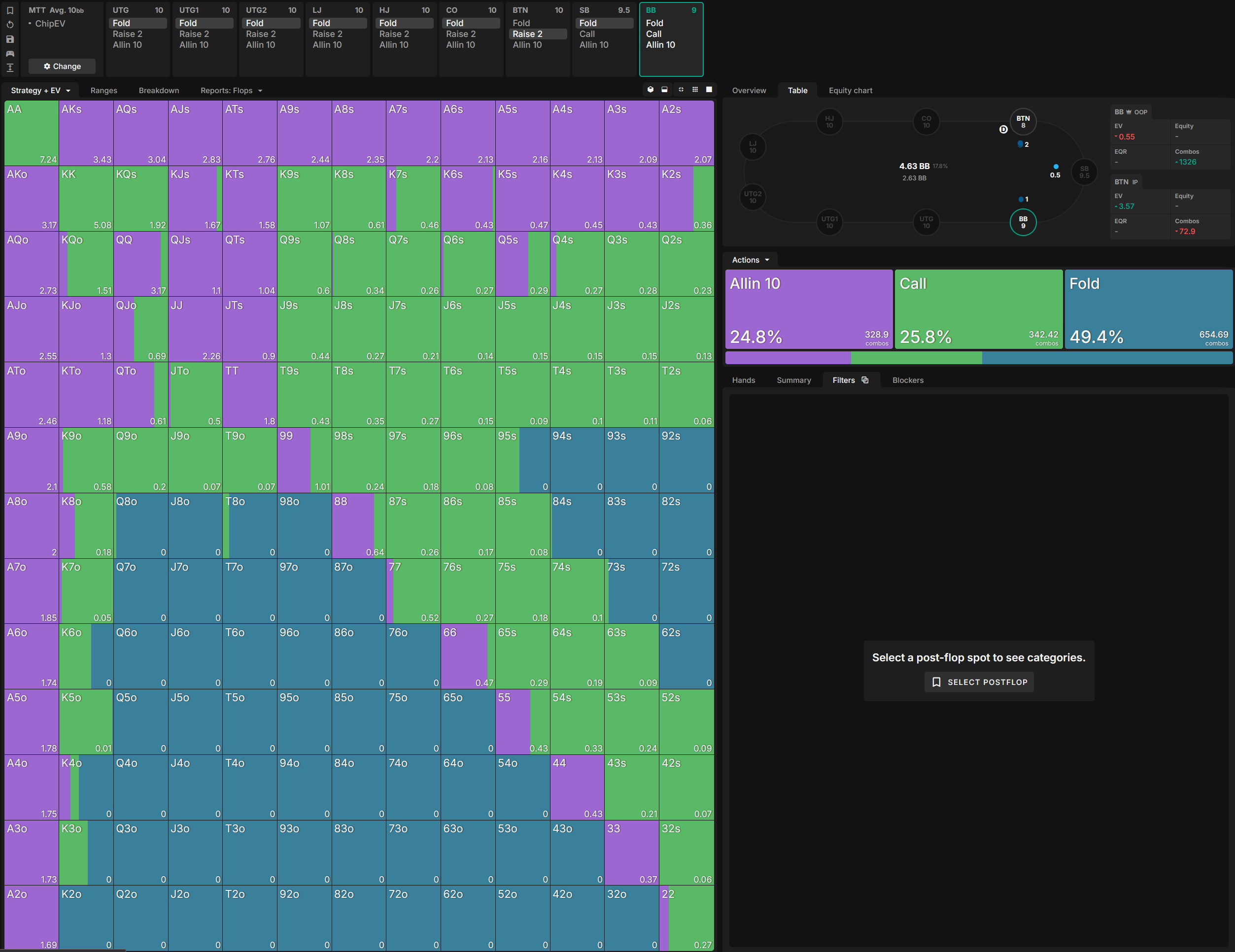
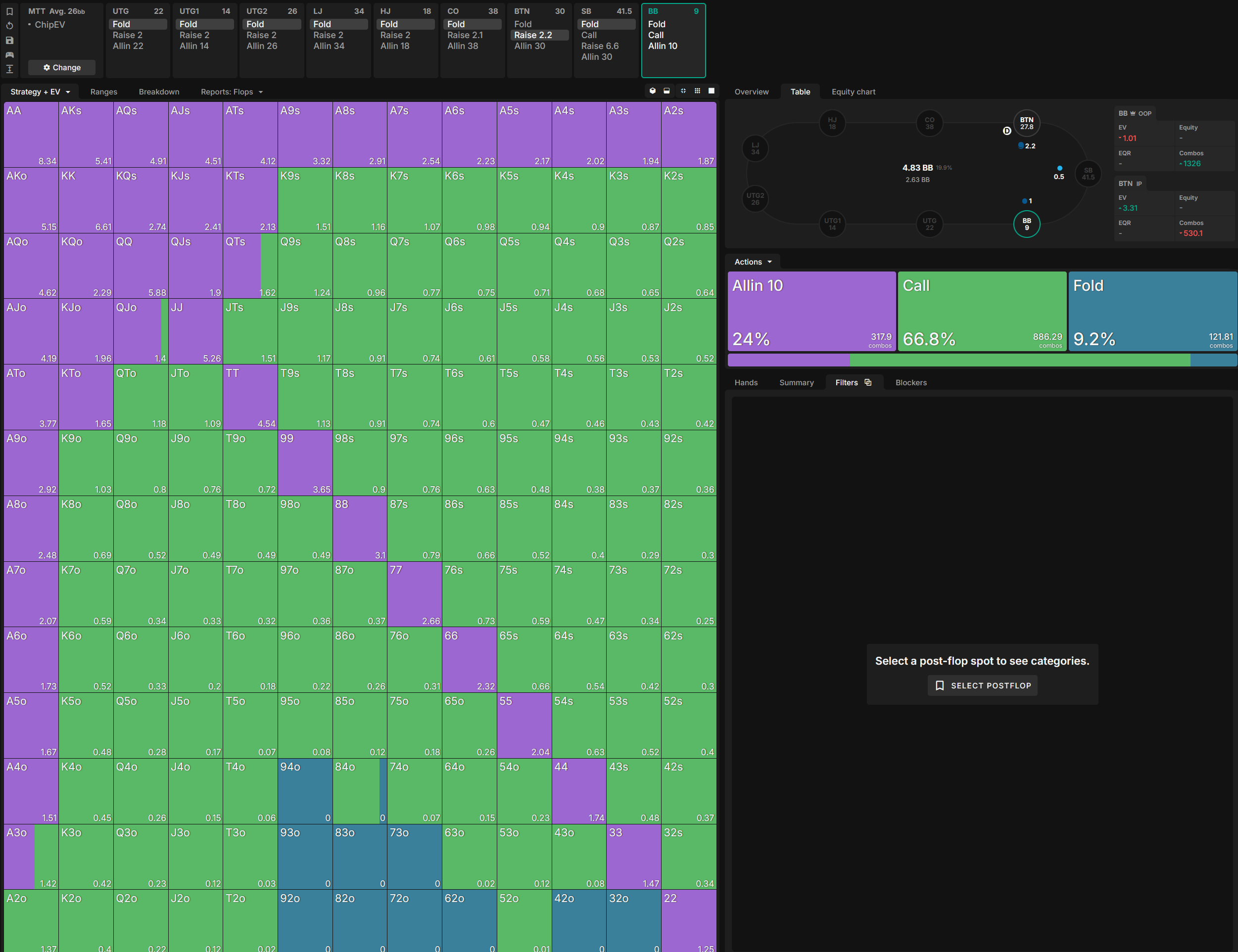
Both are chip ev 10bb effective BB vs BTN open. And the second open is even 0,2bb larger.
Not entirely true, in chip ev short stacks have advantage over the big stacks because they endanger each other. It is not super significant for opening, although sometimes you can open like 1 % more if there are big stacks behind and you are ultra short... but it is very significant if you are a short stack on BB. Both are chip ev 10bb effective BB vs BTN open. And the seco
True, I misspoke. Like if UTG shoves 10 BB and you're UTG+1 sitting with 100 BB which everyone else yet to act at the table covers... You've got to be concerned about the players yet to act raising you off your hand if you call, or calling you if you shove, etc.
I was referring to a situation like the OP's example, where SB is faced with the decision of either shoving or folding vs. the big blind. In this case if the small blind has 10 BB it doesn't matter if the BB has 10 BB or 100 BB as mathematically it is just 10 BB effective (in chip EV).
The situation becomes more complex multiway.
For me its not just the stack size but what type of players are to my left. In some situations I will jam hands like 87s but if there are calling stations in the BB who won't fold regardless of their stack size I'd rather not go down that way.Also it depends on my image as well. Because I look like an OMC if I have been playing tight as a result of bad hands then I will be mu
Definitely, it's important to adjust for our current table image the remaining players.
The point I was making with the BB having a large stack (I really meant like 10x our stack - i.e. he's the chipleader or something) was that we are more likely to get called than by a middle stack with 2x our stack, because it's a much smaller fraction of his stack to make the call, and vice versa - we are less likely to get called by shorter stacks.
Not entirely true, in chip ev short stacks have advantage over the big stacks because they endanger each other. It is not super significant for opening, although sometimes you can open like 1 % more if there are big stacks behind and you are ultra short... but it is very significant if you are a short stack on BB. Both are chip ev 10bb effective BB vs BTN open. And the seco
Sorry, this isn't totally clear. Can you please elaborate on what you're saying here?
True, I misspoke. Like if UTG shoves 10 BB and you're UTG+1 sitting with 100 BB which everyone else yet to act at the table covers... You've got to be concerned about the players yet to act raising you off your hand if you call, or calling you if you shove, etc.I was referring to a situation like the OP's example, where SB is faced with the decision of either shoving or folding
Yes it becomes more complex multiway, but also surely in practice recreational players in the BB will call wider if they have a gigantic stack?
Yes it becomes more complex multiway, but also surely in practice recreational players in the BB will call wider if they have a gigantic stack?
Yeah that's definitely been my experience. It's not a hard and fast rule though. Sometimes you'll have a short-stacked whale that still calls off extremely wide.
That's why it's good to be aware of what you should be doing mathematically then exploitatively adjust as appropriate on a case by case basis.
Generally though it just seems like human psychology that it's easier to call for 1/10 of your stack than it is to call for your whole stack.
Yeah that's definitely been my experience. It's not a hard and fast rule though. Sometimes you'll have a short-stacked whale that still calls off extremely wide.That's why it's good to be aware of what you should be doing mathematically then exploitatively adjust as appropriate on a case by case basis.Generally though it just seems like human psychology that it's easier to call
Yeah absolutely, I agree. It's just strange that you don't see this mentioned much in tournament theory books etc


