Becoming The Boogeyman - From Struggling Grinder to Highstakes Monster
Hello everyone!
This blog is a continuation of my previous one: "I am done with being a life nit" (https://www.runitonce.com/chatter/i-am-d...). I'll be journaling about my new goal to climb to high stakes in tougher pools and approach poker more competitively.
At the end of my previous blog, I had quit my job, become a digital nomad, and started playing poker for a living, shooting for NL1K on some untracked sites. Sounds like smooth sailing, right? Well, it honestly didn't go very well. Below is my graph for the past 175k hands.
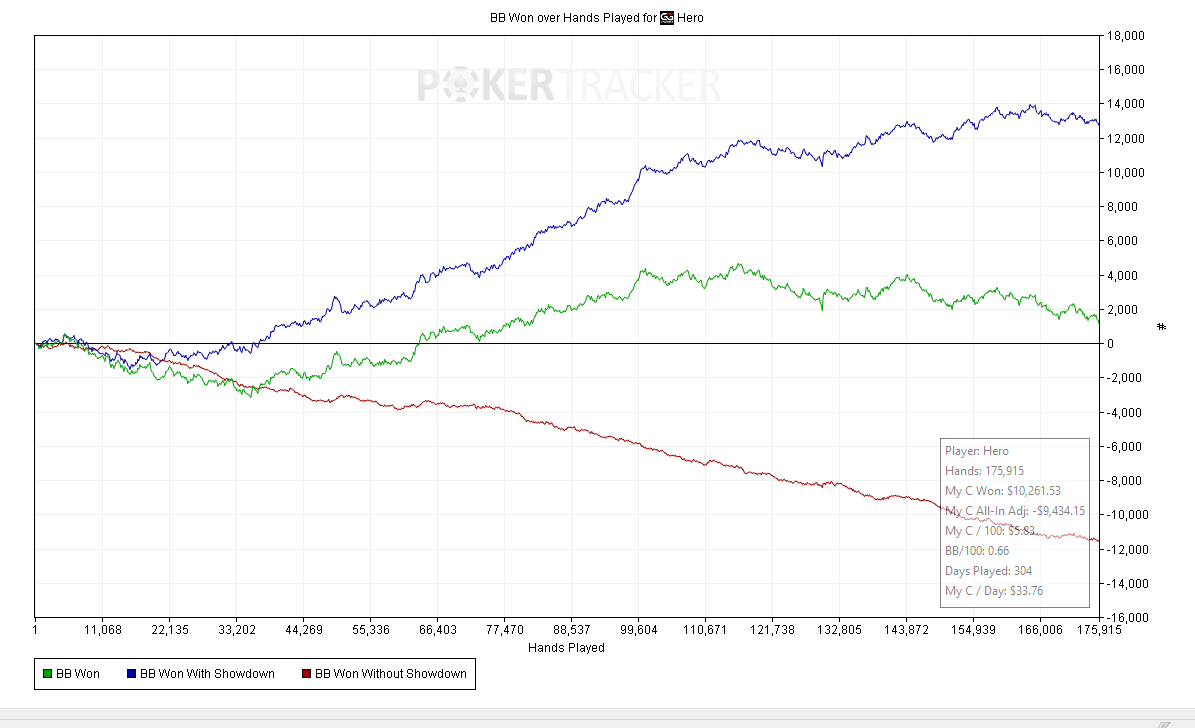
A few things you'll notice:
1. The volume is really bad—this was for a year. The untracked sites play slow, and I'm quite slow with decisions, but I should be able to play 300k hands here.
2. The redline really started to fall off a cliff.
3. I'm break even.
I wouldn't be concerned about point #3, as these stretches happen, if #2 wasn't so bad. However, the volume aspect is the real issue. I've had a lot of anxiety around playing. Even when I was winning, I was scared to play. It wasn't because I was lazy—I would just study instead of playing.
I got into this vicious circle of "low confidence" → "run bad" → "feel like I shouldn't be playing" → even lower confidence. So what went wrong?
A few things could have been the problem:
1. I drastically misunderstood variance and likely jumped to the professional level too fast for myself.
2. I was using an approach mostly based around MDA, and when the meta shifted in some pools, I really struggled to adjust. Without having the theoretical foundation, my strategy was too coarse, and I think a lot of what was really happening was lost on me. I could sense it but didn't quite have the tools to teach myself.
Thanks to my time in Tech, I've saved some money, so I'm not in a financially tough place. My plan now is to address each of these issues. My goal is to play NL5000 on tougher, named sites. To get there, I need to do significant work with mental and technical coaching.
For the mental side, I joined Adam Carmichael's "Poker Athlete" program, which has given me tools to keep working on myself. I have weekly group calls that I find super helpful.
For the technical side, I've done two things:
1. I bought Mechanics of Poker last year, and it's fantastic. The drive to understand "why" has started me on the right path.
2. I hired a new high-stakes coach who plays in the games I eventually want to climb into. His approach feels exactly like what I was missing and is very different from what I'm used to.
It's an exciting time with all these changes and moving in a new direction, but managing expectations will be important. I feel like I'm learning to walk again with poker, so I expect results to be slow-going for a while, but this is what's supposed to happen.
From my old blog, people messaged me saying they appreciated my vulnerability and rawness, so I'll try to maintain that in this new blog.
I believe my anxiety will calm down as I give myself permission to make mistakes while playing. I'm looking forward to just playing good poker and trying to crush people. I'll mostly be playing NL100-NL400 on ACR, but will mix in some GG 100-200 for a while. I've had a bit of a mental reset with all the changes.
In future posts, I'll elaborate more on what has really changed, but for now, I'm excited to chart my journey here.
14 Replies
Hey I have experienced similar if not the same mental game issues that’s affected my volume over the years. I have also made a lot of similar mistakes. Lack of volume had been one of my biggest weaknesses and likely still is but I have made consistent improvements over the years in this respect so perhaps my experience can provide some guidance.
Regarding your anxiety – is it pre-grind anxiety or are you also experiencing anxiety throughout your session? Because for me it was mostly the former though I did have some of the latter as well. Before I offer some potential solutions that I arrived at I just want to say its very important that you get to the root of those anxieties. Only when you get to the root will you be able to strategise to address those anxieties and remedy it through re-conditioning.
If its pre-grind anxiety – consider these options
1/ Create a simple pre-grind routine that you follow through - be kind to yourself in this aspect - you don't need a perfect routine or achieve it perfectly every day before grinding; the important thing is that you try your best
2/ Meditate before grinding – works for some people but not others
3/ Study and prepare before you grind – review hands and mistakes; drill. This is especially important if you have performance anxiety in game – the more prepared you are the more confident you’ll feel which will hopefully diminish your anxiety progressively. Drilling is a good option as well as you will certainly make mistakes whilst drilling and confront those performance anxieties before you dive onto the tables.
4/ Exercise before you grind – play sports or run or gym - much harder to experience anxiety when you've already had endorphins and dopamine running through your veins
5/ Do something you are good at and which makes you feel good or positive before you grind to – it might be chess or sports or music
Its also important to manage your expectations and don’t expect overnight results when addressing mental game issues. But I do think that you have the self awareness & genuine desire to improve as well as the resilience to realise your goals so I wish you the best.
Hey I have experienced similar if not the same mental game issues that’s affected my volume over the years. I have also made a lot of similar mistakes. Lack of volume had been one of my biggest weaknesses and likely still is but I have made consistent improvements over the years in this respect so perhaps my experience can provide some guidance. Regarding your anxiety – is it p
Thanks, I'll experiment with some of these!
Folding a Winning Hand: How Perfectionism Undermines Confidence
Throughout my life, I've heard the same feedback: "You need more confidence." Teachers wrote it on my report cards, bosses mentioned it during reviews, and even my parents, who express pride in my accomplishments, notice it. Despite clear success and outside praise, I still feel I'm not good enough.
The Roots of My Confidence Issue
My confidence struggles stem from perfectionism. I believe everyone else operates at nearly perfect levels, which makes me feel I am always behind, and sets unreasonably high standards. This mindset creates a gap I constantly try to close.
I'm very aware of what I don't know. When my intuition suggests something but I can't explain exactly why, I don't trust it. I need a clear mental map of how things work before feeling confident in my decisions. Without this understanding, I feel uncertain.
My background in math, physics, computer science, and machine learning trained me to seek clear, provable solutions. Real-world situations rarely offer this certainty, which leaves me feeling unsure.
The Real-World Impact
This lack of confidence affects me in several ways. At work, I struggle to highlight my contributions, making it difficult for supervisors to recognize the quality of my work. In relationships, I downplay my abilities, creating false impressions about what I bring to the table.
I avoid taking risks even when they might pay off. The doubt about my abilities prevents me from seizing opportunities. In poker, this manifests as anxiety during important hands and questioning moves that are strategically sound. If I am pretty sure I need a thin value jam, or something just smells like bullshit I struggle to pull the trigger.
Perhaps most harmful is how low confidence makes me prone to quitting. When facing setbacks, I see them as confirmation that I'm not good enough rather than temporary obstacles. This leads me to abandon pursuits too early, creating a pattern of unfinished projects.
The Silver Lining
My confidence issues do have some benefits. My need to understand "why" pushes me to develop deeper knowledge than many others. I'm rarely satisfied with surface explanations – I dig until I find fundamental principles.
This approach helps me simplify complex concepts and identify core fundamentals that others might miss. When I do gain confidence in a subject, it's built on solid understanding rather than false pride – I know things thoroughly.
Strategies for Overcoming Self-Doubt
Moving forward requires changing my perspective. I need to accept that most people aren't as perfect as I imagine, and that’s all in my head. Instead of comparing myself to these imaginary people, I'm focusing on measuring my progress.
Managing anxiety has become important, as I've recognized the cycle between stress and diminished confidence. When anxiety rises, performance suffers, which further erodes confidence.
Understanding my learning style has been crucial. I thrive with approaches that establish big concepts before details. Finding mentors who teach fundamental principles rather than quick fixes has greatly improved both my skills and my confidence.
My Current Approach
I've implemented several specific strategies. I now have a coach whose teaching style matches my need to understand the "why" behind decisions. Rather than memorizing specific situations, I'm building an approach based on principles that work across different scenarios.
I've created a more reasonable schedule that accepts I can't know everything immediately. My previous habit of excessive studying was counterproductive – it reinforced my insecurities rather than building genuine competence.
Lifting weights, meditation, and proper nutrition have become essential parts of my routine. The progressive nature of weight training helps maintain emotional stability and manage performance anxiety, especially during high-pressure poker sessions. There's something powerful about consistently adding weight to the bar that translates to confidence in other areas of life.
A perspective shift from my coach has been transformative: there are no mistakes, only actions within your current ability level. This removes the harsh judgment I often attach to errors and repositions them as valuable information for growth.
Finally, I've come to accept that struggle is universal. In poker and in life, discomfort often signals growth rather than failure. Recognizing that everyone experiences self-doubt has actually increased my confidence.
The most powerful realization has been seeing my capacity for hard work. When I find the right learning approach, persistence becomes my advantage. While others might have natural talent or show more confidence, my willingness to do the deep work that others avoid produces results that speak louder than my self-doubt ever could.
This Week's Grind: Fixing My River Play
It's been just over a week since I started this new journey, and I wanted to check in with how things are progressing. As I mentioned in my introduction post, I'm essentially relearning poker with a new approach, and I'm starting to identify some key areas that need work.
Rethinking River Decisions
I've spent most of my study time this week focused on river play. Looking back at my results, I discovered a significant flaw in my approach: I was using heuristics to build my river sizings that simply weren't correct. This was causing me to miss value in spots where I should have been extracting more.
My coach figured this out pretty quickly after reviewing some hand histories I posted. It was a big relief to have someone spot this issue so fast.
For the next while, my technical work is centered on fixing this specific issue. I've built a new thought process that allows me to "brain solve" spots more effectively. Instead of relying on flawed heuristics, I'm developing a more precise approach to determine optimal bet sizing on the river. Developing these bet sizings requires that I have better intuition for the equity of different parts of my range.
I won't sugarcoat it – this study process is tedious, boring, and often painful. Working through the equity calculations and developing this intuition is not glamorous work. It's grinding through repetitive scenarios, making mistakes, and correcting them over and over. But I can already see the results starting to emerge. Those moments when a spot that would have confused me before now seems clear – that makes the painful work worth it.
My New Poker Routine
I've established a more structured poker routine that seems to be working well:
- 3-4 hours of playing each day
- 1 hour reviewing my hands and other people's hands
- 1-2 hours of drilling and GTO work
That's it. No more endless study sessions that lead to procrastination on actually playing. I'm finding this balance much more productive and sustainable than my previous approach.
I have to admit that I'm quite excited about all the new concepts I'm learning, which means I'm probably studying more than I should be. It's easy to get carried away when you're seeing poker in a new light. But overall, this routine feels right—enough time to develop skills, with a clear commitment to putting in volume.
Getting Back on Track Physically
On the physical side, I've really fallen out of my routine for diet and gym work. And I can definitely feel the effects. My energy has fallen off a cliff, which impacts my focus and decision-making at the tables.
I'm heading back to the gym tomorrow right after I play for 3 hours. No more excuses or delays. There's a direct relationship between how I feel physically and how I perform at the tables, so this is a priority.
Now that I have my process for improvement sorted out, I'm actually looking forward to setting some new gym goals. Having something concrete to work toward outside of poker helps maintain balance and prevents burnout.
Moving Forward
I'm maintaining realistic expectations during this rebuilding phase. There are going to be adjustments and learning curves as I implement these changes, but I'm confident that addressing these fundamental issues will lead to better results over time.
For next week, I'll be continuing my river work but also focusing on getting my physical routine back on track. The small habits compound over time, and right now, building those habits feels more important than any short-term results.
As always, I appreciate everyone's support. Thank you for following along on this journey, and I'll check back next week with another update.
The Beautiful Broken Compass: Embracing Poker Imperfection
Last week, the ACR client icon stared deep into my soul like Michael Myers would gaze into the eyes of his helpless victims. Silent, patient, knowing that eventually I'd have to confront it—and dreading the moment I would.
My goal this week has been tackling my poker anxiety head-on. As I mentioned in my introduction post, my volume has been far below what it should be despite having the time and resources to play.
Recently, my coach shared a letter from Phil Galfond that perfectly captured my experience. Their insights have given me a new perspective on the mental hurdles limiting my progress.
My Poker Wilderness
Galfond's letter begins with a powerful metaphor about being lost in a forest. Imagine being dropped into dense woodland with an exit somewhere, but no clear path. For weeks, you wander, second-guessing every turn. "Was I walking this way or that way?" Eventually, mental exhaustion sets in, and you surrender to aimless wandering.
This perfectly describes my poker experience over the past year. I was losing confidence in my decision-making abilities. Each hand became an exercise in doubt. The constant uncertainty led to mental fatigue and anxiety. Rather than pushing through these feelings, I avoided them by not playing.
I felt trapped in a forest of poker strategy. I would constantly run bad, then feel like I was the reason for losing money. The paralysis set in when I started to be afraid of making mistakes, which ironically prevented me from finding a way out. The more I worried about making wrong moves, the more stuck I became.
Finding Direction in Imperfection
In Galfond's metaphor, he introduces a broken compass—one that wavers unpredictably yet still provides general direction. Despite its flaws, this imperfect tool allows you to orient yourself and make progress.
Any strategy I use at this point will be "broken" in some way, but finding a new approach at least forces me to move rather than remain paralyzed. I am still bad, but, as my coach bluntly put it, everyone is "playing like ****" until they have retirement money.
I'm not pretending I'm doing great—I'm not, I still suck, and that's okay. The difference now is that I'm accepting this reality instead of fighting it.
I'll still make mistakes, but my new approach allows me to fail faster, learn quicker, and develop actual experience. The mental freedom that comes from accepting imperfection creates the bandwidth to notice opportunities I previously missed.
The Microsoft Lesson: Fail Until You Succeed
My coach had a powerful insight: "The only way to avoid failure is already having failed before enough to understand both failure and success." If you don't want to fail, try failing as quickly as possible to gain the experience needed to succeed.
Even when I play badly, I'm gathering critical information that studying alone could never provide. This reminds me of breaking into AI at Microsoft without a PhD or Masters. I progressed by failing interviews, learning, and repeating. Each failure provided valuable direction about what questions to expect and what knowledge I needed.
These interviews were often embarrassing, but each provided valuable data. Eventually, I secured a software engineering job at Amazon, which led to getting an interview for a machine learning team at Microsoft as a developer, but when they heard my ML expertise they hired me as an applied scientist.
My poker journey follows a similar pattern: with each strategy change, I acknowledge previous methods didn't work while moving forward with greater understanding. I suck, and embracing failure is the fastest path to sucking less.
Charting a New Course
I still have anxiety when I play, and it's going to be there for a while—that's normal. There's no magic trick to make these feelings disappear; I just have to acknowledge them without fighting and keep playing.
An insight from Adam at Poker Athlete has transformed my approach: the voice in my head saying "I'm scared" isn't actually me—I'm the one hearing it. Just because that voice tells me I'm scared doesn't mean I am or must act accordingly. This separation gives me power to acknowledge anxious thoughts while still taking action.
My commitment is playing for a set amount of time each day, not trying to eliminate uncomfortable feelings, but recognizing them as thoughts—not commands. My current strategy might not be perfect, but it's pointing me in a direction, and that's all I need to start making real progress.
The forest is still there. The path is still unclear. But now, instead of standing frozen, I'm moving—sometimes in circles, sometimes wrongly, but always learning and getting closer to finding my way out.
If you're struggling with similar anxieties in poker or any other pursuit, know that you're not alone. The fear of making mistakes, the paralysis that comes with perfectionism, the voice telling you that you're not good enough—we all face these demons. Maybe your broken compass is all you need to start moving forward too.
What Jeff Bezos Taught Me About Poker
Recently, a YouTube video breaking down Jeff Bezos's book caught my attention, and surprisingly, several of his core principles resonated deeply with my poker journey. I don’t agree with a lot of amazon’s decisions, but the core principles in this breakdown are very helpful. The video is here: https://www.youtube.com/watch?v=QlN6jzvm...
Here's what a youtube video about the world’s richest bald guy in the world inadvertently taught me about combating poker anxiety, climbing stakes, and building a sustainable approach to the game.
Think Long-Term
Bezos has been obsessed with long-term thinking since Amazon's earliest days. From 1997 to 2007, Amazon's stock price barely moved—a decade of flat performance before its explosive growth. His shareholder letters during this period had titles like "It's All About the Long Term" (1997), "Building for the Long Term" (1999), and "Taking the Long View" (2000).
In poker, this principle is transformative:
The correct question isn't "How do I maximize my EV today?" but "What's my highest long-term EV?" This shift in perspective changes everything. Those shitty downswings are temporary, but the skills you're developing are permanent. No one can take those away from you.
Results lag significantly behind skill development. You could be making all the right moves and still lose for weeks or months. The inverse is also true—you could be making fundamental mistakes but running so hot that you think everything's fine.
My recent changes as an example: I'm investing thousands of dollars and many hours into rebuilding my game and study process. In the short term, this means playing lower stakes and possibly seeing worse results as I implement new concepts. But if my goal is NL5K on tough sites, I need to think in terms of years and months, not sessions.
Every hour spent studying is building equity in my future self, even when the immediate payoff isn't visible.
Focus on Big Decisions Only
One of Bezos's most practical concepts is his distinction between "two-way doors" (reversible decisions) and "one-way doors" (irreversible decisions). His advice: save your mental energy for the one-way doors. For poker players, this means big decisions (worth stressing about):
- Long-term coaching investments
- Whether to focus on cash games or tournaments
- Deciding when to go processional.
- How aggressive to be with your bankroll management. (You can’t go back once you need to move down.
Small decisions (don't overthink):
- Details in implementing a baseline strategy. You will always update this later.
- Making adjustments on a read that ended up being wrong.
- Which poker software tools to use. (GTOW vs PIO)
My anxiety stems largely from treating mistakes as life-altering. That thin value bet I missed? That bluff that got called? Using a B25 or B40 on a specific board. In the grand scheme, these are minor data points, not career-defining moments, because I can fix them later.
The players who thrive are those who can recognize which decisions truly matter. They don't waste mental bandwidth on reversible choices. They make the best decision with the information available and move on. One of my study partners can shrug off a punt and learn from it like no other, and he is an absolute monster now.
Strategy is Doing Hard Things
Bezos defines strategy as "doing hard things that competitors won't do." For Amazon, that meant building same-day delivery infrastructure when everyone said it was impossible.
For poker players, the hard things include:
Pushing for deep theoretical understanding—not just memorizing gto but really grasping why certain hands take certain actions and how those actions change based on how people play.
Paying meticulous attention to opponents and crafting creative exploits. Anyone can follow a solver/mda based/ strategy, but truly elite players go beyond this to develop specific counter-strategies against the tendencies they observe.
Making uncomfortable plays and thin value bets when everything in your body is screaming to take the safe route.
Facing anxiety directly rather than avoiding it. When things go wrong, staying engaged rather than disconnecting.
Maintaining physical health through diet and exercise to optimize mental performance. It's easy to neglect this when grinding online, but the edge it creates is substantial.
For the past year, I've been trying to beat variance by avoiding it—playing less, choosing easier games, ducking when things got uncomfortable. That's not strategy; that's hiding. Real strategy means leaning into discomfort because that's where growth happens.
Build a Study Flywheel
The concept I've found most applicable is Bezos's "flywheel"—a self-reinforcing cycle where each step makes the next step easier. The hardest part is starting; you have to "grind" it manually at first before momentum builds.
My poker study flywheel looks like this:
Consistent study → builds confidence in decisions
Confidence → enables more volume without anxiety
More volume → leads to better results
Better results → validate the process and increase confidence
Increased confidence → creates motivation to study more
And the cycle continues, getting easier with each rotation.
The challenge is that first manual push—grinding through study sessions when you're not seeing immediate results, forcing yourself to play volume when confidence is low, trusting the process when variance is crushing you.
I'm still in this manual grinding phase with my new approach. It's uncomfortable and progress feels painfully slow. But I can already see small signs of the flywheel beginning to turn. Sessions where theoretical concepts click, moments where I make an adjustment I wouldn't have seen before, spots where anxiety rises but I play through it anyway.
An old mentor of mine would always tell us to trust the process, and the above flywheel is why we should trust the process.
Why These Principles Matter
These principles are valuable precisely because they're difficult to implement. Most players won't think long-term because immediate gratification is easier. Most won't focus only on big decisions because micromanaging feels productive. Most won't do the hard things because, well, they're hard. Most won't build a study flywheel because the initial push is exhausting.
But that's exactly why implementing them creates an edge.
I'm not claiming I've mastered any of this. I still fight anxiety every time I sit down to play. I still feel the sting of every mistake. I still question whether I have what it takes to reach my goals.
But these principles give me a framework—a way to approach the journey that's sustainable and built on sound thinking rather than emotional reactions. I just need too: Think long-term. Focus on big decisions. Do hard things. Trust your flywheel (process). Everything else is just noise.
That’s it for now.
Quick Update
Things have been moving in the right direction since my last post, so wanted to share a brief update on where I'm at.
The Coaching is Working
Really happy with the new coach. He's helped me simplify a lot of my thought process, and I'm justlearning tons overall. There are still many more lessons to go, so I'm excited about what's coming next.
The anxiety when playing is basically gone now, which feels huge. I still have a struggle to sit downsometimes, but once I'm in a session, the anxiety fades quite quickly.
Until recently, I was brain-solving most spots during sessions, which made me get tired easier, but I havesome new tools to combat that now. There is a lot of off-table work required for this, but I am able topractice it deliberately, and it fits into my established process for improvement. Having a reallyestablished process for improvement has been game-changing—it gives me something concrete to trustwhen things get rocky.
Embracing the Grind
I'm playing in tougher pools now, but I have this philosophy: if I can make it there, I can make itanywhere. I've really embraced the "it's all just practice" mindset that my coach keeps reinforcing.
One thing that's helped massively is that I removed all results from my tracker—I have no clue if I'm up ordown overall, and it really puts me into a practice mindset. Every mistake, every tough spot, every badbeat—it's all just data for the flywheel.
Volume is getting better, but progress on that front is slow, to be honest. Still working on building those habits, but at least the resistance to sitting down and playing is fading.
Less Emotional Poker
Generally, poker just feels less emotional overall. I'm not riding the roller coaster of results like I used to. When I make a mistake, it doesn't send me into that spiral of self-doubt anymore. When I run bad, I can actually see it for what it is rather than taking it as confirmation that I suck.
The broken compass is still broken, but it's pointing me in a direction, and that's all I need right now. More updates to come as I keep grinding through this rebuild.
In general I am expecting the summer to be uneventful in terms of poker. Just doing my work to get my 1% better each day. I will write continue to write more on what I think is interesting for improvement in poker
Poker's Valley of Despair: Why Most Players Stay Broke
I stumbled across this Alex Hormozi video (https://www.youtube.com/shorts/3iYrbRWXq...) about the five stages every entrepreneur goes through when pursuing any opportunity. After watching it, I realized he was describing my exact poker journey—and probably yours too.
Hormozi breaks down why 99% of entrepreneurs stay broke, and it applies perfectly to poker players. The stages are: uninformed optimism, informed pessimism, valley of despair, informed optimism, and achievement. But here's the kicker—most people get stuck cycling through the first three stages instead of pushing through to the other side.
If this sounds familiar, you're not alone.
The Five Stages of Becoming a Poker Pro
Here's how this plays out in poker:
Uninformed Optimism: "I'm going to study really hard, use GTO Wizard, and crush these games like Linus!"
You're excited. You've bought a course, a solver, used a fancy BRM calculator to figure out how long until NL2000, and maybe even got a coach or joined a CFP. In your head, you're already a crusher—it's just a matter of putting in the work.
Informed Pessimism: "I can't win a hand, the solver always says I'm using the wrong sizing, every time I post a hand people tell me it's misplayed, and I just can't do anything right."
Reality hits. Poker is way more complicated than you thought. The solver outputs seem random. Every hand in your study group people tell you is wrong, and misplayed. Nothing is like in the videos. You're headed for a losing month, while everyone in your CFP is posting $10,000 months at your dream stake. Your GTOW score is 47% overall. Everything you do is wrong.
Valley of Despair: "After all this work, I still don't feel like I'm making progress."
You've been reviewing all your 6bb pots, and drilling every day, but can't tell if you're improving…you still don't understand how come you never get the right size on the river. Your GTOW score is 40% now, and you feel like your getting worse. The anxiety builds, and volume drops because if you can't even pass a GTO wizard drill what is the point in playing. You start questioning everything—maybe you're just not cut out for this.
Informed Optimism: "I understand what this really takes now."
Eventually you made sense of some of the solves and it feels less random. Your study partner explained some principles for bet sizing that you need to practice. You start to see things from the course in action. Your GTOW score is 67 now, and you understand what mistakes you are making. You take more notes on players, and you think they are making the same mistakes you did a month ago. You're not naive anymore, but you're not panicked either. You have a process you trust. The path is clearer, even if it's longer than you initially thought.
Achievement: "I made it!"
You've reached NL500, but the journey isn't over. You know it will take some work, but you don't fear the regulars anymore, and you're continuing to work hard and improve. You study with players better than you and learn every day.
The Restart Trap
Here's where most players go wrong: instead of pushing through the valley, they restart the cycle.
I fell into this trap constantly when I was still playing for fun. Switching to PLO, Jumping to tournaments because cash games felt stale. Jumping on the MDA train, then back to theory, or finding a few courses and restarting all over again—always chasing the approach that would finally "click."
Hormozi calls this "niche hopping," and it's poison. Every time you switch, you reset your progress. You go from stage 3 back to stage 1, convincing yourself this new thing will be different.
But here's the truth: There is no poker format or strategy that doesn't have a valley of despair. Cash games, tournaments, GTO, exploitative—they all get hard. The grass isn't greener; you just haven't dug deep enough in your current spot.
Why Poker's Valley Feels So Brutal
Poker makes the valley especially painful for three reasons:
Variance makes improvement invisible. You can make perfect plays and lose for weeks. Good results don't necessarily mean good play, and bad results don't necessarily mean bad play. You're flying blind.
Feedback is indirect and confusing. A solver disagrees with your line, but maybe your pool doesn't play like the solver. A coach criticizes your play, but their reasoning is based on intuition you don't share yet. You get answers without understanding why they're answers.
Analysis itself is a skill. You don't just need to learn poker—you need to learn how to learn poker. It's like trying to fix a car when you don't know which tool to use, let alone how the engine works.
My Journey Through the Stages
Looking back at my blogs, I can see every stage clearly. Quitting my job was peak uninformed optimism—I thought MDA and GTO Wizard would provide a linear path to crushing.
Three 30-buyin downswings later, I hit informed pessimism hard. I couldn't make sense of solver outputs. When I asked for help, I'd get answers but couldn't understand the reasoning behind them.
The valley of despair nearly broke me. Anxiety skyrocketed, volume plummeted, and I spent hours neurotically studying, searching for the missing piece. I worried I'd be stuck at NL200 for ten years, time completely wasted.
I tried everything—new heuristics, different systems, fresh approaches. I spent too much trying to develop a system for river betting using indifference. I felt guilty for not knowing what to do and frustrated that I couldn't figure out how to figure it out.
Eventually, I found the information that helped me and the issues with my approach. Now I have a structured process I trust. I understand what to practice and how to improve. I'm in informed optimism—though who knows, my next post might be me freaking out again.
What I'd Do Differently?
Expect the struggle. I think every guest on the Mechanics of Poker podcast talks about getting stuck. Absolutely everyone. It's not a matter of if, but when. I should have expected the valley instead of being surprised by it.
Reduce pressure for early results. I had it in my head that I needed to be the next Matt Martinelli in two years or I was a failure. That pressure made everything worse. I just quit my job and went to asia. I should have traveled for three months first instead of jumping straight into the grind. I just didn't have the energy for it. I also think I should have tried to poker professional lifestyle before committing to long term coaching.
Search for a good process, not just the results. As much as I didn't want to admit I wasn't being process oriented I wasn't. I followed a process, but it wasn't one I trusted. That's okay, you need that broken compass in the beginning and you can always upgrade the process. Improving the process is improvement
The Way Forward
I'm pretty happy with how things are turning out. My plan is simple: move up naturally when bankroll management allows, keep mixing NL200 and NL500, focus on executing and upgrading my strategy.
Most importantly: try to handle the next set of setbacks better than I handled the ones before.
If you're reading this and stuck in your own valley, remember that the only way to avoid failure is to have failed enough to understand both failure and success. The players who make it aren't the most talented—they're the ones who don't restart the cycle when things get hard.
Pick your approach. Commit to it. And when you hit the valley—and you will—keep digging instead of looking for a new spot to plant your flag.
The other side is worth it.
Poker's Valley of Despair: Why Most Players Stay BrokeI stumbled across this Alex Hormozi video (https://www.youtube.com/shorts/3iYrbRWXq...) about the five stages every entrepreneur goes through when pursuing any opportunity. After watching it, I realized he was describing my exact poker journey—and probably yours too.Hormozi breaks down why 99% of entrepreneurs stay broke, and
Awesome post, thanks for the quality read.
Best of luck with your grind
Summer Progress: Skills Up, Volume Still Down
I've improved significantly this summer, though I haven't conquered my volume issues yet. Monk mode in Canada didn't go as planned—I got pulled in more directions than expected, but I still should have performed much better.
Running Good and Moving Up
I've been fortunate with variance this summer. The technical changes I've made really help with confidence they are 'working' when you 'win', though I recognize the luck involved.
I didn't realize how well I was running until reviewing the numbers. While I won't open sit NL500 yet, I'm actively hunting for good tables there. The winrate isn't sustainable, but I'm confident I'm doing ok in these games.
Undeniable Improvement
My thought process has improved substantially across multiple areas. Coaching has been transformative—helping me understand not just what to do, but how poker actually works. My handreading has sharpened considerably, and I'm accurately reading opponents much more often. I've been tracking GTO Wizard scores and the improvement is very promising.
I still make plenty of mistakes. My study partner continues finding errors in my play, but I no longer feel like his charity case. The key now is maintaining consistency to build raw skill.
Confidence Progress
The biggest confidence boost has been trusting my process, rather than just my skill level.
I'm usually right about situations, or at least know how to adjust and what needs improvement. I can narrow down opponent ranges and identify the key variables, even when I'm uncertain about their exact weighting. I still worry about looking foolish sometimes, but pushing forward is the only solution.
The Ongoing Anxiety Battle
This remains challenging.
The anxiety is mostly physical now—I shake quite a bit during sessions. Sometimes I need to sit out entirely. When it hits, I either drop down stakes or spend the session drilling instead of playing.
This frustrates me because I need volume to sharpen my skills, but drilling alone isn't sufficient. I should be making money consistently. Canada had many distractions and travel days, but I still should have achieved much more.
Looking Ahead
After a family holiday, I'm heading to Vietnam for focused grinding.
With fewer distractions there, I'll avoid NL400+ when anxiety strikes, replacing drilling sessions with NL200 instead. Momentum kills anxiety, so this approach should work—I just need sustained consistency.
Three months of monk mode in Vietnam, targeting 5 hours daily, 5-6 days weekly. Once I achieve this consistency, I'll reward myself with a long-term Thailand visa and move to Bangkok.
While disappointing that I haven't beaten the volume challenge yet, I'm not worried about my long-term ability to crush midstakes. Either I'm beating them now, or I'll get there soon.

I'm noticing a lot of "I should have done better at this" or "I should have done x instead of y" etc...
I suspect you'll have a tough time with your anxiety if your mindset continues to revolve around beating yourself up mentally and then wanting to "get rid of your anxiety". Your anxiety is likely coming on as a result of feeling like you must do everything perfect when you get into action which is an unachievable goal to begin with. Then when your nervous system gives you feedback telling you the demands you're putting on it with your mindset aren't sustainable your solution is to push away the feedback your body is giving you and "get rid of it"
I'd suggest having a different conversation with yourself. If anxiety comes on I'd start by welcoming it and ask yourself "what is this feeling trying to communicate to me". Once you allow your anxiety to be there and open yourself to getting the message which is probably along the lines of putting less pressure on yourself etc then it will most likely be less intense and less frequent
If most of your self talk is stuff like...I should have folded there, that was ****ing stupid. I'm playing terrible right now. I need to put in more hours. I should be a consistent winner and I'm not. Etc etc...
Well yea ofc you have anxiety, every move you make or don't make is under a microscope and being harshly judged. You're literally walking on eggshells under your own scrutiny.
You seem pretty self aware of your emotions if not in the moment at least in written form within this blog. A lot of your emotions seem to be frustration, disappointment, despair, etc... It's good that you allow yourself to feel these things and that you're honest about it rather than stuffing it down which will only cause more anxiety
I'd work on having more gentle self talk such as....I'm a professional poker player but I'm also human. I'm going to make mistakes sometimes but I'm learning from them daily and they are less frequent. I'm really blessed to be able to make money playing a game I enjoy.
If you talk to yourself like this you will take a lot of the pressure of needing to be perfect away which will reduce any need for you to feel anxious to begin with and make playing poker more enjoyable. If poker is more enjoyable then you'll play more and all the things you're calling "problems" will take care of themself
Edit: Also I'll add, it won't be very productive to beat yourself up for beating yourself up...."I shouldn't beat myself up so much" or "I need to stop beating myself up", that's just going to add more pressure. This process may take some time to undo itself, that's OK
I'm noticing a lot of "I should have done better at this" or "I should have done x instead of y" etc...I suspect you'll have a tough time with your anxiety if your mindset continues to revolve around beating yourself up mentally and then wanting to "get rid of your anxiety". Your anxiety is likely coming on as a result of feeling like you must do everything perfect when you ge
Thanks for the reply! I didn't realize my tone was so negative..yikes! Anyway a lot of the negative self talk is toned down a lot lately. It should come through in the below, and following posts.
Finding My Rhythm: Volume, Vietnam, and the Path Forward
The volume breakthrough finally happened.
After a year of anxiety-driven avoidance and study marathons that never translated to tables, I'm consistently putting in real hours. I'm in Da Nang right now, locked into a routine that's actually working, and for the first time in a long time, poker doesn't feel like a battle I'm losing.
Upgrading my Volume
Three things changed:
Streamlined study process. Coaching helped provide me with a structured approach that builds skills I can actually use at the tables. The feedback loop is tighter, and I can see how study translates to execution.
A clearer picture of how high stakes players think. My coach has helped me understand how they approach poker, and what I need to work on to get there.
Momentum and honest self-assessment. I play until I genuinely feel tired—not until I hit some arbitrary time target. Some days that's three hours, other days it's six. The key is being brutally honest with myself about whether I've actually pushed as hard as I can.
The analogy to this is lifting weights. You show up, you push yourself, you get 5lbs or 1 rep stronger. Then you do it again tomorrow. Progressive overload.
Schedule Upgrade
I've structured my life around 6-8 week work blocks followed by 2-week breaks. During breaks, I'll play maybe an hour a day and drill for 30 minutes, but the focus is on travel and actually living. This setup works with my all-gas-no-brakes personality—when I need to tie one on or explore somewhere new, I have the freedom to do it without guilt.
My daily routine is simple:
4-5 hours of play in the morning
Gym
Hand review and drilling
Done by 5-6pm
On off days, I study 8 hours. If I skip the gym, maybe I study a bit extra. That's it.
I'm working out regularly again and I've stopped drinking during work blocks—saving that for break time. The structure helps me stick to the schedule without feeling like I'm missing out.
Da Nang has been great for my schedule. Cost of living is low enough that I can live off investments alone. I have freedom here that I wouldn't have in Canada, even if I'm potentially leaving some EV on the table by playing Asia/Euro sites instead of North American ones. The happiness trade-off is worth it.
Technical Progress
My game has improved significantly. I was using a solver on the river to help with my river sizings leak, and the scores on GTOW have gone up a lot over the past few months.
I have a much stronger baseline now and a new philosophy on exploits. My river play has significantly improved. I've shifted toward practicing developing exploits and adjustments to certain players. Being flexible was something I really struggled with in the past, so upgrading these skills should have a good pay off.
A lot of getting this right requires feedback from my coach, so getting that tight feedback loop has been invaluable.
Prodigy talked on his Mechanics of Poker podcast about viewing poker as a series of 1v1s, and I'm trying to emulate that mindset. There are so many variables, and getting this down is really important. The downside? You're going to **** it up and punt a lot. But that's just the cost of learning.
The Path
I'm trying to make the process almost boring—just locked in, doing the same thing day in and day out. Show up, grind, study, sleep, repeat.
The weird thing is, as the improvements compound, I'm enjoying poker more and more each day. When you can actually see yourself getting better, the grind becomes its own reward.
What's Next
I have to go back to Canada for Christmas—wasn't planning on it, but it's happening. I'll try to keep it to three weeks. The upside is I'll get to test WPTGlobal, which is supposed to be incredibly soft. If it's as good as I think, I might stay a bit longer to build the bankroll, but I really want to get back to Asia.
This time I'll be staying out here much longer than I did last year. I'm happier here.
Long-term, I want a condo in Thailand. But I want to earn it first—be settled at NL500 and shooting for NL1K before I make that commitment. Until then I will keep the cost of living as low as I can.
Where I'm At
A year ago, I was paralyzed by anxiety, barely playing, convinced I was wasting my time. Now I'm locked into a sustainable routine, improving technically, and actually enjoying the process.
The volume problem isn't completely solved—there are still days where anxiety creeps in—but I've built something that works with my psychology instead of fighting against it.
The broken compass is pointing in a direction. I'm following it and that feels like enough.
I am still playing mid stakes, and for the skills I am developing it's fine for now. In 6 months I will see where I am at and will move forward from there.
Blog Update
It's been a while since my last post. Things have changed and I wanted to share where I am at.
Recap: What's Happened Since Starting This Blog
I started this blog April of last year, so here is a recap of the timeline until now.
In April, I was down 40 buyins with anxiety crushing me. I could barely sit down to play.
From May through September, I went back to Canada and hired Donk as my coach. I managed to win back some buyins, but my volume was still terrible—I was struggling to get hands in consistently.
October through December, I moved to Da Nang. I promptly lost another 25 buyins, and the volume problem persisted.
Total damage: down 55 buyins over 8-9 months, spread across maybe 60,000 hands. That's pathetic volume for almost a year of "playing poker professionally."
Nothing was going well. I started looking for remote coding jobs. I told some poker friends that if I couldn't turn this around, I was going to move on.
The Wall
I'm stubborn. I didn't want to quit, but I really had to do some soul searching about what I wanted and whether this path made sense. The road ahead was going to be rocky no matter what.
Looking back, I realized I was being kind of a bitch when it came to playing. I let anxiety win every time. I would struggle to just sit down and play, and even when I did play, it was hard to get through many hands per hour.
I had convinced myself that if I got really good from training first, I wouldn't feel insecure when I ran bad. But that thinking was keeping me from getting the reps I needed. Without reps, you stay sloppy. You have to just embrace the suck.
I kept having this internal dialogue: "I don't want to be in this situation." It felt like I had jumped into professional poker way too early, and the whole thing felt like a giant mistake.
What Changed
Study Process
I made some changes to my study process to keep myself sharp and focus on actual improvement. On play days, my routine looks like this:
30 minutes of preflop drilling
30 minutes of full hand drilling
4-5 hours of playing
Hand review from the session
Spot drill problem areas based on mistakes from playing to build pattern matching
On study days, I do deep dives into topics I don't understand well, and will add them to the spot drilling rotation if needed.
This creates an improved flywheel that actually works for my needs right now.
Mental Shift
At some point I realized that I was drilling too much, and I was thinking about things that mattered to a GTOW score but didn’t make a lot of EV.
I started chasing EV instead of chasing perfection. I worried less about perfect theory and more about understanding spots where people were making mistakes, and punishing them.
I focused my study on topics that would actually create an edge. For example, I used to worry about getting bet sizes perfect on the river, but I was good enough at it that I was close, and I doubt putting time into it would get me more EV at my current stakes. There's lower hanging fruit.
There were certain skills I wasn’t great at but they had all the low hanging fruit for EV. It took time to build those skills and it could be frustrating. However I am improving.
I find the low hanging fruit by paying attention to people in my pool, and when I see consistent mistakes I study those spots and how to punish them.
I accepted that being break-even or even losing in the short term was necessary.
I needed to develop new skills, and the quickest way to improve was to fail fast. I had changed so much about my approach that results would lag behind the skill development. I had too much theoretical knowledge but it wasn’t intuition.
I needed reps. I needed volume.
Practical Changes
I switched a significant portion of my volume to GGPoker. The games run easier in my timezone, and I don't have to sit around waiting for tables like I did on ACR, Stars, and Coin.
The leaderboard structure provides some motivation. I really need to mincash the leaderboard to offset the high rake.
I still join good tables on other sites when they're running at NL200 or NL500.
Current State
I'm playing 4-5 hours a day, 4-5 tables, 5-6 days a week. My goal is to get to 5 tables for 6 hours, but I'm building toward that gradually.
The anxiety is a shell of what it was. It still shows up occasionally, but it's manageable now.
I'm playing mostly NL200 on GG, with NL400-500 when good tables are running elsewhere.
My game has improved, especially with how I build my own exploits. I'm trying to focus on the low hanging fruit for winrate and moving up stakes.
The improvement trajectory feels very high now that I'm getting real reps in.
Results look like they're turning lately. I haven't had this many winning days in a while.
GG might not be the forever home, but I am getting reps..and I learned the hard lesson about needing those.
Looking Ahead
My six-month goal is to be grinding NL500 on GG.
Long-term, I want to select the best NL500-NL2K games and take shots when my bankroll allows.
Things were **** for a really long time, but it looks like the ship is finally turning.
Sometimes we just need to bet on ourselves, dig our heels in, and refuse to quit.
Flying Too Close to the Sun: The Cost of Exploit Greed
My coach said it to me twice. Two different sessions. "You're flying too close to the sun."
The hands in question were bluff catches on spots the solver pure folds. The calls themselves were the tell - my holdings were so weak that making them at all told them exactly what I was thinking. In turn it took a lot of effort for me to realize they were overbluffing, and the calls were not printing. I saw weakness, I wanted every dollar of it, and I risked burning the edge in the process.
That gap between knowing and doing - that's what this post is about.
Flying too close to the sun has two costs that compound on each other. The first is information - when you push an exploit too hard, you tell them exactly what you know. The second is energy - chasing small edges on every hand burns the mental bandwidth you need for the spots that actually matter. By the time a big opportunity appears, you've already spent yourself.
What is Exploit Greed?
It starts with a real edge. You notice someone bluffs too much, or overfolds to aggression, or telegraphs their range on certain boards. The read is legitimate. The problem is what you do with it.
Instead of using it surgically, you become extremely obvious about it. You're basically screaming that you know something.
The exploit was real. You just burned it.
It's Not Confidence - It's Fear
Here's what I've had to admit to myself: exploit greed doesn't come from confidence. It looks like aggression, feels like conviction, but underneath it's fear.
Fear of leaving EV on the table. Fear that if I don't extract every last drop of it right now that I won't be a winning player. Unless I catch everything. Unless I am perfect.
Exploit greed is anxiety dressed up as strategy.
You're Spending Your Energy Wrong
My coach was on the Mechanics of Poker podcast recently, and he put it simply: focus is the most precious resource you have at the table.
Trying to own someone every single hand burns massive mental energy for tiny EV. Every marginal hero call, every spot where you're forcing an exploit, costs you focus for the hands that actually matter. Your bandwidth is finite and you're spending it wrong.
This is where the sport analogy matters. A boxer trying to punish every small mistake or mis-positioning doesn't have anything left when it counts. When a big mistake happens and it's time to end the fight they can be very tired.
Imagine Mike Tyson: by round 12, he's dropping his shoulder. He's tired. He's a little sloppy - no longer textbook. If you watched that on film and didn't know better you might think he was bad.
He's not bad. He's tired. And he's still dangerous.
Tyson wasn't throwing haymakers in round 6 trying to look impressive. He wasn't trying to catch every small mistake his opponent made. He managed his energy, stayed selective, and saved the big shots for when they counted.
The fighter who spent rounds 1 through 6 playing like it was already round 12 has nothing left when the fight actually gets decided.
That's exploit greed. You're playing a round 12 game in round 6.
Don't Be Scared to Make the Standard Play
The adjustment my coach keeps pointing me toward isn't some complex strategic overhaul. It's simpler and harder than that.
Don't be scared to play more standard in these spots.
Which sounds passive until you've been burning yourself chasing every edge. Then standard is actually the aggressive choice. Folding the pure solver fold takes more discipline than the hero call. Not hammering the exploit with everything you have saves you energy and hides what you know.
You don't have to catch everything to be winning. The overall winrate doesn't disappear just because you didn't extract it this hand.
Save the haymakers for when they count.
Don't Forget: Poker Is Supposed to Be Fun
It's really easy to forget that poker is supposed to be fun.
The grind does that to you. The anxiety, the obsession with doing everything correctly, the constant self-evaluation. It slowly squeezes the joy out. Before long you're not playing poker anymore. You play too safe. You sit down hoping not to lose rather than looking to take someone apart.
When I was in my largest downswing I was focused on executing the right strategy. Validating every decision against a solver, MDA, or some blueprint standard. Sessions felt like a test I could fail, where every mistake got counted against me in some invisible EV spreadsheet. So I looked inward at my own ranges, my own frequencies, my own game and completely ignored how my opponents were actually playing.
I was recently listening to the Mechanics of Poker podcast featuring Raul Mestre, a coach who has been behind some of Spain's most successful players for over two decades. He even coached my own coach. He talks about how solver study can condition you to focus inward on your own ranges instead of looking outward for what opponents are doing wrong. Players who feel balanced stop adapting and stop hunting. The irony is that the more you study this way, the less you see what's right in front of you. People aren't balanced and they give away more than you think.
It took a while, but that eventually clicked for me. Last month I realized the pool doesn't want to fight for pots. Players were telegraphing their hands face up and the EV was sitting right there. All I had to do was go get it.
The game became way more fun, and sessions got dynamic and exciting. I focused a lot less on my strategy and started thinking about the player's tendencies, their tells, how to make their approach completely fall apart against me. That's when poker started to feel really fun.
Poker being fun is very powerful: my studying got more interesting and simplified, volume is still increasing because I actually want to sit down and play. Short term results don't sting the way they used to. I still make huge mistakes but those are lessons that I can use to improve.
The fun was always there. I just had to stop looking at myself long enough to find it.

