Settle the debate! Should BB call wider vs more players?

Hi all,
There is a common belief in live low stakes poker that the BB should widen their range if there has been an open and multiple callers, compared to if there has been an open and it has folded around to the BB.
Similarly, if a player calls an open, faces a 3bet squeeze behind them and the initial opener calls, should the player call wider as there is more money in the pot?
I feel there are some major misconceptions over these spots in poker. Let's settle it!

Personally, I don't think calling HU OOP with a ~speculative hand is going to be profitable in a typically heavily raked LLSNL game with no significant dead money in the pot. However, with multiple callers I think we can make some ~speculative hands profitable here. For example, I'd insta-fold A4s, 55, KJs, etc. facing a HU OOP situation, but with moron callers mixed in for an ~ok price I'd often see a flop.
Gbutthat'smeG

As with everything in poker, it depends. How many players, who raised, how much, stacks, opponents' tendencies?
In general, I'm folding my BB and moving on unless it's a really gamble-y, wild, deep table and I will get paid if I hit.

In general, I'm folding my BB and moving on unless it's a really gamble-y, wild, deep table and I will get paid if I hit.
Pretty much this. And deep means to me having 15:1 implied odds after a raise to call with a pp and over 25:1 for a suited connector. And I don't consider the stack to bet ratio implied odds.

Hi all, There is a common belief in live low stakes poker that the BB should widen their range if there has been an open and multiple callers, compared to if there has been an open and it has folded around to the BB.Similarly, if a player calls an open, faces a 3bet squeeze behind them and the initial opener calls, should the player call wider as there is more money in the pot?
The answer is mostly no. Most fish make the mistake of calling because of pot odds, but they fail to take into account other variables.
On the BB, you re OOP and you won't be able to realize your equity, so you need higher than direct odds to call. Also, many holdings can be dominated so you will find yourself in very difficult situations with marginal holdings. Lastly, live games have bigger sizings than average, so our calling range should be tighter to begin with.
If you are a preflop caller and there's a squeeze your range is already capped to mid-low pairs, SCs, suited aces etc. A skilled opponent would be able to take advantage of this and put you in tough spots. Sometimes, if you are deep enough & therefore have the implied odds and you think the opponent is bad enough to pay you off, maybe you can go for the call. But then again fish call even wider with very shallow SPRs and that's just lighting money on fire.

So what do you consider implied odds then? If I have 400 and bet 25 what do you consider the ratio to be?
My approach is more players = RIO becomes bigger. So a hand like 56cc that makes a baby-flush is quite dangerous as flush-over-flush is much more likely. Same with 22-66, stuff like that. I'd much rather call MW with a suited Ace or even TT or JJ, just to be on the giving end of set-over-set or flush-over-flush. I just keep in mind that if I have A5s for instance, a flop of A-K-2r is not a "hit" it's a whiff.
HU closing the action, depends a lot on the player but I call with all kinds of suited and semi-connected stuff. As wide as S2Gs or even S3Gs.

If you have a pp or Axs, it plays better multiway. I small pp is generally not profitable to play HU OOP.

HU closing the action, depends a lot on the player but I call with all kinds of suited and semi-connected stuff. As wide as S2Gs or even S3Gs.
If BTN is playing raise or fold and opens to $6 in a 1-2 game (stay with me) then SB folds, it's fine to call 75s in the BB ... but if the CO opens to $12 and it folds to you in the BB, it's going to be bad unless you get a _lot_ of bluffs through or run like god.
As I said in another thread recently: people don't seem to realize how much the solver tells you to fold, esp. so for these sizes.
I would not worry too much about what the solver says, particularly it doesn't understand the ranges with big preflop bets.
If you are playing 1/3 and there is a raise to 15, you aren't getting that much discount and are OOP. I would not call light at all. Call or 3! good hands. Fold marginal hands. However, I would call with any pp multiway and with Axs multiway and fairly deep.
Personally, I don't think calling HU OOP with a ~speculative hand is going to be profitable in a typically heavily raked LLSNL game with no significant dead money in the pot. However, with multiple callers I think we can make some ~speculative hands profitable here. For example, I'd insta-fold A4s, 55, KJs, etc. facing a HU OOP situation, but with moron callers mixed in for a
Okay thanks, I'm a little surprised to read this as A4s and KJs are meant to be 3bets about 50% of the time and calls the remaining 50%, rather than folds, and 55 is for sure a standard BB defending hand.
What's your reasoning behind being mroe inclined to call with these hands if there are more players in the pot?
As with everything in poker, it depends. How many players, who raised, how much, stacks, opponents' tendencies
In general, I'm folding my BB and moving on unless it's a really gamble-y, wild, deep table and I will get paid if I hit.
I agree there are many variables to consider. But one interesting thing to point out is that you mentioned "how many players". This is an interesting factor because I think this is one of the main areas where the fallacy lies in BB defence in multiway pots. When you're heads up you are only splitting your equity with one other player, whereas when you're m ultiway you're splitting your equity with many players, and it's massively reduced as a result. Yes, there is more money in the pot to compensate for this, but not enough that it justifies calling with more hands, at least in my opinion.
The answer is mostly no. Most fish make the mistake of calling because of pot odds, but they fail to take into account other variables. On the BB, you re OOP and you won't be able to realize your equity, so you need higher than direct odds to call. Also, many holdings can be dominated so you will find yourself in very difficult situations with marginal holdings. Lastly, live ga
What are the other variables that the fish are failing to take into account? The pot odds are indeed excellent if one is closing the action in a 5-way pot as the BB, but how does this correlate with the equity required to call the bet? I agree that many hands have the right equity to call, but the issue is equity realisation and getting coolered. It's vital the BB calibrates his range to hands that will realise their equity more easily.
A skilled opponent can indeed attack your capped calling range, but this shouldn't matter so much in a multiway pot right?
So here's the approximate range for BB vs Lojack open in a 6max cash game where all players have 100bb stacks. The Lojack has opened and it has folded to the BB - the latter is meant to defend with the following hands:
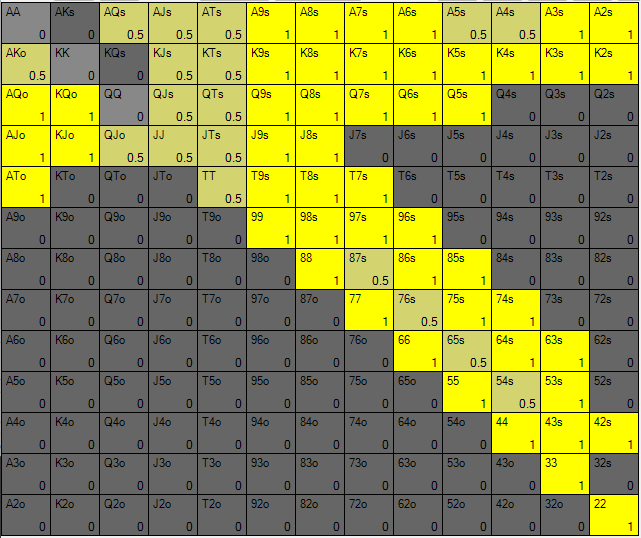
In other words, these are the hands that have the equity to call the open, and therefore have a plus EV defend. Facing a 2bb open, the BB needs approximately (1/4.5) x 100 equity to call, or around 22.22% (ignoring rake).
Now let's say the Lojack opens and there are two callers before the action gets to the BB. The BB now requires only (1/8.5) x 100 equity to call - around 11.8% BUT the pot is going to be 4way instead of heads up. How does this impact the hands with which the BB should defend? Are we calling with a wider range given the reduced equity required to call? Or are we calling with fewer hands and, if so, which hands are we not calling with that we would call with when playing heads up?
Note that the equity required to call has halved, but the number of players in the hand has doubled - how does this impact the defending range?
It's also interesting to look at how some hands are more impacted than others/lose more equity in multiway pots compared to heads up:
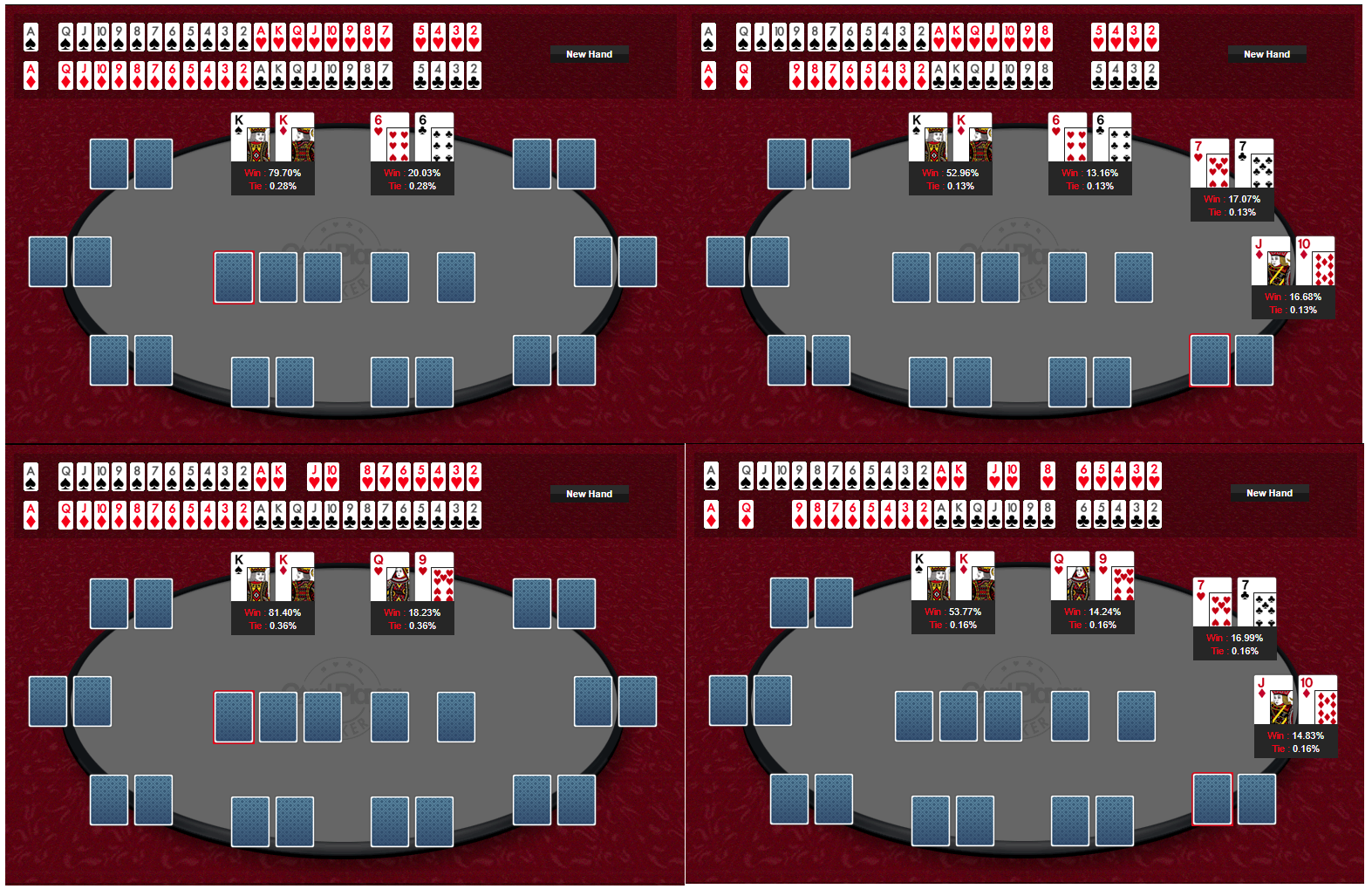
In this setup, Q9s loses less equity when playing multiway compared to heads up than pocket sixes does, but I'm guessing most players would be more inclined to play pocket sixes multiway than Q9s?
So what do you consider implied odds then? If I have 400 and bet 25 what do you consider the ratio to be?
One way to look at it is to think about what the villain would put in the pot with TP if I'm betting. If the villain is will stack off with TP, then the IO are 16:1. If the villain is only going to put in 200 or fold, the IO are 8:1
Not a very realistic open size in LLSNL pokr. Curious as to what the robots say we should be defending with versus a typical ~6+bb open.
Galmostnothing?G
Yep. LOL at a 2bb open. Why is that even an option? And why 6 max when most live games are 8 - 10?
In this setup, Q9s loses less equity when playing multiway compared to heads up than pocket sixes does, but I'm guessing most players would be more inclined to play pocket sixes multiway than Q9s?
It is going to matter greatly the exact hands that Vs have. 77 is going to take more equity away from 66 than JT will take away from Q9. Change the hands, and you'll change the conclusion.
A range vs range equity calculator will be a more useful tool. Open Poker Tools has a nice easy one if you google "Range vs Range Equity Calculator".
Against three ranges, 66 has materially better equity because sometimes you'll be against a higher pp, but much of the time you won't be. A lot of the time, your opponents will have cards that block each other.
And remember, this is raw equity. If you have 66 against three villains with the tools "cutoff" range which is probably pretty similar to what fish might play with IRL, you have 25.5% raw equity. Against one V, you have 52.2% equity.
So, with 4 Vs all playing the same range, you have 25.5% * $40 = $10.20. Against 1 V, you have 52% * $20 = $10.44.
If we 3! $60 to iso, say one V calls us with a range equal to the tools UTG range (9.7% of hands) and we expect to be called by someone about 1/3rd of the time. When called, our equity is 39.7% against the stronger range. That leads to this math:
66% of the time, we win the $30 in the pot when everyone folds.
34% of the time we are playing for a pot of $140 ($60 + $60 + $20 dead money) with 39.7% equity.
Our equity is 66% * $30 = $19.80
39.7% * $140 = $55.58 - $60 (our money in the pot) = -$4.42
$19.80 - $4.42 = $15.38
Note that even though we lose when we get called by a stronger range, the folds generated make up for the difference. And, of course, we could lose more or win more in post-flop play depending on our ability to realize our equity post-flop. The math can get very complicated, but the basic principles apply.
The reason we 3! to isolate is that we would rather play the occasional large pot OOP against one V than many smaller pots OOP against multiple Vs. While we lose more with the weaker part of our range when we are called, this is offset by overrealizing our equity when all opponents fold.
Not a very realistic open size in LLSNL pokr. Curious as to what the robots say we should be defending with versus a typical ~6+bb open.
Galmostnothing?G
Agreed, it was just an example to illustrate the point.
If villain opens to 6bbs and it folds to the BB then for example at $1/$2 there is $13 in the pot and it's $11 for the BB to call, therefore (11/24)x100 equity vs. range required = 46%, i.e. more than twice as much equity required than when facing a minraise (22%) - and this will cut the BB defending range approximately in half.
Yep. LOL at a 2bb open. Why is that even an option And why 6 max when most live games are 8 - 10
The open size and number of players in the game isn't overly relevant to the topic being discussed.
The open size and number of players in the game isn't overly relevant to the topic being discussed.
Of course they are. Is "multiple players" six or nine? Is the BB calling $2 ($4 total) into a $20 pot or $13 ($15 total) into a $120 pot?
Not a very realistic open size in LLSNL pokr. Curious as to what the robots say we should be defending with versus a typical ~6+bb open.
Nick Petrangelo ran sims with large open sizes, after everyone complained that his "Smash live cash" course had similarly small opens (2.25x early, and 2.5x CO/BTN IIRC).
Results were roughly what you'd guess: Robot response is to fold almost everything for 6x opens. Like CO opens 6x and BTN pure folds 99.
Nick's advice was to be aware that you are deviating, but it's probably fine to pretend the 6x open is a "normal" open in lots of spots.
Hi all, There is a common belief in live low stakes poker that the BB should widen their range if there has been an open and multiple callers, compared to if there has been an open and it has folded around to the BB.Similarly, if a player calls an open, faces a 3bet squeeze behind them and the initial opener calls, should the player call wider as there is more money in the pot?
I don’t think this matters too much, to be honest. I’d still call multiway with the usual suspects like AXs and PPs, but I’d avoid seeing too many flops with weak holdings that rarely make the nuts. Also I would 3bet the good but not great hands here quite frequently (think KQs / AJo).
Overall, it seems really advantageous to play a style that avoids putting in money often without initiative / passive.
It is going to matter greatly the exact hands that Vs have. 77 is going to take more equity away from 66 than JT will take away from Q9. Change the hands, and you'll change the conclusion.A range vs range equity calculator will be a more useful tool. Open Poker Tools has a nice easy one if you google "Range vs Range Equity Calculator". Against three ranges, 66 has materially be
Sure these are good points and certainly yes it depends on the other hands in play. I can do some range vs range work in Equilab; will take a look and post later down the thread.
Regarding the EV of calling vs 3betting with pocket 6s, I think it must be pretty close, but this hand is a little too weak for my personal squezing range, though I do get what you're saying and it's pretty cool. It's very very hard to calculate EV accurately preflop - I corresponded with the people at Piosolver, and calculating this EV requires literally millions of calculations, because there is so much noise in between preflop and showdown, especially in multiway pots. For me pocket sixes is almost always just a call and setmine hand in these spots and I have a hard time beleieving that 3betting is a higher EV play, but if someone can prove it I'd love to see the math. It's definitely going to be a difficult hand to play out of position in a 3bet pot, even with a range advantage.
Of course they are. Is "multiple players" six or nine Is the BB calling $2 ($4 total) into a $20 pot or $13 ($15 total) into a $120 pot
The initial query was whether or not the BB should call wider when there has been a raise and multiple callers compared to when there has been a raise and no callers. The size of the raise and to a lesser extent the number of callers is not that relevant to the discussion. Of course BB will call narrower if the raise size is larger (as will the other players) but the question is solely about the influence of the extra money in the pot from the other players.

