Settle the debate! Should BB call wider vs more players?

Hi all,
There is a common belief in live low stakes poker that the BB should widen their range if there has been an open

Again, these are the conditions: it's a really gamble-y, wild, deep table and I will get paid if I hit.
Otherwise, I'm not opening my BB calling range.
You would rather call with suited connectors vs. one opponent than vs. multiple opponents
Yes.
Actually, facing an open-raise and a call, I'd rather squeeze with SCs than overcall.
Of course sometimes with our SCs we will hit a straight or a flush and stack one or more opponents who have TPTK+, but this will happen quite rarely.
SCs become +EV because (or if ...) we can often win the pot by bluffing V off a weak pair or a better high-card, when we have some kind of draw.
Obviously, this is much easier to achieve HU than multi-way.
Plus, sometimes we will be on the wrong side of a cooler, and this will happen much more often multi-way.

Do the immediate odds in a multiway pot really help though? Sure, the pot is bigger, but there are also several more players, making it harder for hero to realize their equity.
For sure the goal is to hit something big and enjoy the implied odds that come with it.
As a caller OOP, realizing our equity when we're setmining probably isn't going to change ~all that much. I mean, our we just floating the flop HU OOP on KT7 to a cbet with 66 a whole heckuva lot more than we are in a multiway pot? Kinda ditto with Axs/etc. when we completely whiff.
We might realize our equity slightly more HU (or parts of it, such as getting to the turn slightly more), but probably not enough where it outweighs the fact that making a hand 6ways has a *much* better chance of getting paid off than making it HU.
GcluelessIOnoobG
Again, these are the conditions: it's a really gamble-y, wild, deep table and I will get paid if I hit.
This might be the disconnect between a couple of you. The game you're describing is much different than a game where some opens to 2.25x and gets it HU with the BB (lol).
GcluelessgameconditionsnoobG

You realize you're posting in the live forum?
I had already established earlier in the thread that I was discussing normal open sizes, and it may surprise you to learn that when you move up stakes playing live NLHE people use theoretically optimal open raise sizes.
I had already established earlier in the thread that I was discussing normal open sizes, and it may surprise you to learn that when you move up stakes playing live NLHE people use theoretically optimal open raise sizes.
Next time you may want to clarify in your title what steaks your discussion is pertaining to. While this forum is open for all steaks, the majority of posts in it are for the lowest steaks, and so it is a fair assumption that we're dealing with a LLSNL question (not a nosebleeds one).
GcluelesssteaksnoobG
Next time you may want to clarify in your title what steaks your discussion is pertaining to. While this forum is open for all steaks, the majority of posts in it are for the lowest steaks, and so it is a fair assumption that we're dealing with a LLSNL question (not a nosebleeds one).
GcluelesssteaksnoobG
Sure, but to be honest it is still not relevant to the initial query that I raised.
These are normal open sizes for the vast majority of live games and live players.
You seem to be surprised by this, especially since it's obvious you don't play nosebleed stakes.
These are normal open sizes for the vast majority of live games and live players.
You seem to be surprised by this, especially since it's obvious you don't play nosebleed stakes.
Yeah, that's because the vast majority of live games are low stakes. No surprise there but again - it's not relevant to the issue that I raised at the start of the thread. Even low stakes tournament players use smaller size opens in tournaments, and before you break a leg getting to your keyboard to pedantically remind me that this is the cash thread and not the tournament thread, take a moment to remember that not everybody is as obsessed with being right as you are - some of us are actually here to learn and improve our game. So if you don't have anything useful to say, please refrain from commenting in my threads, because the toxic and obnoxious nature of your posts is not welcome here.
Next time you may want to clarify in your title what steaks your discussion is pertaining to. While this forum is open for all steaks, the majority of posts in it are for the lowest steaks,
GcluelesssteaksnoobG
I, for one, am happy to see that this forum doesn't discriminate against sirloin, London broil, and flank.
Sent from my SM-A546V using Tapatalk
These are normal open sizes for the vast majority of live games and live players. You seem to be surprised by this, especially since it's obvious you don't play nosebleed stakes.
Yeah, that's because the vast majority of live games are low stakes. No surprise there but again - it's not relevant to the issue that I raised at the start of the thread. Even low stakes tournament pl
Just take the "L" and accept that we don't sell Big Macs at Wendy's.
But you got to participate, and no one can take that away from you.
I, for one, am happy to see that this forum doesn't discriminate against sirloin, London broil, and flank.
Sent from my SM-A546V using Tapatalk
LMAO 😃
You're really going to have to state some major qualifiers here for this to be true (such as the defender's skill advantage over the opener is massive); in general, I flat out disagree with this.
He's already stated that he's not overly concerned with making claims that are accurate or even relevant to the discussion.
Just take the "L" and accept that we don't sell Big Macs at Wendy's.
But you got to participate, and no one can take that away from you.
Right on cue 😃
You're really going to have to state some major qualifiers here for this to be true (such as the defender's skill advantage over the opener is massive); in general, I flat out disagree with this.LLSNL is a negative sum game thanks to the rake. Which means in a HU case (i.e. an opener in the field, the SB donates a piddly $1 to the pot which isn't nearly enough money to even ma
It's a question of having the hand vs range equity to continue, including any rake considerations. For example, look at the BB defending range vs Lojack open in 6max cash, taken from Modern Poker Theory:
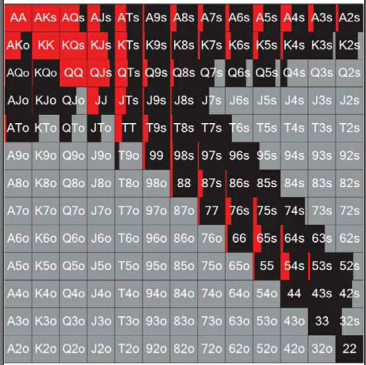
All the hands in black are calls and the deciding factor for this is the EV of calling facing an open. If the EV of calling is zero or higher, then the hands make it into the calling/raising ranges. If the EV is below zero, they are folds. You can see that even many two-gappers make the cut. To fold these hands instead of defending your BB with them is to hand that EV to your opponents. In other words, you're leaving money on the table and not making as much as you could. It does not require the defender's skill advantage to be massive - it assumes that both players are equally skilled.
Absolutely in a long-term situation with the BB vs an opener from the field the BB will be the loser. Putting in 1bb per hand with random cards is an insurmountable deficit. Playing correctly in the blinds is essential in order to minimize the deficit and maximize one's winrate. In MPT Acevedo goes to some lengths to emphasise the importance of playing the blinds correctly, and says that defending ranges from both blinds are the most important ranges to memorize.

There is a common belief in live low stakes poker that the BB should widen their range if...
I find it hard to believe that anyone would think you were talking about GTO sized opens and timed rake, given the words I highlighted from your post.
Yet again, I glance at this thread and wonder if it's an April 1st prank that was posted two days late.
I find it hard to believe that anyone would think you were talking about GTO sized opens and timed rake, given the words I highlighted from your post.
Yet again, I glance at this thread and wonder if it's an April 1st prank that was posted two days late.
The thread that involved this exchange went as follows:
"Suited connectors are plus EV calls in the BB and are all in all rational/reasonable big blind defending ranges".
"Not according to GTO-W. At least not at 10% rake to a x4 raise from UTG+1. In this common live scenario, most of the suited connectors go into the trash, and none of them have +EV."
"A 4x open and 10% rake is obviously completely different."
Reading this thread reminds me of how different this forum is from how it used to be.
I'm almost 70 posts in and there has been no serious discussion of the two major concepts I always use when deciding whether to call an aggressive action before the river: implied odds and reverse implied odds. Using raw equity to determine the answer to the question in the OP is (in my opinion, but I'm very confident about it) extremely misguided.
This is a debate I've seen discussed before. The two real sources of tension in this debate, as I've studied it, are this:
1. The theoretical reason why we fold more hands multiway has to do with, not a massive drop in equity (though that also happens), but a big increase in our reverse implied odds. Heads-up, if we have a hand like T9s or something similar, we can expect to be good somewhat often when we make one pair. Multiway, we are hardly ever going to get to showdown with one pair, and when we do, we'll be no good a lot. (And also when we do and we are good, we're not collecting any more bets because people are going to shut down much faster.) Furthermore, if we are multiway, the postflop bets will be bigger, meaning we may have to fold some draws we wish we could have called with. So we don't just have less equity; we also under-realize the equity that we do have.
2. Standing against that is that when we have a hand that has the potential to make the nuts or close to it, we might expect a big increase in implied odds when there are more people who can pay us off. This would be especially true in a typical live setting where people will pay off a lot. On the other hand, because we are out of position, it gets hard to justify drawing a lot of the time. So suited and connected hands don't get as big a boost in implied odds as we might like.
In the games I play these days, I tend to fold more when it's multiway. #1 takes precedence, especially since I'm going to be out of position almost always on later streets and it's harder to extract value when I do smash the board. But I have definitely played in games where the players are loose and bad enough that #2 takes over and I do start to call with suited aces and sometimes some connected cards. It depends on the lineup.
Reading this thread reminds me of how different this forum is from how it used to be.I'm almost 70 posts in and there has been no serious discussion of the two major concepts I always use when deciding whether to call an aggressive action before the river: implied odds and reverse implied odds. Using raw equity to determine the answer to the question in the OP is (in my opinion
Yeah this sounds smart and I agree. So the bottom line is in fact to play tighter when there are more players in the pot, and calibrate your range to hands that can flop monsters and have good visibility postflop. In other words, hands like pocket pairs, suited aces, suited connectors, and not hands that you would defend in the BB vs a single player that have bad visibility and the potential for bad implied odds postflop, like KJo, J6s etc
Doug Polk says more or less the same thing here:


"When one or more players in front of you have already called the preflop raise, your defense strategy should change in two ways.
First, you should defend with fewer hands, despite your improved pot odds, because it’s tough to realize equity against multiple players. So, if your hand has well above the raw equity needed to call, you may still be better off folding unless the hand plays well in multiway pots. The second adjustment is to reconstruct your range to be better suited to multiway pots. This means playing fewer hands that perform poorly in multiway pots, such as hands with big gaps or hands that will often get into cooler situations (A3o, K7o, 83s, etc)."
So, in a nutshell:
As with everything in poker, it depends. How many players, who raised, how much, stacks, opponents' tendencies?
In general, I'm folding my BB and moving on unless it's a really gamble-y, wild, deep table and I will get paid if I hit.
😀
So, in a nutshell:
As with everything in poker, it depends. How many players, who raised, how much, stacks, opponents' tendencies
In general, I'm folding my BB and moving on unless it's a really gamble-y, wild, deep table and I will get paid if I hit.
😀
Yes. I saw that post and it seemed like it was widely ignored.
It's a question of having the hand vs range equity to continue, including any rake considerations. For example, look at the BB defending range vs Lojack open in 6max cash, taken from Modern Poker Theory: All the hands in black are calls and the deciding factor for this is the EV of calling facing an open. If the EV of calling is zero or higher, then the hands make it into the
I've been reading Modern Poker Theory too and I wanted to add a couple of things. Later on in the book he talks about how hard it is to realize equity in a heads up pot as the BB, and how much in position gains (a lot comes from the option of seeing a free turn or river). From what I remember the BB loses 10-15% just by being out of position on most flops, and the BU gains ~15%+.
Now imagine if solvers could extrapolate that to being out of position to 2 or more players. How much of that suited connected equity are you actually realizing? Or are we just adding money to the pot as an equity dog with poor realization and reverse implied odds? Maybe I'm being too negative but that's what seems to be the case.
The same goes for being out of position with a marginal hand vs a good player in position raising 4x or more. I doubt defending something like QTo is even profitable against an EP or MP raise for example. Particularly with high rake and BBJ drop. So idk how important is to scrape EV from the BB when a lot of pots are limped around or otherwise there seems to be a polarity of raising ranges being either too tight or too loose.
and not hands that you would defend in the BB vs a single player that have bad visibility and the potential for bad implied odds postflop, like KJo, J6s etc
Again, I'm not sure if your charts are taking into account the affects of live rake or what, but as I've already stated: live rake with no offsetting dead money makes this a negative sum game where it is at best only possible for one of the two HU players to be a long term winner in this spot (at the expense of the other player). I will take the guy in position with initiative all day every day over the guy in the BB who thinks he's making a profitable call with anything remotely speculative.
Also, skill level of players is a thing that matters. If you're an expert, you can probably get away with almost anything you think is correct. If you're not an expert, you should completely remove the term "defend" from your vocabulary and fold almost everything that isn't a premium in this spot. The "a little knowledge is a dangerous thing" concept most definitely applies here.
GcluelessNLnoobG
I've been reading Modern Poker Theory too and I wanted to add a couple of things. Later on in the book he talks about how hard it is to realize equity in a heads up pot as the BB, and how much in position gains (a lot comes from the option of seeing a free turn or river). From what I remember the BB loses 10-15% just by being out of position on most flops, and the BU gains ~15%
Yeah, this is all true and valid, but the fact remains that many hands are still plus EV calls for the BB in multiway pots. Absolutely the realization of our equity is not going to be easy and it's certainly advised to play tight as a result.
Facing larger than normal open sizes, like the 4x you mentioned - and with rake and BBJ etc - massively increases our equity required to defend, and shrinks our defending range as a result. Good players play tight in the blinds and bad players call too wide and bleed money. But many suited connectors/gappers/two gappers etc of course have the equity to defend, even when the BB is playing tight.
I'd argue that it's vitally important to play optimally from the blinds, and reducing our losses from the blinds is an essential part of being a winning player. IIRC Acevedo says that strong players can reduce their losses in the BB down to 0.3bb/hand and in the SB down to 0.12/hand, which provides a massive boost to overall bbs/100 hands.
If you're seeing a lot of limping in the live games you play in then learning how to squeeze effectively in the blinds (and indeed from all positions) is another great way to boost your winrate.

