Settle the debate! Should BB call wider vs more players?

Hi all,
There is a common belief in live low stakes poker that the BB should widen their range if there has been an open
Again, I'm not sure if your charts are taking into account the affects of live rake or what, but as I've already stated: live rake with no offsetting dead money makes this a negative sum game where it is at best only possible for one of the two HU players to be a long term winner in this spot (at the expense of the other player). I will take the guy in position with initiative
Yes, the charts take rake into account.
Of course there can only be one long-term winner in heads up pots.
As I stated earlier, you are obviously right - the player in position with the range advantage on the majority of boards and the preflop initiative is of course the favourite in the hand. This does not change the fact that the BB has a clear range of hands that are profitable to defend with, and to fold those hands is to hand EV (chips) to your opponents.
Skill level is indeed a thing but if we are discussing objective theory then we must assume all players are equally skilled.

I'd actually argue the opposite. In typical LLSNL games there will be lots of incredibly +++EV situations, so we can trivially pass on borderline situations and still do very well. Heck, if our default "defending" range in the BB to an HU open was literally TT+/AK we'd probably be leaving relatively very little EV on the table. Not to mention this situation hardly ever occurs in a typical LLSNL game, which again makes it pretty much anything but "vital".
Gnottryingtobeargumentative,juststatingmyopinionG
Technically, with lottsa dead money in the pot (that which is greater than the max rake/etc.), HU pots can possibly be profitable for both players.
This does not change the fact that the BB has a clear range of hands that are profitable to defend with, and to fold those hands is to hand EV (chips) to your opponents.
Skill level is indeed a thing but if we are discussing objective theory then we must assume all players are equally skilled.
I mean, I get you're attempting to approach this from a theoretical point of view and with the assumption that both players are of equal skill, and that's fair enough. But it's also a dangerous thing to do in a forum which has lottsa noobish LLSNL players attempting to learn the game.
Our EV of folding the BB is 0. Yes, that may hand a smidgeon of EV (at a pittance of preflop $) to our raising opponent if we're theoretically overfolding. But your average run-of-the-mill player (who is a losing one, FWIW) is in no way going to magically make most hands in this "clear range of hands that are profitable to defend with" profitable just cuz it is sitting in your chart. They simply aren't skilled enough to do so, and will lose much more than they would have if they simply folded, and in the meantime also give that much more EV (and in real big postflop $$$$ to boot) to that raising opponent. Yes, that's a more "practical" approach than a "theoretical" one, but which one is going to be more hands on useful to the average run-of-the-mill player attempting to get better?
Basically, you're telling everyone to ski down the double black diamond run cuz it is obviously going to be the fastest way down the hill. That'll be fine for the top % who have the skillz to do so. But a lot of others are just going to end up breaking their necks (when there is no reason to do so).
ETA: FWIW, I *love* that there are these free "optimal" preflop charts of what players should be raising / defending with. Cuz 98% of LLSNL simply don't have the postflop skillz, at the grave disadvantage of being OOP to boot, to be profitable with all but the top ~5% (if that). It's pretty much where all my money comes from, in that I'm smart enough to know that I'm not capable of making the majority of those ranges from those positions profitable whereas my opponents aren't. Long live charts, imo.
GmighthavetoagreetodisagreeG

If BTN is playing raise or fold and opens to $6 in a 1-2 game (stay with me) then SB folds, it's fine to call 75s in the BB ... but if the CO opens to $12 and it folds to you in the BB, it's going to be bad unless you get a _lot_ of bluffs through or run like god.As I said in another thread recently: people don't seem to realize how much the solver tells you to fold, esp. so fo
solver also doesnt know you're 300 bbs deep with someone that will put in half or more of their stack with top pair okay kicker.
I'd actually argue the opposite. In typical LLSNL games there will be lots of incredibly +++EV situations, so we can trivially pass on borderline situations and still do very well. Heck, if our default "defending" range in the BB to an HU open was literally TT+/AK we'd probably be leaving relatively very little EV on the table. Not to mention this situation hardly ever occur
Sure, there are of course many clearly +EV situations all the time in LLSNL. If any winning player looks at their winnings in a large sample they will all find the same pattern - they win from every position except the blinds, and they win the most on the button and progressively less at each position as you move around to UTG. Acevedo shows this phenomenon in MPT:
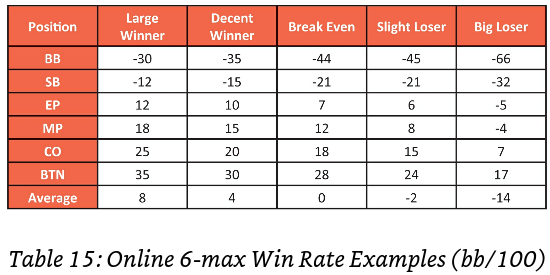
You can see that even "big losers" make money on the BTN and C/O, and "slight losers" make money from every position except the blinds. If you look at the difference between being a slight loser and a decent winner, you can see that about two thirds of the difference comes from improvement in playing the blinds, which I think is pretty self-explanatory.
LLSNL is insanely soft and I'm sure you're right that you can neglect the blinds to a decent extent and still be a winner. But just looking at the math in MPT you can more than double your win rate by improving your play in the blinds. I grind a lot of hours and it certainly makes it a lot more worthwhile if I'm doubling my win rate through effective play in the blinds.
You're leaving a lot of money on the table through neglecting your blinds, probably more than you appreciate.
Technically, with lottsa dead money in the pot (that which is greater than the max rake/etc.), HU pots can possibly be profitable for both players.I mean, I get you're attempting to approach this from a theoretical point of view and with the assumption that both players are of equal skill, and that's fair enough. But it's also a dangerous thing to do in a forum which has lotts
You stated in your previous post that there was no dead money in the pot:
"live rake with no offsetting dead money makes this a negative sum game where it is at best only possible for one of the two HU players to be a long term winner in this spot (at the expense of the other player)."
I don't see any issue with assuming all players are of equal skill when we're talking about theory. On the contrary, it's mandatory if we are going to have a rational discussion.
"A smidgen of EV" per BB adds up to a lot of money in a large sample.
Lol yes of course losing players are not going to defend their blind well, that kind of goes without saying. Winning players are going to defend their blinds well and play well in general - and recognize that giving up EV from their blinds is a massive issue. Those bad players may lose less by folding, sure - and until they learn how to play properly, they should do that. But again we cannot assume that the ranges apply only to bad players, and on the other hand when the player in the BB has a skill advantage over his opponent he can and should defend his BB somewhat wider. So it goes both ways and I don't think we gain much by specualting about the skill level of players when we are trying to ascertain what are profitable defends in the BB and what aren't. It depends on the table of course, but as I have said previously - we have to assume all players are equally skilled, otherwise it's nonsensical to discuss any of this.
It really is not that hard to defend your BB effectively once you have learned the 3bet/call/fold ranges, and how to play postflop with some common sense regarding which boards are better for the BB etc, which even novice players have some understanding about. Combine that with some study about check raising ranges vs late position opens and you're pretty much set to crush live low stakes from the blinds.
Yes, you're right that players are weak at LLSNL, that doesn't change the fact that the BB has a range of hands with which it can profitably defend in the hands of a decent player. That it what it relevant in the realms of theory, and not whether or not players at LLSNL have the ability to defend their blinds effectively. The charts do not apply only to low stakes - they apply right up to the highest stakes.
no you should not call wider. if anything you shoudl be adjusting your 3bet range to an even more polarized distribution than where it already should be if your intent is to spend more time on the dance floor. The goal here is to add some bluffs that have post flop connectivity A9-A2s, K9s and then some K4-K2s - hands that can hit nutted hands. Id take those over suited connectors because your flush value diminishes and the difficulty arises in extracting from OOP ,especially if you have a 7high flush for example, you can get put in some tough spots. Or you can just never fold any flushes and hope you run good.
Big caveat - i'd only be oding this if you are comfortable hitting K no kicker and navigating postflop to get to cheaper showdowns. This requires not just being viewed as good but also a proper image setup where you've sufficiently check raised value hands OOP or checked through turns when OOP with perceived value thus instilling "the fear" into the opponents that you lead the decision tree post flop, not them and that not following your lead may incur financial penalties in the ch/r 3.5-4x range.
Honesty assessment of your post flop ability is necessary here. Check calling into profit due to running above expectation is not the tell tale sign of "good at the post flop"
If you are not the #1 crusher in your room and your opponents are loose passive calling stations (mission critical piece of info here about table dynamic) - just fold. Getting 5.5:1 on your 33 from the BB with average stack sizes around 100BBs aint it. The table needs some stack depth and there's gotta be guys/girls who dont realize how much hand strengths shift the deeper you get (aka the guy who flats w/ 67ss that you get to overflush with teh K4)
To balance... just kidding - this is low stakes nobody ****ing notices.
solver also doesnt know you're 300 bbs deep with someone that will put in half or more of their stack with top pair okay kicker.
in my above reply i mentioned an analogous description to the above but this is another critical player note to hold in your head for when conditions become more optimal to open up your range in BB to maximize opportunity to exploit your opponent's mistakes.
best advice? your opponent's mistakes are more often than not huge post flop leaks which you will easily find better/easier spots to exploit. however, and i started writing a long essay on this which i may or may not edit and post one day: in order to reach escape velocity necessary to advance out of the absurdly high rake environment casinos have these days due to bullshit like high hands or bad beats you really are incentivized to find more and more opportunities to increase frequency of exploitation of opponents OR have a really good job and a vasectomy (kids are expensive) OR rich mom and dad. Any of those situations can let your comfortably sit the timed games.
no you should not call wider. if anything you shoudl be adjusting your 3bet range to an even more polarized distribution than where it already should be if your intent is to spend more time on the dance floor. The goal here is to add some bluffs that have post flop connectivity A9-A2s, K9s and then some K4-K2s - hands that can hit nutted hands. Id take those over suited connect
Great points, agreed.
in my above reply i mentioned an analogous description to the above but this is another critical player note to hold in your head for when conditions become more optimal to open up your range in BB to maximize opportunity to exploit your opponent's mistakes.best advice? your opponent's mistakes are more often than not huge post flop leaks which you will easily find better/easie
Yes I agree that postflop is definitely where most of the profit comes from in live low stakes poker.
Definitely finding leaks is huge, and in my experience many live low stakes player either defend their blinds too loosely or too tightly, and we can exploit both player types.
The rake and high hand bullshit is indeed absurd. I played in Canada for many years and it really was ridiculous. For example - at the casino in Toronto, they take up to $20 per pot in the $1/$2 cash games. By comparison, if you're a regular $2/$5 grinder at the Bellagio they will give you comped rake at $4 per hour(!). Vegas is great for rake due to the competition; unfortunately in Canada everything is so spread out that casinos can afford to price-gouge with rake. Funny you mentioned timed rake as Niagara has timed rake at $7/30 mins and this is actually one of the best rake structures available in the country. Montreal is also criminally high, as is BC (although not quite as bad). Alberta is the cheapest province for rake but it's still a far cry from Vegas rates.
If you've been folding like a monk for 3 hours, nobody’s giving you action when you finally wake up with 54s and bink the board. You’re screaming strength, even the fish won’t pay you.
Good luck getting paid often enough to justify calling with 54ss.
So yeah, calling with suited trash is fine sometimes, if the table, the spot, and your image line up. Otherwise, just light your money on fire.
If you've been folding like a monk for 3 hours, nobody’s giving you action when you finally wake up with 54s and bink the board. You’re screaming strength, even the fish won’t pay you. Good luck getting paid often enough to justify calling with 54ss.So yeah, calling with suited trash is fine sometimes, if the table, the spot, and your image line up. Otherwise, just light your m
if thats the case (i am not sure it is) you should be able to over realize your equity via bluffing no?
Yeah, 3-betting is way better if the spot lines up. Flatting is that classic "I’m the genius who’s gonna hit a flush or two pair and stack the guy" mindset. But live fish aren’t complete morons, if they’ve seen you nit it up for 3 hours, you’re getting the initial pot and maybe one more street when you hit, and that’s it.

